Author Archives: osheadavis

Dominated By the Unmerited Favor of God? Sign Me Up!


“…For the judgment which came from one offense resulted in condemnation, but the free gift which came from many offenses resulted in justification…

For as by one man’s disobedience many were made sinners, so also by one Man’s obedience many will be made righteous…

… as sin [dominated] in death, even so grace might [control] through righteousness to eternal life through Jesus Christ our Lord.”
(Romans 5:16,19-21)


Quick Commentary:

First. A quick clarification on terms. “Justification” in verse 16 is about the Father, in the position of Judge and Governor of the Universe He created, publicly declaring that a person is righteous in His sight. Since, in God’s sight, in context is about His rules and commands, then such a declaration is saying: “this person “x,” is a person whose thoughts and actions value God above all other things, in accordance to God’s commands and precepts.”  This is the gift of Christ, given to all His elect brethren. God gave our sin to Jesus, and Jesus was punished as if He did the sin. And reversely, God freely gave Jesus’ righteousness to us, and relates to us as if we lived it.

Second. Verse 19 is about a pragmatic application. Being made a sinner is about, being created by God’s power (or molded like clay) to be a person who actively/pragmatically acts like a sinner because they are a dirty, sinner. They malfunction when brought into contact with God’s commands. God credited Adam’s sin to all others. Thus, the foundation is that God the ultimate judge declares, person “x” is a disobedient, broken sinner. Then from this proceeds God using His power to mold this person into a sinner, the sinner he declared them to be in Adam. Or that is, God molds them into a defective water jar. Because they are a defective water jar, then when God pours water into them (brings them into contact with His commands) they act broken, because they are broken and defective. God the judge, then judges them guilty for not being able to “in application” hold water (disobeying His commands). It is the reverse for God’s elect Child. God’s mold them into a perfectly made water jar, with no defects. Then, when God pours water into them, they function (in faith obeying God) correctly. God praises and rewards them for pragmatically functioning in a correct way. Or that is, God says believe my promise for healing. God pours this water of His truth into them. Because they have already been re-made into a new creation Christ, they hold (believe) this water correctly.  God rewards their faith (functioning correctly) with blessings and healings.

A quick note about sanctification. The Christian sins sometimes, because they believe the lie that they are not already righteous. Or that, the lie that they are not already made as a water jar that is able to hold water. In essence, God pours in the water (His truth), but then Satan and the deceitful lusts of life, convince the Christian to willfully pour it out. The non-Christian is broken, they cannot submit to God’s command to believe. The Christian is already a new creation. They can hold the water, because they are not broken anymore.

Third. Most translations say “ruled” or “reigned” by sin or grace. To make this clearer, I put in [] the above terms, which mean the same thing, “controlled” or “dominated.” In fact, the NIV will sometimes translate this as “controlled,” which is a good way to translate it, because some might miss the full weight of the ancient meaning of a King ruling in a Kingdom, with absolute authority. The Roman Centurion in Matthew 8:5-13 understood what ruling in authority means. Since in this same letter to the Romans, Paul shows God’s sovereign control to be like a man molding a clay pot to his own arbitrary whims, then this understanding should apply here as well. Relative to us, there might be secondary objects, but to God there is nothing secondary, relative to His direct control of it. That is, even if man is controlled by demon possession, the demon is ultimately directly controlled by God. That is, God directly controls the demon, like a puppet on string (yet in all fairness to God, the control is much greater), and also, the man, and also all aspects of reality. Yet, the Bible mostly speaks on the relative level. And so, relative from man, he is either dominated by sin, or he is dominated by the power of God’s unmerited favor. Thus, if man is not free on the relative level, how much less so on the ultimate (but that is for another post).

Lastly, the result of being dominated by God’s unmerited favor regards the pragmatic sense. It is having and processing and walking in the exceedingly great life of Jesus Christ.  This life is both spiritual life and natural life. It is all joy, peace and righteousness. It is having God as your personal tutor, so that you know the world as it truly is.  Thus this life is also, all riches, health and goodness of things. As Jesus is (here and now) a prophet, priest and King, we also who are made in His image,  walk as prophets, kings and priests. We are co-heirs with Christ. His public life, is our public life. His spiritual life, is our spiritual life. His natural life, is our natural life. His life is already now and here. Thus, our life in Him is now and here.  “Then Jesus said, “Did I not tell you that if you believe, you will see the glory of God, (John 11:40)?”” Martha tried to put resurrection for humans into the future and into a different place. Jesus rebuked her and instructed her, saying His life is more than a spiritual life; rather, His life is everyday life (a life that affects the physical), and it is here and now by faith.


The Foundation, the Now, and the Dominating Control of Grace

In verse 16 we are “declared righteous” (i.e. justification) by God our Father, who is the one and only ultimate Lawgiver.

In verse 19 we are made into righteousness. That is, after declaring that we are the righteousness of God, God then uses His power and might to make our thoughts and actions righteous.  Thus, the more foundational issue is found in verse 16 because when God the judge declares something, He has the integrity to make it happen.

In verse 21 we are under the almighty power of God’s direct control. With the foundation of being declared righteous, the unmerited favor of God dominates and controls (like a puppet on a string) us to fully possess the abundance and eternal life in Jesus Christ. That is, as Jesus is in exceedingly-powerful life at the Father’s right hand, we pray for God’s Will to be done on earth, so that we have the same life, because He is our life. Or as John 4:17 says, “As He is, so are we now in this world.”

We know that we have what we have asked Him for

“If you remain in Me and My words remain in you, ask whatever you want and it will be done for you. My Father is glorified by this: that you produce much fruit and prove to be My disciples. (John 15:7-8) HCSB

Jesus connects answered prayer (exactly what you ask for, not something different) to “proving” one’s discipleship/ or followership. (Vincent helped to understand this better[1] ) At this point, some suggest that with the last death of the apostles, things like always answered prayer, the greater miracles of Jesus and the gifts have ceased. However, this conclusion is based of atheism/empiricism, not Scripture.  Jesus did not say, “if the apostles are still alive, and their words abide in you, then ask for what you wish.” If that was the case, then because the apostles are gone, then logically the greater miracles and always answered prayer are gone for me. Not only is that not what Jesus said, but it makes man the focus. It habitually makes man the center.  When I do deduction from scripture and apply them to myself, Jesus is my major premise not men. Jesus is my deduction for my reconciliation, answered prayers, greater miracles, the blessing of Abraham and gifts.

“If you remain in Me and My words remain in you, ask whatever you want and it will be done for you. My Father is glorified by this: that you produce much fruit and prove to be My disciples. (John 15:7-8) HCSB

Jesus is defining necessary characteristics of branches connected Him (the Vine); He is not talking about apostleship, or anything about the era of apostleship. What exactly is an “era of apostleship,” other than reconciling people to the truth, fellowship and Power of Jesus Christ?  This is not about the era of man, but the era of Jesus. This is not about focusing on limited men; rather, it is about the limitless victory of Jesus’ atonement.  This is not about being fanboys of men; rather, it is about fearing and worshiping Jesus. Regarding truth claims about reality and deductions applied to me, what do the apostles have to do with me? Do I pray to the apostles? Will the Father give me whatever I ask for in the name of James? Did the apostles themselves say, “in the name of the apostles be healed”? Did the apostles take on my curse and make me righteous? Are demons cast out in the name of “Paul”? Does Peter send the Holy Spirit? Does John give me access to the miracles that the blessing of Abraham gives me (Gal. 3:5)? Eras are identified or characterized by Jesus, not men. Jesus is still on the throne. He is still alive. With Him still, are many sons, whose life is hidden and identified with Him. He is still the righteousness of many sons today. Today, because of Him, many still have direct access to the power on High. The same Jesus who gave a Canaanite woman what she asked, even though she was outside of “God’s will” (covenant plan), is still alive and listening to those who cry out for help. Jesus still abides in people. Today, those with faith still abide in Him. He still commands discipleship, and thus, He still demands you prove your discipleship by getting exactly what you pray for.

The apostle John repeats this passage from his gospel, in his personal letter and applies it to the church at large. That is, John applies getting all the miracles, (even those greater than Jesus (14:12-12)), being defined by getting what we wish for, to the entire church. Apostleship has nothing to do with it. For man-centered men, this might upset them, but it was about Jesus. It was about faith in His Name. He is still alive. He is still in authority, and in fact, is in a greater place of authority. He is the defining factor here. He is still giving out the gift of the Spirit. He is still giving out the spoils of His triumph and plundering of the grave, sin and Satan. The curse of the law is still buried in the grave in His death, and the blessing of the law still clothes Him like a robe; furthermore, we are still identified with Him in both His death and the blessed life He lives. Our death is still buried with Him, and our life is still clothed with the blessing of the law in Him. In fact, we are given the ring, sandals and robe of sonship. We are not only robed with “the blessings of the law” in Christ for us (Deut 28), but we are clothed as heirs of God in Christ. We still have the Mind of Christ. All things are still ours in Christ. It was always about Him, not men.  

“Now this is the confidence we have before Him: Whenever we ask anything according to His will, He hears us. And if we know that He hears whatever we ask, we know that we have what we have asked Him for.” .

1 John 5:14-15 HCSB

Note, “God’s Will” here, is defined as God’s commandments, and not decrees. God commands and precepts include all sorts of things such as the command to repent and be reconciled to God; but it also includes things like success, healing and prosperity. Therefore, most prayers (by born again Christians) are in fact according to “God’s Will, or his precepts”. Thus, our confidence is as John says, if we ask in line with God’s commands, we get what we ask for. Some, discovering that their experience does not resemble what John says, will become David Hume empiricists and exchange the truth of God for a lie. They will make truth based off “their” human speculation rather than “Christ’s” revelation. They are practicing atheists, and they like it. However, for believers, we will exchange the lie of our human speculation for the truth of Christ. We will blame our weak of faith, and then in the strength of Jesus Christ grow in sanctification and become victorious. We will submit ourselves to God and obey Him. And so, the issue is often faith or lack thereof, and not a misapplication of God’s Will/ commands when we pray.

———-EndNotes——-


[1] I would recommend Vincent’ essay “Miracles and Predestination,” which talks about this passage from the viewpoint of predestination.

For further reading I would recommend Vincent Cheung’s essay, “Two Views on God’s Word.” Here he righty says such passages like this is meant to expand our options in life, and not limit them. This can be applied to others passages such as Psalm 34, 37, 91 (etc). (As a reminded for clarification: I do not represent Vincent, or represent him; I just like reading and recommending his stuff. )

You Qualify Here & Now

Faith comes by hearing the Word of God.
Fear comes by hearing the lies of the devil
.”
(Kenneth Copeland, Twitter, May 21, 2020)

So then faith comes by hearing, and hearing by the word of God. (Romans 10:17 NKJV)

For you have not received a spirit of slavery leading to fear again, but you have received the Spirit of adoption, by whom we cry out, “Abba! Father!” (Romans 8:15 LEB)

Because God’s children are human beings—made of flesh and blood—the Son also became flesh and blood. For only as a human being could he die, and only by dying could he break the power of the devil, who had the power of death. Only in this way could he set free all who have lived their lives as slaves to the fear of dying. (Hebrews 2:14-15 NLT)

“It has come at last—salvation and power and the Kingdom of our God, and the authority of his Christ. For the accuser of our brothers and sisters has been thrown down to earth—the one who accuses them before our God day and night. (Revelation 12:10 NLT)

The King of Ages:

Satan (The limited god, of a limited age), “You sinned today, you know that, right? Did God say you are the righteousness of God? Really? Maybe at a time in the past, in a different place, but you sinned! You are not a child of God right now. You are not the “perfect righteousness of God,” here and now. You are a sinner saved by grace, because you are STILL a sinner, here and now. You are not in a position to ask and receive healing, supply and help from God, here and now. You need to repent and confess. And to be extra sure, do it again. You need to be righteous again, so that God can hear you again! So, let me give you some advice. You need healing, thus you should be afraid, because you cannot get it, here and now. You are not a child, here and now; thus, God will not help you, here and now. Your help is not here, its way over there. Your help is not now, its later. You should be afraid, because you don’t qualify now, and you don’t qualify until you get over there.”

Yahweh (The King of Ages), “You sinned today. Ok, so what? I will give you some advice: “Do not fear, only believe.”  You are, right now, a child of God. You are an heir of the King of Ages, here and now. You are a co-heir with my Beloved, here and now. You are my righteousness; you are STILL My righteousness, here and now. You need healing, right now and in this place? You qualify now, and this place is a good place. You get healing here and now. Oh, I almost forgot. If you have sinned, then I will forgive that next (James 5:15, healing, and then forgiveness!). I will do this because you are already My Child, already My heir, already My righteousness. You have direct access to Me now, not just later. You have direct access to me here, not just over there. I love my Son Jesus. You are part of Him, here and now. Guess how much I love You? You need righteousness to qualify for answered prayer? Great. I have already qualified you as My righteousness in My Son. My righteous Son is still here, and He is in this place right now. You are still in Him now, and with Him here. Do you understand now, why there was so much extra baskets left over?

Revelation and Logic : Heirs with Christ

Romans 8:16-17, The Spirit himself confirms to our spirit that we are children of God, and if children, also heirs—heirs of God and fellow heirs with Christ, if indeed we suffer together with him so that we may also be glorified together with him. (LEB)

The NLT has this written more like a category logic, rather than how the LEB states in more in propositional format. However, the things being said are better stated as necessary category realities, rather than necessary “connections,” as in propositional logic. This is like the difference between metaphysics vs ontology; both indirectly imply other, but they are not the same thing.

This is another chain syllogism, like the one Paul makes a few verses later in 29-30.

This gives us a glimpse in the mind of God; into His goodness and boundless unmeritable favor given to His elect Children. What sort of inheritance does Jesus Christ get? Well, we get it to.

This also illustrates how truth claims cannot be observed but only revealed, so that category fallacies are not made. If one has a premise, “I am led by the Spirit of God,” and we know this is a positive thing, yet there is no way to conclude/infer into the category of “heirs with Christ” without being invalid and making fallacies. Thanks be to God, He has revealed such precious knowledge to us, so that we can make deductions and apply ourselves to them in hope; and we know Christian hope does not disappoint. This inheritance now include all sorts of things, even miracles (healings, resurrections, prosperity) and the power of God’s Spirit (Galatians 3:2-7).

All [those with the Spirits testimony] are [children of God].
All [children of God] are [heirs of God].
All [heirs of God] are [heirs with Christ].
Thus, all [those with the Spirit’s testimony] are [heirs with Christ].

Faith For Anything, Versus, Love Each Other


I was told growing up this passage of Scripture, John 14-16, is the section about God’s Love.  This is true? What does Jesus emphasize the most here? Let us look together by comparing how many time Jesus commands love of each other, to another doctrine that is repeated here.

The context is interesting here. Jesus is about to die. This is the night of His betrayal and arrest. These are His dying words, so to speak. What did Jesus stress to His followers, to His church? What was so important Him, that in these precious limited moments, He focused on? This was Jesus’ last sermon before His death. Well, what did He preach on? What did He repeat and put emphasis on?

Chapter 14

Verse 12 (Faith to receive anything)
“I tell you the truth, anyone who believes in me will do the same works I have done, and even greater works, because I am going to be with the Father.”[1]

Verse 13 (Faith to receive anything)
 You can ask for anything in my name, and I will do it, so that the Son can bring glory to the Father.

Verse 14 (Faith to receive anything)
 Yes, ask me for anything in my name, and I will do it!

Chapter 15

Verse 7–8 (Faith to receive anything)
But if you remain in me and my words remain in you, you may ask for anything you want, and it will be granted! When you produce much fruit, you are my true disciples. This brings great glory to my Father.

Verse 12 (love)
This is my commandment: Love each other in the same way I have loved you.

Verse 16 (Faith to receive anything)
 You didn’t choose me. I chose you. I appointed you to go and produce lasting fruit, so that the Father will give you whatever you ask for, using my name.

Verse 17 (Love)
This is my command: Love each other.

Chapter 16

Verse 23 (Faith to receive anything)
At that time you won’t need to ask me for anything. I tell you the truth, you will ask the Father directly, and he will grant your request because you use my name.

Verse 24 (Faith to receive anything)
You haven’t done this before. Ask, using my name, and you will receive, and you will have abundant joy.

Verse 26–27 (Faith to receive anything)
Then you will ask in my name. I’m not saying I will ask the Father on your behalf,  for the Father himself loves you dearly because you love me and believe that I came from God.


[1] All translations are the NLT. New Living Translation.

The Fluidness Of Fluidness

Douglas Wilson commenting on the culture says,

Euro-centric Truth?
The central driving engine of all this current pomo madness is the idea that a commitment to fixed, objective truth is itself a Euro-Western form of racism and oppression. …”[1]

This has been my experience of the culture as well.

First. Their “fluidness,” is a revised version of the white Greek philosopher, Protagoras, and his skepticism and relativism. The exception is that instead of public debates of the Skeptics Vs Plato or St. Augustine, Protagoras’ philosophy is applied in a political strong-armed way. I do not use inductive historical arguments, but for sake of argument we are assuming it. The point is that they are using a Euro-centric philosophy to say Euro-centric philosophy is bad. Stupid.

Secondly, they cannot attack objective truth without using objective truth; otherwise, their attack would also be an endorsement of what they are attacking. But if they are endorsing my position, then they are celebrating the fact Jesus is Lord, and they are wrong and under God’s judgment.

For their position to be true it would have to be false at the same time. If they attack my position it would mean their mom is a fish, and all dogs are trees, therefore, all cars are fingers.

In addition, fluidness must be, well, fluid. For example, a position of progressivism to be true, then the foundation of “progress” itself would also have to progress. Maybe it has already done so? And so, for fluidness to be true as a foundational standard, then the standard must also be fluid, so that fluidness might already mean to be rigidness.

Moreover, if they wish to say, all things are fluid except fluidness, and since this cannot be validly inferred from the standard, it would mean they must appeal to a higher first principle to produce such terms and knowledge. Will it be irrational empiricism, that when used with science commits a triple fallacy, and itself also falls into skepticism? But skepticism denies the law of contradiction.[2]

Third. Because skepticism (and all its siblings of relativism, fluidness, etc) denies the law of contradiction, it means their epistemology gives no knowledge period. Forget abstract concepts of ethics, and truth, their epistemology cannot give them terms such as “sky,” “man,” “tree,” or “dog.” A contradiction both affirms and denies the same term, thus, they cancel each other out in an infinite regress. Thus, you cannot affirm or deny anything. You cannot affirm your own position or deny your opponents. It means if they are thinking anything, they are denying their own position. Also, the laws of logic are not only laws of thought, they are also laws of reality. Back to our point of affirming or denying. Skepticism does not allow one to affirm or deny anything, but, to even say this with intelligence, one must affirm it or deny it. They use the very thing their position denies. A more pragmatic example might help. If one tries to deny their own existence, (“I do not exist”), they are forced to use their own existence to do it. Their use of it proves it, despite what their lips say. Thus, reality stops them from doing a contradiction in this world. A contradiction is something that has no being in the mind or in the world. A contradiction is implausible with metaphysics.

Lastly, Christianity has a doctrine of logic, and intelligence. The Bible also says that all others are false, and only God has revealed truth. If they must borrow the things necessary for any intelligence from the Bible, and because it also says all others are false, it means they are false by logical necessity.[3]

—–EndNotes—–

[1] The Grace of White Privilege. Blog. Nov. 18. 2019.

[2] Also, did not this philosophy of empiricism come from David Hume, and thus is Euro-centric? Did not this Euro-centric philosophy drive much of the colonialism, and evolution and science-materialism; but I digress, because I do not rest my arguments on induction.

[3] This is a modified argument I got from Vincent Cheung (Captive To Reason. 2009. 44). www.vincentcheung.com

Psalm 91:14-16 (Revelation & Logic)

Psalm 91

14 Because he loves me, therefore I will deliver him;
I will protect him because he knows my name.
15 He will call upon me and I will answer him;
I will be with him in trouble;
I will rescue and honor him.
16 With ⌊long life⌋ I will satisfy him,
and show him my salvation.  (LEB)

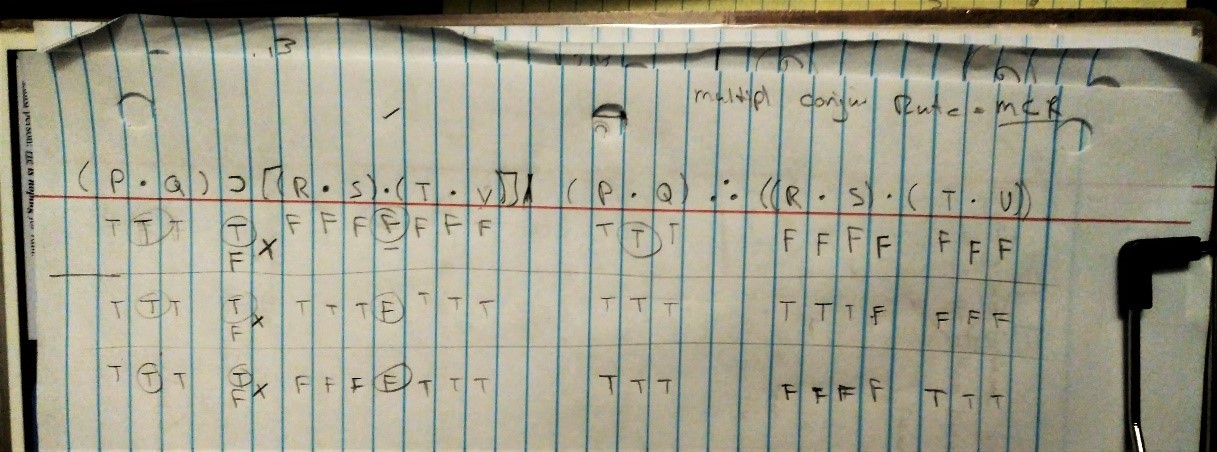
The logical inference is simple. Stating this as a syllogism, (although it is more proper as a propositional argument), we have an A term, B, and a C term. That is, all (A) is (B) and all (B) is (C).  The difference with this and the typical syllogism is the multiple ands or conjunctions.  A simple conjunction is easy to prove with a truth table (see pic below). It does not matter if it is one extra “and,” or “many ands,” the validity will prove to be valid via truth tables—it does not matter if the conjunctions are (p) or (q) or (r). What matters is if all the extra conjunctions terms are true to begin with, which is the foundational issue with all syllogisms.

Instead of making a Natural Deduction or First Order Predicate logic with it—because we know the form is valid—will just put this into a basic Modus Ponens for simplicity sake.  Also, the logical emphasis seems to be on the causality or necessary connection and not merely a categorical inference. It is not merely a sufficient reason, but a necessary ontology to which God insures absolutely.   That is, by God’s causality Person X (A), will “necessarily” receive all the good (C) promised if they love and know Him (B).

Antecedent Premises:

(B) [ if a person loves God] and (C) [ …. know God’s Name]

Consequent premises

 D [then this person is a person God delivers]

and, E [… God protects]

and, F [… God answers]

and, G [… God honors]

and, H [… God satisfies with long life]

and, J [… God shows His salvation]

M.1. IF B & C, THEN necessarily results in D & E & F & G & H & J.
M.2. B & C.
M.3. Thus, D & E & F & G & H & J.

M.1. (B) If a person loves God and (C) knows His name, (D) then God will deliver him, and (E) protect him, and (F) answer him when he prays, and (G) honor him, and (H) will satisfy him with His salvation and  (J) will show him His salvation.
M.2. It is true that I do love God and know His Name.
M.3.  Therefore, God will deliver me, and protect me, and answer me when I pray, and honor me, and will satisfy me with His salvation and God will show me His salvation.

Multi Conju Rule ND

Logic & Scripture: Psalm 46:1-2

Psalm 46:1-2

The categorical reality of not fearing trouble.

God is our refuge and strength, A very present help in trouble.
Therefore we will not fear. NKJV

The NJKV footnotes this phrase “present help,” as an “abundantly available help.” That is, God’s helping his chosen ones is very near and there is an overflowing amount of it.

The syllogism here is a basic E.A.E. or (negative, affirmative, negative) argument. We are told there is a category of people who fear trouble—because they ought to, and because it is proper for them to fear trouble if they are weak and have no one to help them against stronger troubles. However, God’s chosen ones are helped by Almighty God. The God who created the universe in 6 days can help. But more than able to help, the Lord of angel armies has promised to do so for His chosen ones.  His help to them is overflowing and nearby. Since God is the greatest metaphysical and ontological reality, then there is no one, or no thing stronger.  And so, there is no trouble that is greater than God. God at His weakest is stronger than man at his best. God’s Son has already defeated death and sin. Jesus has already make a public spectacle of Satan. In ultimate level ontology the scripture says, all move, live and have their existence in God (Acts 17).

And so, the “middle term,” that separates God’s chosen ones from any fear of any trouble is that God is completely on their side with an abundance of available help for them. One verse that sum this up in another argument, in a much more than form is Romans 5:10). “For since our friendship with God was restored by the death of his Son while we were still his enemies, we will certainly be saved through the life of his Son, (Rom 5:10 NLT).”  Also, “If God is for us, who can ever be against us?  Since he did not spare even his own Son but gave him up for us all, won’t he also give us everything else? Rom 8:31-32 NLT).” This is referring to both spiritual and natural blessings. See James 5:13-15. Also, Jesus in John 14-16 says several of times, to ask for anything in faith and then you receive it. And in other places He says if you ask for a fish, then you get a fish. All the promises are yes and to God’s glory in Jesus, yes, even all those promises in the Psalm (etc.) about God being our help, because the N.T. interrupters them as being so. Also, we have been grafted into the blessing of Abraham (Gat. 3).

This argument is dealing not directly with ethics or axiology—although it is indirectly doing so; rather, it is directly dealing with metaphysics. Salvation and God’s blessings for His children is a sub-category under metaphysics and ontology. It is about how God uses His absolute creation of existence and His absolute control over causality toward this group of people called the chosen ones.

The argument it is not saying you “ought,” not fear; rather, it is stating a categorical reality for God’s children. It is like saying, Lions do not eat stars, and, trees do not use glass to make food. And, God’s children do not fear trouble.

G.1. No [ persons who God is their present help ] are [ those who fear trouble ].
G.2. All [ we ] are [ persons who God is their present help ].
G.3. Thus, No [ we ] are [ those who fear trouble].

Or in plain English. We do not fear trouble.

A Purer Starting Point For Knowledge

God’s Perfect Will Is for You to Be Healed

“Beloved, I pray that you may prosper in all things and be in health, just as your soul prospers.” 3 John 1:2

Look no further than 3 John 1:2 for a prayer that reflects God’s heart. That’s how you know that He wants you healed, healthy and never sick, as much as He wants your soul to prosper!

Don’t go by human experiences to know if God wants His people healed today. If you say, “Well, I know of Christians who are sick,” I can point you to many others whom God has healed. We’re not called to base our believing on human experiences. We’re called to believe God’s Word.

Beloved, never put your eyes on people and their experiences, even good ones. The basis of your faith must always be God’s Word. Believe that God still heals today because His Word says so!

[Joseph Prince. Devotional, “God’s Perfect Will Is for You to Be Healed.” Web.]

—–

Despite the complaints against these so-called health and wealth preachers, here Prince is a perfect textbook example, for how to make God’s revelation your sole epistemology (i.e. sole starting point for knowledge).(I am not saying Prince is perfect in all points of theology in this regard, but in this very common area of everyday living under God’s revelation, he is superior to those who mock him.)

Catholics have their dual epistemology with the Pope. Reformed have their triple epistemology with tradition and even more so with their feelings and experiences (and superstitious conclusions from them). Yet, the so-called back-water health and wealth preachers shame them all with superior philosophy, and having a purer starting point for knowledge, being God’s Revelation. lol ahahahaahhah

God is a Giver, not a Taker: He is a Rewarder, not a Denier

Sometimes I see the preachers of faith and or, health and wealth, take mockery over the fact they say things like, “I speak positive things, not negative things,” or “I focus on grace of Jesus and not His wrath”. I have been listening to some of them the last few months and although they are wrong on some points of theology (like God’s sovereignty (etc.), they are not wrong on this point.  I remember Joseph Prince saying something to the effect of (as I paraphrase), “When Jesus quoted Isaiah 61:1-2, in Luke 4, Jesus did not read the last part of verse 2 when it reads, “and the day of vengeance.” Jesus stopped there, and so I will to. Vengeance is for another day, however, today is still the day to proclaim God’s goodness, to set free, to liberate and to heal.”

He is not wrong in saying this, in the context of saying it.

Context has a big part to play. For example, I remember Joel Osteen being asked about hell on national TV. He dodged the question by saying he only speaks on positive things. The context demanded a straight answer on the truth, but he bowed to cowardness. Jesus told us to teach everything He commanded and taught. Speaking on this broadly. There is a place to do a straight teaching on systematic theology where you cover (at least the basics) on all doctrines; however, context is important as well. Are you speaking to a mixed audience? Are you speaking to mainly a Christian audience, that you know has a decent understanding of God’s word and are doing acts of love and healings? If the latter, then there is nothing wrong in saying, I mostly speak about positive things; I focus on God rewarding and giving; I mainly speak about rewards; I mainly focus on unmerited grace: I speak mostly on all the goodies we get from our Father.

Consider the letters Paul wrote to the Corinthians. There were some serious sinful issues. One man was sleeping with his stepmother. Paul excommunicated him, and by God’s grace he repented. There was some trampling on the body and blood of Christ during the Lord’s supper, so that God killed some of them. In addition, they were acting like children and mere mortals, by playing favorites. In their responsibility of using God’s power of the Spirit, they were using this power in an unloving manner. However, in this context, of gross sins, Paul message is still mainly positive; it is mostly about rewards; it is mostly about God giving; it is mostly about God enriching them; it is mostly about God lavishing the whole world to them. Paul says God gives so much, He has given them the past and future; God has given the world to them! When talking about day of Judgement Paul uses the word for “rewards (bema 2 Cor.5),”. For them God is not judging and taking away; rather He is giving and rewarding. In the same chapter Paul says that they who are reconciled to God in Christ have been so categorically declared, as the righteousness of Christ, that he does not regard them as humans anymore; rather, Paul sees them as new creations, different from humans.  What about a church that is not dealing with such overwhelming sins? Imagine, how fanatically positive it would have been then.

Back to the Letter. Paul says, why are you playing favorites, God has given you the whole world. God has given you the past and the future. You are thinking to small. Enlarge your vision for all of God’s goodies. Because God is a giver, and has given you so much, there is no need for fear to cause you to grab small things and hold on to them tightly. Paul also tells them that only God’s Spirit knows God, but God has given them His Spirit. Paul then categorically says, You have the Mind of Christ. Paul then qualifies what specifically the Spirit of God is telling them about God; He is telling them all the goodies God has and will give to them (ch.2). That is the teaching is positive. In their abuse of the gifts of the Spirit Paul’s teaching is mainly positive, Keep doing what you are doing, just do it correctly, and do in it in love. Oh, and do it even more, not less: Enthusiastically seek the gifts even more.” Again, it is a positive message of God giving and rewarding. Then, the one issue of a broad negative about judgment (ch. 5-6) is not even about God Himself taking things from them in judgment; rather, it is that they should judge themselves, not about God judging them. God has given judging over to the church. And again, it is a positive teaching. You will one day judge angels, and so, start with judging yourselves. If all this positive teaching of God giving is in context of a sinful church, then how much more in a church with maturity?

Jesus tells Peter that he will deny him 3 times. Have not people lost their souls for less? Yet, Jesus (John 14) tells Peter an overly positive message. Jesus says do not fear, but believe. Then in the next statement tells him, He is going to heaven to prepare a room in Yahweh’s Penthouse, for Peter and the disciples. In light of such wicked sin, Jesus’ message is a message so positive it reaches into the highest heavens, literally.  In light of Peter’s sin, God’s message is not one of God taking, but of God giving and then giving more, and even more, and even more than we can imagine. Seriously, how much more positive can it get?

To the Jewish leaders, Jesus had some negative (even harsh and cruel) things to say, because the context of their doubt to believe demanded such a response. However, to those who came to Jesus wanting to receive His message and power it was all grace and positive. In fact, this is precisely how Jesus summed up this message to the messengers to John the Baptist, “Healing, Healing, Healing, Healing, resurrection, truth proclaimed.”

Luke :7:20-23 NLT John’s two disciples found Jesus and said to him, “John the Baptist sent us to ask, ‘Are you the Messiah we’ve been expecting, or should we keep looking for someone else?’”

At that very time, Jesus cured many people of their diseases, illnesses, and evil spirits, and he restored sight to many who were blind.  Then he told John’s disciples, “Go back to John and tell him what you have seen and heard—the blind see, the lame walk, those with leprosy are cured, the deaf hear, the dead are raised to life, and the Good News is being preached to the poor.”  And he added, “God blesses those who do not fall away because of me.”

I do not wish to stay long here but only wish to make a quick point. Some might point out “the last sentence sounds a little negative.” You truly are blind, are you not?  Jesus is not talking about people being offended at His negative news, but positive news. Jesus is not talking about people getting offended and falling away from His teaching on hell. Rather, the context is a total positive teaching of all God’s goodies. God is healing, healing, restoring, setting prisoners free, unchaining people from sin, resurrecting women’s children out of their coffins, making leapers leap, making blind to see their family for the first time and proclaiming the acceptable year of Yahweh. Jesus says if this offends you, then you fall away, and remove yourself from God’s blessing.  That is, the negative message comes in, because you reject God’s positive message and compassionate power. As Paul says in Romans 10, don’t you dare say I will go down, and I will go up, so as to save and bless myself. You do not give to God. God gives to you. God is fanatical with giving to those with faith.

Vincent Cheung’s article has again reminded me of this. He says,

“The Bible says that, without faith, it is impossible to please God. We must have faith that God exists, and that God exists as a rewarder. This second part is usually neglected, but it is integral to true faith. We believe that there is a God, but what do we believe about this God? He is a rewarder of those who seek him. To those who have faith, God is not a punisher, he is not a taker, but he is a rewarder and a giver. Why is it that Christian teachers often present God as a punisher, taker, and withholder even to his own people? It is because they have no faith. It is because their religion is fundamentally different from a religion of faith. And God is not pleased with them. Since the Bible says that faith sees God as a rewarder, this means that if someone teaches God as a taker and withholder, then it must mean that this person has no faith, and that he is a false teacher. What rewards does God give? The Bible also tells us in the same context. It says that God rewards with victories that subdued entire nations, healing miracles that created new life in the wombs and raised the dead, miracles that shielded men from fires, lions, and swords, and things like these. Even when God grants the honor of martyrdom to a person of faith, it is the death of a hero, not the defeat of a spiritual loser who never truly believed God’s promises.”[1] 


—–ENDNOTES—–

[1] Vincent Cheung. Counterfeit Faith. Web March/30/2020