Author Archives: osheadavis

Jesus Qualifies us For Answered Prayers

John 15:7 “If you abide in Me, and My words abide in you, you will ask what you desire, and it shall be done for you.”

John 5:38, “you do not have His word abiding in you, because whom He sent, Him you do not believe.”

John 8:31 “Then Jesus said to those Jews who believed Him, “If you abide in My word, you are My disciples indeed.”

John 15:10 “If you keep My commandments, you will abide in My love, just as I have kept My Father’s commandments and abide in His love.”

1 John 2:24 “Therefore let that abide in you which you heard from the beginning. If what you heard from the beginning abides in you, you also will abide in the Son and in the Father.”

John 6:29 (NIV) “The work of God is this: to believe in the one he has sent.”

1 John 3:23, “And this is His commandment: that we should believe on the name of His Son Jesus Christ and love one another, as He gave [a]us commandment.”


Yes, you qualify for the “if my words abide in you and you abide in Me.” Jesus said abiding in Him is being steadfast in His “Word.” What is this word we are to stand in and obey? In John 6 Jesus tells us that God’s work is to “believe in the one who He has sent.” John later in his own personal epistle sums up the first commandment as “believing in the name of His Son Jesus Christ.”  The work of God and command of God, is just 2 additional ways John says that Jesus’ words are to abide in you. John again says in his personal epistle that if what you heard from the beginning (faith in Jesus) is still steadfast in you, then you are abiding(living) in God. John brings in clarity to this by saying it negatively in John 5, “if no faith in Jesus, then proof His words do not abide in you.” That is, basic discipleship faith in Jesus is proof that God lives in you, and you live in God.

Jesus makes it easy to qualify for the “asking anything you wish,” and getting it. The greater miracles in John 14, Jesus makes so that normal believers with faith qualify. Need to be righteousness in order to qualify to get answers to prayers, Check! Jesus gave that to me already. Need direct access to the Throne room of Power? Check! Jesus my high priest made this a category reality for me already. Need faith to believe Jesus is God’s only Son, who in His atonement saved me? Check. God gave me that awesome gift too. I already qualify. And so do you. Jesus elevates our options up to the heavens and beyond.

Yes you qualify. Look at the Canaanite gentile. Seriously, how much did she know about Jesus? Referring to Jesus as the Son of David, showed she knew enough to know the Hebrew God was full of compassion and mercy. With this, she made Jesus do a 180; do a 180 relative to God’s will. And lest we forget, Jesus is God; He was the most God centered man who ever lived. God went from, “God’s Will to you is No,” to “your will be done, woman.”

The issue is that Jesus is still here. He is still alive and still in power. He still commands faith and discipleship.  The other issue is what Jesus said, “when the Son of Man comes, will He really find faith on the earth”? (Luke 18:8 NKJV)

Valid Logical Sequence is Not Devised, But Only Observed by Man

This is a short quote from St. Augustine talking about the nature of logic (i.e. deductive valid logic, not irrational induction). Ultimately, he says, it’s origin is with God. I would say that Logic is man pointing out particular common or rudimentary structures of God’s thinking, and then giving them names. Some of these structures are so foundational to God’s own thoughts, such as the law of contradiction, that if man does not follow them, man ceases to think at all. The Logos doctrine in John 1 includes this doctrine of logic, so that to translate “Logos” as “Logic” is as good a translation as “Word.”
Also, Augustine focuses on the fact that Logic is observed, not made up by man. Logic is what makes math work. Thus, think about this from the perspective of math. Man does not make up the idea that 1 plus 1 equals 2; rather, man discovers a truth of God and can be smart by affirming this or be dumb and wicked by denying it. I have 1 and 1 arms; and so do most people. There is a reason why you do not find shirts at the store with 170 sleeves stitched in. The reason is that 1 and 1 equals 2 sleeves, and not 170.
.
St. Augustine
Valid Logical Sequence is Not Devised But Only Observed by Man.
50. And yet the validity of logical sequences is not a thing devised by men, but is observed and noted by them that they may be able to learn and teach it; for it exists eternally in the reason of things, and has its origin with God. For as the man who narrates the order of events does not himself create that order; and as he who describes the situations of places, or the natures of animals, or roots, or minerals, does not describe arrangements of man; and as he who points out the stars and their movements does not point out anything that he himself or any other man has ordained;—in the same way, he who says, “When the consequent is false, the antecedent must also be false,” says what is most true; but he does not himself make it so, he only points out that it is so. And it is upon this rule that the reasoning I have quoted from the Apostle Paul proceeds. For the antecedent is, “There is no resurrection of the dead,”—the position taken up by those whose error the apostle wished to overthrow. Next, from this antecedent, the assertion, namely that, there is no resurrection of the dead, the necessary consequence is, “Then Christ is not risen.” But this consequence is false, for Christ has risen; therefore the antecedent is also false. But the antecedent is, that there is no resurrection of the dead. We conclude, therefore, that there is a resurrection of the dead. Now all this is briefly expressed thus: If there is no resurrection of the dead, then is Christ not risen; but Christ is risen, therefore there is a resurrection of the dead. This rule, then, that when the consequent is removed, the antecedent must also be removed, is not made by man, but only pointed out by him. And this rule has reference to the validity of the reasoning, not to the truth of the statements.” [St. Augustine, Christian Doctrine. ch.32]

We Know that We Have What We Asked of Him

We know that we have what we asked of him.

“If you remain in Me and My words remain in you, ask whatever you want and it will be done for you. My Father is glorified by this: that you produce much fruit and prove to be My disciples. (John 15:7-8) HCSB

Jesus connects answered prayer (exactly what you ask for, not something different) to “proving” one’s discipleship/ or followership.[1] At this point, some suggest that with the last death of the apostles, things like always answered prayer, the greater miracles of Jesus and the gifts have ceased. However, this conclusion is based of atheism/empiricism, not Scripture.  Jesus did not say, “if the apostles are still alive, and their words abide in you, then ask for what you wish.” If that was the case, then because the apostles are gone, then logically the greater miracles and always answered prayer are gone for me. Not only is that not what Jesus said, but it makes man the focus. It habitually makes man the center.  When I do deduction from scripture and apply them to myself, Jesus is my major premise not men. Jesus is my deduction for my reconciliation, answered prayers, greater miracles, the blessing of Abraham and gifts.

Jesus is defining necessary characteristics of branches connected Him (the Vine); He is not talking about apostleship, or anything about the era of apostleship. What exactly is an “era of apostleship,” other than reconciling people to the truth, fellowship and Power of Jesus Christ?  This is not about the era of man, but the era of Jesus. This is not about focusing on limited men; rather, it is about the limitless victory of Jesus’ atonement.  This is not about being fanboys of men; rather, it is about fearing and worshiping Jesus. Regarding truth claims about reality and deductions applied to me, what do the apostles have to do with me? Do I pray to the apostles? Will the Father give me whatever I ask for in the name of James? Did the apostles themselves say, “in the name of the apostles be healed”? Did the apostles take on my curse and make me righteous? Are demons cast out in the name of “Paul”? Does Peter send the Holy Spirit? Does John give me access to the miracles that the blessing of Abraham gives me (Gal. 3:5)? Eras are identified or characterized by Jesus, not men. Jesus is still on the throne. He is still alive. With Him still, are many sons, whose life is hidden and identified with Him. He is still the righteousness of many sons today. Today, because of Him, many still have direct access to the power on High. The same Jesus who gave a Canaanite woman what she asked, even though she was outside of “God’s will” (covenant plan), is still alive and listening to those who cry out for help. Jesus still abides in people. Today, those with faith still abide in Him. He still commands discipleship, and thus, He still demands you prove your discipleship by getting exactly what you pray for.

The apostle John repeats this passage from his gospel, in his personal letter and applies it to the church at large. That is, John applies getting all the miracles, (even those greater than Jesus (14:12-12)), being defined by getting what we wish for, to the entire church. Apostleship has nothing to do with it. For man-centered men, this might upset them, but it was about Jesus. It was about faith in His Name. He is still alive. He is still in authority, and in fact, is in a greater place of authority. He is the defining factor here. He is still giving out the gift of the Spirit. He is still giving out the spoils of His triumph and plundering of the grave, sin and Satan. The curse of the law is still buried in the grave in His death, and the blessing of the law still clothes Him like a robe; furthermore, we are still identified with Him in both His death and the blessed life He lives. Our death is still buried with Him, and our life is still clothed with the blessing of the law in Him. In fact, we are given the ring, sandals and robe of sonship. We are not only robed with “the blessings of the law” in Christ for us (Deut 28), but we are clothed as heirs of God in Christ. We still have the Mind of Christ. All things are still ours in Christ. It was always about Him, not men.

“Now this is the confidence we have before Him: Whenever we ask anything according to His will, He hears us. And if we know that He hears whatever we ask, we know that we have what we have asked Him for.” 1 John 5:14-15 HCSB.

Note, “God’s Will” here, is defined as God’s commandments, and not decrees. God commands and precepts include all sorts of things such as the command to repent and be reconciled to God; but it also includes things like success, healing and prosperity. Therefore, most prayers (by born again Christians) are in fact according to “God’s Will, or his precepts”. Thus, our confidence is as John says, if we ask in line with God’s commands, we get what we ask for. Some, discovering that their experience does not resemble what John says, will become David Hume empiricist and exchange the truth of God for a lie. They will make truth based off “their” human speculation rather than “Christ’s” revelation. They are practicing atheists, and they like it. However, for believers, we will exchange the lie of our human speculation for the truth of Christ. We will blame our weak of faith, and then in the strength of Jesus Christ grow in sanctification and become victorious. We will submit ourselves to God and obey Him. And so, the issue is often faith or lack thereof, and not a misapplication of God’s Will/ commands when we pray.


[1] I would recommend Vincent’ essay “Miracles and Predestination,” which talks about this passage from predestination.

For further reading I would recommend Vincent Cheung’s essay, “Two Views on God’s Word.” Here he righty says such passages like this is meant to expand our options in life, and not limit them. This can be applied to others passages such as Psalm 34, 37, 91 (etc). [Again, as a reminded for clarification: I do not represent Vincent, I just like reading and recommending his stuff. I might disagree with him on occasion, or because I am not perfect, might misunderstand him.]


Because God Thinks So

Death Came through Adam but Life Comes through Christ.
 
Because of this, just as sin entered into the world through one man, and death through sin, so also death spread to all people because all sinned. For until the law, sin was in the world, but sin is not charged to one’s account when there[h] is no law. But death reigned from Adam until Moses even over those who did not sin in the likeness of the transgression of Adam, who is a type of the one who is to come. But the gift is not like the trespass[i], for if by the trespass of the one, the many died, by much more did the grace of God and the gift by the grace of the one man, Jesus Christ, multiply to the many. And the gift is not as through the one who sinned, for on the one hand, judgment from the one sin led to condemnation, but the gift, from many trespasses, led to justification. For if by the trespass of the one man, death reigned through the one man, much more will those who receive the abundance of grace and of the gift of righteousness reign in life through the one, Jesus Christ. Consequently therefore, as through one trespass came condemnation to all people, so also through one righteous deed came justification of life to all people. For just as through the disobedience of the one man, the many were made sinners, so also through the obedience of the one, the many will be made righteous. Now the law came in as a side issue, in order that the trespass could increase, but where sin increased, grace was present in greater abundance, so that just as sin reigned in death, so also grace would reign through righteousness to eternal life through Jesus Christ our Lord.
LEB. Romans 5:12-21
Notes:
Why is it a correct definition that all people, born after Adam, were born created with a sinful nature and death, when they did not do the sin themselves? Because God thinks so. Why is it a correct definition that sinful people are credited with Christ’s righteousness, life, health, wealth and inheritance, when they did not do it themselves? Because God thinks so. Why is it correct for God’s adopted children, to have the privilege to ask for anything and then get this anything they desire from Almighty God, from the LORD of Angel Armies? Because God thinks so. Why is it a correct definition that adopted children have bold access to the very throne room of heaven, to the only Immortal, Invisible King of Ages, to ask for help and ask for blessings? Because this King of Ages think so. Why is it correct definition, that God’s children have all their sicknesses and diseases taken away? Because God thinks so, and He has written this definition in stripes upon the back of His only Son.

“I am cut off”: Psalm 31

One quick point. David said that in his panic or emotional state, that in haste he spoke in unbelief, “I am cut off.”

Remember the story about being on the doorstep of the Promise Land? There Joshua and the children of Israel both spoke. Joshua spoke a word faith, but the Israelites spoke in their haste a word of unbelief, “we can’t do this.”

God judged the Israelites harshly. David, after realizing his mistake, confesses to God. God helps David according to His promise. If you are one of God’s elect, do not let a hastily spoken word be the end. While it is still today, repent and exchange that word of unbelief for a word of faith, and keep saying it.


Psalm 31
[NLT] God will help. He is faithful to uphold His promises.–
LORD, I seek refuge in You;
let me never be disgraced.
Save me by Your righteousness.
Listen closely to me; rescue me quickly.
Be a rock of refuge for me,
a mountain fortress to save me.
For You are my rock and my fortress;
You lead and guide me
because of Your name.
You will free me from the net
that is secretly set for me,
for You are my refuge.
Into Your hand I entrust my spirit;
You redeem me, LORD, God of truth.
I hate those who are devoted to worthless idols,
but I trust in the LORD.
I will rejoice and be glad in Your faithful love
because You have seen my affliction.
You have known the troubles of my life
and have not handed me over to the enemy.
You have set my feet in a spacious place.
Be gracious to me, LORD,
because I am in distress;
my eyes are worn out from angry sorrow—
my whole being as well.
Indeed, my life is consumed with grief
and my years with groaning;
my strength has failed
because of my sinfulness,
and my bones waste away.
I am ridiculed by all my adversaries
and even by my neighbors.
I am dreaded by my acquaintances;
those who see me in the street run from me.
I am forgotten: gone from memory
like a dead person—like broken pottery.
I have heard the gossip of many;
terror is on every side.
When they conspired against me,
they plotted to take my life.
But I trust in You, LORD;
I say, “You are my God.”
The course of my life is in Your power;
deliver me from the power of my enemies
and from my persecutors.
Show Your favor to Your servant;
save me by Your faithful love.
LORD, do not let me be disgraced when I call on You.
Let the wicked be disgraced;
let them be silent in Sheol.
Let lying lips be quieted;
they speak arrogantly against the righteous
with pride and contempt.
How great is Your goodness
that You have stored up for those who fear You
and accomplished in the sight of everyone
for those who take refuge in You.
You hide them in the protection of Your presence;
You conceal them in a shelter
from the schemes of men,
from quarrelsome tongues.
May the LORD be praised,
for He has wonderfully shown His faithful love to me
in a city under siege.
In my [haste] I had said,
“I am cut off from Your sight.”
But You heard the sound of my pleading
when I cried to You for help.
Love the LORD, all His faithful ones.
The LORD protects the loyal,
but fully repays the arrogant.
Be strong and courageous,
all you who put your hope in the LORD.

Comments on Justification

Jack: The reformed accuse me of being Catholic[1] for not focusing on Justification enough. Yet the devil can make us weak if we focus narrowly on this one issue.

Oshea: Absolutely. Paul (Galatians 3) says Jesus became a curse for us, so that (not merely to be forgiven) we “are” now part of the blessing of Abraham. In context, this blessing includes the Holy Spirit and miracles, according to Paul. Jesus also referred to this blessing as a necessity for healing, for now and here. More could be said about all this blessing gives us now, but time is short.

Also, think about “who” the Holy Spirit is? Paul says (quoting the O.T.) that it is only God’s Spirit knows Him. God’s own advice is His own Spirit.  However, He has already put His Spirit in us, so much so, “we have the Mind of Christ.” We are indeed a new creation. With new rules. With new authority. In a new family.

Also, the reformed forget the doctrine of predestination, such as in Acts 2:38, is mostly about the baptism of the Spirit, not forgiveness of sins. Acts 2:38-39, “Peter replied, “Each of you must repent of your sins and turn to God, and be baptized in the name of Jesus Christ for the forgiveness of your sins. THEN you will receive the gift of the Holy Spirit. This promise is to you, to your children, and to those far away—all who have been called by the Lord our God.” NLT. That is, predestination is about all the goodies we get “now” as part of Abraham’s blessings and filled with God’s Spirit. Jesus mentions this aspect of predestination and answered prayers in John 15 (see Vincent Cheung. Predestination and Miracles.) The reformed’s pet doctrine of predestination, will be used against many of them on Judgment Day.

Justification is a doorway into the next life. But it is also a doorway “now” into all of God’s good blessings. We enter in the Kingdom now by Jesus’ justification, so that we now have access to Abraham’s blessings and the promise of the Spirit. A person who focuses on justification too much, is like a man who is invited to dinner at the king’s house. However, upon entering the doorway, he stays there admiring it. The invitation seems too great for someone like himself. He just stands there talking about how awesome it is that he is even able to just see this great doorway. He starts to debate about it with other guests as they come in, and has plans for a book about it. However, because of this, he never enters in; He never sits down to eat with the King who invited him in. The table (the Spirit, healings, health, wealth, miracles) seems too good to be true; and so it is for him. It is unbelief of the invitation (justification). It is a dishonor and disobedience to the host.

Think about justification as the father receiving the prodigal son back. The proof that the son has received his father’s mercy, is when he puts on the best robe, ring and sandals and marches in the house as if he belongs there! If the son would not do those things, would not enter in the main doorway, to sit down with the signet ring on finger, and order a servant to prepare him some food, then it would mean he did not believe his Father’s word, that He accepted him as a true son, (justification).

Many reformed wrongly feel humble when they refuse “now” to put on the baptism of the Spirit (best robe), put on healing (sandals), and put on the ring (faith for all sorts of miracles and prosperity). They feel unworthy to put on the Father’s best robe, and enter the house, with their face held high, as a true son. And so, as a slave they are still sitting with the pigs behind the father’s house endlessly debating things. (Oh, and the pigs are winning the debate). They have not received the Father’s justification, and those who dare put on the ring, robe and sandals, (as if these things belong to them), they mock and persecute. They are blind to the fact it is about the Father; the Father accepted them; it was the Father that decreed they have the best robe. Because their focus is on men, and they still view themselves as mere men, they cannot understand how someone (like themselves,) could dare put the Father’s best robe on and march in God’s throne room as if they belong there like a prince.


———EndNotes——-

[1] I will only deal with this as a footnote. But this is rich, seeing that the Reformed are halfway Catholics (as Vincent Cheung labels them) themselves. But I digress.

WHO IS THIS KING OF GLORY? – Jonathan Edwards

Headnote to Ps. 24:7-10, #449

Jonathan Edwards sketched out this sermon, dated in Jan. 1738.

Edwards identifies Ps.24 as speaking of Christ’s ascension into heaven after his suffering; among other things showing that it is Christ who has clean hands to ascend the “hill of the Lord,” for he “alone is [worthy], who was perfectly free from all defilement of heart and hands,” and how this Psalm treats, “both the head and members of the church of Christ into heaven.”  Transitioning to Doctrine Edwards offers a sequence of contrasts from Christ’s humility on earth to his exaltation in heaven, from his divinity to his humanity (etc); this crescendos as Edwards demonstrates how this backdrop undergirds such a grand entrance when Christ entered into his glory, so that all heavenly beings cried out, “Who is this King of glory?”  Edwards ends this transition showing why Christ is worthy of being exalted with such greatness, and this for his sufferings on earth.

In Application there is contrasting rhetoric of heaven excepting Christ in all praises and joy to that of resisting, stubborn hearts for, “Instead of joining with the heavenly hosts that beheld Christ’s ascension after his suffering with such great admiration, and attended him into his glory with praises and acclamations of joy, you treat him with neglect and set him at naught, and spit in his face.” And so we are exhorted to give admittance to Christ who knocks on the doors of our hearts with the same joy that heaven received him, and open as wide as the Gates to heaven opened to him at the Father’s command.  J.E. ends with a series of rising encouragements for the saints to consider, such as, “Let our hearts be there where Christ is, in the same world of holiness and immortal glory. Let our souls mount up thither…  If we thus ascend in our hearts beforehand, it will be a sure token {that we will} ascend in person.”

*  *  *  *  *

The original manuscript consisted of 18 leaflets, and its longer length comes from Edwards preaching the Doctrine for the morning service and the Application that evening.  Interestingly, the application indicates a section was bracketed off for repreaching. [1]


WHO IS THIS KING OF GLORY?

Psalm 24:7-10.

Who is this King of glory? The Lord of hosts, he is the King of glory. Selah.


The scope of the Psalmist in the first few verses of the Psalm is to declare the qualifications of those [who] shall ascend into the “hill of the Lord,” or into heaven. After the preface in the two first verses, then the inquiry is made in the 3d verse, “Who shall ascend onto the hill of the Lord, and who shall stand in his holy place?” The terms here used—“the hill of the Lord” and “his holy place”—is taken from the holy hill or mountain where the sanctuary in Israel was, which was called the holy place.  This in David’s time was Mt. Sion, where he had placed the ark, and afterwards in Solomon’s time was Mt. Mariah, the place where the temple was built, which Scripture calls “the mountain of the house of the Lord,” and was a type of heaven. And when the Psalmist here inquired, “who shall ascend into the hill of the Lord, or who shall stand in his holy place,” we by the hill of the Lord, and his holy place, are to understood heaven.

After the Psalmist had answered this inquiry, and had set forth the qualifications of those that should {ascend the hill of the Lord},  in the 4th, 5th and 6th verses, then he proceeds and says, “Lift up your heads, O ye gates; even lift them up, ye everlasting doors; and the king of glory shall come in.”  The gates and doors here meant, are the gates and door of that sanctuary and holy place on God’s holy hill, spoken of before, which as we observed, is heaven.

And as by the king of glory is meant Jesus Christ, who we are told is the brightness of God’s glory, and is often represented in Scripture as the Lord of hosts or armies, as the captain of the Lord’s hosts and the captain of his people’s salvation, and the Lord mighty in battle; so it follows that the Psalmist is here speaking of Christ’s ascension into heaven, of which David’s carrying the ark out of the house of Obededom  and down into the sanctuary, which he had prepared for it in Mt. Sion—what is often spoken of as God’s holy hill—was a type: on which occasion the 68th Psalm was penned, in which, in the 18th verse it is said, “Thou hast ascended on high; thou hast led captivity captive; thou hast received gifts for men,” which is applied to Christ’s ascension in the New Testament.

When the Psalmist in this Psalm had inquired who shall ascend “the hill of the Lord,” he makes answer: “he that has clean hands, and a pure heart.”  In one sense, all Christ’s sincere disciples and followers are such.  They are pure in heart and hands, with a purity of sincerity [and] universal obedience; but in another sense, Christ alone is so, who was perfectly free from all defilement of heart and hands.  This Psalm treats of the ascension of both head and members of the church of Christ into heaven.

When Christ ascended into heaven after his sore battle, or conflict with his enemies in his death and suffering, and his glorious victory over them in his resurrection, wherein he appeared to be the Lord strong and mighty, the Lord mighty in battle, the word was proclaimed to the gates of that eternal city and doors of that everlasting temple, that house not made with hands, eternal in the heavens, that they should be lift up, that the King of glory might come in: signifying with what joy and welcome Christ was received in heaven by his Father and all the heavenly inhabitants, when he returned thither after his victory over sin and Satan in his death.  When Christ ascended to heaven, he ascended in triumph in a most joyful manner: as the Roman generals, when they had been forth on any expedition and had obtained any remarkable victory, when they returned to the city of Rome, whence they were sent forth by the supreme authority of that city, used to enter the gates of the city in triumph, the authority of the Roman state gladly opening the gates to ‘em, and all the Roman people receiving them with shouting and the sound of the trumpet and with many such-like manifestations of joy, and their enemies that they conquered led in triumph at their chariot; which the Psalmist in the 47th Psalm, 5th verse, speaking of Christ’s ascension, says, “God is gone up with a shout. The Lord with the sound of the trumpet.”

And ‘tis probable that the day of Christ’s ascension into heaven, was the most joyful day that ever was seen there, when he ascended as it were leading principalities and powers in triumph at his chariot, which [was] attended with a glorious retinue of angels, and many saints that rose and ascended with their bodies into heaven with him.  When Christ thus joyfully ascended, this sight was beheld by the angels, and those holy ones that saw it, with great joy and admiration; and therefore, when that word was preached, “Lift up your heads, O ye gates,” they upon it inquired, “Who is the King of glory,” which is a note of their great admiration at the sight which they beheld.

The devil had been the instrument of Christ’s being put to death.  He put it into the heart of Judas to {betray Jesus}, and he stirred up rage and malice in the chief priests and scribes and elders of the people to use cruelty to him, so that their cruelty,[2] and the cross they used as the instrument of his death was as it were the devil’s sword he used in battle against Christ, that when Christ rose, he got the victory over him, and slew Satan as it were with his own sword, as David cut off Goliath’s head with his own sword.  And Christ ascended into heaven in triumph as it were with the head of Satan in his hand, as David  after he had slain Goliath, went up to Jerusalem with the head of this Philistine in his hand.

And as David after this conflict with Goliath, and victory over him, was beheld with great wonderment, and Saul inquired, “Whose son is this youth?” . . . “Whose son is this stripling?” [I Sam. 17:55-56], with such honor and glory, with the head of such a giant in his hand; so it is here inquired of Christ, “Who is this King of glory?”

And ’tis made answer, “The Lord strong and mighty, the Lord mighty in battle” [v. 8]; which is like the song of the day laborers of Israel, when they came forth with songs out of the cities of Israel to meet David, when he came from the slaughter of the Philistines, saying, “David hath slain his ten thousands” [I Sam. 18:7].

We are not to take this inquiry, in this place, “Who is this King of glory?” as a note of the ignorance of the inquirers, but of their great admiration.  Such interrogations are often so used in Scriptures, as notes of admiration. So is that interrogation concerning Christ in Is. 63:1, which was made on the same occasion, viz., his coming from his sore conflict with his enemies: “Who is this that cometh from Edom with died garments from Bozrah, that is glorious in his apparel, travailing in the greatness of his strength?”

The interrogation is made twice over in this context, and the answer is twice made, the more livelily representing thereby the greatness of the admiration with which it was beheld. As when a person beholds that which they are very much filled with wonderment at the sight of, [which] they are ready to cry out with a repeated exclamation, “Oh! who is that, or what is that?”


DOCTRINE.


Jesus Christ entering his glory after he suffered, was a sight worthy to be beheld with great admiration.


In speaking to this Doctrine, two things are to be considered.[3]

  1. That which is implied in it; and,
  2. That which is directly asserted in it.


  1. The proposition implied in it is that Jesus Christ, after his sufferings, entered into his glory; as in Luke 24:26, “Ought not the Christ to have suffered these things, and to enter into his glory.” In his sufferings he was in a very low, abased state, or state of great ignominity and reproach, and sunk into an abyss of contempt and torment. But when this was all past, he entered in a state of the highest glory; God highly exalted him with his own right hand, wherein the height of the exultation was answerable to the depth of the depression.  He was first made a little lower than the angels for the suffering of death, and then in that suffering of death was made lower, not only than angels, [but] was made lower than men, or than any other man on earth; so that he spoke of his suffering, [and] says, “I am a worm and not a man” [Ps. 22:6], but then he was crowned with glory and honor.  Because he humbled himself, and became obedient unto death even the death of the cross, “therefore also God highly exalted and gave him a name that is above every name” [Philip. 2:9].  Many were astonied at him; “his visage was so marred, more than any man, and his form more than the sons of men”; but he in this state, as God’s servant, has[4] done prudently; he was “exalted and extolled very high” [Is. 52:13-14].

This was prefigured in Joseph, who was first appointed to death by his brethren, and was sold by ‘em as a slave, and was a servant in Egypt, yea, was cast down into a dungeon; and then was exalted, and set over all the land of Egypt, set at the king’s right hand with his ring on his hand, to be a savior to save the people from famine by feeding them with bread, and particularly for the saving the lives of his own kindred.

Christ’s humbled state and his state of conflict with his enemies was presaged in David, who was persecuted as “a partridge in the mountains” [I Sam. 26:20], and afterwards spent his life very much in war; he was a man of blood.  But Christ’s exalted state was[5] prefigured in Solomon’s reign that followed David’s, who God exalted to such exceeding riches and honor, and had a name according to the “name of the great men that are in the earth” [II Sam. 7:9], as God after Christ’s sufferings “divided him a portion with the great, that he might divide the spoil with the strong; because he hath poured out his soul unto death” [Is. 53:12].

Christ thus entered into his glory not merely as man, but as the God-man and mediator.

The entrance into his glory was begun, and was accomplished in some measure, in his resurrection; but it was chiefly in his ascension into heaven and sitting on the right hand of God, which is more properly his entering into his glory, and is the thing chiefly meant by this expression in Christ, in what he said to his disciples, “[ought not Christ to have suffered these things, and to enter into his glory],” Luke 24:26.

For Christ, after he had descended, ascended, after he had not only descended from heaven to earth, but descended into the lower parts of the earth; and then after that ascended up far above all the heavens, Eph. 4:10, and there sat down on the right hand of the majesty on high, [and] was vested with exceeding glory and honor.

I now proceed now, in the

  1. [Second] place to that which is directly asserted in the Doctrine, viz., that Jesus Christ entering into his glory after his sufferings, was a sight worthy to be beheld with great admiration.

And to manifest this I would show, first, that Jesus’ entry into his glory, was a very admirable sight, in itself considered; and secondly, that it was a sight worthy of great admiration, if we consider it with those sufferings that it was consequent upon; and third, it was so, if we consider[6] [it] with the end of it.

First. Jesus Christ entering into glory, was a sight worthy of great admiration, if we consider in itself: and that on account of the wonderfulness of the person that entered into glory, and on account of the transcendent degree of glory that he entered into, and on account of the glorious manner of entering into it.

  1. 1. On account of the wonderfulness of the person that entered into glory.  Jesus Christ, God-man, is a sight worthy of great admiration, in what circumstances or state soever he is beheld: whether in his conception and birth, or in his infancy or ripe years; whether in his private life or public ministry; whether in the course of his life, or his last suffering, or his resurrection, or ascension into heaven, or his sitting on the “right hand of the Majesty on high” [Heb. 1:3], or his coming to “judge the earth” [Ps. 96:13], or his eternal glory with his complete church after the “day of judgment.”

He is a wonderful person, however and whomever viewed.  His name is called “Wonderful” in Scripture, Is. 9:6.

He is a divine person, and so wonderful. All the persons of the Trinity are wonderful, because they are all persons of infinite glory; persons that can’t by searching be found out, being incomprehensible, whose glory is infinitely above the reason of all created understanding. But Jesus Christ, as God-man, has that which is peculiarly wonderful, because in him God and man are united in one person; God is become man. This is an admirable union, a wonderful mystery. I Tim. 3:16, “without controversy, great is the mystery of godliness: God was manifest in the flesh.”

This is such a union as none would ever have thought of, had not God revealed and effected it. How wonderful was this, that he that made the world should be himself a child born; that he that fills heaven and earth, and whom the “heaven of heavens cannot contain him” [II Chron. 2:6], should be a child, in bodily clothes, held in the arms and sucking the breasts of a woman, a truly human being. There is no other such wonderful person as this. Well might the sight of such a person excite those who behold it, to cry out with admiration, “Who is this, a worm of the dust, and yet the King of glory!”

When Christ was entering into his glory, then the divinity of this person had its manifestation. Before it had as it were the veil of his hot flesh, with the form of sinful flesh: for Christ, though he was in the form of God, did as it were empty himself of the glory of this divine form.

But now it was most gloriously manifested how that this very man, that had dwelt on earth in mortal flesh, was indeed a divine, for now he appears as the King of glory. God himself proclaims him the King of glory. The words of that proclamation in the context, “Lift up your heads, O ye gates; and be ye lift up, ye everlasting doors that the King of glory shall come in,” may be looked on as the words of God the Father. He gives him the title of the King of glory, and commands the everlasting gates and doors of heaven to lift up their heads to him, as such, so that in this proclamation of God the Father, the Father declares his deity; as much as in Heb. 1:8, “Thy throne, O God, is forever and ever: a scepter of righteousness is the scepter of thy kingdom,” which are there spoken of as the words of God the Father to his Son. Well might the heavenly hosts, when they heard God thus proclaim, concerning one that was man, a child of the human race, and saw him coming in the state and significance of the King of glory, indeed, well might they be filled with admiration, and cry out as in the text, “Who is this King of glory?”

  1. Jesus Christ entering into his glory, in itself considered, was a sight worthy of great admiration, on account of the transcendent degree of glory that he entered into. Not only was the person that entered a very wonderful person, but the glory he entered into was wonderful glory.

Christ, after he had suffered, was exalted to a height of glory that is admirable and unspeakable: so great, that the beholding of it might well fill all the saints and angels that behold it with wonderment. For though he was truly man, and ascended in his human [form], yet when he approached heaven’s gates, God commanded and proclaimed to the gates that they should lift up their heads, as it were to acknowledge him to be the owner of heaven, and to receive him as the King of heaven.  The glory he entered into, was not the glory of an earthly prince,[7] that glory of a dominion over some[8] large part of the face of the earth or over the whole earth, it was not the glory of Domitian[9] over the Roman Empire, the biggest and mightiest empire that ever was set up in this earth, but it was that glory of being King of heaven, not only of part of heaven, but of all heaven. He entered heaven, to sit on the throne of heaven; thrones, dominions, principalities and powers being made subject to him, and God commanding all the angels of God to worship him, Heb. 1:6. [The] word was proclaimed to the gates of God’s palace, when Christ was coming, to lift up to their heads, to receive him as the owner of the palace, and him that was to be king in the palace, Heb. 3:3, “for this man was counted worthy of more glory than Moses, inasmuch as he that hath built the house hath more honor than the house”; [and] v. 6, “but Christ as a son over his own house, whose house are we.”

Yea, he entered there, not only to receive the glory of being king of heaven, but king of the whole universe, that he might have a name above every name that is named, both of “things in heaven and things in earth.”[10]

He had all power given him in heaven and in earth, and had “all things put under his feet, and was made head over all things” [Eph. 1:22], “that at the name of Jesus every knee should bow” [Philip. 2:10].  He entered into the glory of the King of angels, and King of saints, and King of kings and Lord of lords, God saying unto him, “Sit thou on my right hand” [Acts 2:34].

And the manifestation of the glory of his person, and the glory that was put on his human nature, was answerable hereto. If the saints shall shine forth as the sun in the kingdom[11] of their Father, how brightly then does the man Christ Jesus shine forth in heaven in the glory he has entered into?

Christ is represented in the 21st chapter of Revelation, 23d verse, as the light of heaven, as the sun that serves the heavenly world was light. ‘Tis said they have “no need of the sun, nor of the moon,” because his glory is the light of the world.

If the material sun of this lower world be so bright and glorious, how glorious is the sun of the heavenly world in comparison, of which this world is but a dark dungeon? And if the very inhabitants there are enlightened there by the rays [of] Christ’s glory, do themselves[12] shine as the sun, how brightly then does He shine who is a Sun to them, and does as much exceed them in glory as the sun exceeds our bodies?

  1. Jesus Christ entering into his glory is {worthy of great admiration}, on account of the manner of his entering into this glory. He ascended and entered with heavenly pomp and magnificence, being attended with the heavenly hosts: for Christ ascended with the like glory with which [he] will descend at the last day. Acts 1:11, “Jesus shall so come in like manner as ye have seen him go into heaven.” And doubtless, he ascended with myriads of angels attending of him, as when the ark was removed and carried from the house of Obededom up to the top of Mt. Sion, which prefigures Christ’s ascension: all tribes of Israel, the inhabitants of Canaan, were gathered together to attend it, who attended the ark with shouting, and with the sound of a trumpet, and the greatest tokens of joy, II Sam. 6:75. So we may suppose to answer this in the antitype: all the hosts of heaven, the inhabitants of the heavenly Canaan, came forth to meet Christ and attend him into his glory.  If one soul of a saint, when it goes out of the body at death, be attended to heaven by a convoy of angels, much more may we suppose that the King of saints and angels, when he ascended into heaven, was attended by an innumerable host of angels.  Thus, Jesus Christ entering into his glory was a sight worthy to behold {with great admiration}, in itself considered.

I proceed now to show,

Secondly. That it was so [worthy of admiration], considering those sufferings that it was consequent upon. His entering into glory was consequent on his sufferings: it did not only succeed them in order of time, but he entered into glory through his suffering; his suffering made way for his glory. So the Apostle says, Heb. 9:12, “He entered into the holiest of all by his own blood.”

Seeing he had undertaken to stand for sinners, he never could have entered into heaven but by going through those sufferings. His sufferings made way for his entering into glory, as the battle makes way for the triumph.  This glory was given him in reward for sufferings, for acquitting himself so well in his sore conflict, and the victory that he had obtained in it.  When we consider Christ entering {into heavenly glory} with those sufferings, it may well excite great admiration in us, both because that glory that he entered into shows the wonderfulness of his suffering, and also because the consideration of his suffering shows the wonderfulness of his glory.

  1. The glory that Christ entered into, shows the wonderfulness of his suffering.

It shows the wonderfulness of the suffering, because it shows how glorious a person he is that has suffered.  When Christ came to ascend to heaven, then he appeared as the King of Glory; he was then manifested as a divine person. And how wonderful might it then appear to all that were the spectators of this glory, and had also been the spectators of the sufferings that preceded, to consider that such a person, so glorious an one, had undergone such sufferings, had endured such disgrace, and made [himself] subject to the wrath of God.  When God commanded the gates to lift up their heads, and everlasting {doors to lift up}, well might the heavenly hosts say with admiration, “Who is this King of glory, who but just now appeared as a mean, despicable man, a poor, condemned malefactor that we beheld, buffeted and spit upon and scourged, and then put to death between two thieves, and crucified as a slave, and was buried in the grave, and so descended into the lower parts of the earth?”

The glory that Christ entered into, showed the wonderfulness of what was accomplished by his suffering, for this glory was an evidence that justice for men’s sins was satisfied, the law answered: and that without the sufferings of the sinner, which was a very wonderful thing.  This showed that God and man was reconciled, that were at such a wide distance, and were enemies the one to the other: for this glory that the Father gave Christ was a testimony of that, but this was a wonderful thing that was brought about by the sufferings of Christ, and which no other could ever have brought about.

This glory was an evidence that Satan was conquered, that Christ had obtained a complete victory, for it was the reward of that victory; it was his triumph.  But such a victory was a wonderful victory, and that which no other person but this King of glory was sufficient for. On this account, he is on occasion of his entering {on his glory}, proclaimed “the Lord strong and mighty, the Lord mighty in battle.”

  1. On the other hand, the consideration of those sufferings that were past, rendered the glory that he entered into wonderful. How admirable a sight was it, to see one that so little a while ago, was so low, now exalted so high? What an admirable change was here: one that just now appeared as a malefactor, and was treated with such indignity and reproach, made a spitting stock for  the wrath of men; how wonderful was it, to see such an one now appearing as the glorious king of heaven and earth, the object of the worship of all the heavenly host. How admirable was this, that he that so little a while ago was treated as though he were a worm and no man, should now appear in glory, infinitely above the greatest of men, yea, and the most glorious of the angels. How wonderful was the transition, when he passed from being treated as the off-scouring of the earth, thrown out of this lower world by death, as though he were not fit to live in it, to be honored as the darling of heaven, its greatest ornament and glory, and to be worshipped by all the hosts of heaven as such.

He just now was treated as a slave on earth, and the meanest and worst slave in it, but now enters into heaven as its Lord, and as its supreme Lord.

In the

Third, and last place. Jesus Christ entering into {glory was worthy of great admiration}, considering the end for which he entered: for he did not enter into this exceeding glory only for himself, but for his people that he died for; for he was exalted at God’s own “right hand to be a Prince and a Savior,” Acts 5:31.

He went to heaven as the head of the elect.  He went into the holy of holies with his own blood for them, as the high priest {entered} for the people, {having obtained redemption [Heb. 9:12]}.  “He is gone to make intercession for the transgression” [Is. 53:12].  He is gone as the forerunner of believers, and to take possession of glory in their name, and to keep [it] for them, to [be] bestowed in due time.

Which was a thing exceeding wonderful, that he should enter into such glory, that those that had been rebels against God, {who} deserved eternal damnation, unworthy of the least mercy [should enter into glory as well]. To behold him as the King of glory, entering into such glory as the head of such, and as their forerunner, and to receive glory for them, was indeed a very wonderful sight.[13]


APPLICATION.

The,

  1. [First] Use may be of Reproof to those that despise the Lord Jesus Christ. So do all unbelievers, those that han’t heartily accepted of him as their Savior. What can it be from else, but despising of him and setting him at nought, when he has been offered to ‘em so many times, with such arguments and entreaties to accept of him?

What can it be from, but despising him? That when Christ stands at their door, knocking and calling with many powerful persuasives, making suit to their soul, offering himself with all his glorious benefits, they regard not his calls, they make him no answer, but go on minding other things, as though there were no person at all at the door; or as though if there were any, he were one worthy of no consideration, and refuse to open the door to him.

And how light do they manifestly set by Christ that, notwithstanding all that they hear and read of him, take but little notice of him, concern themselves but little about him, but neglect him, let him alone, don’t seek after [them,] regard a thousand earthly trifles more than him. Yea, that instead of giving him honor above all things in this world, do spend their time in dishonoring of him and shamefully entreating him, living in a practical contradiction to his commands, casting contempt on his glorious gospel by the sins that they are daily allowing themselves in. Whereby they do indeed virtually say to Christ, “Depart from us, get thee hence; we desire not the knowledge of thee; we desire no acquaintance or concern with thee.”

Let such consider what they do in thus despising Christ, and how disagreeable their practice in so doing is to the Doctrine that we are upon. You despise that wonderful person that has in such a wonderful manner entered into such unspeakable glory, him that obtained this glory by meriting of it by suffering for such sinners as you are, the benefits of which sufferings have often been offered to you. Him that God has exalted and given him a name above every name, is the very person that you, instead of exalting of him, do in your heart and practice thrust him down; instead of exalting him up to honor and far above all heavens, you cast him down under your feet.

Instead of joining with the heavenly hosts that beheld Christ’s ascension after his suffering with such great admiration, and attended him into his glory with praises and acclamations of joy, you treat him with neglect and set him at naught, and spit in his face.

How must this needs be resented by the great God, the God whose beloved Son he is, and who from love to him hath thus exalted him. Surely his wrath abides on such despisers of Christ, and he will set them at nought, as they set his beloved glorified Son at naught; they shall be trodden down of him, as they trample on Christ. God will make them Christ’s footstool, and he shall rule over them with a rod of iron and as the vessels {of wrath}, and they shall be trodden down as the mire of the streets, as Is. 10:6.

[The]

  1. [Second] Use may be of Exhortation in several branches.[14]

First, If Christ has entered into such wonderful glory, and his entrance into it be a sight worthy of such great admiration, then be exhorted to give him entrance into your heart.  Shall Christ have such abundant and glorious entrance in heaven, and will you refuse to give him any admittance into your heart?

Shall he be received there as the King of glory, and shall be shut out by you as a poor, vile, abject vagabond, not worthy to be admitted within your doors?

Shall the gates and everlasting doors of that glorious palace of the most high God, when he approaches, lift up their heads to him, that he may come in; but when he comes to the doors of your heart, shall they remain shut, without any manifestation of readiness to receive him?  But instead of opening to him while he is yet coming at a distance, lifting up their heads and standing open ready against he approaches, that there may be no obstacle to his entrance, shall they remain fast shut, even after he be put to it to stand and knock and wait there before he can have entrance?  Yea, and the doors remain still closely shut and hard against, after he has stood long there knocking and waiting, and graciously calling and wooing, and using many winning arguments and persuasive, and promising that if you will hear his voice and open the door, he will come in and {sup with you, and you with him} and waiting there till his head is waters, {and his eyes a fountain of tears [Jer. 9:10]}.

Christ, after his sufferings, comes to two kinds of doors. One is the doors of the highest heavens, that glorious and magnificent seat of the great Jehovah. And when he came there, he was received with abundant welcome and exceeding joy. He was joyfully received by the Father who, when he approached, commanded the gates {to lift up their heads}; he was joyfully received by all the many thousands and millions of heavenly inhabitants.  When Christ ascended into heaven, his chariots were thousands of angels. And he went up with a shout: and probably that was the most joyful day that ever was seen in heaven. Then was it said to that heavenly Zion, “Rejoice greatly, O daughter of Zion, shout O daughter of Jerusalem, behold, thy King cometh to thee,” [Zech. 9:9].

And another door that he comes to after his suffering, is the door of sinners’ hearts.  After he has gone through his dreadful passion, waded through a sea of blood, he comes to this, to the door of your heart, with that glorious salvation he has in his hand, and there stands and knocks.  And is your heart a more worthy and honorable seat than heaven itself, that he should be so readily and joyfully received there into heaven, and you should think it too much to admit him into your heart, and should continue obstinately to refuse it?  And therefore, here particularly consider the following things:

  1. Your heart, unto which Christ so earnestly seeks entrance, is a sink of all manner of filthiness and abomination. Instead of being a more honorable

seat than heaven is, [15]that world of light and perfect purity and glory, that palace and throne of Jehovah, it is a hold of every foul spirit, a cage of every unclean and hateful bird,[16] a rendezvous of devils and nest of hateful serpents, or a seat and fountain of those abominable lusts that are a thousand times as hateful and poisonous as the most venomous serpent,  a grave full of dead men’s bones and crawling worms and all manner of nauseous putrefaction, a jakes of filthiness and abominable stench. Such a heart is it, the door of which it is that this King of glory graciously comes to, and knocks and waits, that he may come in and sanctify and cleanse it, enlightens it and perfumes it with divine sweetness, and purges away its filthiness and makes it a lightsome, beautiful and blessed habitation for himself, [that he] may honor it, and beautify and glorify it with his own presence, and have it for his happy and glorious habitation to all eternity.

Having made provision for it by shedding his own blood, he having passed through an extreme death, brings his blood to the door of your heart, that he may sprinkle it and sanctify and cleanse.[17]

But you refuse:  no, you don’t look upon him worthy to be admitted; you won’t hearken to any such proposals; you despise the offer that he makes; you shut up your heart fast against the Lord of glory.

Christ entered into heaven as the owner and King of heaven. He entered there to set on the throne of heaven, and was most joyfully received to it; but you don’t look upon him worthy to be admitted, to set on the throne of your heart.

What, is the throne of this sink of sin more honorable than the throne of the heaven of heavens? Are you more worthy than those glorious angels and archangels, all of which God commanded to worship him, when he brought in the first begotten into that world, and who received him with such gladness?

Are you more worthy than the glorious God, the eternal owner of that heavenly house, who commanded the gates of his house, his palace, to lift their heads when Christ approached, that you won’t let him come to you, but bolt your door against him?

Is Christ worthy to be admitted as the owner of and possessor of all heaven, and as its lord and king: and is he not worthy to be admitted as the possessor of your heart?

What great thing will it be for Christ to be admitted to dwell in your heart. Does he now in his glorified state, stand in any need of it? Now he has heaven for his throne, and the earth for his footstool. Will it be any great thing for him to be admitted into such a polluted heart? Does he stand in need of such honor?

No, it is your honor that he mercifully and graciously seeks it. ‘Tis that you may be advanced and glorified, and not that he needs your heart for a habitation he would enter into, to adorn you. He brings crowns of glory and precious jewels in his hands, whereby to beautify and honor your soul.

  1. Consider that your soul is miserable, and the end why Christ seeks entrance into, it is that he may make it happy. Heaven, that he has entered into and where he has been received with such welcome and joyful praise and adoration, is an habitation of glory and happiness; but yet he is admitted there as the bright light of that world, as the darling of that world, and the fountain of its happiness.

But your soul is miserable; it is in a ruined condition; all things in it lie in ruins: there are the woeful devastation of the great adversary to be seen in it, and nothing else. Christ comes to your door and seeks entrance into your soul to restore it, to raise up the ruins of it, to bring order out of confusion and peace out of war, and quietness out of tumult and uproar, rest and comfort from trouble and perplexity, light out of darkness, and to make of a poor, wretched, miserable child of hell a holy and happy child of God.

  1. Consider what an evidence Christ’s entrance into his glory is of the excellency and sufficiency of that sovereign that stands at your door and knocks. It shows his excellency, for in this his exaltation, his glory appears without a veil. When he was on earth, his glory was veiled; but when he came to ascend into heaven, he appeared as the King of glory indeed. In this, he appears with all the angels and hosts of heaven proclaiming his excellency, and God the Father showing forth his glory.

This is a glorious evidence of the sufficiency of Christ to be your Savior, to deliver you from God’s wrath and to bring you to the eternal enjoyment of his love, as it was given of the Father. It was as it were the Father saying to him that it was enough, he desired no more; his declaring his perfect acceptance and great delight in what Christ had done and suffered, as being perfectly sufficiently for sinners’ redemption. Because he did that which was so sufficient, therefore God highly exalted him, and so gloriously rewarded him.

  1. Christ makes suit to you for entrance into your heart, that you may have entrance with him into his glory in heaven. It is for no less a benefit to you, that he may bring you, as far as you are capable, to be partakers with him in the glory of his ascension into heaven. For he is gone into heaven to set on the throne of heaven, in the name of all such as will truly admit him into their hearts. He in his intercession before the Father represents it as his will, that all such should be with him where he is, that they may behold his glory, John 17:24; and tells the Father that the glory that he has given him, he has given them, v. 22.

And consider, is not such a benefit as this worthy of regard, to be a partaker of such a glorious ascension as you have heard, and that, as a member is a partaker with the head, or as a spouse is partaker of the honor and glory of her husband?

Will it not richly recompense you for opening the door of your heart to Christ, to have heaven’s gate opened to you, for it to find free and abundant entrance administered there, and to set there on the throne with Christ?

Therefore, hearken to the call of God to you: for the same God who called to the gates and everlasting doors of heaven to lift {up their heads} when Christ was approaching, that the King of glory might come in, calls also to your heart to lift up and open its doors, that the same King of glory may have entrance there.

Second.[18] Let us all be exhorted from this Doctrine to give glory to our ascended Redeemer. Seeing God hath so glorified him and exalted him for what he hath done for us, let us extol him for what he hath done for us.  Who does he deserve glory from by what he hath done and suffered more, than for those for whom he hath done and suffered it?

Our Redeemer, that is entered into his glory, should be glorified by us in these following respects:

  1. By admiring of him with an exalting thought of his wonderful glory. This is a proper way of glorifying Christ, in that consideration of that which is worthy of so great admiration, in which we have shown that Christ entering into his glory in [heaven]. Let us seek that we may behold this admirable sight with an eye of faith. Though we can’t behold it as the disciples on Mt. Olivet did, in the beginning of it, with a bodily eye, nor behold it as the heavenly saints and angels beheld him actually enter into the highest heavens with an immediate sight; yet we may behold it spiritually by faith, which is the evidence of things not seen.

Let us look unto Jesus, the author and finisher of our faith, and how he, after he had endured the cross, set down on the right hand of the majesty on high. Let us behold him clothed with his heavenly glory there.  And let our hearts be lifted up with exalting, admiring thoughts of him, therein joining with the disciples who beheld him with admiration as he ascended; and joining with the heavenly hosts who, when Christ was ascending and God proclaimed, “Ye gates lift up,” and they saw [him] coming in so glorious a manner, cry out again and again, “Who is this King of glory!”  The same that was answered to them, is made known to us: “The Lord strong and mighty, the Lord mighty in battle, the Lord of hosts; he is the King of glory,” that we may entertain a high and admiring esteem of him, worthy of such an one. As God hath exalted him above all, so let us in our honor, esteem and love [him] above father and mother, above our dearest enjoyments, above ourselves, [above the] whole world, [and] above our own lives, [counting them as] loss and dung.

  1. Let the people of Christ rejoice in and with their exalted Savior. All that are Christ’s, both in heaven and earth, are called upon to rejoice on this occasion, as in the 68th Psalm, that is concerning Christ’s ascension. V. 3, “Let the righteous be glad; let them rejoice before God, yea, let them exceedingly rejoice.”

How did all Israel rejoice on occasion of the carrying the ark into Mt. Sion, which was a figure of Christ’s ascension into heaven, with music and dancing and all manner of manifestations of joy.  And shall not the spiritual Israel rejoice in the antitype?

God’s people, seeing they are one with Christ, should rejoice with heaven.  The day of Christ’s ascension was a day of great rejoicing with Christ, whereby a glorious joy followed his deep sorrow and dreadful sufferings. As David rejoiced exceedingly, His disciples should rejoice with their Master; his people should rejoice that their King, the spiritual David, as all Israel rejoiced with David, “has gone up with a shout.”  The Apostle says, I Cor. 12:26, “when one of the members is honored, [the rest should rejoice]; but much [more] when the head is honored, should all the members rejoice with the head.”

Herein we should join with the heavenly hosts, who greatly rejoice.  ‘Tis fit when the Captain of our salvation, having conquered his people’s enemies, gloriously triumphs over them, that all his people should rejoice: because he ascends for them, whose enemies are conquered,[they] should triumph. John 16:6-7, “It is expedient that I should go away.” John 14:28, “[and so] ye should rejoice together with him.”

  1. Let the people of Christ extol their ascended Savior in their praises. In this also, let us join with the heavenly hosts, who praised and extolled. Therefore the Psalmist speaks of Christ’s ascension, Ps.47:5, saying, “God is gone up with a shout.”

Those that are truly Christ’s people belong to the same society {with him}, for all is but one family. Eph.3:15, “of whom the whole family in heaven and earth are named.”  They should therefore join their praises.

Herein, the people of Christ should do with respect to the ascension of Christ, as the people of Israel did on occasion of the carrying up the ark {to Mt. Sion}, who all united in praising God on that occasion. I Chron.15:28, “Thus all Israel brought up the ark of the covenant of the Lord with shouting. and with the sound of the cornet and with trumpets, and with cymbals, making a noise with psalteries and harps.”

  1. Another way that we should glorify our Savior, who is entered into his glory, is by submitting to him. If Christ be exalted so high, then we ought to be low before him; if he be exalted as so glorious a King, then we should exalt him by being willingly and joyfully subject to him.  When the Lord said unto our Lord Christ, “Sit thou on my right hand, till I make thine enemies thy footstool,” Ps.110:1-3, he said to him at the same time, “thy people shall be willing in the day of thy power.”

{Therefore}, let this be verified in us.  Let us approve ourselves his willing people joyfully, obeying and serving this King of glory.  And let us set him high on the throne of our heart, every thought and imagination and inclination and affection, and every power and faculty, and every member of our bodies being made subject unto him.

Again,

Third.[19] I would exhort [the people of Christ] earnestly to seek that they may be fitted to enter into glory with Christ. This is a benefit bestowed on some. Eph. 2:6, “raised us up together, and made us sit together.”

But God’s manner is first to fit persons for so great and unspeakable a blessing, before he bestows it upon them.  I will here mention two things that are needful, in order to our being fit to be made partakers of the exaltation and glory of Christ:

  1. In order to this, it is needful that we should be of an humbled, lowly spirit. This we are often taught is a preparation for, and the way to glory and exaltation, Luke 18:14. Job 22:29, “When men are cast down, then thou shalt say, [There is lifting up; and he shall save the humble person.” Jas. 4:6, “God resisteth the proud.” I Pet.5:5, “Humble yourselves under [the mighty hand of God].”

The connection there is between humility and glorious exaltation remarkably appears in Christ, who was meek and lowly of heart; who with respect to humility was least of all and lowest of all, “humbled himself and became obedient unto death.” And we see what glory and exaltation was the consequence of this: “God hath highly exalted him [Philip. 2:28-29].”  So you, if you would be partakers of {Christ’s exaltation}, you must be a partaker of Christ’s humility: seek to be of a meek, humble spirit, a lowly heart, contrite [and] poor in spirit. “Theirs is the kingdom of heaven” [Matt.5:3]. Walk humbly with God, humbly amongst men.

  1. In order [to being fit, we] should in our hearts and affections leave this world and ascend up with Christ to heaven, [be] weaned from the world and be heavenly minded. Christ, when he entered into his glory, he left this world, all of it, with all its glory, all its wealth; all its honors and possessions and splendid shows were left far below, under his feet. So let us in our hearts ascend, and leave the world and all worldly vanities in like manner, as far below our feet as Christ did when he ascended into the highest heaven.

And let not our hearts only leave the world as Christ did, but to go where Christ did, viz., to heaven.  Let our hearts be there where Christ is, in the same world of holiness and immortal glory. Let our souls mount up thither on spiritual wings, even the wings of the heavenly graces of the Spirit of God.

If we love the Lord Jesus Christ, it will be thus. Our hearts will be where he is, in heaven, and not in this world, because Christ is not here.  If we thus ascend in our hearts beforehand, it will be a sure token {that we will} ascend in person

[The]

III. [Third] and last Use, may be of Consolation to those who are humble, contrite, heavenly minded Christians, and so are in some measure meet {to ascend with Christ}.  It may well be matter of great comfort and exceeding joy to you, that Christ [has ascended to heaven.]

Examine yourself, whether you are of such a spirit.  Are you {humble and lowly}? If it be thus with you, you have cause to rejoice with exceeding joy.

For such as you is it, that Christ is ascended. He brought your name, written in his heart, when he came down {from heaven}; and he carried your name again [when he ascended].

It may be a great comfort to you, in whatever case you are, that you have a Savior that is entered {into glory}.

You have an advocate in heaven.

He has received gifts [for you].

He has taken possession of glory in your name, prayed that you might be with him, promised that he will come and take you to himself.

Whatever your case, it need not sink {your spirit, for} God will exalt you in due time.


————-END NOTES ————

[1] Transcribed, edited & Headnote provided by:

Jonathan Edwards Center @ Yale University (http://edwards.yale.edu/),

Oshea Davis, Kenneth Minkema.  2011

For permission use see the Jonathan Edwards Center website:  http://edwards.yale.edu/copyright

[2] MS: “cruel.”

[3] M.S. “Considering”

[4] MS: “have.”

[5] MS: “as.”

[6] MS: “considered.”

[7] MS: “the glory.”

[8] MS: “something.”

[9] An Emperor of Roman who conquered Britain; his reign, AD 81-96.

[10] [Philippians 2:10 & see Ephesians 1:10; 1:21]

[11] M.S. “R.”

[12] M.S. “Hims.”

[13] This is the end of the first preaching unit, whichJE probably preached in the morning, and then preached the remainder (the application) in the afternoon.

[14] JE’s shorthand reads, “From here to the bracket the second time.”

[15] MS: “it.”

[16] M.S. “brids”

[17] In revising for repreaching, JE drew a closed bracket, indicating the end of the repreached section.

[18] MS: “3.”

[19] M.S. “4.”


Logic & Jesus Christ: The Law of Non-Contradiction

These are the most basic for 2 reasons. One, they are the most fundamental to the motion of God’s mind itself. God’s knowledge is the content of His mind logic is the motion of God’s mind.  If we do not follow these most basic motions, then we no longer think. Second, they form the foundation for all other logics and mathematics.

The best advice I can give for being better at logic, and thinking more like God is practice. Particularly, to practice in the basics of logic, such as the three basic laws, defining terms, having precise and truthful premises, avoiding informal follicles and lastly to make valid inferences.  It is not good enough to just read a book on logic, but one must practice over and over until it becomes second nature. This lesson is to practice the most basic, the Law of non-contradiction. For this reason I will post several people teaching on this for your practice of it.

FIRST. The law of contradiction.

Jesus appeals to it in,

Mark 12:37, “Therefore David himself calls Him ‘Lord’; how is He then his Son?” And the common people heard Him gladly.”

If the LoC is not an immutable motion of thinking, then Jesus’ appeal to it would mean David’s son(Jesus) is not David’s Lord and is David’s Lord. They would cancel each other out. There would be no doctrine to affirm or deny. There would be no knowldge, no thinking.  Jesus’ point was the David’s promised Son is not merely human, for if so, then he could not be David’s Lord. But since this promised son is the God-man, then it is possible for Him to be both David’s son, physically, but also David’s Lord because He is the eternal Son of God.  This means the laws of identity (thus, no category fallacies) and non-contradiction are not violated. Subjects and predicates are put together in proper categories and affirmed in understanding.

Also, in 1 Corinthians 14:7, “Even things without life, whether flute or harp, when they make a sound, unless they make a distinction in the sounds, how will it be known what is piped or played?

For a word or sound to have intellectual meaning it must not only mean something, it must also not mean something: it must have definite meaning; it must make a distinction from other meanings.  Aristotle’s explanation will open up what this means more.

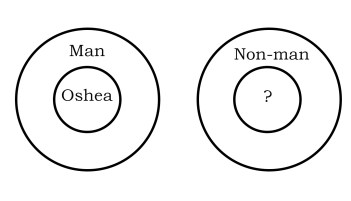
Below is Clark to talk about the meaning behind the Law of noncontradiction. I could just give a symbolic notation for the Law such as ( A is B” and “A is not B”) are exclusive of each other, or give it in Natural Deduction, but on this matter a more in-depth explanation seems to be better to due to the importance of the subject.  I prefer to see circle diagrams in my mind for a visual help.

If Oshea is predicated in the category of “man,” then there is no way for the category of non-man to be predicated to Oshea because of the immediate deduction of (obversion)[1], “Oshea is a man,” is “No Oshea is non-man.” That is, to destroy the LoC would be to fail the rest of logic/Logos, it would kill God in essence. God could not affirm, “Jesus is My only Son,” because it could men “Jesus is not My only Son.” Jesus could not affirm that He is the truth, because it could be that Jesus is not the truth. See diagram.

For Doctrine: There are many verses which directly teach or use logic in the Bible. Jesus is the Logos. Jesus appeals the law of non-contradiction. Jesus at times would not quote the O.T. but only use logic to refute His opponents. We are made in His image.  Thus, within the doctrine of Systematic Theology, there is a Doctrine of Logic. Christians ought to know this better.

Man - NON-man LoC

Cannot Deny It!

I deny the Law of non-Contradiction.” I must use the LoC to say this premise, otherwise, my denying of the LoC would men, “I affirm the Law of -non-Contradiction.”

Words are not important.” If that is the case, then the words I used to say words are not important are not important.

Anyone who says anything absolutely is arrogant.” If this is not said absolutely, then it does not apply to me, and so I do not care. But if the person who said it, does say it absolutely(as a dogmatic), then they by definition, are arrogant.

These statements, in order for them to be true, must be false at the same time. But the world I live in is not false. My existence is not false; that is, I must us my existence to deny it, and thus, I prove it.

St. Augustine had a way to show the stupidity of skepticism with the self-authenticating aspect of the LoC, by asking his opponent, “would you please deny your own existence (hint: without using it)?”

This is an important aspect ( must use the LoC to deny it) to remember, because Romans 1 says that the non-Christian is a moron because they cannot rationally deny God’s innate knowledge He put in them.

Romans 1:20-22, 2:14-15 (NLT)

20 For ever since the world was created, people have seen the earth and sky. Through everything God made, they can clearly see his invisible qualities—his eternal power and divine nature. So they have no [rational denese]* for not knowing God.

21 Yes, they knew God, but they wouldn’t worship him as God or even give him thanks. And they began to think up foolish ideas of what God was like. As a result, their minds became dark and confused. 22 Claiming to be wise, they instead became utter fools [Morons].

 Even Gentiles, who do not have God’s written law, show that they know his law when they instinctively obey it, even without having heard it. 15 They demonstrate that God’s law is written in their hearts

*Strongs Greek. “ἀναπολόγητος [anapologetos /an·ap·ol·og·ay·tos/] adj. From 1 (as a negative particle) and a presumed derivative of 626; GK 406; Two occurrences; AV translates as “without excuse” once, and “inexcusable” once.
1 without defense or excuse. 2 that which cannot be defended, inexcusable.”

This is where we get the word Apologetics. It is like a lawyer in court giving an objective rational defence for something.  In context of God writing His laws on our minds–then  when we see the world it stimulates this innate knowldge of God to our thoughts– is the logical reason why it is impossible to give a rational defence for suppressing God’s truth.  To do so, one must use God’s innately written truths to deny it; thus, they prove it.  This is not the Law of contradiction itself,  but a method using it to show its undeniablity.  Vincent Cheung has do a good job explaining this “method” (don’t confuse this for the apologetic itself, which is the Bible) for Christian apologetics. See his book, Ultimate Questions.  Also, Gordon Clark,  A Christian View of Men and Things.

Because the Bible speaks about this in context of Christian apologetics then it a doctrine Christian ought to know and practice.

Aristotle[2]

It is an amazing coincidence of history that Plato and Aristotle (384-323 B.C.) lived in the same century and that the latter was the pupil of the former. No other century can boast of such an amount of genius; no other pupil had such a teacher, and no other teacher had such a pupil. Extreme enthusiasm for Kant or Hegel might place the one or the other nearly on a level with Plato or Aristotle, but sober judgment fails to find an equal combination anywhere. Coincidences of history, however, may be of little significance. It is the clash of ideas that is important.

In the last chapter, in the section on the Parmenides, it was stated that Aristotle accepted the objections which Plato raised against his own theory. And there are others also. Accordingly, Aristotle considered the world of Ideas as a useless duplication of this world: useless, quite aside from the apparently intolerable difficulties involved in Platonism, because skepticism and all the troubles inherited from the Presocratics can be satisfactorily removed without its dubious aid. The student should be forewarned that Aristotle is not building on unaltered Platonic foundations; but precisely what Aristotle accepts from Plato and what he rejects, and how he combines and modifies the several factors, is a long and intricate story which makes Aristotle one of the hardest philosophers to understand. Then, too, his dull and methodical style does not cheer the flagging spirit. Plato was a vigorous and stimulating writer; he could combine the subtleties of epistemology, the excitement of politics, and the mathematical awe of astronomy all in one dialogue. The interrelations of the subjects, he constantly keeps before our eyes. Aristotle, on the contrary, carefully devotes one book to Logic, another to Physics, another to Psychology, and so on. This method undoubtedly has advantages, but the interrelations, which still exist, are hidden from view and must be sought out.

The Law of Contradiction

It is most appropriate to begin an account of Aristotle with some reference to his views on logic because the books on logic are logically put first in the corpus, and because his discussion of the fundamental laws of logic – the law of contradiction and the law of excluded middle – though taken from the Metaphysics, Book Gamma, forms a firm connection between earlier philosophy and the body of Aristotelian thought. For if Aristotle rejects the essential principles of Platonism, we should see at once how he will avoid the skepticism of Protagoras. Also it is at this point that the connection between logic and natural philosophy in general can be most clearly seen. For although logic aims to discover the principles on which all true judgment depends, it is not a merely formal science of thinking; but rather, since truth requires a relation to reality, the laws of logic must be not only the laws of thought, but the laws of reality as well.

Logic and Reality

Aristotle introduces the topic by questioning whether logic and reality are the objects of the same science or of two different sciences. In view of the fact that the truths of logic and the principles of reality apply universally and are not restricted to any special field of study, Aristotle concludes that they belong to the same science. The truths of botany or of geometry, on the other hand, do not apply universally: Geometry concerns being in so far as it occupies space, and botany is limited to being as it exhibits nutrition and growth. Yet all the special sciences make common use of the laws of logic because these laws hold for all reality, and not merely for that part of reality that the special science studies. But the special sciences use logic without discussing it. It would be incongruous for a botanist or an astronomer to discuss the nature of truth and the law of contradiction. No doubt some of the Presocratics did so, and their inclusion of this material is perhaps defensible on the ground that they thought they were discussing the whole of reality. But in this they were mistaken; for nature is only one genus of reality, and physics, while it is a kind of wisdom, is not the first kind. Therefore there must be a still more universal science that deals with primary being, and to this science Aristotle sometimes gives the name of First Philosophy. As the botanist or physicist is responsible for the most general principles within his special sphere, principles applying to the particular kind of being that forms the subject matter of that science, so the philosopher must state and explain the principles that apply to being without qualification, to all being without exception, to being qua being – principles that are absolutely universal without any restriction at all. It is therefore the prerogative of philosophy, and not of botany or any other special science, to study the most general principles of all existence.

The most certain of all principles is the law of contradiction, for it is impossible to be mistaken about it. It is not an hypothesis, a tentative by which to rise to something more general, for a principle which everyone must have who knows anything about being cannot be so characterized. The principle is this: The same attribute cannot attach and not attach to the same thing in the same respect. Or, otherwise, contrary attributes cannot belong to the same subject at the same time. This principle, be it noted again, is stated not merely as a law of thought, but primarily as a law of being. The ontological form is basic; the purely logical is derivative: It becomes a law of thought because it is first a law of being. If anyone should object to the law of contradiction and should assert, as Heraclitus is supposed to have done, that contrary attributes attach to the same thing, it would be necessary to conclude that he cannot believe what he says. For if we have shown that the number three cannot be both odd and even, and that a stone cannot be both heavy and light, and so on, then it follows that no one can think that three is both odd and even, even though he verbally makes such an assertion. Anyone who pretended to believe that contrary attributes attach to the same subject would be affirming two contrary opinions at the same time; and these two opinions would be, as it were, two contrary attributes attaching to him as a subject. But this is what the law of contradiction makes impossible.

Indemonstrable Axioms[3]

Not only has the Heraclitean coexistence of contraries been maintained, but there are some writers who, thinking that the above derivation of psychological from ontological impossibility is circular, demand that the law of contradiction be formally demonstrated [deduced]. This demand, however, evinces their ignorance. The demonstration [deduction] of a proposition, such as any theorem in geometry, is completed only when it is referred to the axioms. If the axioms in turn required demonstration [deduction], the demonstration [deduction] of the proposition with which we began would remain incomplete, at least until the axioms could be demonstrated [deduced]. But if the axioms rest on prior principles, and if these too must be demonstrated [deduced] – on the assumption that every proposition requires demonstration – the proof of our original theorem would never be finished. This means that it would be impossible to demonstrate [deduce] anything, for all demonstration [deduction] depends on indemonstrable [non-deducible] first principles. Every type of philosophy must make some original assumptions. And if the law of contradiction is not satisfactory, at least these Heracliteans fail to state what principle they regard as more so. Nonetheless, though the law of contradiction is immediately evident and is not subject to demonstration, there is a negative or elenctic[indirect] argument that will reduce the opposition to silence.

Significant Speech

The negative method avoids the charge of begging the question, for it is the opponent and not oneself who makes the assertion. Of course, this depends on the opponent’s willingness to say something. The proof aims to show the opponent who attacks the law of contradiction that so soon as he says anything at all, he is recognizing the principle. If he should say nothing, we have neither an opponent nor an objection to face. Nor need we insist that he make some tricky admission that plays into our hands. All that is required is that he say something significant for himself and for us, for this is the presupposition of every understanding between two persons, or even of one person’s understanding himself. Let the opponent then say something: that three is an odd number or that Socrates is a man. It will always be of the form, x is y. Now, in the first place, the word is has a definite meaning and does not mean is not. Therefore, Protagoras was mistaken when he said that everything is and is not.1 But perhaps the argument will be clearer if we consider the x and the y.

In any sentence the predicate, the y, must have a single, definite meaning; and when we say that x is y, or that Socrates is a man, we are asserting of Socrates the meaning of man, whatever it may be – two-footed animal, perhaps. Thus we assert something definite. The remark that words have several meanings will not damage this contention, provided the meanings are limited in number. Suppose the word man had ten different meanings: It would be possible to invent ten different terms so that each term would stand for a single meaning; and once more the predicate and the assertion as a whole would be definite. If, however, terms had an infinite number of meanings, then all reasoning would come to an end. For if a word is to convey a significance, it must not only mean something, it must also not mean something. If it had all the meanings of all the terms in the dictionary, it would be useless in speech. Therefore, if terms had an infinite number of meanings, no term would have one meaning; and not to have one meaning is to have no meaning; but if words have no meaning, it is impossible to argue with other people or even to reason privately within oneself. If we do not think one thing, we think nothing; but if we can think of one thing, then we can assign to it a single unambiguous term. On this basis it is impossible that being a man should mean precisely not being a man, or that perception should be non-perception, or that a wind should be both y and not-y. And this is in reality a justification of the law of contradiction.

The Sophists, both of antiquity and of the present, ignoring the ontological basis of this argument, attempt the reply that what one person calls a man, another may call a mouse and not a man. Hence the same thing would be both man and not-man. But this is elementary ambiguity. The question is not whether a subject can be man and not-man in name, but whether it can be so actually or ontologically. If man and not-man mean two different things, as was indicated above, and if man means two-footed animal, it follows that anything that is a man must be a biped. But if this must be so, i.e., if this is necessary, the contrary is impossible: It is impossible that the subject should not be a two-footed animal, and hence the same subject cannot possibly be both man and not-man.

Denial of Substance

Further to refute his opponents, Aristotle plunges into logical and ontological complexities that will try the most ambitious student. Those who argue against the law of contradiction must also deny substance and reality. To explain how this is so and why it is absurd requires reference to the theory of categories, later to be explained. To anticipate, however, it may be briefly stated that a category is a predicate; or, more precisely, the ten categories are the ten types of possible predicates. For example, of Socrates it may be said that he is a man, he is ugly, he is wise, he is short, he is heavy, and perchance he is a musician. But of these, the predicate man holds a favored position. Heavy and musical are accidental predicates; that is, it is not necessary or essential to being a man that one should be heavy or musical: There are men who are frail and unmusical. These predicates and other accidental predicates fall under the categories of quality, quantity, relation, or others. But the predicate man, when one says that Socrates is a man, is no accident: Man is what Socrates essentially is. The predicate man falls under the category of substance or reality. And the category of substance is basic because there can be no quality or quantity unless there is a substance that it is the quality of.

The Sophistic opponents of logic, however, do away with substance, for they must say that all attributes are accidents, and that no subject is essentially man. The line of reasoning behind this is as follows. To be essentially and substantially man is incompatible with being not-man or not being man, for when we say that Socrates is essentially man, we are designating his substance; and to designate a thing’s substance, essence, or reality is to deny that it is essentially or really something else. The skeptical relativists must say, therefore, that nothing can be defined, and that all attributes are accidental. But if all predication is accidental, there will be no reality of which the predication is made, and predication would be endless. This, however, is impossible, because, far from being endless, not more than two terms can be joined in accidental predication. We may say that the musician is blond or even that the blond is musical; but the accidental conjunction of blond and musical is possible only because they are both accidents of the same reality – Socrates perhaps. In the absence of an underlying subject of which both are predicates, blond could not be predicated of musical nor musical of blond. Now, when we say that Socrates is musical or that Socrates is blond, the predicate is not related to its subject as in the previous predications, for, while blond and musical were equally accidents of an underlying reality, Socrates and musical are not thus on the same level as accidents of some third subject. Socrates is not a predicate at all, and hence there cannot be an infinite series of predicates: Every series must end with a reality.

As this section of Aristotle is somewhat subtle, and as its importance has been seen in Plato’s refutation of Protagoras, it will be well to elaborate a little. Aristotle may be willing to admit that the law of contradiction as stated does not hold for accidental predication. The musician can be white; yet since white is “not-musical,” the musician can be “not-musical.” But with substantial predication, the case is different. Suppose we ask the opponent if A is a man. He could answer, Yes, but he is also white and musical, and these are not-man; hence, A is man and not-man. This answer is correct to the extent that a subject may have an indefinite number of accidents; but so understood the answer is beside the point. Our original question was, Is A essentially a man? If the opponent ignores the “essentially,” as he did in the answer just given, he should list all the accidents – all, and that includes the negative as well as the positive ones. He should therefore say A is man, musical, white, not-green and therefore blue, not-ship and therefore house. For, if it is true that man is not-man, as the opponent claimed just above, it is all the more true that man is not-ship; but since house is not-ship and since on this theory contrary accidents attach, the man must be both a house and also a ship. Such a list of accidents would be infinite. Yet, if the opponent begins to list these accidents, he ought to continue with them. Let him give all or none. There is no reason for specifying only three or four. From which it follows that if he begins and continues, he will take so long that we shall be spared the trouble of answering him. In other words, if the opponent depends on accidental predication, if he repudiates the distinction between substantial and accidental predication, discussion ends. On this theory no predicate is definitive, and the metaphysical implication is that reality does not exist.

Now, to repeat a thought previously stated near the beginning of this analysis of the law of contradiction: This analysis or “proof” is a negative or elenctic one. It is not a demonstration based on more original principles. A careless reading might conclude that the law is demonstrated from the principle that every word must have a single meaning. But the truth of the matter is quite the reverse. Aristotle is saying rather that every word must have a single meaning because the principle of contradiction holds. He is applying the law to this particular case. And the particular case is chosen for the purpose of showing that an opponent cannot carry through his own theory. He becomes tangled in an infinite regress and must drop out of the argument. Therefore, if anyone, including the opponent, wishes to argue, reason, discuss, or say anything meaningful, he must presuppose the law of contradiction. Hence, this law is not demonstrated from some higher principle, but Aristotle shows that it must be presupposed by anyone who wishes to speak intelligibly.

The inanity of skeptical relativism was hinted at in the remark above that the musician must be a not-ship and therefore a house. This has a further ontological implication. If contradictory statements are true of the same subject at the same time, evidently all things will be the same thing. Socrates will be a ship, a house, as well as a man; but then Crito too will be a ship, a house, and a man. But if precisely the same attributes attach to Crito that attach to Socrates, it follows that Socrates is Crito. Not only so, but the ship in the harbor, since it has the same list of attributes too, will be identified with this Socrates-Crito person. In fact, everything will be everything. Therefore, everything will be the same thing. All differences among things will vanish and all will be one. Such is the metaphysical nonsense to be derived from Protagoras or anyone else who denies the law of contradiction.[4]

As a Christian deductionalist it is important to consider logic and theology proper.  Thus, here is Clark to talk about John 1:1.  Clark’s board focus is, “the Logic was God,” but particularly he focuses on the law of non-contradiction and the motion of God’s thinking.

Gordon Clark. He explains how the LOGOS is the Divine Nature itself. Thus, not only is logic a doctrine taught from the Bible, it is a Ultimate Question of life for man.

Logic Is God

It is to be hoped that these remarks on the relation between God and truth will be seen as pertinent to the discussion of logic. In any case, the subject of logic can be more clearly introduced by one more Scriptural reference. The well-known prologue to John’s Gospel may be paraphrased, “In the beginning was Logic, and Logic was with God, and Logic was God…. In logic was life and the life was the light of men.”

This paraphrase-in fact, this translation-may not only sound strange to devout ears, it may even sound obnoxious and offensive. But the shock only measures the devout person’s distance from the language and thought of the Greek New Testament. Why it is offensive to call Christ Logic, when it does not offend to call him a word, is hard to explain. But such is often the case. Even Augustine, because he insisted that God is truth, has been subjected to the anti-intellectualistic accusation of “reducing” God to a proposition. At any rate, the strong intellectualism of the word Logos is seen in its several possible translations: to wit, computation, (financial) accounts, esteem, proportion and (mathematical) ratio, explanation, theory or argument, principle or law, reason, formula, debate, narrative, speech, deliberation, discussion, oracle, sentence, and wisdom.

Any translation of John 1:1 that obscures this emphasis on mind or reason is a bad translation. And if anyone complains that the idea of ratio or debate obscures the personality of the second person of the Trinity, he should alter his concept of personality. In the beginning, then, was Logic.

That Logic is the light of men is a proposition that could well introduce the section after next on the relation of logic to man. But the thought that Logic is God will bring us to the conclusion of the present section. Not only do the followers of Bernard entertain suspicions about logic, but also even more systematic theologians are wary of any proposal that would make an abstract principle superior to God. The present argument, in consonance with both Philo and Charnock, does not do so. The law of contradiction is not to betaken as an axiom prior to or independent of God. The law is God thinking.

For this reason also the law of contradiction is not subsequent to God. If one should say that logic is dependent on God’s thinking, it is dependent only in the sense that it is the characteristic of God’s thinking. It is not subsequent temporally, for God is eternal and there was never a time when God existed without thinking logically. One must not suppose that God’s will existed as an inert substance before he willed to think.

As there is no temporal priority, so also there is no logical or analytical priority. Not only was Logic the beginning, but Logic was God. If this unusual translation of John’s Prologue still disturbs someone, he might yet allow that God is his thinking. God is not a passive or potential substratum; he is actuality or activity. This is the philosophical terminology to express the Biblical idea that God is a living God. Hence logic is to be considered as the activity of God’s willing.

Although Aristotle’s theology is no better (and perhaps worse) than his epistemology, he used a phrase to describe God, which, with a slight change, may prove helpful. He defined God as “thought-thinking-thought.” Aristotle developed the meaning of this phrase so as to deny divine omniscience. But if we are clear that the thought which thought thinks includes thought about a world to be created-in Aristotle God has no knowledge of things inferior to him-the Aristotelian definition of God as “thought-thinking-thought” may help us to understand that logic, the law of contradiction, is neither prior to nor subsequent to God’s activity.

This conclusion may disturb some analytical thinkers. They may wish to separate logic and God. Doing so, they would complain that the present construction merges two axioms into one. And if two, one of them must be prior; in which case we would have to accept God without logic, or logic without God; and the other one afterward. But this is not the presupposition here proposed. God and logic are one and the same first principle, for John wrote that Logic was God. At the moment this much must suffice to indicate the relation of God to logic. [5]

H.W.B. Joseph gives a short summary of the Three Laws of Logic.

The Three Laws of Thought.

The connection between questions about our thinking, and what we must think things to be, is excellently shown in the so-called Laws of Thought. These are certain very general principles exemplified in all thinking, and some have supposed the task of Logic to consist merely in developing their implications. They are known as the Law of Identity, the Law of Contradiction, and the Law of Excluded Middle. The Law of Identity may be formulated by saying that whatever is, is ‘ : or symbolically, that A is A’ ; the Law of Contradiction, that ‘ a thing cannot both be and not be so and so ‘ that ‘ contradictory propositions cannot both be true ‘, or that A cannot be B and not be B ; the Law of Excluded Middle, that is a thing either is or is not so and so ‘, that contradictory propositions cannot both be false ‘, or that ‘ A either is or is not B ‘. In other words, if we think about anything, then (1) we must think that it is what it is; (2) we cannot think that it at once has a character and has it not; (3) We must think that it either has it or has it not.
Now though these are called laws of thought, and in fact, we cannot think except in accordance with them, yet they are really statements which we cannot but hold true about things. We cannot think contradictory propositions, because we see that a thing cannot have at once and not have the same character; and the so-called necessity of thought is really the apprehension of a necessity in the being of things. This we may see if we ask what would follow, were it a necessity of thought only; for then, while e.g. I could not think at once that this page is and is not white, the page itself might at once be white and not be white. But to admit this is to admit that I can think the page to have and not have the same character, in the very act of saying that I cannot think it; and this is self-contradictory. The Law of Contradiction then is metaphysical or Ontological.

So also, is the Law of Identity. It is because what is must be determinately what it is, that I must so think. That is why we find a difficulty in admitting the reality of absolute change, change when nothing remains the same; for then we cannot say what it is which changes.

The Law of Excluded Middle is so far different as a disjunctive proposition expresses doubt, and doubt belongs to the mind, not to things. But to deny that this page need either be or not be white is to deny that it need be anything definite; determinateness involves the mutual exclusiveness of determinate characters, which is the ground of negation; and that is a statement about things. In other words, unless the primary Laws of Thought were Laws of Things, our thought would be doomed by its very nature to misapprehend the nature of things.[6]

Vincent Cheung explains the concept of how a contradiction cancels the two propositions out. Thus, in theology there would be no doctrine to affirm or deny. There would be no salvation, no God or no man to affirm or deny.

For any proposition that affirms X, the proposition that contradicts it is one that affirms not-X. This is what a contradiction means. Any proposition that affirms one thing is by necessity also a denial of its opposite. To affirm X is to deny not-X, and to affirm not-X is to deny X. To keep this simple, let us assume that Y = not-X, so that the opposite of X is Y. Thus to affirm X is to deny Y, and to affirm Y is to deny X. Or, X = not-Y, and Y = not-X. Then, since to affirm a proposition is to deny its opposite, to affirm X and Y at the same time is the equivalent of affirming not-Y and not-X. Thus to affirm two contradictory propositions is in reality to deny both. But to affirm both not-Y and not-X is also to affirm X and Y, which again means to deny Y and X. And so the whole operation becomes meaningless. The upshot is that it is impossible to affirm two contradictory propositions at the same time.

To affirm the proposition, “Adam is a man” (X), is to deny the contradictory proposition, “Adam is not a man” (Y, or not-X). Likewise, to affirm the proposition, “Adam is not a man” (Y), is to deny the contradictory proposition, “Adam is a man” (X). Now, to affirm both “Adam is a man” (X) and “Adam is not a man” (Y) is only to deny both propositions in reverse order. That is, it is equivalent to denying “Adam is not a man” (Y) and “Adam is a man” (X). But then we are back to affirming the two propositions in reverse order again. When we affirm both, we deny both; when we deny both, we affirm both. Therefore, there is no intelligible meaning in affirming two contradictory propositions. It is to say nothing and to believe nothing.

To illustrate, it is clear that divine sovereignty and human freedom contradict each other.[7]If God controls everything, including man’s thoughts, then man is not free from God. If man is free from God in any sense or to any degree, then God does not control everything.[8] Yet some theologians claim that the Bible teaches both divine sovereignty and human freedom, and so they insist that we must affirm both. However, since to affirm divine sovereignty is to deny human freedom, and to affirm human freedom is to deny divine sovereignty, then to affirm both only means to reject both divine sovereignty (in the form of an affirmation of human freedom) and human freedom (in the form of an affirmation of divine sovereignty). But to deny both means to affirm both in reverse order, and to affirm both means to deny both in reverse order again.

The necessary result is that the person who claims to believe both divine sovereignty and human freedom believes neither. In claiming to believe all of the Bible, he in fact believes none of it. In this example, since the Bible affirms divine sovereignty and denies human freedom, there is no contradiction – not even an apparent one. On the other hand, when non-Christians allege that the incarnation of Christ entails a contradiction, the Christian does not have the option to deny either the divinity or the humanity of Christ. Rather, he must formulate the doctrine as the Bible teaches it, and show that there is no contradiction. The same applies for the doctrine of the Trinity. In any case, if a person claims that he sees contradictions in the Bible, this means that he does not – he cannot – believe the Bible.

A popular response is that these are only apparent contradictions; that is, the doctrines only seem like contradictions to the mind of men, but they are in perfect harmony in the mind of God. This answer is futile. There is no difference between an apparent contradiction and an actual contradiction when it comes to affirming it. It remains that to affirm one thing is to deny the other at the same time, so that to affirm both is to deny both, and that to deny both is to affirm both again. Thus the person who affirms an apparent contradiction really affirms nothing and denies nothing. Whether the contradiction is only an apparent one is irrelevant. As long as it appears real to the person, it is real enough.

Moreover, how can a person distinguish between an apparent contradiction from an actual contradiction? He can never know that a contradiction is only an apparent one.

Unless he knows how to resolve the apparent contradiction, it will appear the same to him as an actual contradiction. And if he knows that a contradiction is only an apparent one, then he has already resolved it, and the term contradiction no longer applies. If we must tolerate apparent contradictions, then we must tolerate all contradictions. We often challenge non-Christian views on the basis that they contradict themselves. But if we tolerate apparent contradictions, then there is nothing to prevent non-Christians from claiming that the contradictions in their worldviews are only apparent ones.[9]

——-END NOTES——

[1] Obversion works because of the Law of Noncontradiction and excluded middle.

[2] Clark will be giving Aristotle’s explanation for the law of noncontradiction with his own commentary woven throughout. In General it seems Clark agreed with Aristotle’s indirect defense of the LoC because Clark used some similar remarks about the LoC and in defending the coherence of the Scripture against non-Christian worldviews in, “A Christian View of Men and Things,” see last chapter. And in his essay, “God and Logic.”

[3] Gordon is using the term “indemonstrable” as “non-deducible.” He states there are indirect arguments for logical tautologies. These are more like indrect methods to show. Similar to how a reductio ad adsurdum argument is an indirect use of denying the consequent.

[4] Gordon Clark. Thales To Dewey – A History of Philosophy. The Trinity Foundation. 2000. Pg.86-92. Chapter on Aristotle.

[] – Added by Author. Emphasis added by author.

[5] Gordon Clark, God and Logic.  Copyright © The Trinity Foundation, www.trinityfoundation.org. Post Office 68, Unicoi, Tennessee 37692
Phone: 423.743.0199 Fax: 423.743.2005

[6] H.W.B. Joseph. 1906. An introduction to LOGIC. Pg.13

Read the book here. https://archive.org/details/introductiontolo00jose/page/n6

[7] The doctrine of divine sovereignty will be discussed and applied throughout this book. Also see Vincent Cheung, Commentary on Ephesians and The Author of Sin.

[8] The doctrine of compatibilism teaches that man is not free from God, but that man is still free in a sense. However, unless the kind of freedom under consideration is freedom from God, it is irrelevant, since the topic concerns God’s control over man. See Vincent Cheung, The Author of Sin.

[9] Vincent Cheung. Systematic Theology. 2010. www.vincentcheung.com. Chapter, Scripture, sub-section, The Unity of Scripture.

Logic Lesson – Categorical vs. Hypothetical. James Creighton

By: James Creighton
§ 41. Relation of Categorical and Hypothetical Arguments.
— It is evident that the form of the hypothetical syllogism is very different from that of the categorical. But, although this is the case, it must not be supposed that with the former we have passed to a new and wholly distinct type of reasoning. In hypothetical reasoning, as in categorical, it is the presence of a universal principle which enables us to bring into relation two facts which formerly stood apart. Indeed, in many cases, it is a matter of indifference in which form the argument is stated. Thus, we may argue in hypothetical form: —
.
If a man is industrious, he will be successful,
A is an industrious man,
Therefore A will be successful.
.
The same argument may, however, be expressed equally well in categorical form: —
.
All industrious men will be successful,
A is an industrious man,
Therefore A will be successful.
.
It is clear that, in spite of the different forms in which the argument is expressed, the reasoning is essentially the same in both cases. The middle term, or general principle which makes it possible to unite the subject and predicate of the conclusion, in the hypothetical as well as in the categorical syllogism, is ‘ industrious.’ A will be successful, we argue, because he is industrious, and it is a rule that industrious men are successful.
Moreover, if an argument is fallacious in one form, it will also be fallacious when expressed in the other. The defects of an argument cannot be cured simply by a change in its form. When an hypothetical argument, in which the antecedent is denied, is expressed categorically, we have the fallacy of the illicit major term. Thus, to state the example of denying the antecedent given on page 146, we get: —
.
The case of his being well is a case of his writing,
The present is not a case of his being well,
Therefore the present is not a case of his writing.
.
Similarly, when an argument in which the consequent is affirmed is changed to the categorical form, the defect in the reasoning appears as the fallacy of undistributed middle —
.
If this tree is an oak, it will have rough bark and acorns,
This tree has rough bark and acorns,
Therefore it is an oak.
.
When this argument is expressed in categorical form, it is at once clear that the middle term is not distributed in either the major or minor premise: —
.
All oak trees are trees having rough bark and acorns,
This tree is a tree having rough bark and acorns,
Therefore this tree is an oak.
.
The change from the categorical to the hypothetical form of argument, then, does not imply any essential change in the nature of the reasoning process itself. Nevertheless, it is important to note that hypothetical propositions and hypothetical arguments emphasize one aspect of thinking, which is entirely neglected by the theory of the categorical syllogism. When dealing with the extension of terms (§ 16), we pointed out that every term, as actually used in a proposition, has both an extensive and an intensive function. That is, the terms of a proposition are employed both to name certain objects or groups of objects, and to connote or imply certain attributes or qualities. In the proposition, ‘ these are oak trees,’ the main purpose is to identify the trees given in perception with the class of oak trees. When, on the other hand, we say,’ ignorant people are superstitious,’ the proposition does not refer directly to any particular individuals, but states the necessary connection between ignorance and superstition. Although the existence of ignorant persons who are also superstitious is presupposed in the proposition, its most prominent function is to assert a connection of attributes which is wholly impersonal. We may perhaps say that, in spite of the categorical form, the proposition is essentially hypothetical in character. Its meaning might very well be expressed by the statement,’ if a man is ignorant, he is also superstitious.’ What is here emphasized is not the fact that ignorant persons exist, and are included in the class of superstitious persons, but rather the general law of the necessary connection of ignorance and superstition. The existence of individuals to whom the law applies is, of course, presupposed by the proposition. It is not, however, its main purpose to directly affirm their existence.

Creighton, James Edwin, 1861-1924

An Introductory Logic.

https://archive.org/details/introductorylogi00crei/page/n6

What is the Chief characteristic of Superstition?

Superstition is precisely (such) LOGICAL VOIDS between premises and conclusions that characterize superstition. [1]


Therefore, science by definition is superstitious, in addition to being a triple logical fallacy: empiricism, inductive and affirming the consequent.


Logic Voids


[1] John Robbins, Forward of Gordon Clark’s book, Three Types of Religious Philosophy