
Category Archives: Christian Logic

“God’s Will,” – Is, A Fish for Fish

If [animal sacrifices provided by the priest] could have provided perfect cleansing, the sacrifices would have stopped, for the worshipers would have been purified once for all time, and their feelings of guilt would have disappeared…

For God’s will was for us to be made holy by the sacrifice of the body of Jesus Christ, once for all time.

Our High Priest offered himself to God as a single sacrifice for sins, good for all time. Then he sat down in the place of honor at God’s right hand.

For by that one offering he forever made perfect those who are being made holy.

And the Holy Spirit also testifies that this is so.

For he says,  “This is the new covenant I will make
with my people on that day,  says the Lord:
I will put my laws in their hearts,
and I will write them on their minds.

Then he says, “I will never again remember
their sins and lawless deeds.”

(Hebrews 10:2,10,12,14,16)

First we will discuss what “God’s will”[1] necessitates here, and Secondly, dive more into what it means for “God to be our God” and “we His people,” which is stipulated in the  new contract.

Hebrews points out in more than one place that the result of “God’s Will,” (for us to be holy), is for us to approach His throne of grace and receive what we ask of Him

The first mention is in Hebrews 4. What is the application for knowing our high priest has redeemed us? The idea of having peace with God is the ability and position to approach God, in His throne room of grace, to ask and then to receive the help we are asking for. There is no way to spiritualize this away. It is about receiving what we are asking for. Jesus when talking about prayer to God, teaches us something that opposes eastern religious like Buddhism (etc.). Such paganistic religions teach us that even if we do not change God’s will in our prayer, we have changed inwardly for the better, by seeking God. People who say such things are spiritual perverts. They are deceived and blind. Jesus contradicts this superstition about prayer and God, by teaching us that God gives a fish for a fish, and the Spirit for the Spirit. Let Buddha be damned, and Jesus and His teaching be highly valued.

“Ask and it will be given to you; seek and you will find; knock and it will be opened for you. For everyone who asks receives, and the one who seeks finds, and to the one who knocks it will be opened. Or what man is there among you, if his son will ask him for bread, will give him a stone? Or also if he will ask for a fish, will give him a snake? Therefore if you, although you* are evil, know how to give good gifts to your children, how much more will your Father who is in heaven give good things to those who ask him? Matthew 7:7–11 (LEB)

Since it is God’s, and not man’s definition that a “good” God gives you the very thing you ask for, anyone who teaches otherwise is spouting a doctrine taught from demons. Some bark up like mad dogs that, “what if you ask for something bad?” Yet this is not a relevant point because James says if you ask God for evil things (“God help me murder this person”), then you are God’s “enemy,” and so prayer is the least of your concerns. Since I am addressing Christians or those who at least claim to be so, and not sworn enemies of God, I will ignore logically non-relevant points. Thus, if you ask you will get what you ask for, Jesus says, in more than one way, in case we missed it. What Jesus is doing here with prayer, is the same He is doing throughout the “Sermon on the Mount.” You have heard it said “do not murder your brother, but I say to you, do not do it, even in your heart.” When Jesus teaches on judging people, His point presupposes that you are able to judge your brother, and to do it without hypocrisy. You do this by removing the wood from your own eye first. Some wicked fools say, “you cannot judge without hypocrisy”; yet, Jesus contradicts this in His sermon. He teaches the true ethical standard God demands for judging, and He expects His disciples to do it. It is good news to see in the new covenant, God promising to give us ethical power, “I will write my laws in your hearts.”

In this context of Jesus repeatedly correcting the low opinion of people’s thinking on God’s commands and standards, Jesus talks about “prayer and faith.” Thus, when we see Jesus saying, “if you ask God in faith, you get the very thing you ask for,” then we can infer the presupposition behind it, at least in the broad sense; and so, Jesus’ teaching is in opposition to the people’s low opinion of what they think prayer and faith should accomplish. It seems little has changed in 2000 years, for who can find a person who values and does prayer the way Jesus demands it? The Jews had a perverted and low view of prayer. From the Mount, Jesus corrects their error and describes the true ethical standard that God commands about faith. Whatever the low valuation of prayer the Jews had, it was not to the standard of, “if you ask in faith, you will get what you ask for.”  Jesus is expecting and demanding, (just like He demands us to not even lust in our hearts after another woman), to pray and get what we pray for.  Jesus in essence says, “You have heard it said, if its God’s will, then you might get what you pray for. But I say to you, It is God’s Will for prayer, if you ask in faith, you will get the very thing you ask for, because God is the good Father.” This is the type of Being we are dealing with. You must deal with Him and not someone else. Do you know Him?

Back to the two passages in Hebrews.

“So let us come boldly to the throne of our gracious God. There we will receive his mercy, and we will find grace to help us when we need it most,”
(NLT Heb 4:16).

Next, after several chapters of doctrine and theology about how Jesus accomplished salvation, Hebrews 10, starting in verse 19 gives us the conclusion or result.

“And so, dear brothers and sisters, we can boldly enter heaven’s Most Holy Place because of the blood of Jesus.

By his death, Jesus opened a new and life-giving way through the curtain into the Most Holy Place.

And since we have a great High Priest who rules over God’s house, let us go right into the presence of God with sincere hearts fully trusting him. For our guilty consciences have been sprinkled with Christ’s blood to make us clean, and our bodies have been washed with pure water.

Let us hold tightly without wavering to the hope we affirm, for God can be trusted to keep his promise,”
(Hebrews 10:19–23 NLT)

God being faithful to His promise is in context of the New Covenant. We will talk more about this later.

Here we are again seeing the same thing. Since in “context” of Hebrews 4 defining approaching God’s throne is about getting answers to our prayers for help, it therefore, does not mean the opposite here. The end says, “for God can be trusted to Keep His promises.” The promise that He will not remember our sins, and that He will be our God who loving gives us help when we ask for it. The emphasis is on two points here by the preacher. One is the category fact or truths. You are holy in Jesus right now. You are beloved and stand before God without Him remembering your sins against you. The second, is that you stand firm, believing these truths. You stand believing you are categorically holy, righteous and a child of God. That you believe you can boldly walk into heaven and push the door of God’s throne room open, and then you ask like a beloved son, for Him to help you. And that you stand believing He is the Good Father as He defined Himself to be in His word, so that He will indeed give you bread for bread.  The first part is always true, due to Christ’s finished work, whether or not a particular Christian has weak faith about it. However, if one has strong, unmoving faith about Jesus’ finished work, then truly you stand before God and He will answer your prayers.

The point is that Scripture makes the logical (or necessary) connection from Jesus’ atonement that makes us holy, to boldly going to God and getting “fish for fish, healing for a healing,” when we pray for help. Because the connection is not merely sufficient but necessary, then it is a “modus ponens” logical connection. If Jesus made you holy by His body, then you necessarily have access to boldly receive the things you ask for in faith.

If these two are necessarily connected, and they are according to Hebrews, then the logic of modus tollens applies. That is, if you deny the consequent you deny the antecedent. If you negate the application, you negate the foundation. If you negate getting our requests answered at God’s throne, then you negate being made holy by Jesus’ body. Novices play with the Bible like its play-dough. Their pet theories and traditions are not harmless when they make mistakes. They condemn themselves and turn the body of Christ in a spiritual casualty, in order to be fanboys of the past.

So to summarize, Hebrews knows no gospel that does not bring a person who is already perfected and “holy” to the throne of God, to ask and receive what we ask for. “God’s will,” is thrown around much today, but rarely do I see it used how the Scripture uses it. The preacher says it was “God’s Will,” to make us holy; however, we learn more.  There was a pre-determined point for why God desired to make us holy and perfected. The necessary result (or a previous in order Decree of God) is a person, according to Hebrews, who by faith (who assents they have been made ‘holy’), stands at God’s throne, to ask and receive what they ask for. The conclusion is obvious, it is “God’s Will” for you to stand in faith, with your head held high, before His throne, to ask and receive a fish for a fish, mercy for mercy, son for a son, health for health, wisdom for wisdom, wealth for wealth, inner strength for inner strength, protection for protection in your time of need. To say this is “not God’s will,” is to logically say it is “not God’s will” for us to be made holy by the body of Jesus Christ.

Many educated people feel proud of their intellect and academia, but in their fanboy affirmation of the past–such things as cessationism and things like “only if it is God’s will” (negating God’s promises)—they expose themselves as plus ultra perverts. They think they know logic and knowledge; however, deductive logic, like math and truth, is not flexible. They try to bend the sword of truth to pervert it; however, they only end up impaled on it. Leave these voodoo practitioners, and return to standing firm in the truth that you are holy, and standing before the throne of grace. God made the world and defines His world as He wants. His Word defines you as already a holy child, who when you ask for help, then you will get the type of help you asked for.

The “Will of God” is that He is your God, and you are His people.

We just discussed the connection of God’s Will to prayer in His throne room (in context of Hebrews), now we will further look at this connection within the new covenant.

Hebrews 8 when quoting the Old Testament about the details of the New Contract says,

“But this is the new covenant I will make with the people of Israel on that day, says the Lord:
I will put my laws in their minds, and I will write them on their hearts.
I will be their God, and they will be my people.”

(Hebrews 8:10 -quoting Jeremiah 31)

Hebrews 10 reveals it was “God’s will,” for us to be made holy by Jesus’ body. Then a few verses later it quotes Jeremiah 31 (the new covenant promise) as proof for this, “I will no longer remember their sins.” However, it is important to remember to read this in context. Hebrews 8 quotes the fuller promise of the God’s covenant with the Elect, from Jeremiah. It mentions that “God is our God, and we are His people.” The logical connection is the new covenant. It was God’s Will for us to be made holy by the body of Jesus; the way this is given is the promise of the new covenant. In other words, if it is “God’s Will,” for us to be holy, which is a new contract promise, then the new contract is “God’s Will.” Also, God is not under any pressure or obligation when He makes a promise. He is the only being who has intrinsic self-existence, self-freedom and self-definition. Thus any promise He makes is by definition “His Will,” because in total freedom and foreknowledge and power He made a choice. Also, the new covenant was stipulated by God and not man, thus, it is perfectly what He wants, or the perfect stipulation of “His Will.” This contract given in oath of Jesus’ blood, promises that God will be our God and we His people. What does that mean? This is important because it is “God’s Will” for Him to be this to us. And it equally, God’s Will, for us to be this to God.

Isaiah 41:10 says regarding God “being a God to His people,” which is a commonly quoted promise verse (as it should be) says,

“Don’t be afraid, for I am with you.
Don’t be discouraged, for I am your God.
I will strengthen you and help you.
I will hold you up with my victorious right hand.”

About king Hezekiah it said in a more indirect way through king David, however, the point is the same, God is Hezekiah’s God, and Hezekiah is God’s people.

“Return; you must say to Hezekiah, the leader of my people, ‘Thus says Yahweh the God of David your ancestor, “I have heard your prayer and I have seen your tears. Look, I am about to heal you.” 2 King 20:5

However, the first major stating of this phrase and an explanation of its meaning is found in Leviticus.

 “I will look favorably upon you, making you fertile and multiplying your people. And I will fulfill my covenant with you.  You will have such a surplus of crops that you will need to clear out the old grain to make room for the new harvest! I will live among you, and I will not despise you.  I will walk among you; I will be your God, and you will be my people.  I am the Lord your God, who brought you out of the land of Egypt so you would no longer be their slaves. I broke the yoke of slavery from your neck so you can walk with your heads held high,
(Leviticus 26:9-13 NLT)

This is a foreshadow of the New. That is, what you see here is much more so in the new blood oath, by Jesus Christ. The freedom from the slavery of Egypt is in the, New Contract, about us being freed from sin. Freedom from the conscience of sin and from Satan’s oppressive accusations, because God remembers them no more against us. So much so, we can march in the throne room of heaven to ask from God what we wish, “with our heads held high.” But that is just one part of “God being our God, and we being His people.” As being freed from Egypt is the foundation for the other blessings, so too within New Covenant. That is, God’s promise is NOT blessing them with surplus crops in Egypt, but in the promise land. Their blessings awaited them in the promised land, not in Egypt. They needed freedom from the yoke of slavery first. Jesus does this for us in the New Contract. He frees us from sin and its guilt, so that He has a righteous foundation to lavish all His other blessings. Our promise land is not so much a place, for it is foundationally being brought near to God. There is however, a place for Jesus’ throne, and yet, the scripture says we have already (past tense) been raised and set with Jesus at God’s right hand. . In 1 John 3 he goes so far as to command us to keep our thoughts where our lives are at, and our lives are not on earth, but are already hidden in Jesus, who is at the Power’s right hand. Thus, even if one wishes to make the promise land heaven, our lives are there. John also says in chapter 4 that “as Jesus is so are we in this world.” Jesus with awesome power, frees us from the law and Satan’s oppressive accusations against us. Now, He gives us a surplus of the Holy Spirit for miracles and healings; which is to say, since we are already in the promise land through Christ, Christ therefore, pours the promise land’s and kingdom’s power into us on earth by the Spirit. Paul even says Jesus became poor for us, so that we might become rich, by His substitutionary death (in context it is decisively about money). Thus, Jesus multiplies our bank accounts and barns, because, in Jesus, our lives are already connected to the promise land. Our lives are even connected right up next to the Power, because our lives are connected to the valuable Person who sits at the Power’s right hand. If the blessings were so great in the Old Contract, then much more now when the Promise Land we are connected to  now, is the true heavenly one! He pours over us an ocean of unmerited favor that is all for the taking by faith. How could someone be so depraved, so as to despise the oath of God, confirmed by the blood of His Son?

“For God’s will was for us to be made holy by the sacrifice of the body of Jesus Christ, once for all time.”

MADE holy. This causality is God’s doing, and it is His promise. To be holy relative to or “before God,” is more than not being punished. In Ephesians 1 it says holy and “beyond reproach.” This means we are perfectly moral and flawlessly ethical before God, so much so, we are beyond even the hint of an accusation against the demand for absolute perfection. By the body of Jesus, this is now our reality, “BEFORE GOD.” Even if our sanctification is not perfect, it is a non-logical point, because God considers you holy and righteous before Him. And God is not fickle or emotional like man. He promised to treat you as holy and righteous and not something else. Thus He interacts and treats you as perfectly and morally righteous. However, our holiness and righteousness by the body of Jesus, which we have now, is a God-level holiness, because it was performed by Jesus Christ and given to us. And so, our position with God is not us standing somewhere in the back corner of God’s throne room or somewhere even farther; rather, our position NOW, is with Christ at God’s right hand. Do you understand the position you have now in Christ and before the Power?

Christ being at God’s right hand, presently enjoys and partakes of the goodness that rightfully belongs to being in that position. Yet, we are now with Christ! Thus, to be made holy by Jesus, is to be a partaker of the holy God, now.

To be made holy is similar to how Paul said that we were made righteous in Christ in Romans 5:19.

“For just as through the disobedience of the one man,
the many were made sinners,
so also through the obedience of the one,
the many will be made righteous (LEB).”

By God’s sovereign control over His own creation, He authored and caused Adam to sin, and then by this He caused all mankind to be made into sinners by His direct and absolute causality. But the reverse is also true, but much more. God sent His Son and by His righteousness (holiness) God caused the elect to be made righteous. God is sovereign. Man has no free choice relative to God’s control on the ultimate level. God without asking humanity, and humanity not being free from God’s causality, made them sinners. Then God made some of them into His righteousness. However, there is even more to this sovereign control of God. In the New Covenant, God, without our consent and without us not being free to do otherwise, also made Himself to “be our God” and “made us to be His people.”  This New Contract is a packaged deal. If you negate one part, then you negate the rest.

To see what this means, consider the woman bent over for 18 years. Jesus said, because she was a daughter of Abraham it was “necessary” for God to heal His daughter. God was God to Abraham, and Abraham was God’s people. This is why Abraham was victorious when he defeated the 5 kingdoms and was blessed by Melchizedek, and why the other non-people of God were defeated. To be a true child of Abraham, means God is your God. We are so today in Christ (Galatians 3). This is a categorical truth. Recall an earlier comment about logical connections. A logical connection is only about “necessary” connections; logic is not about sufficient ones, for there is no valid inference with only sufficient connections.  Thus, Jesus said it was “necessary” for God to heal this woman, and not merely a good or sufficient reason. If God promises to be your God and you are part of His family, it is “necessary” for Him to benefit you with the goodness He promised.

Not in another place, or in a different time, but here and now, God is our God and we are His people. Act like it. Receive from your Father’s table. If God put you at His table (i.e. in Christ at God’s right hand) then it is God’s Will for you to partake of the fatness of His table. You have heard it said that God disciplines His legitimate children, and this is true; however, the other side of the coin is also true. Taking food from your Father’s table is necessary for you to prove you are His legitimate child. Illegitimate children cannot ask and get what they want from God. You, take and eat. This is what the sovereign God has done. This is the type of Being His is. These things already belongs to you. It is NOT God’s will that you do not take it. It is His will, that you ask and receive what you ask for, knowing God is your God and you are His holy beloved child.

Endnotes——————

[1] I will not deal with the teaching that “God’s Will” can categorically mean two things in Scripture, for I have done that elsewhere. For a quick read, then see Vincent Cheung, “Ezekiel 18:23 and 33:11.” The problem I often see is that most make a category error by mixing these two categories up. Conveniently, this fallacy is most often made when people try to avoid Jesus’ demand for us to get what we want in faith.
Jesus Finishes the Syllogism

Jesus Finishes the Syllogism:[1]

“Behold, a leper approached and worshiped him, saying,
“Lord, if you are willing, you are able to make me clean.”
And extending his hand he touched him, saying,
I am willing, be clean.”
And immediately his leprosy was cleansed.” (Matthew 8:2-3)

The leper presents a partial logical argument or enthymeme. Most arguments are given in partial format for convenience. In this 3 premise modus ponens argument, the leper gives the first compound premise. The next two silent premises, is in reality the leper’s faith.

The partial argument when finished out relative to the leper:

H.1. (P) If You are willing, (Q) then necessarily you are able to make me clean.
H.2. (P) You are willing.
H.3. (Q) Thus, You are able to make me clean.

The interesting and precious thing here, is that Jesus finishes the man’s argument! That is, the leper gives H.1., and when Jesus engages the man, He finishes the argument with H.2. and H.3.

The leper says, H.1 (P) “If You are willing, (Q) then you are able to make me clean.”  Jesus then responds, H.2. (P) “I am Willing.” And then the conclusion. H.3. (Q) “Be cleansed.”

H.1 (P) “If You are willing, (Q) then You are able to make me clean.”
H.2. (P) “I am willing.”
H.3. (Q) “Be cleansed.”

In logic books and in logic class there were often boring and unrelative arguments for examples, and which did not have an practical application to me. Yet, here before us, Jesus the LOGOS itself, when He teaches logic, not only helps us with our syllogism, but the logic lessons are relatable arguments that affects our lives with good, in the land of the living.

Endnotes—————-

[1] This is technically a Modus Ponens, or propositional logic, and not 3 premise categorical logic.

Deduction simply applies the knowledge

Helped a friend work out a syllogism yesterday, regarding God’s absolute sovereignty or causality. The important thing to remember here is that deduction is an application of knowldge, or that is, deduction does not manufacture new information and then add it to the conclusion, which is what induction does. For this reason all induction is a non-sequitur, that is, all inductive conclusion are, “it does not logically follow.” By importing new information not from your source premises, you just ruined all validity.
Deduction simply applies the knowledge already stated to particular instances. If the bible says, all men have sinned, then to say this to the particularly man Oshea (Oshea has sinned), is simply “applying” the knowledge. It does not makeup or manufacture new information to shove into the conclusion like induction does. Thus, when the Scripture shows a doctrine that God is the ulitmaite sovereign and absolutely controls all things, then to “apply” this knowledge one would need to affirmed it on every particular instance.
G.1: All [things that happened/ens] are [ caused by God].
G.2.: All [Adam’s fall] is [a thing that happened].
G.3. Thus, [Adam’s fall] is [caused by God].
Or since this is about causality, or ontology, I personally put such into propositional arguments. Here, I would put an extra conjunction in the antecedent, and so it would technically be a Natural Deduction format, but for simplicity, we will look at it as a basic Modus Ponens.
H.1. If (P) God caused/s all things to happen, and (Q) Adam’s fall is a thing that happened, then (R) God caused Adam’s fall.
H.2. P and Q.
H.3. Thus, R

Falling With the Rocks, Sinking With the Waves

Though the mountains be shaken
and the hills be removed,
yet my unfailing love for you will not be shaken
nor my covenant of peace be removed,”
says the Lord, who has compassion on you. (Isaiah 54:10 NIV)

I posted this verse yesterday; however, I wanted to make some points about it. The most obvious point of this passage that God is saying centers on a simple use of logic. God’s logic lecture is this: Category (A) and its necessary connections, is not the same category (B) with its necessary connections.  They are not the same; therefore, whether something is affirmed or denied in category (A), then it does not logically infer this other category (B) is affirmed or denied in the same way.

I happen to read this excerpt from Vincent Cheung yesterday, in which he was giving a similar logic lecture:

“We reject the positive thinking of self-help psychology. Yet there is a biblical faith, which indeed produces a positive outlook, and constitutes a spiritual and psychological power in the Christian. The two are different, and it requires some misunderstanding of both to mix them up. If you reject Budd[h]a, do you have to renounce Jehovah? What does one have to do with the other?”[1]

Psalm 91 says although 10,000 people perish at my feet, what does that have to do with me? There is no logical connection of 10,000 people dying right next to me, to me dying. The Psalmist is sitting under the shadow of God’s wing. He is in a different category, in a different location, in a different reality from these other people. Those people were under their own strength. He is under the promise of Yahweh to strengthen him and protect him. What applies to them, has no necessary connection to him. The Psalmist is logically saying this: “Even if there is no light in a deep cave, it does not logically infer that there is not a frog in my pond.” What does one have to logically do with the other?

Christians can forget that the consistency of this world we live, stands only on the word, and promise of God. God promised after the flood that there would be seasons on earth. This constant reality that the whole world revolves around, in which billions of people plan their calendars by every year, stands solely on the mere word and promise of God to do it.

Back to our verse. God is addressing a category error in the thinking of His beloved children. The mountains shaking is a different category of God’s promise being shaken. What does one have to do with the other? In the new testament this vast category difference is clearer. Paul tells us that we are (here and now) the righteousness of God. We are a new creation, so that the old has indeed past away, (past tense). Paul’s point is the old is gone, the new is here and now. You are already a child of God. Paul says he does not even consider Christians as mortals anymore, because they have been so drastically made into a new category of reality, in Christ. And as Vincent points out in “The “Already / Not Yet” Fallacy,”[2] the necessary consequent of being a new creation and a child of God is here and now, and not over there, and not some time in the future. Jesus’ resurrection of life, is not spiritual now and physical for later; rather, His lecture to Martha was that His resurrection is physical. It is for here and now. It is for those who believe.

So from now on we regard no one from a [human] point of view. …Therefore, if anyone is in Christ, the new creation has come: The old has gone, the new is here! All this is from God… God made him who had no sin to be sin for us, so that in him we might become the righteousness of God. (2 Corinthians 5:16-18,21 NIV)

A good example of this is seen with Peter walking and then sinking on the water. Calm waves and stormy waves have no logical connection to the promise of Jesus commanding him to walk on the water. The only necessary connection of sinking in the water or walking on it that Jesus made was, “faith.” So what, if the whole world is shaken and stormy, the only necessary connection here for the child of God, is faith. God will do, what He said He will do.

It is interesting that many who think themselves spiritual have this necessary connection flipped upside down. They deny Jesus’ claim about the necessary connection of faith in the storm. To make it worse, they affirm the shaking mountains and stormy waves, infer that it is “God’s Will” for you to suffer, that it is “God’s will” for you to die with the 10,000. Their Satanic connection is for you to fall with the shaking rocks upon the mountain, and to sink in the stormy water, for the “glory of God.” Their condemnation is just..

As for us, let us sit in the secret place of Yahweh. Let us sit at His feet and be teachable children. Let us enjoy the safety under the promise of God’s wings. If we must, then let us cry out, “help my unbelief,” but let us never excuse our unbelief and then encourage others to join in our rebellion.


——-Endnotes——-

[1] Vincent Cheung. Sermonettes Vol. 2. 2010. Pg. 7

[2] Vincent Cheung. “The “Already / Not Yet” Fallacy.” From, TRACE. 2018. Chapter 2.

I say this sometimes for clarity, Vincent is the main pastor I read, and so I quote him often; however, I am not officially with him or represent him.

Revelation and Logic : Heirs with Christ

Romans 8:16-17, The Spirit himself confirms to our spirit that we are children of God, and if children, also heirs—heirs of God and fellow heirs with Christ, if indeed we suffer together with him so that we may also be glorified together with him. (LEB)

The NLT has this written more like a category logic, rather than how the LEB states in more in propositional format. However, the things being said are better stated as necessary category realities, rather than necessary “connections,” as in propositional logic. This is like the difference between metaphysics vs ontology; both indirectly imply other, but they are not the same thing.

This is another chain syllogism, like the one Paul makes a few verses later in 29-30.

This gives us a glimpse in the mind of God; into His goodness and boundless unmeritable favor given to His elect Children. What sort of inheritance does Jesus Christ get? Well, we get it to.

This also illustrates how truth claims cannot be observed but only revealed, so that category fallacies are not made. If one has a premise, “I am led by the Spirit of God,” and we know this is a positive thing, yet there is no way to conclude/infer into the category of “heirs with Christ” without being invalid and making fallacies. Thanks be to God, He has revealed such precious knowledge to us, so that we can make deductions and apply ourselves to them in hope; and we know Christian hope does not disappoint. This inheritance now include all sorts of things, even miracles (healings, resurrections, prosperity) and the power of God’s Spirit (Galatians 3:2-7).

All [those with the Spirits testimony] are [children of God].
All [children of God] are [heirs of God].
All [heirs of God] are [heirs with Christ].
Thus, all [those with the Spirit’s testimony] are [heirs with Christ].

The Fluidness Of Fluidness

Douglas Wilson commenting on the culture says,

Euro-centric Truth?
The central driving engine of all this current pomo madness is the idea that a commitment to fixed, objective truth is itself a Euro-Western form of racism and oppression. …”[1]

This has been my experience of the culture as well.

First. Their “fluidness,” is a revised version of the white Greek philosopher, Protagoras, and his skepticism and relativism. The exception is that instead of public debates of the Skeptics Vs Plato or St. Augustine, Protagoras’ philosophy is applied in a political strong-armed way. I do not use inductive historical arguments, but for sake of argument we are assuming it. The point is that they are using a Euro-centric philosophy to say Euro-centric philosophy is bad. Stupid.

Secondly, they cannot attack objective truth without using objective truth; otherwise, their attack would also be an endorsement of what they are attacking. But if they are endorsing my position, then they are celebrating the fact Jesus is Lord, and they are wrong and under God’s judgment.

For their position to be true it would have to be false at the same time. If they attack my position it would mean their mom is a fish, and all dogs are trees, therefore, all cars are fingers.

In addition, fluidness must be, well, fluid. For example, a position of progressivism to be true, then the foundation of “progress” itself would also have to progress. Maybe it has already done so? And so, for fluidness to be true as a foundational standard, then the standard must also be fluid, so that fluidness might already mean to be rigidness.

Moreover, if they wish to say, all things are fluid except fluidness, and since this cannot be validly inferred from the standard, it would mean they must appeal to a higher first principle to produce such terms and knowledge. Will it be irrational empiricism, that when used with science commits a triple fallacy, and itself also falls into skepticism? But skepticism denies the law of contradiction.[2]

Third. Because skepticism (and all its siblings of relativism, fluidness, etc) denies the law of contradiction, it means their epistemology gives no knowledge period. Forget abstract concepts of ethics, and truth, their epistemology cannot give them terms such as “sky,” “man,” “tree,” or “dog.” A contradiction both affirms and denies the same term, thus, they cancel each other out in an infinite regress. Thus, you cannot affirm or deny anything. You cannot affirm your own position or deny your opponents. It means if they are thinking anything, they are denying their own position. Also, the laws of logic are not only laws of thought, they are also laws of reality. Back to our point of affirming or denying. Skepticism does not allow one to affirm or deny anything, but, to even say this with intelligence, one must affirm it or deny it. They use the very thing their position denies. A more pragmatic example might help. If one tries to deny their own existence, (“I do not exist”), they are forced to use their own existence to do it. Their use of it proves it, despite what their lips say. Thus, reality stops them from doing a contradiction in this world. A contradiction is something that has no being in the mind or in the world. A contradiction is implausible with metaphysics.

Lastly, Christianity has a doctrine of logic, and intelligence. The Bible also says that all others are false, and only God has revealed truth. If they must borrow the things necessary for any intelligence from the Bible, and because it also says all others are false, it means they are false by logical necessity.[3]

—–EndNotes—–

[1] The Grace of White Privilege. Blog. Nov. 18. 2019.

[2] Also, did not this philosophy of empiricism come from David Hume, and thus is Euro-centric? Did not this Euro-centric philosophy drive much of the colonialism, and evolution and science-materialism; but I digress, because I do not rest my arguments on induction.

[3] This is a modified argument I got from Vincent Cheung (Captive To Reason. 2009. 44). www.vincentcheung.com

Psalm 91:14-16 (Revelation & Logic)

Psalm 91

14 Because he loves me, therefore I will deliver him;
I will protect him because he knows my name.
15 He will call upon me and I will answer him;
I will be with him in trouble;
I will rescue and honor him.
16 With ⌊long life⌋ I will satisfy him,
and show him my salvation.  (LEB)

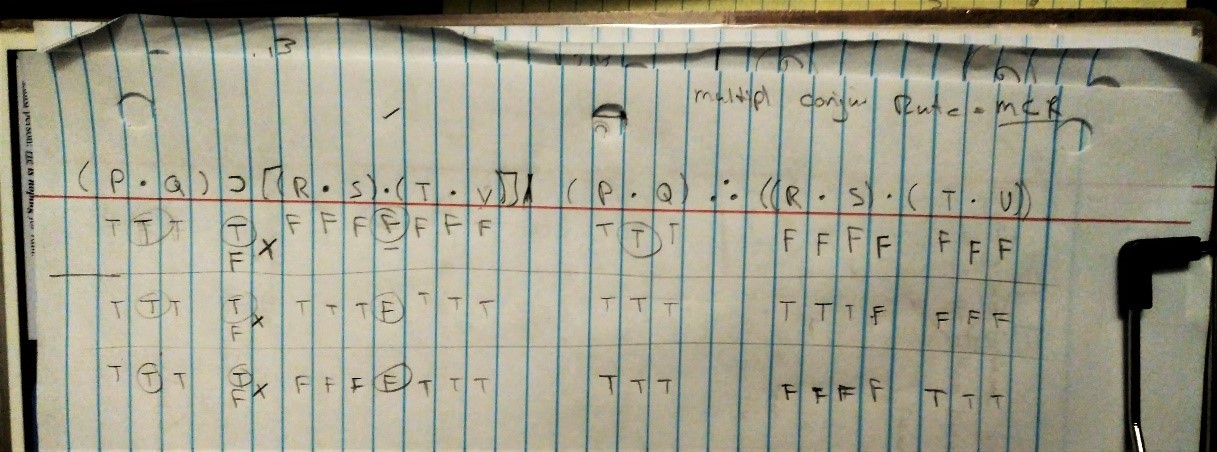
The logical inference is simple. Stating this as a syllogism, (although it is more proper as a propositional argument), we have an A term, B, and a C term. That is, all (A) is (B) and all (B) is (C).  The difference with this and the typical syllogism is the multiple ands or conjunctions.  A simple conjunction is easy to prove with a truth table (see pic below). It does not matter if it is one extra “and,” or “many ands,” the validity will prove to be valid via truth tables—it does not matter if the conjunctions are (p) or (q) or (r). What matters is if all the extra conjunctions terms are true to begin with, which is the foundational issue with all syllogisms.

Instead of making a Natural Deduction or First Order Predicate logic with it—because we know the form is valid—will just put this into a basic Modus Ponens for simplicity sake.  Also, the logical emphasis seems to be on the causality or necessary connection and not merely a categorical inference. It is not merely a sufficient reason, but a necessary ontology to which God insures absolutely.   That is, by God’s causality Person X (A), will “necessarily” receive all the good (C) promised if they love and know Him (B).

Antecedent Premises:

(B) [ if a person loves God] and (C) [ …. know God’s Name]

Consequent premises

 D [then this person is a person God delivers]

and, E [… God protects]

and, F [… God answers]

and, G [… God honors]

and, H [… God satisfies with long life]

and, J [… God shows His salvation]

M.1. IF B & C, THEN necessarily results in D & E & F & G & H & J.
M.2. B & C.
M.3. Thus, D & E & F & G & H & J.

M.1. (B) If a person loves God and (C) knows His name, (D) then God will deliver him, and (E) protect him, and (F) answer him when he prays, and (G) honor him, and (H) will satisfy him with His salvation and  (J) will show him His salvation.
M.2. It is true that I do love God and know His Name.
M.3.  Therefore, God will deliver me, and protect me, and answer me when I pray, and honor me, and will satisfy me with His salvation and God will show me His salvation.

Multi Conju Rule ND

Logic & Scripture: Psalm 46:1-2

Psalm 46:1-2

The categorical reality of not fearing trouble.

God is our refuge and strength, A very present help in trouble.
Therefore we will not fear. NKJV

The NJKV footnotes this phrase “present help,” as an “abundantly available help.” That is, God’s helping his chosen ones is very near and there is an overflowing amount of it.

The syllogism here is a basic E.A.E. or (negative, affirmative, negative) argument. We are told there is a category of people who fear trouble—because they ought to, and because it is proper for them to fear trouble if they are weak and have no one to help them against stronger troubles. However, God’s chosen ones are helped by Almighty God. The God who created the universe in 6 days can help. But more than able to help, the Lord of angel armies has promised to do so for His chosen ones.  His help to them is overflowing and nearby. Since God is the greatest metaphysical and ontological reality, then there is no one, or no thing stronger.  And so, there is no trouble that is greater than God. God at His weakest is stronger than man at his best. God’s Son has already defeated death and sin. Jesus has already make a public spectacle of Satan. In ultimate level ontology the scripture says, all move, live and have their existence in God (Acts 17).

And so, the “middle term,” that separates God’s chosen ones from any fear of any trouble is that God is completely on their side with an abundance of available help for them. One verse that sum this up in another argument, in a much more than form is Romans 5:10). “For since our friendship with God was restored by the death of his Son while we were still his enemies, we will certainly be saved through the life of his Son, (Rom 5:10 NLT).”  Also, “If God is for us, who can ever be against us?  Since he did not spare even his own Son but gave him up for us all, won’t he also give us everything else? Rom 8:31-32 NLT).” This is referring to both spiritual and natural blessings. See James 5:13-15. Also, Jesus in John 14-16 says several of times, to ask for anything in faith and then you receive it. And in other places He says if you ask for a fish, then you get a fish. All the promises are yes and to God’s glory in Jesus, yes, even all those promises in the Psalm (etc.) about God being our help, because the N.T. interrupters them as being so. Also, we have been grafted into the blessing of Abraham (Gat. 3).

This argument is dealing not directly with ethics or axiology—although it is indirectly doing so; rather, it is directly dealing with metaphysics. Salvation and God’s blessings for His children is a sub-category under metaphysics and ontology. It is about how God uses His absolute creation of existence and His absolute control over causality toward this group of people called the chosen ones.

The argument it is not saying you “ought,” not fear; rather, it is stating a categorical reality for God’s children. It is like saying, Lions do not eat stars, and, trees do not use glass to make food. And, God’s children do not fear trouble.

G.1. No [ persons who God is their present help ] are [ those who fear trouble ].
G.2. All [ we ] are [ persons who God is their present help ].
G.3. Thus, No [ we ] are [ those who fear trouble].

Or in plain English. We do not fear trouble.

God’s Will Failed, Because of Non-faith

“But the Pharisees and lawyers rejected the will of God for themselves, not having been baptized by him,” (Luke 7:30).

Sometimes when reading, “faith and or, health and wealth,” preachers I notice their complete lack of talking about God’s power and causality on the ultimate level. This goes so extreme at times it becomes an excommunicable offense. They will say things like “God does not give sickness, “ONLY,” the Devil.” They are referring to passages like Acts 10:38 when Peter said Jesus healed all those oppressed by Satan. This is indeed true; however, it is only regarding relative level ontology, not ultimate level causality. What they have correct is that Jesus mostly speaks on this level. Jesus says if you have faith, then the mountain will OBEY YOU. Your, faith saved you. Your, faith healed you. And let us be honest here, Jesus was and is, more God-centered than you. And he mostly speaks on this relative level ontology.

This divide over what “the Will of God,” means is a similar issue. It can mean 2 things. It either refers to God’s decrees (or causality, either by direct force, or to the ordering of what God causes, i.e. “ontology”) and to what God commands (ethics).  Luke refers to the will of God as His commandments. And let us also be honest again, Luke is also more God-centered than you. Luke is not saying the Sovereign God made a decree and the Pharisees used their own self-existence-power (ontology) and overpowered God’s causality (ontology) on the ultimate level. Rather, Luke is saying God has commanded all to repent and be reconciled to God, but the Pharisees “rejected God’s Command.” Ethics (i.e. God’s Commandments) is especially important because the Bible says so. Thus, talking about, ‘the Will of God,’ as His commands is a common and important part of Christian theology.

Thus, when a faith preacher says, “do not reject God’s Will,” or “do not miss out on God’s Will, by unbelief,” or “you will miss God’s Will,” or “you need to accomplish God’s Will,” he is correct in this. Jesus Christ, the most God-centered man who ever lived, spoke on this (ethics, relative ontology) level more than ultimate causality. Let that sink into your thick skulls.

Pharisees and lawyers rejected the will of God.” Thus, on this level God’s Will Failed, because of unbelief. There is nothing wrong in saying it this way. OR better said, God’s command failed to produce obedience in minds of unbelief.  It is saying the same thing.

I would recommend Vincent Cheung’s essay, “ “Ezekiel 18:23 and 33:11.”[1]

Below is a small excerpt from that essay. Notice the “will of God,” is used differently.

1 Samuel 2:25

His sons, however, did not listen to their father’s rebuke, [precept] for it was the LORD’s will to put them to death. [decree]…

Mark 3:35, For whoever does the will of God, he is my brother and sister and mother. [precept]
1 Peter 3:17, For it is better to suffer for doing good, if that should be God’s will, than for doing evil. [decree][2]

Paraphrasing Mark and Peter with a more direct meaning of the term “will of God.”

Mark, “Whoever obeys God’s commandments is my brother.”

Peter, “It is better if God causes you to suffer for doing good rather than evil.”

Obviously, the doctrine of God’s sovereign causality over all things, and His commandments revealed to man are quite different categories. To make an equivocation here is a huge category fallacy. It would be like saying my invisible thoughts and rocks are the same category; therefore, all rocks are invisible. It would directly violate the basic laws of logic. It would make all inferences from scripture to be invalid.  If categories were to be violated like this, then it would thrust knowledge into skepticism. Yet, skepticism denies the law of non-contradiction. To be true, it must be false.

Look, what happens if we mix categories up?

If God caused(ultimate ontology) the Apostle Thomas to not believe Jesus’ resurrection, then it is right(ethics) for Thomas to not believe what Jesus commanded to.

God did indeed, referring to ultimate level causality, cause Thomas to doubt. However, to infer an ethic from God’s causality like this, is voodoo, witchcraft divination. It is David Hume empiricism in full display.

Or,

“If God caused(ultimate) Elijah to fail 6 times in his prayer (or your prayers) for rain, then it is not God’s Will (ethic) for Elijah to pray for this miracle and receive it (or yours).” Right?

Or,

“If God caused (ultimate) the disciples to not have enough faith to heal the father’s boy (or caused you to), then it is God’s Will (ethic) for God not to heal the boy (or heal you).” Right?

God did cause the disciples to have a lack of faith, in the ultimate sense, but to act like a voodoo witch-doctor and conclude, it must not be God’s Will to heal the boy, is superstitious rebellion, because Jesus turned around and healed the boy anyway.

OR,

“If God caused (ultimate) Satan[3] to temp David to take a census and God caused David’s heart to be weak (ultimate) to this temptation, then it is God’s will (ethic) for David to take it.” Right?

Or,

“If God caused (ultimate) the leaders of Israel to give a bad report of the Promise Land, then it is God’s will (ethic) for them not to take it.” Right?

Or,

“If God said No, and God gave the Canaanite woman a correct theological reason for not answering her prayer, then it is not God’s Will (ethic) to answer her prayer (or yours).” Right?

You realize how dumb that is, right? You realize if the saints in the Bible where to play this witchcraft, empiricist-superstition with God’s Word, they would have never become heroes of faith.

It is always God’s Will to heal, (it is part of the substitutionary atonement of Jesus, Isaiah 53), because it is His standing “commandment.” James 5:14-15, “Are any of you sick? You SHOULD … pray … in the name of the Lord. Such a prayer offered in faith will heal the sick, and the Lord will make you well. And if you have committed any sins, you will be forgiven.”[4] The word “should,” is an ethic. You should or ought to do this or that. Thus, it is the Will of God, for you.

Stop playing satanic witchcraft, and start obeying the Will of God; start accomplishing the Will of God, in your life.


———Endnotes——–

[1] It is also found in his book, “Sermonettes Vol. 8, chapter 4.” 2015. Pg, 22-32.

[2] Vincent Cheung’s essay, “Ezekiel 18:23 and 33:11.” (www.vincentcheung.com). It is also found in his book, “Sermonettes Vol. 8, chapter 4.” 2015. Pg, 22-32.

[3] I am not talking about allowing here, for there is no such thing with God, relative to Him directly causing all things by His own power. There is no such thing as secondary causation, relative to God’s direct causation.

[4] Emphasis added by author.

God’s Revealed Definition for Christians

Leave the Past Behind

(Kenneth Copeland, “Faith to Faith, devotion)

…But this one thing I do, forgetting those things which are behind, and reaching forth unto those things which are before.

– Philippians 3:13

Failures and disappointments. Aches and pains from the past that just won’t seem to go away. Most of us know what it’s like to suffer from them but too few of us know just what to do about them. So we limp along, hoping somehow they’ll magically stop hurting.

But it never happens that way. In fact, the passing of time often leaves us in worse condition—not better. Because, instead of putting those painful failures behind us, we often dwell on them until they become more real to us than the promises of God. We focus on them until we become bogged down in depression, frozen in our tracks by the fear that if we go on, we’ll only fail again.

I used to get caught in that trap a lot. Then one day when I was right in the middle of a bout with depression, the Lord spoke up inside me and said:

Kenneth, your problem is you’re forming your thoughts off the past instead of the future. Don’t do that! Unbelief looks at the past and says, “See, it can’t be done.” But faith looks at the future and says, “It can be done, and according to the promises of God, it is done!” Then putting past failures behind it forever, faith steps out and acts like the victory’s already been won.

If depression has driven you into a spiritual nose dive, break out of it by getting your eyes off the past and onto your future—a future that’s been guaranteed by Christ Jesus through the great and precious promises in His Word.

…Instead of looking behind you and saying, “I can’t,” you’ll begin to look ahead and say, “I can do all things through Christ which strengthens me!”


Oshea

Whether Kenneth knows this or not he is doing fantastic deduction here and avoiding logical superstitions. He puts to shame most of the educated reformed and Christian elites in this one simple devotion.

I will not go long into explaining logic here; however, one or two quick points will be helpful. In logic class or a book on logic, one will soon learn the principle that after one defines a term, they must be consistent to it, or else one will end up in a formal fallacy of a “4 term fallacies,” or informal fallacies such as equivocation.

For example If I say, “ (1) No non-men are smart. (2) All women are non-men. (3) Thus No women are smart.” The issue here is that I changed or equivocated the meaning of non-man (as mankind) from my major premise to just males in the minor premise. By doing this I can make the Bible to superstitiously say whatever I want it to.

Jesus is famous for pointing this issue out in a deduction to the Jewish leaders about the resurrection. Jesus’ deduction hinged on the fact He was consistent with the present tense verb (“I am,” and not I was) in the argument or application of knowledge.

Kenneth correctly points out that past tense, is based off “your” observations. It is merely a descriptive statement about the past. Yet, the promises of God is a truth claim about the present and future.

In other words, saying “[Oshea] is [he who has failed on moral x],” is invalid (equivocation) to say in present or future tense “[Oshea] is [he who will fail on moral x].”

To bring this some context, this is one of the many issues with having empiricism/observation as a starting point for knowledge. To make a statement about past observations to then make a present tense or future tense conclusion is always a logical fallacy; it is always superstitious. To say, “The sun is that which has always risen. The sun is that which as risen today. Thus, the sun will rise tomorrow,” is superstitious nonsense. It is the same as saying, “All trees are organic. Oshea is a tomato. Thus all dogs are clouds.”  Both arguments are making many fallacies, but the biggest issue is the ontological one of “category error.” God’s consistent control over reality stops you from obliviating categories. Example, try saying “I do not exist,” without using your existence? It is ontologically impossible. A radio wave might pass through your desk, but your face is not a radio wave. This is one reason, why you do not slam your face as hard as you can into your desk, because your organic face would not harmlessly pass through it like a radio wave. A radio wave and an organic body are not the same categories.  Past tense is not the same category as future tense. If you do not have the knowledge of future tense given to you up front (as truth), you cannot morph it into the conclusion without being superstitious and irrational.

To put this simply, the problem with saying, “I have failed this many times, thus, I will fail again,” is that you are an empiricist, which is to say, you are an atheist. You are an atheist because your starting point for knowledge is man’s speculations and not with God’s revelation. All the logical irrationality of empiricism is now part of your reasoning. The more foundational issue here is that empiricism contradicts the Scripture as an epistemology. And thus, it is a point of choosing which God will you submit to and worship. Will you submit to God and start with the knowledge He has revealed, or will it be “your” observations (empiricism) and your superstitions (irrational)? Will you be a Christian or will you be an atheist (empiricism).

People often miss these technical points I brought up here, because it involves God’s good promises about aspects of our lives that some are rather emotional about. God’s good promises for overcoming besetting sins, or healing is God’s revealed definition for Christians just as much as this is God’s definition about the weather,  “I will never again destroy all living things. As long as the earth remains… there will be summer and winter, day and night.” ( NLT Ge 8:21–22). This is God’s definition about the earth He created. God’s promises are definitions about His elect. The added layer that sometimes confuses people is the context of relative level ontology. That is, they must believe to receive the completeness of the promises.

Consider the Christians who were sick and dying that Paul mentions in 1 Corinthians 11. Paul said God did this because of the dishonor they were doing to Jesus through the Lord’s supper. Paul also says God killed and made them sick (judged) them so that they would not be eternally condemned with the world. These Corinthians are the righteousness of God, as Paul says in chapter 5. It is a categorical fact by God’s definition and power. However, those who died or were currently sick, failed to fully believe the promise of what this meant. That is, there are some aspects of our being adopted and being made the righteousness of God that is intuitive or automatic to faith when we are born again; however, there are further aspects of growing our faith that is acquire by faith taking hold of the promise through maturity.  Paul’s encouragement was to stop sinning so that they would stop being killed off and made sick by God.  Thus, it was not God’s Will for them to be this way. God’s will is our sanctification, not gross sin. God’s will is for our healing not death and sickness. Christian ethics (i.e. God’s Will for us) is what God commands. This exhortation in James is perfect for them and for any in their shoes, “they will be healed, and they will be forgiven,” (James 5:15). James, as does Isaiah 53 and Psalm 103 and other places, puts the forgiveness of sins and healing together in the same gospel, and same atonement benefit. If you negate one you negate the atonement, for both are produced by the same Jesus in the same atonement. And so, weak faith will lead you to fail in accomplishing God’s will. Weak faith will lead you to fail in aspects of ministry, and so on.

It is odd, when the religious elite Christians mock someone like Kenneth, but when it comes to applying God’s promises and truth to our everyday life, he puts them to shame through fantastic systematic theology, Christian epistemology, logic and application. Kenneth, as least here, leaves empiricism and human superstitions behind and starts with scripture as his epistemology and uses systematic theology, to then validity apply God’s definitions to himself. If he is wrong in other aspects of doctrine, it is correct here.

I will be the first person to happily recommend logic books for any Christian to read, but if after all the book reading and systematic theology you find you cannot believe God’s good promises for your life, you seriously messed up something. You failed Christianity. Faith is God’s love upon a person; it is His public support of a person. God’s good promises, even ones like health and wealth is God’s definition of His children. What good is it, to say you believe in God’s overall sovereignty and truth to define the world, but reject God’s definitions when it comes to you? What a worthless piece of trash. ‘You,’ are ‘you.’ If you reject God’s definition of you, then it matters little that you believe God is truthful when He defines what a dog is. Since you mentally assent God gives a definition of a dog, then maybe that’s why you eat your own vomit of superstitions and speculations, like a dog. As for the rest of us, we will mentally assent to God’s good promises and receive them. Keep your empiricism and atheism to your vomit pit. God’s promises are for me, and I will take them by faith, with or without you, because they are God’s definition over me. God is the all sovereign God, who is able to say, ‘what have you done, why did you make me this way”? God is the Potter and I am the clay, and so, who am I to resist God’s definition over this aspect of reality, called ‘His Elect’?