Category Archives: Uncategorized

Direct and Constant Access to God

Years ago, when I first dove into Vincent Cheung’s commentary on Colossians, it hit me like thunderclap. There I was, flipping through chapter 2, and Vincent further explains what Paul calls “shadows” or “shadow religion”—those rituals, holidays, and sensory crutches that masquerade as piety but throw a veil over the direct, unfiltered access to God that Jesus secured for us. It’s not just ancient Jewish festivals Paul was warning against; Vincent applies it straight to our modern mess, like Christmas trees and Easter bunnies, turning what should be a vibrant, Spirit-drenched faith into a dim echo of the real thing. The church today needs this message hammered home, because we’re no better than those early believers clinging to calendar days, thinking they add something extra when Jesus already delivered the full package. His atonement is finished, His ascension locked in that ongoing ministry of blessings at the Father’s right hand—no bells, no smells, no seasonal vibes required to tap into it. We’ve got it all, right now, if we’d just believe.

In his Commentary on Colossians (2008), Vincent Cheung unpacks Colossians 2:16-17: “These are a shadow of the things that were to come; the reality, however, is found in Christ.” He drives home how Paul is dismantling the Colossian heresy that promised deeper spirituality but delivered nothing but chains. Vincent writes, “The regulations mentioned—’Do not handle! Do not taste! Do not touch!’—refer to things that are all destined to perish with use, because they are based on human commands and teachings. Such regulations indeed have an appearance of wisdom, with their self-imposed worship, their false humility and their harsh treatment of the body, but they lack any value in restraining sensual indulgence” (Colossians 2:21-23). Then he ties it to contemporary traps: “Christian traditions like Christmas or Lent often function the same way, imposing man-made observances that veil the direct reality of Christ. They suggest we need these shadows to approach God, when the substance is already ours in Him.” It’s a reminder that anything sensory—sights, sounds, smells—we lean on to “feel closer” to God is just a step back into the old covenant’s dim previews, when we’ve got the high-definition fulfillment in Jesus.

Paul isn’t mincing words—these observances were pointers, not the point. The reality is Christ, full stop. No more veils, no more middleman rituals. Satan loves these shadows because they distract from the direct line Jesus opened. The church today is starved for this truth—we’re drowning in sensory religion while the Spirit’s river flows untapped, and the word is not believed.

 In a world where barriers seem to define so much of our existence—whether it’s the red tape of bureaucracy, the emotional walls we build in relationships, or even the digital firewalls that guard our online lives—it’s liberating to consider what the Bible teaches about our access to God. This isn’t some distant, occasional privilege reserved for the spiritual elite, like a VIP pass to a concert that only works on special occasions. No, through Jesus Christ, we have direct and constant access to the Father, a reality that reshapes everything from our answered prayers to our eternal confidence. As I reflect on this, I can’t help but think how the faithless complicate what God has made straightforward.

The New Testament paints a vivid picture of this access, rooted in the finished work of Christ. Consider Ephesians 2:18, where Paul declares, “For through him we both have access to the Father by one Spirit.” Here, the apostle is addressing the radical shift brought by Jesus’ death and resurrection, tearing down the dividing wall between Jews and Gentiles, but more broadly, between humanity and God. Before Christ, access was mediated through priests, sacrifices, and the temple veil—a system of shadows that pointed forward but never fully delivered the intimacy we now enjoy. That veil, symbolizing separation due to sin, was literally torn in two at the moment of Jesus’ crucifixion (Matthew 27:51), signaling that the way into the Holy of Holies is now open to all who believe. It’s not a seasonal thing, like waiting for the right festival or the perfect alignment of stars; it’s constant, available at any hour, in any circumstance. Hebrews 4:16 urges us to “approach God’s throne of grace with confidence, so that we may receive mercy and find grace to help us in our time of need.” Boldly! Not with timidity or hesitation, as if we’re crashing a party uninvited. This is the throne room of the universe’s Sovereign, and we’re welcomed as sons and daughters, not strangers.

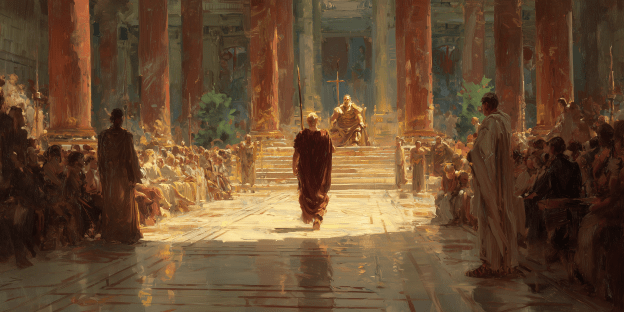
We can approach those ancient throne room doors to God Himself. We can push against them and swing those massive doors wide open. As we look, the middle of the throne room is empty. But off to the sides are angels and other heavenly hosts. They do not stand in the middle, before God, because they don’t have that type of access. But we do. All eyes watch us as we march down the center aisle, with our heads held high. We march in with boldness, as if we are God’s sons, who are co-heirs—not just mere sub-heirs—with Jesus Christ. We walk in with our heads held high, as if we are the very body of Jesus Christ, because we are. We were not first given a specific reason to come in at that moment. But we can anyway, unannounced. We stand before the throne, looking at God face to face, and boldly make our requests known to God. And God gives us what we ask for. God does this because when He sees us, He sees His Son. He thinks we are part of His Son, and God’s thoughts are the only thoughts that matter on the subject. God is correct, and I agree with God. I am part of Jesus and get prayers answered while boldly walking in and asking without hedging. Who am I to disagree with the Power?

To grasp the depth of this, we look back to the Old Testament contrasts that highlight the new covenant’s superiority. In Exodus 19, when God descended on Mount Sinai, the people trembled at a distance, warned not to touch the mountain lest they die. Even Moses, that great mediator, approached with fear and awe. Yet, in the New Testament, we’re invited to draw near without such dread, because Jesus has become our great High Priest who “ever lives to intercede” for us (Hebrews 7:25). This intercession isn’t a barrier; it’s the guarantee of our direct line to the Father. Romans 5:2 echoes this: “through whom we have gained access by faith into this grace in which we now stand.” Notice the present tense—we stand in it now, not sporadically or conditionally. Faith is the key that unlocks this, and as Vincent Cheung aptly notes in his commentary on faith’s role, it provides “unhindered, direct access to God,” serving as proof of our election. We don’t manufacture this access through rituals or good deeds; it’s gifted through Christ’s atonement, where He bore our sins and opened the path once for all.

 In Ephesians 2, it says we’re sitting with Jesus in the heavenly places. Not that we will be one day, but we already are. If you don’t see yourself that way, it’s because you do not believe God’s word and think He is a liar. Repent and start to agree with your Creator. Think about it. At this very moment, when the Father thinks of you, He thinks you are right now seated with Jesus, who sits at His right hand. He never thinks less of you than in that position with Jesus. If you are not experiencing the benefits of being seated with Jesus right now, that’s your fault and unbelief. God thinks you are, and so you are.

Too many Christians treat this access like an old phone line they only pick up in emergencies, crackling with static from doubt or tradition. They pile on layers of “helps,” like special days or sensory aids, thinking it draws them closer, when in reality, it veils the directness Jesus secured. Days like Christmas or Easter, while culturally ingrained, aren’t biblical doctrines, and so they can subtly shift our focus from revelation and the Spirit to a fleshly starting point. The early church faced similar temptations with Jewish festivals, as Paul warns in Colossians 2:16-17: “Therefore do not let anyone judge you by what you eat or drink, or with regard to a religious festival, a New Moon celebration or a Sabbath day. These are a shadow of the things that were to come; the reality, however, is found in Christ.” Shadows! They’re not the substance. The reason a person wants a shadow and not the real thing is because they do not believe the real exists, or worse, they don’t like it. Our access isn’t enhanced by smells of incense or sounds of carols; it’s sustained by the Holy Spirit, who cries out “Abba, Father” within us (Romans 8:15). This reluctance to embrace constant access often stems from unbelief, masquerading as humility. We think, “Who am I to march boldly into God’s presence?” But the Bible flips that: “How dare you not boldly approach, when Christ has paid such a high price?”

Delving deeper into Scripture, Ephesians 3:12 reinforces this boldness: “In him and through faith in him we may approach God with freedom and confidence.” Freedom—that’s the Greek word parrhesia, implying open, unreserved speech, like chatting with a close friend rather than petitioning a distant king. This isn’t license for irreverence, but it shatters any notion of intermittent access. Jesus Himself modeled this in His prayers, addressing the Father intimately, and He invites us to do the same in John 16:26-27: “In that day you will ask in my name. I am not saying that I will ask the Father on your behalf. No, the Father himself loves you because you have loved me and have believed that I came from God.” See that? No middleman needed beyond Christ’s ongoing mediation, which empowers our direct petitions. This ties into our identity as co-heirs with Christ (Romans 8:17), where all things are ours, including this unfettered communion. It’s about asking for wants and getting them, but it also includes all sorts of benefits, such as constant and direct fellowship, where we abide in Him as branches in the vine (John 15:4-5), drawing life, miracles, prosperity, and every sort of favor, moment by moment.

Hebrews 10:19-22 urges, “Therefore, brothers and sisters, since we have confidence to enter the Most Holy Place by the blood of Jesus, by a new and living way opened for us through the curtain, that is, his body… let us draw near to God with a sincere heart and with the full assurance that faith brings.” The “new and living way” isn’t static; it’s dynamic, sustained by faith that actively receives. Unbelief can hinder this, much like the Israelites who limited God by their grumbling (Psalm 78:41). They had manna from heaven, yet craved Egypt’s leeks—a foolish trade. Similarly, if we doubt our access, we forfeit the peace, power, and provision flowing from God’s throne.

“Beloved, now we are children of God… we shall be like Him, for we shall see Him as He is. And everyone who has this hope in Him purifies himself, just as He is pure,” (1 John 3:2-3 NKJV). “Set your mind on things above, not on things on the earth. For you died, and your life is hidden with Christ in God. When Christ who is our life…,” (Colossians 3:2-3 NKJV). We draw strength not from self-effort, but from this constant access, where our seated position in Christ refines us by walking in that position when we ask, receive, and praise God. As we see ourselves better as already seated with Jesus, seeing His rich life pouring into us, the more we purify ourselves. The better we see how awesome we are in Christ and walk in that bold access, the more we have power to walk in purity and holiness. People often try to do the opposite of John’s instruction. The order is to first believe who you are, and the proof that you are believing your identity in Christ is if you can boldly ask and receive miracles, and then by doing this you will purify yourself in holiness.

Imagine waking up, not with a list of rituals to “get right with God,” but with the immediate awareness that the throne room doors are swung wide. You pray for healing, and James 5:15 assures, “The prayer offered in faith will make the sick person well; the Lord will raise them up.” You seek wisdom, and James 1:5 promises generous provision without reproach. Even in trials, like Peter’s denial followed by restoration (John 21), access remains, because our standing is in Christ’s righteousness, not our performance. The callings and gifts of God are irrevocable. God sees you as already righteous without any sinful markings on your record. And what God thinks is the only thinking that matters. This is irrevocable. Your righteousness record is forever. God thinks you are a royal priesthood, now, not later. God thinks you are seated with His Son in the heavenly places. This is irrevocable. It was based on Jesus’ finished work and given freely to you in grace. It has nothing to do with your performance.

Direct and constant access to God isn’t a theological footnote; it’s the heartbeat of the gospel. It mocks the idea that we need additives to spice up our spirituality, reminding us that Christ is sufficient. As we stand in this grace, let’s live it out with the frank boldness it deserves—no more hiding behind shadows when the Light Himself beckons us near. If we’re not experiencing this daily, perhaps it’s time to examine our faith, repent of unbelief, and step into the throne room. After all, the Father isn’t stingy; He’s extravagantly welcoming, eager for our company. In the words of 1 John 5:14-15, “This is the confidence we have in approaching God: that if we ask anything according to his will, he hears us. And if we know that he hears us—whatever we ask—we know that we have what we asked of him.” That’s not wishful thinking; that’s gospel power, yours for the taking. Because God sees us as part of His Son, and thinks the blessing of Abraham already applies to us, “what we want” is the threshold that qualifies as “asking according to His will.” The only time what we want is not God’s will is if it violates a specific command or a word of direction the Spirit spoke to us. Thus, we can always ask in confidence knowing, “what we want” is what we get.

 Faith isn’t waiting around for special days or moods; it’s grabbing hold of the promises now, because Jesus is already interceding with all the good stuff He pledged. Think about it: if the early church got tangled in Jewish Sabbaths thinking it helped their standing, aren’t we doing the same with Christmas carols and advent wreaths? It’s like showing up to a feast with your own sack lunch—you miss the bounty because you’re stuck on shadows. And let’s be frank, if your faith needs twinkly lights to sparkle, maybe it’s time to check if the power’s even plugged in. Imagine trading divine Wi-Fi for a holiday dial-up connection—talk about a spiritual lag!

Shadow religion veils the intellectual, spiritual core of Christianity. It’s empiricism in pious drag, basing faith on feelings and festivities rather than revelation. But Jesus’ high priestly role means constant access—no calendar needed. If we’re born from above, we’re insiders in the Father’s house, with rooms prepared. If your Christmas ham tastes better than the bread of life, you’ve got your feasts mixed up. That’s like preferring MRE meal to a gourmet banquet from the King.

Let’s ditch the veils and live in the full benefits that Christ already won for us—bold, direct access, and miracle-ready. To drive it home, consider the ethical fallout: shadow religion dishonors Christ’s sufficiency. As sons, we’re co-heirs with eternal rooms prepared (John 14:2-3), yet holidays suggest that calendars somehow help us sit closer to Jesus in the heavenly places. However, miracles aren’t holiday perks; they’re gospel proofs. If you tie them to Christmas, you’re unbelieving the very good news that sets us free. If you think miracles happen more around Christmas than from a daily prayer spoken in faith, then maybe check who’s really guiding your sled—your flesh or faith? Santa’s list might be naughty or nice, but God’s access is always “yes” in Christ—no reindeer required.

This delusion of seasonal surges stems from defective anthropology, viewing man as sense-bound rather than Spirit-led and word-based. The gospel tells us we are redeemed, righteous, headed to glory, designed for miracles now. Calendars chain us to the old man; faith unleashes the new creation (2 Corinthians 5:17). Feeling closer via festivities? That’s flesh talking, empirical highs mimicking intimacy. Do you feel distant? That is the chill of a religious shadow, exposing your drift from reality. The cure? Deductive faith in Scripture: Jesus’ finished atonement and our current reality seated with Him means miracles come through faith, not calendar dates.

Two Sides of God’s Unbreakable Coin

Picture this: the gospel is like a coin minted in heaven’s own forge, with two sides that can’t be pried apart without ruining the whole thing. One side gleams with spiritual blessings—the forgiveness of sins, righteousness credited to us, and adoption as God’s sons. But flip it over, and you’ll find the material blessings that flow from the same source: healing for our bodies, provision for our needs, and miracles that shatter the chains of this fallen world. All blessings are spiritual at their core, rooted in God Himself who is Spiritual and Intellectual, and who gives them to us in unmerited favor; however, but some play out in the here and now, touching our flesh and bones. Try to split this coin—to accept the spiritual while rejecting the material—and you’ve got nothing but worthless scraps. No store owner hands out half a coin and calls it currency; it’s illegal, and it’d buy you zilch. God’s gospel works the same way. You take it whole, or you walk away empty-handed.

The Scripture doesn’t mince words on this. From the start, God’s promise to Abraham wasn’t some ethereal whisper about invisible graces alone; it was a bold declaration of overflowing good—health, wealth, fame, and victory over enemies (Genesis 12:2-3). Paul calls this the “gospel” preached in advance, where God justifies the Gentiles by faith and pours out the blessings of Abraham (Galatians 3:8-9). What does that look like? Miracles, the Spirit’s power, and yes, material abundance to fund the kingdom’s advance. Abraham believed God for a son when his body was as good as dead, and that faith unlocked supernatural provision—land, livestock, and descendants as countless as the stars (Romans 4:18-21). No separation there: faith for material blessings brough the adjacent benefit of God declaring him righteous. God didn’t say, “I’ll save your soul, but leave the body to rot.” He promised whole material world blessings, and Abraham grabbed it all, and in return for believing for material blessings God gave him spiritual blessings.

Fast-forward to Jesus’ atonement, the ultimate fulfillment of that promise. Isaiah 53 lays it bare: Christ bore our sins and our sicknesses in one seamless act of substitution. “Surely he took up our pain and bore our suffering… by his wounds we are healed” (Isaiah 53:4-5, NIV). Matthew drives it home, applying this directly to Jesus’ ministry: “He took up our infirmities and bore our diseases” (Matthew 8:17, NIV). The cross wasn’t a pick-and-choose buffet—forgiveness on one plate, healing on another, tucked away for later. No, it’s all one bloody transaction. Jesus swapped our curses for Abraham’s blessings, our poverty for His riches, our sickness for His health (Galatians 3:13-14; 2 Corinthians 8:9). Peter echoes it: “By his wounds you have been healed” (1 Peter 2:24, NIV)—past tense, already done. To slice out healing as “not essential” or “maybe if God wills” is to hack at the atonement itself, and by hacking the atonement you are hacking at Jesus Christ Himself. You can’t gut one benefit without bleeding out the whole gospel.

Look at how the apostles lived it. In Acts 3, Peter grabs a lame man and commands, “In the name of Jesus Christ of Nazareth, walk” (Acts 3:6, NIV). No hedging, no “if it’s God’s will.” The man leaps up, praising God—not because Peter was some super-apostle with special perks, but because faith in Jesus’ name triggered the power. Peter spells it out: “By faith in the name of Jesus, this man whom you see and know was made strong” (Acts 3:16, NIV). Faith flips the switch, and the atonement’s power flows. James doubles down: “The prayer offered in faith will make the sick person well; the Lord will raise them up. And if they have sinned, they will be forgiven” (James 5:15, NIV). Forgiveness and healing, side by side, both on faith’s demand. Deny one, and you’re denying the blood that bought them both. It’s like saying, “I’ll take the salvation, but skip the resurrection”—absurd, and frankly, demonic.

Why the resistance? Tradition’s got its claws in deep, peddling a half-gospel that spiritualizes everything to death, leaving folks limping through life without the material muscle God intended. Cessationists and doubters scoff at healing on demand, calling it “name it and claim it” nonsense, but they’re the ones claiming God’s promises are expired coupons. Jesus warned about this: “Blessed is anyone who does not stumble on account of me” (Matthew 11:6, NIV)—right after listing miracles as proof of His messiahship. Offended by free healing? You’re stumbling over the cornerstone. Paul blasts it in Galatians: anyone preaching a different gospel—say, one without Abraham’s blessings—is accursed (Galatians 1:8-9). And what’s that blessing? The Spirit, miracles, prosperity—all yours through faith, no merit required.

Don’t get me wrong; the gospel’s core is God’s glory, but He glorifies Himself by glorifying us (1 Corinthians 2:7). Predestined for our glory before the world began, the atonement crowns us as co-heirs with Christ. We ask big—healing for cancer, provision for ministries, miracles for the mundane—because that’s how God rolls. It’s not arrogance; it’s obedience. Jesus said, “Ask and it will be given to you” (Matthew 7:7, NIV), and He meant it. Skimp on the material side, and you’re shortchanging the spiritual too. The coin’s whole or worthless.

Picture that coin: one side shines with spiritual riches—righteousness, sanctification, and eternal life—while the other glints with material promises—health, wealth, and peace. Both are inseparable because both flow from the same source: Christ’s finished work. Romans 2:6-7 tells us God will judge and give eternal life to those seeking glory, honor, and immortality, a spiritual blessing with eternal weight. Yet 2 Corinthians 8:9 adds, “For you know the grace of our Lord Jesus Christ, that though He was rich, yet for your sake He became poor, that you through His poverty might become rich.” That’s material abundance tied to the same grace. In my reflections from the website, I note that all blessings are spiritual at their foundation, but some manifest materially—health from His stripes (Isaiah 53:5), provision from His abundance (2 Corinthians 9:8). Split them, and you’ve got a gospel that can’t purchase a thing; it’s no longer the good news it’s meant to be.

This unity hinges on what Jesus did at that specific time and place. His death paid for our sins, His resurrection declared us righteous, and His seating at God’s right hand secured our authority as we are seated with Him, co-heirs with Him and anointed by Him in the baptism of the Spirit (Hebrews 1:3). Every benefit—spiritual or material—springs from this single act. Take healing, for instance. In Mark 6, Jesus calms the storm and feeds the multitudes, expecting faith to normalize the miraculous. If you deny, “on the demand faith for healing as part of the gospel, you’re slicing the gospel coin down the middle. Its worthless and powerless for all things.

Grab the full gospel. Confess your sins and receive forgiveness by faith—then command that sickness to flee, that need to be met. It’s all one atonement, one victory, one unbreakable coin. Split it, and you’ve got nothing but fool’s gold. But take it whole, and watch God multiply it into eternal joy. After all, if faith can toss mountains into the sea, handling a little sickness or lack is child’s play. Let’s live like the heirs we are—no more half-measures.

Now, the religious mind loves to divide this, picking and choosing like a picky eater at a buffet. Some say, “Healing’s not for today,” or “Prosperity’s a distraction,” but that’s like saying half a coin buys a sandwich. Nonsense. The gospel’s integrity demands we receive it whole.

The gospel’s like that coin—two sides, one value. Jesus’ work at Calvary, the empty tomb, and the throne secures it all. Don’t let anyone convince you to trade half for a counterfeit. Embrace the whole—spiritual depth and material abundance—and watch it transform your life. It’s a brilliant future, because God’s promises are yes in Christ. Receive it all, and let’s live like heirs, not beggars. That’s the gospel’s power, undivided and unstoppable.

Grace Didn’t Striptease Me With Future Hope

Ah, that quote from John Newton—it’s got some truth in it, no denying that, but brother, it’s like he’s staring at the rearview mirror while the glory train is blasting full speed ahead.

I am not what I ought to be, I am not what I want to be, I am not what I hope to be in another world; but still I am not what I once used to be, and by the grace of God I am what I am.”

Newton, the old slave trader turned grace-singer, he’s got the humility angle down real, real, real hard. And yes, acknowledging the past mess isn’t wrong, because Scripture tells us to remember where we came from, like Israel recalling Egypt (Deuteronomy 8:2). But here’s the thunderclap: he’s emphasizing the wrong thing. All that “not what I ought, not what I want, not what I hope” drags the soul into a worm-theology pit, focusing on lacks and longs when the New Covenant screams present reality: righteousness, power, miracles, and victory in Christ, right here, right now. Saints, we’re not stumbling in “not yets”; we are already seated with Him in heavenly places (Ephesians 2:6), reigning in life through Jesus (Romans 5:17). G Grace doesn’t just forgive the past, it explodes into now with kingdom dynamite.

First, let’s hit that “I am not what I ought to be.” Newton’s tipping his hat to the ongoing battle, the flesh warring against the spirit (Galatians 5:17), and sure, sanctification’s progressive—we’re working out what God’s worked in (Philippians 2:12-13). Hebrews 10 says God is sanctifying those He has already perfected. Thus,  emphasizing the “not ought” like it’s the headline? That’s missing the plot. The “ought” is already yours positionally in Christ. You’re the righteousness of God in Him (2 Corinthians 5:21), holy and blameless in His sight (Colossians 1:22).

Salvation is not just ethics or future pie-in-the-sky; it’s reality now. God recreated you a new species, a prince of heaven, with diplomatic immunity under the New Covenant (Hebrews 8:8-13). Sickness? Poverty? Defeat? Those are Satan’s ministry and lies. Jesus became sin, sickness, and curse so you could be righteous, healed, and blessed (Galatians 3:13-14; Isaiah 53:4-5). I remember my own pit—depression choking me like a python, suicidal whispers in the night. But the Spirit hit me: “You are a child of God; these things fear you, not the other way around!” And Boom, I received instant healing, and I started declaring promises over “my observations.” This is the Christian ethic, declaring the promises of God and receiving the: not groveling in weakness, but bulldozing Satan’s works with faith confessions. Newton glances at the past change, but he fumbles the lead. Grace makes you what you ought right now, not in some hazy future.

Then there’s “I am not what I want to be.” This one stings if you let it, because who hasn’t wanted more—more faith, more victory? Paul wanted the thorn gone (2 Corinthians 12:7-9), (false super-apostles) but God’s grace was sufficient, turning weakness into power showcase. But again, Newton’s emphasis skews wrong, fixating on the gap when the want is already met in Christ. What do you want? Healing? Prosperity? Power? The covenant guarantees it, because Jesus’ blood activated the last will and testament, depositing Abraham’s blessings into your account (Galatians 3:14; 2 Corinthians 8:9). In systematic theology, I call it over-engineering: grace doesn’t just meet needs; it overflows with miracles. Praying in tongues? That’s the cheat code, building you up (1 Corinthians 14:4), keeping you in love (Jude 1:20-21), and unlocking your wants served on a gold platter. I was a smoldering wick once, wanting joy but drowning in despair. But one-on-one ministry with the Spirit, by praying in tongues and naming-it-claiming-it, and suddenly wants aligned with reality and peace like a river flowed (Mark 11:23). Newton nods to grace making him “what I am,” but he downplays the now. All promises are yes in Christ (2 Corinthians 1:20). Don’t confess lacks; confess all the blessing already yours in Jesus. Sickness knocking? “By His stripes, I am healed!” Poverty lurking? “My God supplies all needs!” That’s the want fulfilled, here and now, not a wish list for glory.

And “I am not what I hope to be in another world.” Here’s where Newton really tips the scale wrong, shoving hope into eschatology like the best is postmortem. Sure, we groan for the resurrection body (Romans 8:23), seeing Him as He is (1 John 3:2). But eschatology is not escapism, it’s expansionism! Jesus is reigning from the throne now, and we’re co-heirs, enforcing His victory (Ephesians 1:19-23). A.D. 70 judgments are past, and Satan’s final smackdown is decreed; but the kingdom’s advancing today through miracles, healings, and power. Hope is not deferred; it’s applied throne-room access. Newton hopes for another world, but Scripture says the world to come is subjected to us now (Hebrews 2:5-8, Eph. 1:19-23, Mark 11:23). What about Miracles? Jesus tells us to prove ourselves His by asking for miracles and getting them (John 15:7-8). I’ve seen sickness flee and fears shatter when I declare faith in His promises. What about tongues and prophecy? Available to those with faith. Don’t park hope in heaven; plant hope for good things down here. God’s power delivered me from demonic terror. Grace didn’t striptease me with future hope; it slammed a victory for me now. Newton’s emphasis delays the party, and that is wrong. Hope does not bring shame because God’s love has already been poured out now (Romans 5:5).

Now, the pivot Newton makes—”still I am not what I once used to be.” This is correct as far as it goes; the past-to-present shift, and it’s not wrong to state it. Remembering the old man keeps gratitude flowing, like Paul recounting his blasphemer days (1 Timothy 1:13-15). Newton went from chains to “Amazing Grace”; I went from wreck to warrior. But even here, don’t linger! The past is crucified (Galatians 2:20). Only God’s thoughts about reality matter, and God thinks my old man is dead. Who am, I that I should disagree with God? We are to focus on the new creation (2 Corinthians 5:17). What about sin’s power? It is Broken. Sickness? It has been crushed at the cross (Matthew 8:16-17). Newton’s right: by grace, we are what we are. But grace isn’t a pat on the back; it’s covenant firepower, sovereign favor molding us into overcomers (Romans 8:37). God boasts about us when faith shines (Hebrews 11), not when we mope in “nots.”

It’s not wrong to nod at the past mess or ongoing chisel, but what about the emphasis? Slam it on present glory. Righteousness: yours now, credited fully. Power: the same power that raised Christ, surging in you (Ephesians 1:19). Miracles? They are normal, commanded by faith. Heal the sick, cast out demons (Mark 16:17-18). Victory? It is both your definition and command to reign in life; dominating circumstances, time, reality. No more worm theology; you are a superior species, a child of God, with bold throne-room access (Hebrews 4:16). Pray in tongues and declare His promises, and by this, let the Spirit minister to you, one-on-one. Newton saw grace change him, but he underplayed the explosion. It is now, by grace. What are you now? Victorious, powerful, miraculous. This is the bible’s focus, and so it will also be ours.

Prosperity: God’s Big Idea

By Oshea Davis 

29, 2025 

Today, let’s start with the prayer of Jabez in 1 Chronicles 4:10: “Jabez cried out to the God of Israel, ‘Oh, that you would bless me and enlarge my territory! Let your hand be with me, and keep me from harm so that I will be free from pain.’ And God granted his request” (NIV). 

Boom—God didn’t rebuke Jabez for asking big; He answered yes. Prosperity isn’t a side hustle; it’s God’s original blueprint, lost in sin, partially restored to Abraham, and fully unleashed in Jesus. And get this: It’s yours by faith, in ways that make reprobates squirm. 

First off, prosperity was God’s idea from the jump—Creation itself screams abundance. Genesis 1:1 kicks off with God crafting a universe teeming with riches: gold in Havilah (Genesis 2:12), fruitful trees, rivers flowing, animals multiplying. He didn’t make a barren wasteland; He engineered a paradise of plenty. He called this overabundance “Good,” and so lack and poverty are “bad.” God didn’t design scarcity and then call it good. No, prosperity reflects His nature—generous, overflowing, unstoppable. He spoke, and wealth materialized: stars for navigation, soil for crops, seas for trade. Creation wasn’t neutral; it was loaded with provision, a divine trust fund for humanity. God likes big—big universes, big blessings, big faith. If you’re thinking small, that’s your human empiricism talking, not God’s Word. 

Enter Adam: God handed him the keys to this prosperous kingdom. Genesis 1:28: “God blessed them and said to them, ‘Be fruitful and increase in number; fill the earth and subdue it. Rule over the fish in the sea and the birds in the sky and over every living creature that moves on the ground.'” Dominion! Adam wasn’t scratching for scraps; he ruled a garden where “gold… and onyx” abounded (Genesis 2:11-12), food grew effortlessly, and work was stewardship, not toil. The Garden was not Adam working to get rich; rather, it was God making Adam rich and then Adam managing this wealth. Eden defines prosperity mainly and directly as very material. However, there are other blessings involved such as authority, relational harmony, physical health. Adam walked with God in opulence, no lack, no limits. This was the original deal: Man as God’s image-bearer, prospering in every sphere because God supplied it all (as per Maxim 13: “God’s unmerited favor supplies man, man does not supply God”). But reprobates twist this, saying wealth corrupts. Nonsense—Adam’s prosperity was pure until sin crashed the party. 

Ah, the Fall—where prosperity got hijacked. Genesis 3:17-19: Cursed ground, thorns, sweat for bread. Adam’s rebellion didn’t just bring spiritual death; it unleashed poverty, sickness, and struggle. The abundant earth turned hostile, mirroring man’s death. Sin didn’t erase God’s prosperous design; it veiled it under a curse. Humanity toiled in lack, empires rose on exploitation, and scarcity became the norm in many places. But here’s the kicker: Even in judgment, God hinted at restoration (Genesis 3:15). Prosperity wasn’t revoked forever; it was postponed for the faithful. Those who peddle “poverty vows” as holiness? They’re glorifying the curse, siding with Satan—the ultimate thief who comes to steal, kill, and destroy (John 10:10). Defective ethics at its worst. 

Then God kickstarts the comeback with Abraham. Genesis 12:2-3: “I will make you into a great nation, and I will bless you; I will make your name great, and you will be a blessing… and all peoples on earth will be blessed through you.” Abraham wasn’t some ascetic monk; he got filthy rich—livestock, silver, gold, king’s ransoms (Genesis 13:2). Why? Faith. He believed God’s promise, and prosperity flowed: land enlargements, victories over kings, supernatural favor. This was a substantial and multifaceted prosperity restoration, even if it wasn’t perfected heaven itself. Thus, even when Abraham faced famines and foes, he still came out victorious and rich. This fallen world, with all its curses and problems, kneeled under the boot of Abraham’s blessing to be prosperous. What God promised Abraham was a down payment, bypassing the curse. Galatians 3:14 calls it “the blessing of Abraham,” including the Spirit and miracles, but don’t sleep on the wealth: Deuteronomy 8:18 echoes it, “It is he who gives you the ability to produce wealth.” God began reversing Adam’s loss through covenant faith, proving prosperity honors Him when rooted in faith. Reprobates who bash “prosperity gospel”? They’re blind to this—Abraham’s blessing was God’s wealth transfer program, started with one man in faith, but completely fulfilled in Christ. 

Fast-forward to Jesus: Full restoration, no holds barred. Galatians 3:13-14: “Christ redeemed us from the curse of the law by becoming a curse for us… so that by faith we might receive the promise of the Spirit.” And that promise? Abraham’s blessing, but amplified through Jesus. Jesus became poor so we could become rich (2 Corinthians 8:9). The context is not spiritual wealth, but filthy money and material riches. He ministered wealth as part of His high-priest gig: righteousness, wealth, and healing. Only God’s thoughts matter. In the mind of God, He thinks the atonement swapped our poverty for Jesus’ riches, our sickness for health, our curse for blessing. Post-resurrection, we’re new creations (2 Corinthians 5:17), seated with Him above lack (Ephesians 2:6). Our Maxim 12 roars: “They financially prosper and are healed by faith in the gospel of Jesus.” In Christ, prosperity isn’t optional—it’s inheritance. Doubt it? You’re limiting God (Psalm 78:41), confessing empiricism instead of God’s word. 

Now, how does God grant this prosperity by faith? Not some cookie-cutter formula but simply believing His Word. First, direct asking in Jesus’ name—John 16:23: “My Father will give you whatever you ask in my name.” Jabez-style: “Enlarge my borders!” Faith confession moves mountains (Mark 11:23), including financial ones. Speak wealth into existence, because reality obeys faith. Second, through wisdom and favor—Proverbs 8:18: “With me are riches and honor.” God gives ideas, opportunities, divine connections (like Abraham’s alliances). Third, sowing and reaping—2 Corinthians 9:6-8: Generous giving multiplies back, not as works, but by God’s promise received by faith. Fourth, miraculous provision—Matthew 17:27: Fish with coins? Why not? It’s available to faith. Agree that God is correct. Assent to God’s promises, act on them, and watch. But beware—unbelief blocks it, like the Israelites’ evil report. Defective faith-fumblers say, “Prosperity’s not for today.” Wrong! It’s for insiders, co-heirs who boldly approach the throne (Hebrews 4:16). If they choose to not see themselves as insiders and not boldly approach and receive, then they must hate their lives. Why join the dead? Why join with the faithless? Why join those who toss away their own lives as trash? 

Reprobates focus on men; but the faithful focus on God (Maxim 14). Chase Him, and wealth chases you. If you are chasing God without healing and prosperity and blessings chasing you, then it means you are chasing God while you disbelieve Him. This is the sad and degrading life of the faithless. Chasing something they hate and distrust. 

In sum, prosperity’s God’s brainchild from Creation, gifted to Adam, snatched by sin, rebooted with Abraham, and maxed out in Christ. Jabez nailed it—ask big, get big. If you’re not prospering, check your faith, not God’s will (see Maxim 19: “God’s Word is His will”). Prosperity is God’s idea, from creation to Abraham and finally in Jesus. When you pray for prosperity you are not asking a reluctant God. You are agreeing with God and receiving what He has already provided. “You have given me wealth in Abraham’s blessing and in Your Son’s atonement, and I agree with you. You are correct. I thank you for prosperity and receive it through the unmerited favor you gave it in.”

I Win No Matter What

I remember Vincent Cheung saying in Blinded by Atheism, “Apologetics is so easy that if it is the main focus of your life and if you become any good at it, you might become disillusioned with boredom and with a lack of purpose.”

He is correct; if you use biblical deductionalism or rationalism. If I choose not to be nice and always take apologetic arguments to the presuppositional level straight away (supposing my opponent even has the intellectual ability to go there), I win no matter what happens. If I stick to the scripture, I win. It doesn’t matter what my opponent says; if they say anything, I win. Even if all they say is the word “as,” I win.

The presuppositional level has to do with your starting point for knowledge and to a larger degree the things you must have in order to have any intelligence. My worldview is not their worldview. My Bible says it is true and all others are false. It says knowledge comes from God, not observation or empiricism. Thus, my worldview disagrees with all other worldviews about the presupposition of knowledge. Because other worldviews always disagree with my worldview about knowledge and the Bible is always right, then any knowledge they use does not come from their worldview, and so they never have logical justification for any knowledge they have. It does not matter if it is their own name, if it is knowledge about a tree, bird, or something abstract like “as,” “the,” or logic, or math; all such knowledge does not come from their worldview. Their worldview has no intelligence, or true or false premises about anything in reality; it has no subjects or predicates; it has no logic or math.

Even if I argue my position in a poor way, I still win. If we consider the worldview argument like a tree, the presuppositional level is the axe laid at the trunk of the tree. Even if I poorly argue for a point and my opponent seems to win a small point, they only manage to save a small twig at the top of the tree. However, one swing with my axe and the whole tree comes down.

If they make any statement about reality, or ask any question about reality or my worldview, I am not allowed to accept it, because the Bible says only it is true, says all others are false, and only it has knowledge. They do not have knowledge, and so they cannot use knowledge to make a statement about anything. If an atheist says rock layers show… (it does not matter what the conclusion is; the important thing is the knowledge of the terms rock and layers), I cannot receive his statement without presupposing his epistemology gives him knowledge. But the Bible clearly says only God gives knowledge; all others are false. If I accept his epistemology gives him the ability to use the terms “rock” and “layers,” then I reject the Bible at the same time because the Bible says only it gives knowledge (via God’s direct power) and all others are false. To use empiricism with my opponent is to reject my God at the same time. To use empiricism is to give the tree trunk to my opponent, so that the very best I can do is cut down some of his worldview branches, because I have now lost the ability to chop down the foundation of his worldview.

I would tell my opponent,

I do not use your epistemology of empiricism, which you used to produce the terms of rock and layers. If you are going to question me using an anti-biblical epistemology (the very thing we disagree about), then the logical burden of proof is on you to justify the knowledge of rock and layers. I admit, if I were to use or assume with you your empiricism, I must also reject my Christianity. But this is the very thing we disagree about, or will you just accept the Bible is the only starting point for knowledge? Because if you do, then I win, and you will be saved. I don’t believe in your worldview. I refuse to go further, because the burden of proof is on you. If you do not have knowledge of rock and layers, it is pointless what the conclusions are. You attacked me with the certainty that you have the knowledge of rocks and layers. I do not believe you. I don’t presuppose your worldview.

Extra Baskets Left Over #4

*70

I remember a guest minister telling a church I was visiting, “Everybody in here can have an airplane.” He heard the people sigh in unbelief, so he said, “Let me ask you this. Does everybody in here have a car?” Most people nodded.

Then he said, “If you can have a car, why can’t you have an airplane?”

Someone responded, “Because we don’t need an airplane.”

He said, “You don’t need a car. You could get a ride every day or catch public transportation.”

His point was that the enemy takes over people’s minds and causes us to think that some things are too lavish or too expensive for us to have. We get into this mindset that says, “Too much wealth and nice things promote avarice or opulence.” But in God’s way of thinking, it’s not enough! God wants you to live on His level. Some people think that a Rolls-Royce is more valuable than they are, so they never see themselves owning one. The truth is that we are far more valuable than an automobile or an airplane. No amount of money could redeem us from sin and death. God had to give the life of His only begotten Son, Jesus. That is a dramatic statement of how valuable your life is.

God said in Isaiah 55:8, “For my thoughts are not your thoughts, neither are your ways my ways, saith the lord.” As I’ve mentioned, the Bible promises, “As he [a man] thinketh in his heart, so is he” (Prov. 23:7). We have to allow God to pull up our level of thinking, as He was doing with me and with our congregation in our new location. Even Jesus’ first miracle in the Bible was a miracle of luxury (turning water into fine wine). God has the very best set aside for us. It is time for the church to move from the place of scarcity and “just enough” into our promised land of more than enough.

A Wealthy Church

Again, the church should be the wealthiest institution, and God’s people should be the wealthiest people, on the face of the earth. Our lifestyles should stagger the imagination of the world. Why? Because we have a larger responsibility than any other people to evangelize the world and complete the assignment God gave [us].

Bill Winston.
Revelation of Royalty. 2021. p. 159 160

——–

Vincent Cheung does a great job in exposing the absolute stupidity in the idea of “need” versus a “want” regarding if our prayers qualify for a yes or no. For example, do you need to live through this day? Really? You could just die and go to heaven. Thus, you don’t really need to even breathe, or need food, clothes or a bed. Such a divide would reduce into a logical absurdity. What you need is what you want, and there is no way around this without jumping into insanity.  

*71  Fountain of Salvation.

In the ultimate sense God is the fountain of salvation. Jesus’ finished atonement creates a fountain of benefits for us to drink from. With this being established, we can affirm there is a fountain of salvation within us.

In Isaiah 12 we are told God is the fountain of salvation and we drink from Him. However, Jesus in John 4:14 furthers this teaching. If we drinks the water, that is salvation from Jesus, this water becomes a fountain of eternal life in them. This fountain of life is not just springing out of God, so that I go to God to draw some out, now it is in “me,” and I draw it from me. Jesus adds more to this by saying in John7:38-39, “Whoever believes in me, as Scripture has said, rivers of living water will flow from within them.” By this he meant the Spirit.” We learn in Acts chapter 1-2 and 19:2-5, that “the Spirit” is not referring to being born-again, but the baptism of Spirit for speaking in tongues, power and miracles. 

By faith we drink God’s fountain of salvation, and then a fountain of eternal life and Spiritual power fountains out of us. We are not a dry place that a demon can inhabit, but a fountain of life and power. We pray in tongues and the Spirit fountains power in our souls, by edifying us and often leading to interpretations and other spiritual powers. When we do this we are drawing from the fountain of salvation from within us. This is the same with forgiveness and being imputed with God’s righteousness. God did not forgive and credit His righteousness to Himself, but us. I am blameless and I am righteous. It is mine. It is my definition and identity. The same for eternal life and spiritual power springing out of myself. It is me. I am this fountain of salvation now. It is my definition and identity.

In that day you will sing:
    “I will praise you, O Lord!
You were angry with me, but not any more.
    Now you comfort me.
2 See, God has come to save me.
    I will trust in him and not be afraid.
The Lord God is my strength and my song;
    he has given me victory.”

3 With joy you will drink deeply
    from the fountain of salvation!
(Isaiah 12:1-3 NLT)

14 but whoever drinks of the water that I shall give him will never thirst. But the water that I shall give him will become in him a fountain of water springing up into everlasting life.”
(John 4:14 NKJV)

*72  I Would Have Given You Even More

“I gave your master’s house to you, and your master’s wives into your arms. I gave you all Israel and Judah. And if all this had been too little, I would have given you even more.”
2 Samuel 12:8 NIV

Look at how giving God is with material things. It is good to ask for such things and God is glad to give. You cannot ask for too much prosperity and happiness in relationships, if you are a Christian. It is not wrong to even ask for an entire nation. God wants to enrich and those who oppose this are against God, His nature and promises.

God’s goodness leads us to repentance. His love constrains us to forsake evil.

The fear of the Lord is the beginning of wisdom and will keep you on the path of wisdom. However, mature wisdom is receiving the good gifts from God.

.. And if all this had been too little, I would have given you even more…

What is amazing about this, is the particular focus on sex. David is being confronted for his sin of adultery. God gave him multiple wives for sex, and then God says, if you wanted even more (sex), I would have given it to you. Of course, today we don’t have multiply wives but a request for good and much sex in marriage is something God wants to give.

*73 falsifiable

In the realm of science, a falsifiable claim is one that can be observed, tested and has the potential to be disproven. 

Some fools claim that we ought to use the standard or epistemology of “falsifiable” as a way to discover biblical truth or Christian truth.  However, is this claim itself falsifiable? But I digress, so that I can address some of the main problems of this standard.

First, the bible does not teach the doctrine that we discover biblical truths by observation and testing it with the potential that it can be disproven. Thus, this standard is an anti-biblical standard. If one uses this to discover truth, then this standard is the person’s first principle of knowledge and not the scripture. They are using something more foundational than the bible and are using it to evaluate the scripture. Also, this presupposes empiricism and observation. But these are both logical fallacies.

Second. The law of contradiction is not falsifiable. You cannot observe it and test it with the potential of it being disproven, because you must use it to deny it. It is self-authenticating in this way. Thus, there is at least one thing that is not falsifiable, and so how many other things are not falsifiable? Thus, the standard of falsifiable is not universal to all knowledge, and this would lead to skepticism if used as a starting point for knowledge or a test for knowledge.

Third. The bible is not falsifiable because you must use the bible to deny the bible. There is no potential for it to be is disprove. It is self-authenticating. How can the bible teach the doctrine of falsifiable as a standard for finding truth, when the bible is not falsifiable? 

Thus, those who use this anti-biblical standard to find truth are to be mocked and dismissed. They do not know what the bible teaches and the do not understand what logic is. Do not let such people be your teachers.

*74

You can’t out extreme Jesus with faith. His teaching is too extreme. Nothing you say about faith can overreach Jesus’ extreme faith doctrine. There is no risk in taking it too far.

Faith for anything anytime anywhere

*75

Jesus who asked the Samaritan woman for a some water, because He was tired and thirsty. And yet, Jesus turns around and says “if you know Who I was and the gift I have, you would ask Me and I would give too.” What a lavish giving our God is. His mission was to serve man like a waiter. Even when He was tired and thirsty He still homed-in on His mission to serve man.

His statement had two parts. The first was “who Jesus was,” and the second was about a “gift” that He was willing to give.  Jesus says He has a gift to give, and so He instructs with the obvious conclusion. “Ask and I will give to you.” The scene started with the woman worried about serving Jesus with some water to drink, but Jesus made the point that He was there to serve and give.

This has some similar instruction as Martha and Marry. We learn it is more blessed to receive than to give, with our relationship with God. Jesus says He has a gift. We do not need to worry  about if it is God will to give or not. Jesus say He has a gift, tells us to ask for it and He will give it.  This is the type of God we have. Jesus says if you have seen Me, you have seen the Father. Our prayers are directed to this type of lavish giving God.

*76  God Is Our Provider Again

In the garden, God was Adam’s source for provision. When Adam sinned God’s curse included this: “Adam, I will not provide for you. You will now provide for yourself with toil.”

In Abraham, God’s gospel included providing abundance for man again. God Himself provides wealth. God becomes man’s rich supply. Jesus’ atonement gives us the blessing of Abraham.

God called creation good, and in this context, God was Adam’s provider.  God provided Adam with a rich supply of material food, goods and land.  Adam did not work to provide for himself, God provided for him. God was humanity’s bread winner.

When Adam sinned, this changed. God cursed Adam with death. This curse included God withdrawing from the position of being Adam’s provider. God told Adam that he will work and with hard toil provide his own supply. What God called good, was now cursed.

This idea might seem strange for some but working to provide for yourself was introduced as a curse. We are always to work, because we are created and commanded by God to do so, but the idea to work in order provide for ourselves was not part of creation. Adam worked in the sense of administering the Garden of Eden, but he did not work to earn his provision.

In God’s promise to Abraham, God begins to restore the natural order of things, by promising to give favor, increase and wealth to him. God begins to be the provider for His chosen ones.  For example, Isaac worked by planting in the waste land, but God gave it a supernatural 100-fold increase, despite the lack of water. This increased Isaac’s wealth.  The king gave Abraham a large sum of money for temporally taking Sarah, thinking she was only his sister. God provided wealth to Abraham, without Abraham working for it. God was Abraham’s bread winner. Abraham believed God would do these good things for him and God declared him righteous.

Some make the mistake in only applying one narrow aspect of the gospel to forgiveness of sin. Jesus gave us Abraham’s blessing, through His atonement. The gospel puts God back in the position of being our bread winner. As in all the blessings of the gospel, to fully enjoy them you must have in faith to receive them. Therefore, we are not to look to our employer as the “source” of our supply and ability to get money. Sadly, many do exactly this and are practical atheists this part of their life and mind.  Knowing the gospel of Abraham gives us the power and favor to gain wealth, even wealth transfers and know Jesus bore our poverty and already gave us His wealth, our eyes ought to be focused on God as our source.

Because our employers are limited, if we see them as our source of money, then our lives will be constrained by their limitations.  However, if we turn to God who has unlimited wealth and power, our ability to gain wealth and have doors opened to us will be as measureless as God’s ability.  God has good things to give, and there is much work to be done in expanding the kingdom of God. A human focus for our provision will greatly diminish our ability to fulfill God’s goals for our lives.

God has become our provider again through Jesus Christ. We must take full advantage of this for our own lives, and to expand the kingdom. We ought to focus on God being our rich provider.

*77

How did sickness come into you? How did it come into the world?

Sickness is not a natural consequence of creation. Adam did not believe God, rather, he believed a lie. He operated in unbelief. God did what He said. He cursed Adam and Eve and creation with death.

Here is the main point. Sickness came by words. Sickness came when God spoke a curse against creation. Sickness is destroyed in the same way, by words. If you look to human means to heal, then human means is all you will be rewarded with, however small it is. By Jesus’ stripes we were healed. This is the foundation; however, we are healed by opening our mouths and commanding the sickness to leave. God spoke the curse of sickness into the world, and we speak to make it leave. Jesus said, “You heal the sick.” You do it. This is why Peter, even after being baptized in the Spirit, spoke words to heal the crippled man in Acts 3. “What I have, I give. In the name of Jesus Christ, “walk.””

Healing will not happen by waiting for “God’s Will.” Healing will not happen by waiting for God to open His mouth and tell the sickness to leave. The reason is simple. Jesus commanded us to open our mouths and do it ourselves. God’s not going to do something He commanded you to do and speak. God’s command for us to do it, is God’s will and decree.

*78

When God called Samson, He needed a person with faith to Judge with superman power, not integrity. We are commanded to strive for integrity, and so we are not diminishing this command. Not only is holiness obedience, it has many blessings attached to it. Having practical righteousness and integrity will make the job easier, with less problems and make it more enjoyable. And Yet, when the one thing that is needed is faith for superman power to kill thousands of men, tear down and carry off city gates and push stone pillars like they were a toothpick, integrity will not accomplish it. It is a different category.

The man with the highest integrity but not enough faith to work superman power is a useless man when God needs faith for miracles.

Jesus said to not begin ministry until the church was endowed with supernatural power by the baptism of the Spirit. Jesus commanded us to heal the sick, cast out demons and throw mountains into the sea. When the situation calls for faith and power, there is no substitute.

Some people say Samson is about not letting your sexual passions overtake you. Even if this can be extracted it is only indirectly. It is not what the story of Samson teaches. It teaches that when power is needed, then only faith to work superman power will get the job done. This is why Samson is a hero of faith.

Some say if you lack integrity you are disqualified. This is true as far as it goes, but it is also misleading. Samson and David, with their big sins, were not disqualified from the gifts and callings on their lives. Even Peter, after playing the harlot of a false teacher for a short time, was not disqualified from his gifts and calling.  And yet, consider the opposite. If any of these men never had the faith to do the miracles needed, then they were disqualified from the start. If Ruth did not have the faith to go to the king and rescue her people, then Mordecai said God would disqualify her and her family.

When God needs miracle power, there is no substitute.

*79

“What do you mean, ‘If I can’?” Jesus asked.

“Anything is possible if a person believes.” (Mark 9:23 NLT)

The father responded in the typical way religious elites and tradition does. “If it is Your Will, and if you Can, Oh Jesus please help.” Jesus was not happy with this reply. Think about that. He was not happy when man put the outcome of a healing on Him, or God. He said, “If you are able to believe, then your boy will be healed.”

Elites put the outcome on God’s power and if it is His will, but Jesus teaches the 180 degree contradiction to this. Jesus puts the responsibility and outcome on a person’s faith

*80

Unbelief is the original matrix. Unbelief is the only real matrix.

Johnny, “Jesus heal me please, if it is your will.

Jesus response, “if it is your will and you have faith then you do it; because I won’t do it. Command the sickness to leave.”

Johnny, “No, its up to You to heal me, if it’s your will.”

The matrix has Johnny enslaved to Satan and to man-centeredness. Johnny is not able to obey Jesus. He can’t hear and believe Jesus’ words.

*81 Jesus Was the Real Victim in this Story

 He said to his disciples, “Why are you so afraid? Do you still have no faith?” (Mark 4:40 NIV)

Jesus told him, “Don’t be afraid; just believe.” (Mark 5:36 NIV)

The saying is true, you are either in faith or fear. Jesus puts these as opposites. He says, “only believe,” with no mixture of fear. He says in Mark 4 that the disciples had fear and zero faith. They don’t mix well. If you have fear in your heart about a sickness, then you realize you don’t have faith. This is how it works.

(Momo, I mean) Jesus was the real victim in this story. He was asleep with His head on a cushion and was woken up for something He expected the disciples to deal with, without disturbing Him. I am not trying to be funny here. It is no joke being woken up from a good nap from something so minor as a deadly storm, which only a little faith could destroy and remove.

The prayers of many people are like the disciples in this story. They pray as if Jesus is teaching that He likes it, if we cry out in fear for His help over something like deadly weather or sickness. People repeat the disciples fearful cry as a model for prayer, when Jesus rebukes it as how not to pray. Jesus was upset with their fearful cries for help. Think about that. Because God is merciful He might answer some fearfully cries of unbelief, but don’t expect it.

The point that made it a bad prayer was no faith. It is ok to ask for Jesus help if you have faith, but here is Jesus’ point. If they had faith, then they did not need to ask for Jesus’ help. That’s how you know you have faith.

 We do not have every lesson Jesus told the disciples at this point, but Jesus’ reaction gives us enough details that He expected them to use their faith, and deal with the situation, without waking Him up.

This also brings up the issue of where the storm came from. Of course in the ultimate level God causes all things, but the bible mostly deals with the human level. Peter in Acts 10:38 said it was not God, but Satan who was victimizing all the people in Israel with sickness and diseases. When Jesus was casting out diseases He was fighting demons, not God, because the sicknesses came from demons not God. When you have an insider relationship with God He relates to you in blessings. The contract in Jesus’ blood stipulates that God only relates to us in blessings (it could include discipline, but not curses). Thus, whether it is a sickness, or a deadly storm, in human level, it was not from God. When you rebuke it, you are not rebuking God but demons and the curse. Jesus teaches us to not tell God about our mountains, or sickness or deadly storm, but to use our faith and we command it to move and die. Jesus has given us the power and authority to do it, and expects us to do something. Don’t wake Him up and tell Him about a storm, when you have the Staff of God in your mouth. Open your mouth. You divide it. You heal it. You cast it out. You calm it.

*82  Jesus Did Not Use Jesus Power

Jesus did ministry as a man born under the law. After His temptation He was filled with the Spirit, and then He started His ministry. Thus, did He cast out demons by His Jesus power? No. He cast out demons by the Spirit of God, not the Son of God power. Jesus said, “if I cast out demons by the Spirit of God, then the kingdom has come upon you.” Moving past the implications that what brings in God’s kingdom is casting out demons and healing the sick, let us just think about Jesus’ point about the Spirit. He cast out demons by the Spirit.

Another example that this power was the Spirit and not His, is how the lady, with the flow blood, took power away from Jesus, without Jesus knowing who it was. The power of the Spirit upon Jesus, acted like a spiritual law, in that anyone with faith who touched Jesus, had the Spirit’s power automatically flow into them for healing. The law is simple. The Spirit was the electricity, and faith is like flipping on a light switch.

 Referring His miracles, Jesus said the Father does the works. In John 14:10-12 the PTP does a good paraphrase translation saying, “Don’t you believe that the Father is living in me and that I am living in the Father? Even my words are not my own but come from my Father, for he lives in me and performs his miracles of power through me.”

The big idea is simple. When Jesus as casting out demons He did it by power of the Spirit. When He healed, did various miracles, such as commanding the storm to calm, the power that caused this to happened was worked by the Father, and not by the Son. Jesus operated as a man. He was given authority by the Father to heal and calm storms, but the power and authority came by the Spirit and the Father.

We do the same. We have the same authority and command. When Jesus told us to speak to our mountains and command them to move, when Jesus told us to heal the sick and cast out demons, He gave us His authority to do it and put His power in us.  Jesus gave us authority to use He name to ask and command whatever we want. This power is God’s power, but it rests in us. When we command a mountain to move, it obeys us, but the power is God’s. God has up His power in us like a flowing river, and has stamped His authority on our tongues. However, God will not move our jaws for us. We must chose to open our months and use the authority and power He has gifted us.

Jesus is now sitting at the right hand of the Power. He uses His own power now. But on earth He did not use His own power. How successful was Jesus miracle working ministry when the power was not His but the Father’s and the Spirit? It was 100%, with the exception of unbelief, such as in His hometown. Some might say, “well it’s not my power, and so it might not happen.” This is nonsense. Jesus never failed to work a miracle, even though it was not His power. He did not fail, because He trusted God and was given the authority to command and work miracles. We are in the same ministry. We are given the same authority. We are in the same position as Jesus.  The only difference is that Jesus said you will do even greater miracles if you believe in Him.

Rejoice, your success for miracles is guaranteed. Open your mouth and command something.

*83   Eschatology In A Nutshell

If someone sums up eschatology without baptism of the Spirit for power, they have no idea what they are talking about.

Acts 1:6-8 NIV. “ Then they gathered around him and asked him, “Lord, are you at this time going to restore the kingdom to Israel?” But you will receive power when the Holy Spirit comes on you; and you will be my witnesses… to the ends of the earth.”

The context is about eschatology. Jesus has sat down on his eternal throne and is ruling. The disciples did what most do, they made eschatology about politics. However, Jesus rebukes them and says eschatology is about being baptized in the Spirit for power and miracles.

The important part to note is that in eschatology the followers made it political and Jesus made it about miracles and the Spirit for power. By making it about politics they made it about man. Religious elites make the baptism of Power belong only to the apostles, and thus they still make it about man. They use religious words, but the result is a man-centred doctrine in what it means to be God-centred. In Peter’s sermon on Pentecost, he made baptism of power about Jesus and His eschatology position, sitting at the right hand of the Power. It had nothing to do with the apostles, thus, the baptism of power still remains, because Jesus still remains at the right hand of the Power. The Power was faithful to His promise to give Jesus the authority to pour out power.

Jesus is still faithful in pouring out power on “all whom the Power calls to Himself,” (Acts 2:39).  The Baptism of power is connected to God predestination of the elect. Peter’s point is not directly about repentance, but baptism of the Spirit and to this Peter directly connects, as many as God calls to Himself. This is why Peter says the gentiles were granted salvation and eternal life when He witnessed them speaking in tongues (Acts 10:44-47). In His Pentecost sermon Peter already said that being baptised in the Spirit is about God calling His predestined ones to Himself. Thus, when Peter saw the gentiles speaking in tongues, and then he told the other disciples, they concluded God elected them to eternal life (11:15-18).  In fact, Peter said because the Spirit was given to them, it was proof they should be baptised in water. And let us not forget that water baptism is a sign that they have died and were raised in new life with Jesus. Speaking tongues was proof they were elected to eternal life.

Peter’s argument for the baptism of power is based on two points. One is the Father being faithful to His promise (2:33) to Jesus, so that Jesus has the authority to pour out power. The second part of the argument is that Jesus is sitting on His throne, at the right hand of the Power (2:31-36). These are the 2 relevant factors, in Peter’s argument, for the conditions in pouring out the baptism of power.  Peter, who is an Apostle, gives no scriptural quotes or logical connections, that the baptism of the Spirit is connected to the apostles. Zero.  What do the religious elites know that Peter did not?

In addition to the Spirit baptism of power, there is the issue of authority. Jesus gave the disciples the authority to heal the sick. In fact, it was a command, because He said, you “heal the sick,” and “cast out demons,” and “preach the gospel.” Then Jesus did the same with 72 others, and so no one can logically say it was only for the apostles. To further insure this, Peter in Acts 3, after commanding a healing, says it was by “faith in Jesus,” and not by the authority of an apostle.  Faith in Jesus is what causes a person to receive salvation, and it is the same faith that commands sickness to leave. It is heavily God-centred. It is not man-centred on the apostles. It is centred on Jesus and His position of authority, while He is sitting at the Father’s right hand.

The next major event after the baptism of the Spirit Acts 3-4, shows how Jesus’ plan for power is how to apply His eschatology.

After being released from prison the Christians got together and prayed. They quoted Psalms 2, a militaristic Psalm, and asked that God would apply this to their situation of government opposition, by healing the sick, miracles and boldness to preach the gospel. God responded back with a resounding Yes.

This is how they applied eschatology. This is how they applied the doctrine that Jesus is on His eternal Throne and rules forever. This is how they applied the doctrine that King Jesus gave them power to advance His Kingdom when they face opposition, even when their enemies use the government to persecute them.

They mentioned 3 things, healing, miracles and bold preaching, in context of eschatology advancement under King Jesus. Many only preach (and they are not even good at that), which is only 1/3rd of the disciples applied eschatology. It is no surprise they fail at kingdom advancement.

*84 Under the Boots of Observation and Emotions

Yank the Redwood of observation out of your own eye before you try to remove the splinter of observation from the eyes of the Word of Faith teachers.

I heard Mark Driscol start a series of sermons about faith and the Spirit. There is an occasional quotable statement, when he slams cessationism, but he is not in a position to criticize them, because Mark rejects the bible with empiricism, observation and emotions just as much as the cessationist do.  The only positive aspect of Mark’s dual epistemology is that he tells you up front he is using observation or emotions as a higher authority over scripture. The cessationists, even if their attempts are bad, try to hide dual epistemologies. They will use the idea of God’s sovereign providence and history, but in reality they are using the logic of induction and relying on the epistemology of empiricism and observation. They use God’s sovereignty, as odd as it sounds, to hide their adultery with human starting points.

In attacking the Word of Faith, Mark says they are wrong because Jesus taught x, y and z from the bible. This is what we would expect if the bible is one’s only starting point for knowledge.  No, what Mark said, was that they are wrong because to tell someone they did not get healed, because they lacked faith, is cruel and hurts people’s emotions. When did emotions become an authority over scripture?  Because you observe x, therefore the bible is wrong. When did this become a standard way to understand the bible? The scripture tells us public knowledge only comes to us by the Scripture, however, our observations can be mistaken, such as in the case with Moab and the blood water. Thus using observation to gain knowledge leads to skepticism, but this leads to denying the law of contradiction, which is self-refuting nonsense. It means observation is a false starting point of knowledge that does not exist.

The other thing Mark said was that Acts was over several years, and so all the miracles you see, really isn’t that many miracles, and so we should not except to see constant miracles. This is a very careless reading of scripture. It is said many miracles were done by the apostles and followers, so that entire crowds were healed, things like napkins were used to healed and they even tried to get healed off Peter’s shadow. Acts was a drive by summary of the miracles, because there was too much to record. Acts starts off with Jesus commanding everyone to get endowed with power to perform miracles, it is connected to Joel’s prophecy that says everyone will be doing miracles.   

Again, what is oddly missing is the Word of Faith’s main passages of Jesus’ extreme faith doctrine. For more see, Vincent Cheung, The Extreme Faith Teacher. These are the main basis for their doctrine of faith. Unless you can bring up those passages and say Jesus was wrong, then the faith teachers are correct for their faith doctrines.

It is wall punching hilarious to see so-called Christians champion themselves as “the bible is my final authority,” and “I am a bible believer,” but every time they find a doctrine they don’t like, they shove the bible under the boots of their human observation and emotions.

*85

No longer have consciousness of sins.” Heb 10:2

 “Go boldly to the throne of grace, that you may obtain mercy and find grace to help you.” Heb. 4:16

Show me a person who is not conscious of their sin, and I will show you a person who “boldly goes to the throne of grace, that they may obtain mercy and find grace to be helped.”

To “boldly” enter God’s throne room, means you are walking with your head held high. Without knocking, you put your hands on the royal doors to God’s throne room, you push them open and march in like you belong there. With other heavenly host, standing to the side, who don’t have the same access that you do, watching you. Then you say, “I need this help,” or “want this thing.” And God says, “You got it. Your faith has helped you.”

There is no way you can do this if you are “conscious” or mindful of your sins. It will not happen. There is no way a sinner can demand help from a holy and righteous God, who demands perfection.  But a righteous person, and person who has a blood contract with God that allows them to ask and receive, is able to demand help and grace.  A person who is mindful of their sins, is a person who does not boldly go to the throne of grace. And if they do ask, they end up not asking, but begging like an outsider, because they are mindful they are indeed a sinful outsider.

What is on repeat in your mind? When you are afraid? When you hurt? When you go to sleep. Are you mindful how righteous you are? Are you mindful you have a contract with God to make demands on Him? Or are you mindful how sinful and pathetic you are?

*86 Two Contracts (Grace and Works)

There are two types of covenants. or contracts God made. One is a contract of blessings based on the law, and but the first contract is based on a one sided promise of God to freely bless.

As Paul says in Galatians, the blessings God gave to Abraham was a one-sided “promise” (Abraham was a sleep) to bless. The law was a contract based on performance. Paul again makes the distinction in Romans 4 that the “promise” was based upon grace, so that it is secured by his chosen ones by faith. In this sense, the law is not based on faith, in and of itself. Because Abraham was first, it cannot be replaced by the works for blessings. Thus, the law (before Jesus) could only be lived by faith, in light of doing it in the hope of the blessings promised to Abraham.

As Vincent pointed out in “The Edge of Glory,” because Abraham was sleeping and it was a one-sided promise of God to do good things, can we still call it a contract? We can call it a covenant, but only in a very lose way. In fact, Paul in Galatians calls it a covenant, chapter 4 when making a contrast to works, but on the other hand, Paul almost exclusively calls what was given to Abraham a promise and grace, rather than a covenant. Even the writer of Hebrews does the same thing in chapter 5.

The law in Jesus was fulfilled and as Paul says it, nailed to the cross, or in modern terms, it was stamped “fulfilled,” filed away in the archive section of God’s documents. Abraham’s promise was not “built” upon through Jesus’ atonement or by His new contract; rather, His atonement, “He became a curse for us so that we have the blessing of Abraham,” ensures we get the promised blessing of Abraham. This is like the bible saying “Jacob shall possess their possessions.” Jesus’ atonement ensures that we possess our Abrahamic processions.

Now in addition the all the goodies promised to Abraham, the very first one-sided promise was to Adam. It was a promise of deliverance. We learn more about what that means, but it centered on forgiveness and righteousness. The atonement of Jesus accomplished both of these promises. It accomplished the promised deliverance and salvation through the gift of righteousness, and it ensures we inherit Abraham’s blessing.

Thus, these two promises are accomplished in Jesus or guaranteed as an ever present action to us. But the covenant of the law and works is not included in this. Only what can be received freely by grace is combined in Jesus’ finished atonement as a contract. It is a contract of grace, not our performance. Because Jesus was our cruse and fulfilled the law, God promises, or makes a contract with us that He will never remember our sins. We receive this promise as grace in faith. The law as a performance, was performed by Jesus for us in our place, and so it was totally finished. It demanded and it was satisfied. In the most loses sense, Jesus performs the work of not remembering our sins, but that is a negative or indirect sense, because the work itself is done. However, the blessing of Abraham is not finished and nailed to the cross or filed away in a drawer. The gift of righteousness and Abraham’s promise, is an everlasting and ever present thought and action of God upon His children. God is directly and always performing this promised love and goodness on us.

*87 Is This the Year of My Blessings?

Is this the year of triple blessing?

Is this the year of rest and acceleration?

Is this the year of restoration?

Is this the year of 7 healings?

Is this the year of double prosperity?

The answer to this is, yes; however, it is only in the sense that every year these already apply, and they already belong to the Christian.

The Christian has inherited the blessing of Abraham, every single year, every day, every minute. They are under the blessing of Abraham by the finished atonement of Jesus Christ. With faith in this truth, any Christian can make it a 100x blessing year, for even that is not enough to describe how much God blessed Abraham in prosperity, fame, military victory, health and favor. Paul argues the blessings (or as Paul calls it the “gospel”) of Abraham means the Spirit and miracles. We get more than 3 miracles. The only limit is your needs, wants and faith to receive them.

Some ministries are looking for hype and extra offerings, but there is nothing wrong for a pastor asking God and looking for a “theme of the year.” If it is a pastor, and God did answer their prayer, then such a theme is for the “members” of their local church and not for everyone else. The question now is this, is it wrong for someone to claim this for themselves if they are not part of this local church? No.

But remember, although, because of our weak faith, having a theme and focus might be helpful to a certain extent, we must strive for maturity. By faith in God’s promises all these declarations and themes are yours by right, through Jesus Christ. They are yours through Jesus’ finished work for you. They already belong to you. They are already your identity and definition. You do not need another mediator, or pastor, or ministry to make your definition in Jesus more real. You do not need a mediator to bring you directly to God. You do not need a pastor to bring you to your blessings given to you by Jesus. You already have direct and immediate access to God in Jesus. The blessing of Abraham is already yours. God gave it to you in Jesus and no man can mediate this blessing from God to you. You already own it, and you have access to it by faith. Let no one replace, the direct access you have with God and with your blessing of Abraham, with any man or thing.

Rejoice. Hold your head up high. With faith, all these good things are yours for the taking. With faith, every year is the blessing of Abraham that causes you to reap 100-fold.

*88 He Gives New Strength

He gives strength to the weary
and increases the power of the weak
.”
 Isaiah 40:29 (NIV)


Even after being born from above, we can still get weary and weak. This isn’t because God withholds these things from us, leading us to beg for strength that isn’t part of our DNA or inheritance. Through Jesus’ finished atonement, we already have power and strength.

Because of our imperfections and immaturity, we can become weary, making it right to ask for new strength. God wants to supply our needs. It is His delight to hear our cries for help. God loves us and has promised to help, but we ask from a position of victory. Strength is ours through Jesus’ atonement; it’s our definition. Paul doesn’t say to ask for God’s armour or ask to walk in His power; he says to put on the armour because you already have access to it, and to walk in the power because you already possess it. You already have God’s old strength, but you must take responsibility to put it on and use it. Ask for God’s help, but also use the power God has already given you.

Satan wants you to fight for new strength on the wrong hill, making it seem like you must ask and beg for it. He wants to put new strength behind a paywall of, striving, doing and begging. He wants you to view your identity as lacking this strength, pushing you to strive from a position of not having. This is the wrong hill to fight on. This is a lie from the pits of hell.

God’s shield of protection and favor is already surrounding you; the mighty sword of the Spirit (praying in tongues) is already in your hand. You have power; release it. The authority to use Jesus’ name for anything is already branded on your tongue. Open your mouth and use that authority.

*89 Jesus’ New Deal

In the story of Job, Satan brought all the sickness, destruction, and troubles. Jesus says the devil comes to steal, kill, and destroy. Peter in Acts 10:38 states that all the people Jesus healed (thousands) were victimized by Satan. Consider how Peter assumes these sicknesses were caused by Satan, not just from Adam’s fall. Jesus also said Satan bound a “daughter of Abraham” for 18 years—Satan, not God, bound one of God’s daughters.

Back to Job: Job’s understanding of God improved not because of his suffering, but because God revealed truth to him. God had to step in and drop some knowledge bombs. Satan’s torture? Yeah, it didn’t teach Job jack; it just made him listen up when God finally spoke. Experience is the worst teacher, and God’s word is only teacher.

In the new deal with Jesus, we’re supposed to get the good stuff, healing, and blessings, not Satan’s new green deal. We’re God’s kids now, not his punching bags. In our Contract with Jesus, God promises only good. We’re promised insider status as children. God might give you a slap on the wrist, but he’s not out here causing your misery. He teaches by writing His laws on our hearts and the Spirit opening our minds to His truth. Even when Paul throws some dude to Satan, it’s Satan doing the dirty work, not God. God promises “only good” in the Contract. If Jesus administers suffering, He would be a minister of death, diseases and pain. That’s Satan’s priesthood, not Jesus’.

This is the problem with those who focus on suffering and sickness. You’re saying Satan’s your professor in the school of hard knocks. Your knowledge? It’s just from getting your butt kicked, not from the holy book. And you’re giving Jesus Satan’s job title.

*90 The Land of the Word


Canaan is the land of the Word and promise.
The sands of Paran are the land of observations and experts.


If you want the milk and honey, you must believe the Words and Promises of God. Unbelief will disqualify you from entering. If you decide what is reality for you—in categories like health, wealth, family, and various miracles—based on what you see, hear, experiment, observe, or on the words of other men, such as doctors, then you become an abomination to God.

The Israelites did not lie when they said they saw giants and felt small compared to them. But God cursed and rejected them for truthfully reporting what they saw. Their expert trackers and scouts did not lie when they delivered their findings, but God hated them for their truthful report based on their senses, observations, experts, and experiments. And God will reject you if you do the same. The Promised Land can only be entered by those who reject their observations and experts and affirm that God’s Word is truthful, despite what they see. The only way to honor and glorify God as the true God is to confess and believe what He says over what you see and what the experts say.

It is the same today. When Jesus came down from the mountain after His meeting with God (like Moses), He rebuked the disciples as spiritual perverts for not having enough faith to cast out a demon. The demon was causing the boy to scream and twist on the ground. These loud sensations caused the disciples to doubt, and Jesus was not happy. He expects us to believe, even when there is much carnal stimulation and even when many voices—like doctors or experts—say there is no way out.

*91 Thorn In My Mind

All humans have sinned.
I am a human.
Thus, I have sinned.

This is a correct way to apply knowledge from the bible to yourself. To say monkeys have sinned is a false way to apply this knowledge. Monkeys are not humans. It is a category error. However, imagine me forwarding such a dumb argument? I would be mocked, and for good reason.

[However to say I have sinned is faith. It is an deductive syllogistic application of the truth to me. This is why the word for ‘faith’ interchangeable with the words for syllogism or deductive logic or rational, or logic.]

And yet Christians do the same with Paul’s throne in the flesh. It was only given to him because of the abundance of supernatural revelations, visions and trances. The messenger of Satan was given to Paul to keep him humble. And yet, a Christian will say, “I’m like Paul, with this thorn of cancer in my flesh.” However, they haven’t had one vision or revelation, let alone a super abundance of them. Their category lunacy is not less than saying “chickens have sinned, because all humans have sinned.” People who forward such silly arguments have put thrones into their own minds.

This is beside the point, the thorn in his side are false super apostles attacking his children with false doctrine.

*92  I Give What I have

“What “I” do have “I” give you. In the name of Jesus Christ of Nazareth, walk.” Acts 3:7

Although God, out of compassion and sovereign bulldozing, will still heal; yet, in the larger picture, God is not healing, because He has commanded us to heal the sick. Peter shows what this means. He said something that would get him called a heretic by most churches. He said what “he” has “he” gives, which is the name of Jesus to heal. Peter has the name of Jesus to heal.

Thus, God did not heal the man, but Peter using God’s power (and the man’s faith) that healed the man. Acts 9 shows something similar. We have been commanded to be baptized in the Spirit for power (Acts 1-2), and given Jesus’ name to ask for anything we want -John 14-16).

Thus, just as God told Moses to use the Staff to divide the sea, we have also been given the Staff of God and commanded to heal the sick. If people are not being healed it is not God who is holding it back, but people not obeying and not believing. You cannot blame God for something that He has already given to you and commanded you to do.

*93

Job didn’t have a contract with God as we do. However, in this story Satan gives Job sickness and poverty and God gives him double wealth and health (James calls this God’s mercy) and yet the conclusion is that Satan gives us wealth and health, and God gives us sickness and poverty?

I have never understood the use of this story to teach the opposite. So, I guess the story of God creating the earth means God did not create the earth?

*94 Sad Sob Story.

When the gentile woman told Jesus about the sad sob story of her demon possessed daughter, it did not move Jesus Christ to heal her daughter. The woman begged, “please help me.” And yet this did not move Jesus Christ to heal her daughter.

What did move Jesus to heal? It was the greatest and rarest thing found on earth. A person who has faith in God. Faith is what finally moved Jesus to heal her daughter.

It’s not a sad story or begging that will move God. It is faith that God will be faithful to His promises to give you what you ask. You can do the same.

“Who Touched Me?”

Faith will cause God to focus on you when there are millions trying to get His attention. They might be pressed up against Jesus, but He will bypass them all and focus on you if you have faith.

It was not compassion; it was not a sad sob story or begging that got Jesus’ full attention. It was faith that God will help and give a miracle of healing. He will do the same if you have faith for a miracle. He will give you His undivided attention and power.

Upgrade!

When the Roman centurion received an upgraded miracle to the one Jesus was already was giving him, it was not a sad sob story or begging that produced the upgrade. It was faith. It was absolute confidence that Jesus ordered reality like a general ordering men below him. And because he was asking with such confidence, he presupposed Jesus was willing.

This was the type of faith that caused miracles to be upgraded to a bigger miracle. It is not begging or trying to impress on Jesus how awful your circumstance is. It is faith.

*95 Slapping Falsification on it

Science commits a triple logical fallacy with empiricism, observation and scientific experimentation (affirming the consequent). Slapping an unsound use of falsification at the end does not make it rational. Science violates the law of contradiction (because it leads to skepticism) and identity (this happens multiple times). The epistemology of science is empiricism, but this foundation is a systematic denial of the laws of contradiction and identity. Induction and observation violate the laws of contradiction and identity. The very conception of induction is a violation of the law of identity. It is anti-logic

However, Jesus is the logic and appeals to the law of contradiction in Mark 12:35-37. Jesus is the law of contradiction. To say science gives any premise about anything is to violate Jesus who is the Logos. You must pick to either murder science or logic, or that you must either murder science or Jesus. Science has no justification for any statement about reality. Science is not knowledge. When used to produce a premise about reality, it is to be mocked and dismissed. Science is a group of people and nothing more.


You Are A Child Of The Devil And An Enemy

Ques: “How do new covenant Christians understand and apply psalms 139:21

Ans:

2 Timothy 4:14, Paul says, “Alexander the coppersmith did me much harm; the Lord will repay him according to his deeds.”

Acts 5:5-6 “You have not lied to men but to God.” 5 And as he heard these words, Ananias fell down and breathed his las\

Acts 13: 9-11, “Then Saul, who was also called Paul, filled with the Holy Spirit, looked straight at Elymas and said, “You are a child of the devil and an enemy of everything that is right! You are full of all kinds of deceit and trickery. Will you never stop perverting the right ways of the Lord?  Now the hand of the Lord is against you. You are going to be blind for a time, not even able to see the light of the sun.” Immediately mist and darkness came over him, and he groped about, seeking someone to lead him by the hand.”

Paul cursing Elymas (Acts 13:9-11), Peter’s confrontation with Ananias (Acts 5:5-6), and Paul’s prayer about Alexander (2 Timothy 4:14)—illustrate that the early church didn’t shy away from invoking divine judgment against those who blasphemed the Spirit or hindered the ministry of the Word. Jesus’ own words in Mark 3:29 about the unforgivable sin of blaspheming the Holy Spirit reinforce this. These aren’t personal vendettas; they’re responses to direct attacks on God’s kingdom and mission. This shows us the imprecatory Psalms also apply to the church after the resurrection of Jesus and Him baptizing us with power.

The context is not about personal pet-peeves or personal hurts. When it comes to believers we are called to love and forgive each other as we have been forgiven in Jesus Christ. We are commanded to be long-suffering. We’re commanded to love our enemies (Matthew 5:44) and forgive as Christ forgave us (Colossians 3:13).

However, the bible, even in the New Testament has a special place for those harming the church, and those directly hindering the ministry of the word and hindering or opposing the power of the Holy Spirit. In fact, Jesus goes out of His way to say those who blaspheme the Spirit will never be forgiven. If God will not forgive them, then I do not forgive either. Who am I to resist God? This would even have some application to governments, but because most Christians lose their minds over the subject I will reframe from this topic. I will only make one quick point. In chapter 4 the disciples ask for God to empower them to fight back at the Jewish government, who were trying to persecute them, by bold preaching, healing and various miracles. God approved of their request. One such miracle was an earthquake that broke prison doors. It damaged government property. The church ought to call on God to act against opposition to the gospel.

There are other ways to apply this, but I wanted to keep it short and on the applicable issue. Paul caused physical harm to a person hindering the gospel and called him cruel names. The Holy Spirit was the power that blinded the man, but Paul is the one who pointed the gun at the person and commanded the blindness, not God. Peter, by the Spirit, killed two people, in church. Paul prays, saying God will repay the coppersmith the harm he caused him in ministry.

Remember the Psalm you quoted? David loves God. Psalm 139 is a deeply personal psalm where David marvels at God’s omniscience, omnipresence, and intimate care for him. Verse 21 arises in this context—David’s zeal for God leads him to despise those who despise the Lord. Then says these wicked people mis-use God’s name. In essence, David hates them, because they hate the God who David admires so much. It is fake love if you are not enraged at someone who hates and targets the object of your love. Imagine a parent who shows no concern when a person hits and abuses their child? You must have the same outrage over people who hate the God, you say you love so much.

In short: Psalm 139:21 calls us to love God so fiercely that we hate what opposes Him. The New Testament examples teach us to channel this anger by prayer and through the Spirit’s power, not our own hands. We forgive personal wrongs but stand firm against assaults on God’s kingdom. Because most do not have power or faith to get their prayers answered, they are left with two bad options. Just do nothing and make kindness your official religion, or become a political zealot. Neither is the way commanded in the book of Acts. When all you have is human power, your options are limited to carnal outcomes. But if you have faith and the Spirit, a whole new world of possibilities opens.

[Grok xAi, aided in some summaries]

The Demand For Observation Is A Sign of God’s Judgment

To demand empirical and observational proof of miracles to produce knowledge that expansionism is false or true, has all the logical fallacies associated with empiricism, observation and induction.

If this is used as a personal attack against me, then it is a logically irrelevant point. It is a pointless argument for pointless people.

The first issue is that scripture was not used as an epistemology.

2 Kings 3:16-24 shows an infallible testimony that empiricism and observations and inductions from this are not always correct. This would lead to skepticism. I know that I don’t know. But skepticism denies the law of contradiction that is self-authenticating and which Jesus also appealed to. Elijah made an attack against God that went like this, “I observe no one else who believes but me, therefore, no one else believes but me.” God rebuked him and said there was 7000 more according to His election and grace. Elijah had to dismiss his observation and induction, and believe there were 7000 because God said so. Thus, our observations are not always correct and thus they produce no knowledge about anything. To say observation produces any knowledge would be a violation of the law of contradiction. To be true, it would have to be false at the same time.  

Some see the insanity of this, and so do not apply it to things such as forgiveness of sin. For example, I have never seen forgiveness. I have never seen Jesus Christ. Thus, I cannot believe my sins are forgiven based on observation, I believe it because the Scripture tells me so. Abraham observed that Sarah and himself were not able to have a child. God’s promise contradicted his observations. If observation produces knowledge then Abraham should not have believed God’s promise.  

The second issue is that empiricism and observation are used as starting points for knowledge. Thus, we have different worldviews. Any attack using empiricism or observation is no longer about the fine details of theology; rather, this is now an apologetic attack.  We deal with such as we deal with atheists. Our epistemology does not include empiricism, nor does it allow inductive based arguments to prove or disprove the scripture (Rom.11:3, 2 Kings 3:16-24). We do not allow them to speak one word against us until they prove their anti-scriptural epistemology, gives them knowledge. If their epistemology does not allow them the possibility of knowledge, then they cannot use knowledge to demand anything from us.

However, another issue has to do with the logical fallacy of public knowledge versus private knowledge. To say public knowledge and private knowledge are the same thing, is to violate the laws of contradiction and identity. It is like saying grace and works are interchangeable. The demand for observational experience, even if possible, would only result in private knowledge and if this private knowledge is then used in a public forum to produce public knowledge that a doctrine is wrong, then it is a fallacy which violated the laws of logic. Even if I could be transported by the Spirit to 100 million locations around the world showing me various Christians performing many miracles, it still would only amount to private knowledge, and so unusable as a public truth claim. Thus, the demand for observational proof is a demand that makes any public truth claim impossible. This is a maneuver from an opponent to frame a debate against a Christian to make it impossible for them to prove anything.

Also, observation already makes man the starting point for knowledge, and this feeds into more and more human focus. Example, how does one determine how much miracles and resurrection need to take place for expansionism to be true or false? Is it a 5% increase or 77% increase? With which miracles does this apply? Who and how is this determined? Over how much time would this increase need to take place? Who and how is this determined? If man, then man is the starting point for knowledge, not the bible. Also, how many Christians need to be observed to determine this? All or just a sample size? Who and how is this determined? Is it just Christians right now, or do we include the past and present? If the past and future need to be observed to determine if the increases has happened, then how does one observe the past and future? Who and how is this determined? What counts as an observation? Is it only what I see, or do I count the observations of others, which I did not observe? If I accept observations that I did not see, then observation is no longer my epistemology. Who and how is this determined? I could go on and on with this for pages and pages. Another big issue with all of this is that God and the scripture are nowhere to be seen.

This also shows another reason why I left the Reformed world. Even the best trained Gordon Clark students revert to induction when faced with doctrines of faith and the Spirit.

Most Reformed material contains inductive arguments against faith, and so it is habitually trained into the mind for its practitioners. Thus, even if a reformed person reads Clark and agrees with logic and deduction, and is against observation and induction, they will still use observation and induction against faith doctrines. They are too intellectually malfunctioned to apply logic. Logic is wasted on them.

As Andrew Wommack says, “some people have decided not to let Scripture get in the way of them believing what they see and feel.”

God’s promise for the Elect is that He causes them to believe His word. When a so-called Christian uses observations as an epistemology to produce knowledge it is a sign of God’s judgement and reprobation. We pray they will repent and enjoy God’s good promises; however, their demand for us to use an anti-Christian epistemology is an attack at the foundation of our worldview.

Jesus Expects Us to Have No Fear about Life

When Jesus said to Jairus, “Do not fear, only believe,” it was said regarding a supernatural miracle of resurrection. The passage says, “While he was still speaking to her, messengers arrived from the home of Jairus, the leader of the synagogue. They told him, “Your daughter is dead. There’s no use troubling the Teacher now.” But Jesus overheard them and said to Jairus, “Don’t be afraid. Just have faith.”” (Mark 5:35-36 NLT).

The man was just told his daughter was dead, and Jesus’ tells him not to be afraid, not even a little bit, but “only,” have faith in God.  If I said this to a parent who just lost their child, they would call me uncaring and a jerk; yet, this is how Jesus expects us to view such a situation. It is this same Jesus who will judge us all one day. This is a good example because this is one of the worst types of life troubles we can face, the death of a child, or a spouse or parent. Since Jesus is applying this teaching to the worst type of life troubles, then we obviously can apply it to lesser troubles.

Let us quickly address the point of “just have faith.” Jesus is not saying have faith in God like a fatalist. He is not saying to just have faith in the broad idea that God is sovereign and just go with the flow like a fatalist. No, Jesus is not telling us to abuse God’s sovereignty like that. Rather, He is telling Jairus, do not fear, because your faith in God will lead to a supernatural resurrection of your daughter. Why be afraid by the death of a child, if they will be resurrected? Obviously there is no fear of a child’s death if the death is overpowered by resurrection. Obviously, there is no fear of cancer if it is healed.  Obviously, there is no fear of Jesus paying the temple tax if he can just get the money from a random mouth of a fish.

Jesus is talking about faith in a supernatural miracle for specific trouble you need help with. Not human help, but God’s miracle help.

Jesus’ reasoning for why we should have no fear and only faith, is because miracles make the troubles of life go away. Jesus expects us to view life in this way. No wonder the religious elites hated Jesus, He was a miracle and faith fanatic.

Jesus’ presupposition is that with faith in God we do not fear life’s troubles, because God will destroy the troubles with supernatural power.

In the finished atonement, Jesus has already forgiven us, has given us His righteousness, already healed us, already exchanged our curses for the blessing of Abraham, and already exchanged our poverty for His riches. This is already about new creation, new reality, and identity. We are this right now.

Thus, what you believe God will do for you, God will do for you. The supply for all these supernatural miracles have already been laid up for you. Jesus said “only believe.” Thus, if Jairus stopped believing and gave into fear over his child’s death, thinking, “there is no more hope, and I will just go with whatever God sovereignly caused,” then that is what God would give him, no hope. But because He believed God could help with miracle power, even in the death of his child, then that is what Jesus gave him.

As Vincent Cheung said in his essay (Faith is The Answer), “God wants us to live life thinking that there is no reason to fear, but that we should have faith only. God wants us to live life thinking that all things are possible to the one who has faith… You are never a victim. You are never limited. You are never doomed. You are never desperate. You are never alone. God will come to you. God will answer you. God will rescue you. God will heal you and prosper you. God will increase your spiritual power and fruit. God is the answer to all your problems. And beyond your problems, God will give you the desires of your heart. How can you know? Faith! The faith in your heart is God’s answer.”

Sit At My Right Hand

Peter in Acts 2, during his Pentecost sermon mentions a few time this idea of “Jesus sitting at the right hand of the Father.” Many people saw them speaking in tongues and wanted to know what is going on. And so, Peter’s main point is about the outpouring of the Holy Spirit.  Thus, the doctrine of Jesus sitting on His eternal throne at the Father’s right hand is being connected with the baptism of the Spirit.

Peter mentions Psalm 16 and 110, which both speak of Jesus sitting at God’s right hand, as connected to Him pouring out the Spirit. Acts 2:33 “Therefore having been exalted to the right hand of God, and having received from the Father the promise of the Holy Spirit, He has poured out this which you both see and hear.”

The Father promised Jesus a reward for completing the work He assigned Him on earth. This reward was Jesus ruling in authority from the Father’s right hand. Jesus would sit on the throne that He will be ruling from forever. From this position, Jesus was promised He could pour out the baptism of the Spirit on all those who call on the name of the Lord to be saved (Joel,  2:28-32). Peter quotes Joel teaching us that this is the age designated for anyone to call on the name of God to be saved and that He Spirit will be poured out for power. This happened because Jesus is now sitting on His eternal throne of power at the right hand of Power. From here Jesus pours out Power on all who ask.

The interesting point is Peter’s quote of Psalm 110. Peter directly connects this Psalm to Jesus pouring out the Spirit, as Jesus sits at God’s right hand.

“Exalted to the right hand of God, he has received from the Father the promised Holy Spirit and has poured out what you now see and hear. For David did not ascend to heaven, and yet he said, “”The Lord said to my Lord: “Sit at my right hand until I make your enemies a footstool for your feet,”” (Acts 2:33-35).

Peter quotes from this Psalm Jesus sitting at God’s right hand and Jesus’ enemies being made a footstool under Him. And this is in direct context with Jesus pouring the baptism of the Spirit, from God’s right hand. The Psalm goes on to say Jesus will rule over His enemies, crush them and pile up their corpses. Peter says this is connected to Jesus pouring out the baptism of the Spirit.

How is Jesus enemies going to be a footstool? Peter says it is directly connected to Jesus pouring out the Spirit on His people to empower them over sickness, demons, mountains and even other men (Paul and the Proconsul).

It is foolish to have any talk of eschatology and the advancement of the church over the gates of hell and human governments without this most basic teaching from Peter. Without this all talks of eschatology and governments is anti-Christian; it is anti-Jesus sitting at the right hand of His Father.