
“All things are yours, whether Paul or Apollos or Cephas or the world or life or death or the present or the future—all are yours, and you are of Christ, and Christ is of God.”
(1 Corinthians 3:21:23 NIV)
They were all baptized into Moses in the cloud and in the sea. 3 They all ate the same spiritual food 4 and drank the same spiritual drink; for they drank from the spiritual rock that accompanied them, and that rock was Christ. … 6 Now these things occurred as examples to keep us from setting our hearts on evil things as they did. … 11 These things happened to them as examples and were written down as warnings for us, on whom the culmination of the ages has come.”
( 1 Corinthians 10:3-4,6,11 NIV)
“And the prayer offered in faith will save the one who is sick, and the Lord will raise him up, and if he has committed sins, they will be forgiven him… The effective prayer of a righteous man can accomplish much. Elijah was a man with a nature like ours, and he prayed earnestly that it would not rain, and it did not rain on the earth for three years and six months. Then he prayed again, and the sky gave rain and the earth produced its fruit.”
(James 5:15-18)
As Vincent Cheung points out in “All Things Are Yours,” the bible moralizes itself. We use the word “moralize” to mean a deductive application of the truth and promises to oneself. The bible moralizes Elijah prayer for rain (natural weather) to be used to pray for healing and forgiveness of sins. The bible moralizes Elijah to the horizon and back.[1]
Paul directly tells us in 1 Corinthians 10 that moralizing Old Testament stories is good biblical interpretation. These stories are for our example to learn from and apply to ourselves. If you are a Christian, then these stories can be moralized. This is what keeps the bible from being used in a broad way for everyone to find ethical stories and apply them as a secular teaching. Only if you are a Christian can you apply them. Only if you are a Christian can you moralize Elijah praying for rain as an ethical story to apply to yourself to pray for healing. Non-Christians do not have the right, intelligence, or faith to do so.
Only if you are a Christian and you have inherited all things are you allowed to do this, well, because all things are indeed yours. This is not advanced calculus. Because all things are yours, of course you can moralize all these examples for yourself. As Paul says, they are yours, and you are allowed to use them.
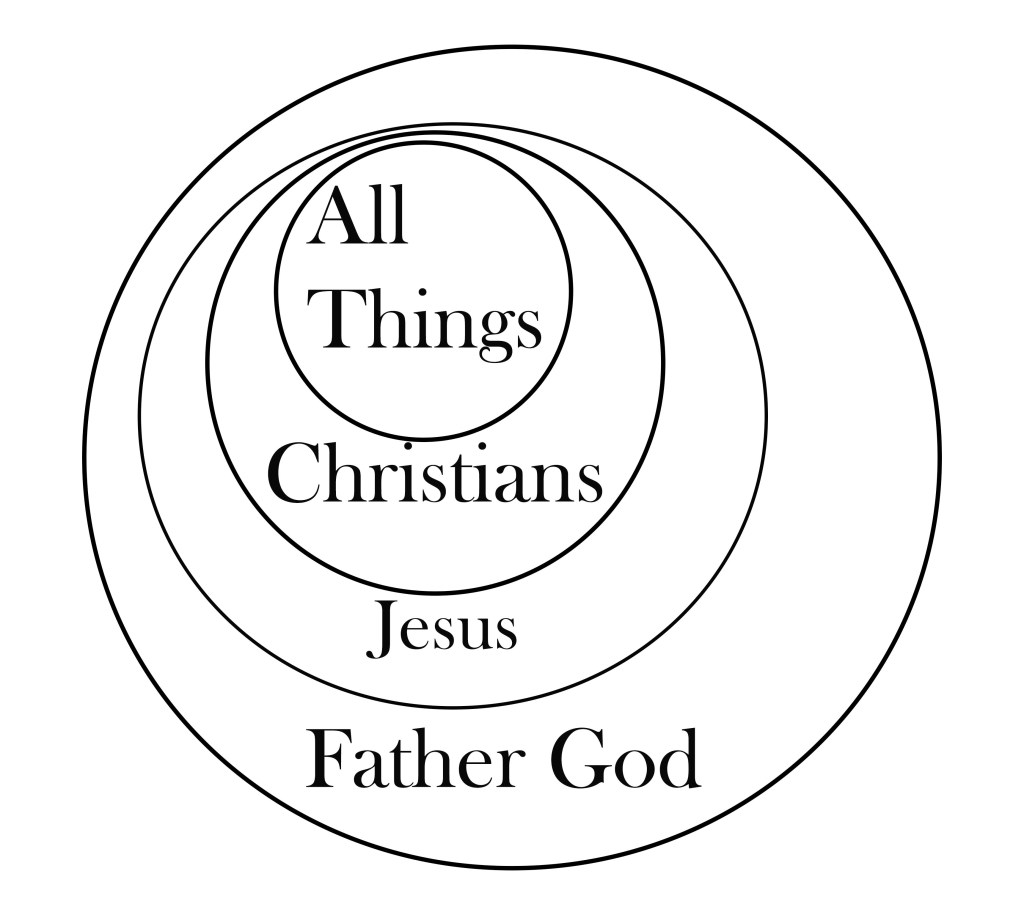
Our identity in Christ means we have inherited all things. Reality itself belongs to us. Remember our earlier diagram. It is true that all reality belongs to Jesus. Yet, God has so highly exalted, glorified and positioned us in Christ, that instead of “reality” being contained in Jesus as a subcategory, “reality” now belongs as a subcategory in us. This is why we can apply all the stories in the Scripture to ourselves for our benefit. All things are ours. And we are Christ’s. And Christ is the Father’s.
We are discussing this in the ethic section of the book, because it is not a suggestion to live and walk in our new identity in Christ. It is a command. It is good ethics to read the Psalms and apply them to yourself. Psalm 103 is yours. Use it! The Exodus story is yours. Use it. The judges and prophets are yours. Apply them to yourself. And do it over and over.
We are to understand how all things are ours and walk in our new definition. Part of this walking is to use biblical examples and apply them to ourselves for instruction, growth and faith. Do not let religious elitists deceive you from using your inheritance. You can apply the bible to yourself, and if they keep hindering you, use your authority in Christ and hand them over to Satan to either repent or be destroyed.
[1] See Vincent Cheung, All Things Are Yours. This paragraph has paraphrased statements from this essay.
 Oshea Davis