
Some folks out there still treat 1 Corinthians 1:18 and 2:2 like a pair of spiritual brass knuckles, swinging them at anyone who dares point out that a lopsided “cross-centered” slogan has been twisted into an excuse for unbelief and disobedience. They read Paul’s words about the message of the cross being foolishness to the perishing and decide that any critique of a so-called cross-centered gospel must mean the critic is perishing too. They quote Paul’s resolve to know nothing among the Corinthians except Jesus Christ and him crucified, then act as if that single phrase cancels out the rest of the apostolic deposit. It doesn’t. It never did. The cross is glorious, but when the faithless use the doorway of the gospel to bludgeon gospel into a blood heap, they have become Satan’s little helpers.
Scripture never hands us a minimalist gospel; that’s the devil’s job. God’s revelation is the sole starting point for knowledge, and that revelation is a seamless, non-contradictory system. Paul did not preach a bare fact of crucifixion and then stop. The faithless love a bisected gospel because it reduces the one thing they can’t do, faith. They can’t believe Jesus and they will do all they can to make sure you follow them in their perversions. Paul preached the whole counsel that centers on Christ crucified precisely because that message, understood in its full biblical context, is “the power of God and the wisdom of God” (1 Cor 1:24). To rip the phrase out of that context and wave it like a stop sign against systematic theology, apologetics, sovereign election, miraculous gifts, or the present authority of the risen Christ is not faithfulness; it is the very anti-intellectual distortion the apostle confronted. The same Paul who said he knew nothing but Christ and him crucified went on to write thirteen chapters of dense doctrine, ethics, and correction to those same Corinthians. He reasoned, disputed, and taught the entire worldview that flows from the cross and resurrection. Anything less is not the gospel Paul preached; it is a counterfeit that leaves people sick, defeated, and emotionally broken while boasting that “this is the power of the cross.” That is not power. That is unbelief dressed up in Calvary language.
Vincent Cheung nailed this exact abuse years ago, and his words still cut through the fog better than most modern pulpits ever will. In “The Proof of the Spirit” (December 26, 2008) he wrote:
“The entire chapter of 1 Corinthians 2 has been distorted by many anti-intellectual commentators. For example, Paul says in verse 2, ‘For I resolved to know nothing while I was with you except Jesus Christ and him crucified.’ … The statement … refers to the gospel’s contrast against non-Christian thinking, and not an anti-intellectual strategy of evangelism.”
He said it again in “Remember Jesus Christ” (November 16, 2009):
“Many people, especially those with an anti-intellectual bias, interpret this to mean that Paul did not preach an entire body of biblical doctrines, and that he was not interested in theology or in intellectual arguments, but that he only preached the ‘gospel.’ … such usage misrepresents what the New Testament means by ‘gospel.’ … although he uses ‘Jesus Christ and him crucified’ as an expression that embraced all that he preached to the Corinthians … this is only a representation (not even a summary) of what he preached, when what he preached was doctrinally much more extensive than the bare expression can convey in itself.”
And in “Theology of the Throne” (November 23, 2025) he drove the point home with surgical precision:
“If the cross becomes the sole reference point, Christianity risks degenerating into perpetual guilt and weakness, as if believers must linger forever at the site of sacrifice without grasping the triumph that followed. … We are not standing at the foot of the cross as if history had stopped there, nor are we waiting outside the empty tomb as if resurrection were the end. … A theology of the throne guards against distortions that arise from an incomplete focus.”
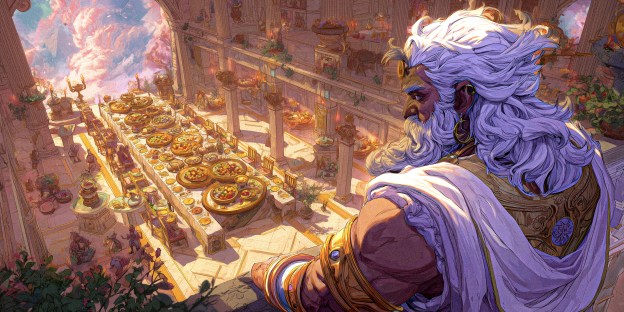
The same abuse shows up when people grab 1 Corinthians 15 and twist Paul’s phrase “of first importance” into another excuse to camp out at the doorway instead of walking through it. Paul opens that chapter by saying, “Now, brothers and sisters, I want to remind you of the gospel I preached to you… For what I received I passed on to you as of first importance: that Christ died for our sins according to the Scriptures, that he was buried, that he was raised on the third day according to the Scriptures” (1 Cor 15:1, 3-4). The atonement and the resurrection are indeed first in importance—the doorway, the entrance, the non-negotiable foundation that gets you inside the house of God’s. But the doorway is not the dining room. The doorway is not where you sit down at the table and feast with the King. You do not build your whole life in the foyer, staring at the hinges while the banquet hall echoes with joy and power and promises kept. Paul goes on in that same chapter to thunder about the bodily resurrection, the defeat of death, the sovereignty of Christ, and the certainty that “God may be all in all” (15:28). He is not handing us a slogan to linger at Calvary or the empty tomb forever; he is flinging wide the door so we can enter the gospel, which includes the present throne life, Spirit baptism, healing by faith, mountains moved, and every promise made good in Christ.
The Lord’s Supper itself proves the point with blunt apostolic logic. Jesus commanded, “Do this in remembrance of me” (Luke 22:19; 1 Cor 11:24-25). If we were meant to stay perpetually cross-centered, locked in endless sin consciousness and weakness at the foot of the cross, then commanding a repeated supper that looks back while we press forward would make zero sense. The table presupposes we have already walked through the doorway. It calls us to remember the price paid so we can enjoy the victory won. It is a feast of triumph, not a funeral dirge. To treat the cross or the resurrection as the entire meal is to turn the Lord’s Supper into a self-flogging session that the apostle never authorized. That is not biblical piety; that is a unbelief that robs the gospel of its forward momentum and leaves believers spiritually malnourished in the foyer while the King waits at the head of the table.
Vincent Cheung saw this coming and warned against it with the same clarity he brought to the cross-centered slogan. The full gospel is never a truncated one; it is the doorway that opens onto the throne room. Anything that stops short of that full-orbed revelation—election, resurrection power today, miracle gifts, sovereign lordship over every thought and every sickness—is not protecting the gospel; it is shrinking it into something the faithless can do by human effort.
If you find yourself reaching for 1 Corinthians 2:2 or 15:3-4 every time someone says the atonement and resurrection are the entrance, not the whole house, stop. You are not defending the gospel; you are defending a half-gospel that leaves people sick, broke, and powerless while boasting that “this is the power of the cross and empty tomb.” And when they die before their time, their blood is stained on your hands. The real cross and resurrection say, “By His stripes you were healed” (1 Pet 2:24) and “All things are possible for the one who believes” (Mark 9:23). They fling open the door to the throne where we boldly approach and ask and receive. Anything that stops short of that is not the power of God; it is the power of unbelief sugar-coated with spiritual-sounding phrases.
The throne is where the story ends, not the cross or the tomb. Stop lingering at the doorway like it is the finish line. Get up, believe the full revelation, walk through, and sit down at the table with the King. That is where Jesus is. And that is the only way the cross and resurrection stay anything but empty in your life.
 Oshea Davis