
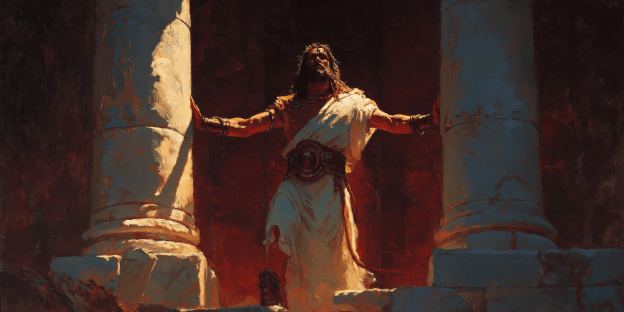
Samson, the muscle-bound judge who could bench-press city gates in faith but couldn’t find one believing friend in the entire land. You’ve heard the Sunday school version: Samson the strongman, brought low by a haircut and a honey trap. But let’s cut through the atheistic interpretation that too many preachers pile on. The real story isn’t a cautionary tale about lust or bad hair days; it’s a stark expose on faith versus unbelief, where even pagans grasp God’s power better than His own people. As Vincent Cheung aptly sums it up in The Shadow of Christ, “His parents misunderstood him, his wife betrayed him, his countrymen abandoned him, and his enemies hounded him.” That’s the setup, but the punchline? The enemies got the theology right, while the faithless in Israel fumbled it like a greased pig.
The story of Samson teaches that when power is needed, then only faith to work superman power will get the job done. It’s great to have an honourable marriage bed, but it will not rip city gates out of the ground. Holiness cannot compensate for miracle working faith, when miracles are needed. There is no substitute for this. It teaches that God stamps his sign of approval on people who have faith. This is why Samson is a hero of faith. God honors Samson in Hebrews 11 alongside Moses and David, not for flawless morals, but for faith that moved mountains—or in his case, temple pillars. God spotlights Samson’s faith with a smile on His faith. His name is gravel in mouth of the faithless, but Samson is honey on God’s lips.
Let’s rewind to Judges 13-16, where the drama unfolds. God handpicks Samson from the womb, announcing through an angel that this Nazirite kid will “begin the deliverance of Israel from the hands of the Philistines” (Judges 13:5, NIV). No small task—the Philistines are oppressing Israel, and oppression isn’t just bad luck; it’s a slap in the face to God’s promises. Remember, God swore to Abraham an “exceedingly great reward” (Genesis 15:1), blessing his descendants with land, prosperity, and victory over enemies. For Israel to cower under Philistine thumbs wasn’t mere hardship; it was disobedience, a failure to showcase God’s glory. They were meant to be a billboard for divine favor, not a doormat. Yet, when Samson steps up—ripping lions apart, torching fields with fox-tails, and slaying a thousand with a donkey’s jawbone—his own people treat him like a liability. The faithless do the same today. If you have faith, they treat you like a liability. This is the same game.
Take Judges 15:9-13. After Samson unleashes holy havoc on the Philistines, burning their crops in retaliation for their treachery, the men of Judah—three thousand strong—march up to bind him and hand him over. “Don’t you realize that the Philistines are rulers over us?” they whine. “What have you done to us?” (Judges 15:11, NIV). These are God’s chosen, the descendants of Abraham, moaning like defeated slaves. Gideon routed Midian with 300 faithful; Samson could’ve turned the tide with a fraction of that if Israel had believed. But no—they betray their own deliverer, tying him up like a sacrificial lamb. It’s not just abandonment; it’s a betrayal of God Himself, who publicly revealed Samson’s calling. Israel refuses to believe their own God can help them. Unbelief doesn’t just blind; it turns you into a traitor. Unbelief in God’s word makes you blind and stupid. Jesus had these type statements after both multiplication miracles, ‘Why is it that you still do not understand?’ Then we are told why the disciples were so stupid. “For they had not understood about the loaves, because their heart was hardened.” Being amazed at miracles isn’t a compliment—it’s a diagnosis of heart so hard with unbelief it makes granite stone envious.
Samson becomes a lone ranger not by choice, (as Vincent helped me understand better) but because faithlessness forces it on him. His family? They misunderstand him. (Judges 14:4). His wife? Betrays him for silver, weeping him into revealing his riddle (Judges 14:16-17). His countrymen? They abandon him in masse, preferring chains to change. Even Jeremiah had a scribe to jot down his prophecies, but Samson? Utterly alone, because no one else had faith in God—to join the fight.
And so, the legacy of the faithless is trash: they abandon God’s man, force him into isolation, then blame him for going solo. Worthless garbage, is putting it mildly without crossing into outright comedy. It’s like watching a team bench their MVP because they’re afraid of winning, and then blame MVP for not winning. This is all too common among the unbelieving. To have doubts in God’s promises for victory is to assign yourself to loss and misery.
Now, contrast this with the Philistines, those Dagon-worshipping heathens. They drag a blinded Samson to Gaza—the very city where he once uprooted the gates and hauled them off like oversized luggage (Judges 16:3)—to mock him in a grand religious bash. Thousands pack the temple, praising Dagon for handing over “our enemy… who laid waste our land and multiplied our slain” (Judges 16:23-24, NIV). Here’s the irony that stings: the Philistines recognize Samson as God’s weapon against them. They see his strength as divinely sourced, his victories as assaults from Israel’s God. Capturing him? That’s Dagon triumphing over Yahweh in their minds—a worldview clash where gods duke it out through human proxies. In modern terms, they grasp the theological stakes: this isn’t just personal beef; it’s cosmic warfare. “Our god has given our enemy into our hand, the ravager of our country” (Judges 16:24, ESV). They attribute Samson’s power to divine favor, even if misdirected to the wrong deity.
Meanwhile, Israel? Crickets on the theology front. Their own church-going peers—yes, Israel was the church then, God’s assembly—lack the faith to see Samson as God’s hammer. They’re so busy not believing, they miss the obvious. The Philistines, enemies though they are, have better theology here: they understand the implications of a God-empowered man wreaking havoc. It’s like the demons in the Gospels who recognize Jesus as “the Holy One of God” (Mark 1:24) while the Pharisees scoff. Unbelief dulls the senses worse Pharisee compassion.
This isn’t ancient history; it’s today’s mirror. Faithless Christians peddle unbelief like it’s gospel, sidelining miracles, healing, and power because “that’s not for us.” They mock bold faith as a liability, just as Israel handed over Samson as if he was the danger, and not their own unbelief. But our enemies? Atheists, skeptics, even cults—they often see the worldview clash clearer. They know if Christianity’s claims are true, their wisdom and power are a facade. We claim a God who parts seas and raises dead; they call our bluff when we settle for mediocrity.
The faithless have no redeeming qualities, because they make our enemies look enlightened. The are salt, with not even a hint of saltiness left. Worse than trash.
I give you permission to leave the Philistine camp of unbelief. Join God in approving Samson as a faith giant. Believe big, fight hard, and watch reality obey. After all, if pagans can spot divine power, shouldn’t we? Let’s not be the ones hardening hearts while enemies applaud the show. Faith isn’t optional; it’s the hammer that crushes oppression.
Wield it, or get out of the way.
[See “The True Story of Samson, by Vincent Cheung, who has helped me understand this story better.]
 Oshea Davis