Category Archives: Christian Axiology

The Goal of the Gospel is Happiness?

You Bet It Is!

Someone spotted a church called “The Love Church” and pegged it as a seeker-friendly joint. I quipped it beats “Sad Church.” They fired back with conviction: happiness isn’t the gospel’s goal. Their evidence? An emotional roll call of extended family members—churchgoers all—wrestling with sickness, poverty, and troubles. “Sad Church sounds about right,” they smirked, implying it’s a fitting name for real life.

I could write a theological tome on this, but I’ll keep it short.

First, let’s zoom to the cosmic blueprints—God’s decrees (supralapsarian style). God’s intentions are pure positivity, not a divine Debbie Downer vibe. His original plan? Our joy, happiness, glory, and blessedness in Him. Justice comes first, then injustice. You can’t have a villain without something good for it to attack. God’s intentions are positive. They are positive for us first in the decrees. God’s heart is for our happiness. The gospel was predestined for our glory and happiness. Before we dive into specifics, happiness was already the gospel’s goal. All sunshine, no storm clouds.

Second, the “gospel” (even being declared righteous by God) is about our favor, glory, fame, prosperity, healing, miracles, empowerment by the Spirit, and inheriting the world through Abraham’s blessing. Sin didn’t even get a cameo in Abraham’s story. It was all positive, overflowing like a divine jackpot. Paul calls Abraham’s blessing—where he inherits the world, receives the Spirit, and sees miracles—the “gospel.” Not just for Abe, but for us too. This positivity would make health-and-wealth preachers blush for playing it too safe, shaming every church tradition for underselling the gospel’s joy.

We sinned against God. He brought the law 400 years after Abraham’s blessing-fest to expose our sinfulness. But Jesus arrived to seal both sides of the deal. He crushed sin by grace and ensured Abraham’s blessing flows to Jews and non-Jews alike, all by grace.

Happiness isn’t the gospel’s only goal, but it’s no sidekick either. In fact, forgiveness isn’t even the main event. Peter says forgiveness is the starting line, a springboard to the gospel’s true aim: being baptized in the Spirit for power.

Peter replied, “Each of you must repent of your sins, turn to God, and be baptized in the name of Jesus Christ for the forgiveness of your sins. THEN you will receive the gift of the Holy Spirit.” (Acts 2:39)

This Spirit-baptism for miracle power is what Paul calls the “gospel” in Galatians 3. Receiving Abraham’s blessing—healing miracles, financial windfalls, relational breakthroughs, and a whole miracle smorgasbord—fills us with happiness and joy. The gospel’s goal is absolutely happiness. Paul says Jesus became a curse for us (Galatians 3:13) to secure this miracle-soaked joy. That means these blessings have Jesus’ blood sprinkled on them, nailed to that cursed tree. To say happiness isn’t the gospel’s goal is to spit on Jesus’ blood like it’s cheap wine, disrespecting the cross where His hands and feet were pierced. Those who scoff at the gospel of happiness can’t dodge their spit landing on Jesus’ nailed feet.

Let’s skip Isaiah 53 for now, where Jesus, our scapegoat, carries away sickness and heals us by His stripes. Healing in this life is as much the gospel as forgiveness. I’m not saying healing trumps forgiveness in importance, but both flow from the same atonement and resurrection. Slap one, and you slap the blood that bought them both. You can’t curse part of the gospel without torching the whole thing. If Jesus’ blood fails to spark our happiness, what hope does it have to forgive us? Zilch.

Healing alone, a gospel cornerstone, brings joy in spades. Jesus and Acts show people leaping with happiness, entire towns buzzing with “great joy” (Acts 8:8). Jesus Himself says His love brings abundant joy (John 14-17), tying answered prayers to overflowing happiness. We pray and receive whatever we want because of the gospel and Jesus’ blood. The gospel’s goal? Happiness, served piping hot.

David’s Psalms are a happiness playlist, praising God for constant healing, deliverance, and joy in the morning. God is David’s salvation and blessing, sparking loud, happy shouts of praise.

Those who reject the gospel of happiness reject the gospel itself. They’ve got itching ears for a different seeker-friendly church—one that whispers, “God won’t heal you,” or “It’s up to His will, so stay in the dark.” They hand out spiritual comfort blankets to keep you cozy in sickness, defeat, and depression. They make you feel excited when Satan is cockblocking you. A huge crowd seeks this message, craving comfort in their suffering. But they suffer like Israel in the wilderness—not for God’s glory, but for their unbelief and stupidity (we are too small and they are too big). They don’t suffer for the gospel under persecution; they suffer because they reject it.

They claim the gospel is for God’s glory. Duh, even demons nod at that. The real question is how God glorifies Himself through the gospel. He does it by making it a fountain of blessings and miracles, crowning us with glory (1 Corinthians 2:7).

As Gabriel Arauto quips, “If God doesn’t serve you with healing, miracles, prosperity, and happiness, He’ll become your executioner” (John 13:8, paraphrased).

The gospel of happiness isn’t just feel-good fluff—it’s got eternal stakes. Reject it, and you’re dancing on thin ice.

What God Ordains Is always Good

A woman was suffering with cancer asking for prayer on twitter, and a person responded with the Hymn called, “What God ordains is always Good.”

Satan’s little helpers are all over the place.

God ordained all things. True enough. Let us remember that God ordained for me to be born a sinner with a sinful nature (Rom 5). Thus, this is good. No, really, it is good by definition because God did it. God does tell us why He did it, (Rom.9), but this is logically irrelevant. Whatever God does and ordains is good. However, good “relative” to whom or what? If we are asking what is good on the ultimate level, relative to God, then anything God does is good by definition, because God did it. However, if meant relative to me, then good is defined as God’s commandments and promises. Relative to me it is about my obedience to God’s commands and acquiring God’s promises in my life. This is the only definition for biblical ethics. For me, good is defined by me understanding what is happening (what God ordains) and then find a command and promise that relates to it and obey it and make the promise manifest by my faith. Anything less than this is disobedience and rebellion against God. Disobedience is bad; it is not good.

In regard to being born a sinner, I cannot say, “What God ordains is always good,” and so,” because God ordained me to be born a sinner, thus it is good that I remain a sinner who hates God and loves sin.” We know if someone does this, they are making excuses for their rebellion. This is stating something God does and then irrationally concluding an ethic from it. No. God has both commanded me to repent and promised to save me if I call on His name. God ordained me to be born a sinner, but also told me what to do about it, by making His promise of forgiveness a reality in my life by my faith in Him. Jesus told me to save myself by faith in His promise of mercy.

The same with everything else. So, what if God ordained me to have a sickness? God ordains all things; tell me something I don’t already know. However, God has commanded (James 5:15) and promised (Isaiah 53:4-5) me to use faith and I will be healed. I cannot say, “What God ordains is always good,” and so,” because God ordained me to have this sickness, thus it is good that I remain in my sickness.” We know if someone does this, they are making excuses. God’s promise for healing is “good” and His command to be healed is “good.” Those who reject this are bad. You cannot use what God has ordained to invalidate God’s commandments and promises. Those who teach such, teach a doctrine of demons.

Don’t Speak to God, Speak to Your Problem About God

When Peter, (even after baptized with the Spirit), commanded the man’s sickness to leave (stand up), Peter did not speak to God about the problem; rather it was more like Peter spoke to the problem about God.

In the broad sense, a word of faith command like this, is just a shorthand way to pray without hedging. And because it is a prayer, you are aware God is listening to you and that you are using His authority and that you are standing on His promise.

However, in the most direct sense, these types of prayers are spoken to the problem, and not to God. Jesus did not say to “speak” directly to him about your mountain, “oh God, I am nothing and I need your help.” No, Jesus told us to “speak” to the mountain directly and tell it to get out of our way. Jesus teaches us that we already have His authority and His approval to pray like this and get powerful results. To command and get what we want. The fact many Christians do not pray like this, means they do not obey and do not understand their identity in Christ. They do not understand prayer.

So the lesson to learn here is this, when you have a problem you speak directly to it. It is not wrong to go to God in prayer about your problem, but Jesus has officially instructed us how to pray in such situations. It is like the sermon on the Mountain. Jesus is raising the bar for His expectations and command about how we pray and get results. Who am I to alter Jesus’ instructions?

Therefore, speak to your problems about God, telling them to throw themselves into the sea.

Once a Prince of Heaven, Always a Prince of Heaven

“For we do not have a high priest who cannot sympathize with our weaknesses, but One who has been tempted in all things like we are, yet without sin. 16 Therefore let us draw near with confidence to the throne of grace, so that we may receive mercy and find grace to help in time of need.”
Hebrews 4:-5-16

The immediate context of approaching God’s throne of grace for help is that Jesus can sympathize with our weakness and struggle against sin.  This verse should be used to approach God boldly for all types of asking and help, but it is important to remember the immediate context. In our struggle to fight sin we are told Jesus sympathizes with us and commands us to boldly approach God’s throne for help.

This is important because when we do sin, or if we are still fighting a besetting sin, one major battle Satan will fight us on is boldly approaching God for help. When we fight sin, approaching God boldly is the #1 thing we need to do. Why. Only God can help. And Satan wants to hinder you from going to the only one who wants and can help you.

The temptation is from shame. You feel ashamed and so you do not want to approach God’s majestic throne with boldness, and yet, this is the most important thing for you to do. We must remember that our faith is based on God’s revelation not “feelings.” We must repent and by faith know we are forgiven.

We do not fix a sin by sinning more. The command is for us to approach God with confidence, with our heads held high, and ask for help. Because we are asking for help in a sin, some see God is angry and does not want to help. They think a correct application of “the fear of God” is keeping them from boldly approaching. Yet, our passage says Jesus sympathizes with us and will help us if we ask Him.  Because it is a command, then to not boldly approach God for help is “not fearing him.”  Any sin qualifies for “not fearing God,” because it is a violation of God’s command. God has intelligently thought of everything, and His command is simple. If you are struggling with sin, repent, but do not stop there; you must also boldly approach God asking for help and you will receive help.  

You do not have permission to sit in the corner of your room in self-pity and whine and then approach God like a beggar for help. It is good to have godly sorrow for one’s own sin, but that does not excuse you from disregarding your identity in Christ when you approach God. A beggar is the definition of an outsider, but you have been redefined as an insider. You are always a prince of heaven, therefore, when you enter God’s throne room you always enter in as a prince, with your head held high. It is similar to the line from the popular book Narnia, “once a king or queen of Narnia, always a king or queen of Narnia.” You have a new definition, given by God himself. It is final and permanent. Therefore, when you approach God, you always approach Him as a child of God, a royal prince of heaven, especially if you need help fighting sin.  Let nothing hinder you from approaching God in confidence to receive His help.

You Already GOT It.

I publicly proclaim bold promises.
I do not whisper obscurities in some dark corner.
I would not have told the people of Israel to seek me
if I could not be found.

I, the Lord, speak only what is true and declare only what is right.
Isaiah 45:19 (NLT)

We start this section with a presupposition that the Father and Jesus have when engaging men. The presupposition is if God talks about good things, no matter how awesome and wonderful, it is attainable by anyone who has faith. God is no respecter of persons. Small or great, it does not matter. If God promised to make Abraham’s name great, give him supernatural health, and excessive fruitfulness, then Abraham can get these by faith, and it is very doable.  It is like God commanding a plant, “if you gather sunlight and water, you will have food.” In the context of a plant this is more than doable. God’s precious promises and definitions for man, is in context, that we more than able to walk in these excessive blessings.

When Jesus rebuked the disciples for not casting out a demon because of their lack of faith, the presupposition from Jesus is that the disciples are able to do this. When Jesus rebuked the disciple in multiple applications for their lack of faith, His presupposition is that they can have faith to do these things. When Jesus said, “if you seek, you will find, if you knock the door will be open,” and to pray and never give up because you will get what you pray for, the presupposition is that you are able to do this. Jesus would not said that if you bind something on earth it will be bound in heaven, if you could not do it. This is an encouragement. Jesus’ presupposition means casting out sickness or mountains, in His Name, is some as attainable as a plant getting food from soaking up water and sunlight. When you read the New Testament you realize doing miracles is an easy thing; it is only Satan and false tradition that teach the opposite. It is obvious why the devil is afraid of such a doctrine, but why do men conspire with him?

This presupposition might seem obvious, but some seem to miss this due to false teachings or the emotional hurt from being attacked by the devil. Be encouraged, God would not have promised these good things if you could not do them. He is cheering for you more than you are for yourself. He promised these good things because He likes you, because He loved you with and everlasting love.

The sword of the Spirit is already yours. You wield it, not God. You have been baptized in the Spirit with “power.” You wield this power, not God.  It’s yours. You have authority in Jesus’ name to command demons and sickness to flee. You have the status of a child to ask for whatever you want and to get it. You do this, not God.

You already have these benefits, power, authority and blessings, you simply receive them freely by faith. God has already defined you with these things, and so you do not beg for them. I remember Andrew Wommack saying in a sermon “What if I gave you my bible, and then while holding my bible you look at me and say, “Andrew will you give me your bible?” I would think such a person is missing a few screws and wouldn’t know what to say to them. I would likely stay silent, which is exactly how God treats many of your prayers for the same reason.”[1] Andrew’s point is an important one. Many Christians do not know the fullness of their new definition in Christ; they do not understand they already possess God’s blessings, power and authority.  And so, they end up begging God for things they think they do not have, but in fact already do. They walk in constant lack and defeat. This is why Christianity for many things is a Word of Faith Confession (“I am the father of many nation”), rather than asking God for things. This is why Christianity for many things is a command: “demon, sickness, mountain, trouble, Get out of my way.” You cannot confess something as true, when reality is a contradiction to it, if you do not have the power to make it happen. You cannot command something to leave if you do not already have the authority to do it. Jesus is an extreme faith teacher; He tells us to confess and command things because we already have His power and authority to do it.

Think about Christmas gifts, with your name on them, under the Christmas tree. They have already been given to you. Imagine picking up a present with your name on it and then begging your mom if you can have this on Christmas day. Your mom says “it is yours, your name is on it, open it!!” But then you continue to hold it and begin to beg even more if you can have it. Yet this is how many Christians treat God in prayer. This is why they do not see victory in their lives.

Faith is assenting to what God says is true. When you beg and hedge your prayers, it means you are not assenting to God’s definition of your new identity in Christ. Paul says in 1 Corinthians 2 that the Spirit of God, who alone knows God, has been given to us to help us know all things that God has “freely given” us. You do not beg for a Christmas gift with your name on it, you simply receive it. You do not beg God for gospel benefits that have been freely given to you; you simply receive them by faith. They are already yours. You do not beg the bank teller to give you your money when it is already in your account; and likewise you do not beg God to give you gospel blessings that have been deposited into your account by grace. They are already yours. Faith is your access or admission to retrieve them and use them.

Jesus did not say, “God will feed them” rather He said, “You feed them.” Jesus did not instruct us to tell God about our mountain in prayer; rather, the most God centered man told us to speak to the mountain and make it disappear.  Jesus did to say God will cast out these demons and heal the sick; rather, He gave us the power and commanded us to do it (Acts 1:8).

The bibles tells us that it is not God who resists the devil and makes him flee, but that we resist the devil and he will flee from us (James 4:7).

Again, many things that people leave for God to do, God has already given us the grace, supply and authority to do it ourselves. They beg God to give them things that God has already given them. This is why God is silent for much of their prayers. It is hard to respond to insane requests.

They come to God saying, “we are nothing, we have nothing, and so we ask you to help us.” They approach God like beggars and outsiders to His Contract. The relate to God like reprobates. A person who is part of God’s Contract has the contractual right to boldly approach God as a prince of heaven, and by this same contract they have the authority to command demons, sickness and mountains to flee.

Because they said “they are nothing and have nothing,” then like God said in Exodus 14 to the Israelites by giving them what they said, He will say “ok, you are nothing, and you have nothing.”

Their faith in God’s Contract, by the blood of His only Son, is no greater than a brick wall. It seems unrealistic they can command mountains and sickness to flee, because they view the Contract by the blood of Jesus as insufficient to produce such great results. They reject God’s power and His love.

He clothes them in the full amor of God. He gives them His shield and even His sword of the Spirit. But these same people will leave God’s armor hanging on the wall, the shied of faith in their closet and the sword under their beds. Then they cry out for God to be a mighty warrior and come down to save them. It is not funny. It was not a suggestion for Christians to adorn God’s armor, use His weapons and be empowered with His power; It was a command. “Be strong in the Lord and in His might power.” They cry out for God to be a mighty warrior but God has given them the authority, power and weapons to be a mighty warrior.  God has given all Christians the power to be like David facing Goliath, no, He has given greater power. David said God made him strong enough to leap over a wall (Psalm 18), but by the power of God’s Spirit Phillip was transported to different cities.

Imagine having to be in God’s place. He gives us power and authority, and people ask God to use authority to make Satan flee. He not only has given us this authority but commands us to make Satan flee by resisting him. “Lord, please make the devil flee.” How would you answer such a contradictive request? Imagine they keep asking over and over? Yet many Christians pray to God like this. The keep asking for things God has already given them.

“Truly I tell you, whatever you bind on earth will be bound in heaven, and whatever you loose on earth will be loosed in heaven.
“Again, truly I tell you that if two of you on earth agree about anything they ask for, it will be done for them by my Father in heaven.”
Matthew 18: 18-19.

Christian: “how much authority do I have?”

God: “Whatever you bind, I will bind;
Whatever you lose, I will lose;
Whatever you allow, I will allow.”

This is another example of what God has already given us. He has already given us the authority to gather, ask for anything and then God will do it. This is not something we do not have and then ask God to have the privilege to gather, agree and then receive whatever we ask for. It is already our identity and definition in Jesus. This is already our royal privilege and right. The ablity to lock and unlock something on earth and then have this to be the same in Heaven is something God has already given us. You do not need to be a Christian for 10 years, working to achieve 100 acts of charity and a 1000 years of soul cultivation to be able to do this. Because we already have this, we simple do it and walk in it. If things need to be locked and unlock on earth and in heaven, we do it in Jesus’ Name rather than begging God about it. If we want anything, then we come together, agree, and receive our miracles.

Take for example depression. If the reports are true, this is a rampant issue in the church. Yet, does not the scripture address this problem? Paul faced many hardships and overwhelming difficulties. How did he deal with this, so that he did not succumb to depression? He tells us how in 1 Corinthians 14. He says that praying in tongues “edifies” the person. This is referring to the inner man. The soul of a Christian is strengthened to edification and peace by praying in tongues. Why else do you suppose Paul brags about praying in tongues more than the Corinthians. He needed inner edification and so he used the power God has already given him. He suffered continually and so he prayed in tongues continually. It’s so simply a child can do it. When you read the book of Acts, praying it tongues is a gift for all. Not the gift of “tongues” spoken in a congregation to be interpreted, but the gift of tongues for personal edification appears to be given to all (or super vast majority) in the book of Acts for those baptized in the Spirit.

And so, God has given us the power to be strengthened in the inner man for peace and joy. Beyond this, those who are experienced in Spiritual operations know praying in tongues for personal edification is a gateway into other spiritual powers and operations to manifest. This is such a powerful tool and many under use and under value it. I can personally testify in my own struggle with depression that it was overcome by praying in tongues and power. More than once when praying in tongues in my fight over sadness, fear and depression it led to interpretation and powerful words from God. It led to God being my personal counselor.

I will give this quick testimony and example. The important point to remember is the you need the foundation of God’s word and to continually study God’s word. Sometimes you might need your pastor for advice and counsel, but the thing that will deliver you is POWER. God’s unadulterated power is what will deliver you. Praying in tongues is gateway to God’s power. It is like a game cheat that can bypass all sorts of things and suddenly load you with God-mod power.  

The other day I awoke feeling off and with a headache. Halfway through the day I saw a reminder to seek God in devotion for spiritual strength, and I felt the Spirit prod me to do this. As the day went on the headache got worse and I felt an irrational oppressive pressure on my mind. I even had a difficult time remembering things. Finally it got to a point where it was irrational fears and accusative thoughts coming out of nowhere.

I have been seeking personal inner strength as a priority for a few years. God has been delivering me from many of my old fears and even sins and etc. I remember as a young man I experienced a direct demonic attack regarding temptation. It frightened me. I lacked the knowledge and power to know how to deal with such a thing. It caused me years of terrible fear in my heart. Vincent’s materials were helping me, and his essay on Demonic Attacks was a moment when I began to experience real breakthrough.

However, I suddenly felt all those old fears suddenly being pressed upon me, like they once did. So, I did the easy thing and just began to pray in tongues and declares God’s promises over me. When I began this, the oppressive mental attacks ratcheted up strength. After about 15 minutes I felt a sudden power in speaking in tongues. This happens sometimes. You will be praying in tongues and suddenly, the power will increase. The bible says both the woman and Jesus “felt” power regarding the healing. There is such as thing as spiritual force and you can feel it. The bible is always true and men are liars. The moment this happened I heard the Spirit say to me, “You are a child of God, these things are to be afraid of you, not the other way around!” At this exact moment, all the oppressive thoughts and pressure vanished. Wonderfully, even my headache was instantly healed.

In a perfect world of mature faith, a simple word would have stopped this attack earlier on the day. And we are all to seek this level of faith. So, while you work on a strong faith, have compassion on yourself and those around you needing help, by praying in tongues and bringing down the power of God to expand His kingdom.

Vincent Cheung in the essay, “Cure for Psychological Trauma,” says, “Power is what will finally deliver you.” The foundation is first correct theology and promises. But the thing that will deliver from all your troubles is power. Unadulterated power of God. Mature faith will always do this. However, praying in tongues is one of the easiest ways to move the power of God directly into your soul, body and life. You should eagerly seek this gift. We need less talk and more power! God’s power can deliver you, your family, your church and even entire nations.

The point is God has already given you the power to be edified. And yet people will be depressed and cry out to God, “oh lord please help me overcome this depression.” Yet God has already answered their prayer by given the baptism of the Spirit and gift to pray in tongues. They keep asking for something Jesus has already purchased by His blood and given them free access to use. Jesus said the Father has given Him the Spirt, just as the Father promised, to freely pour out on His chosen ones. All you need to have the Power and tongues is faith and you receive it, just like you receive forgiveness of sins.

This is not to say we do not cry out to God for help in our troubles and emotional upheavals. Elijah was deeply saddened, and so God came down. He rebuked him and encouraged him. God gave him food that supernaturally sustained him. Elijah’s sadness was replaced with purpose and joy. We see God’s willingness to help. Because we see God in scripture wanting to help us in our sadness, and commands us to keep praying, we gladly obey Him. We pray continually until we get what we ask for. We seek and find. We knock and the door opens. The promise is that the door will open. The promise is that we will find it. The promise is if we do not give up praying that we will be given what we ask for.

The point is simple. Why cry out for God to help with depression if you are not willing to obey Him and do the things you are able to do, which is to pray in tongues. Being edified by praying in tongues does not mean this is all there is to fighting depression, but it means we are delusional if we seek God for help and are too lazy to do the things that are in our means to use. We see God’s love in both aspects. We see power that God has already given us, and recognize when there are closed doors that they will open, if we only keep knocking. God has predestined us to win. We win in both aspects. In preinstalled power and in opening shut doors, we are made to only win.  

Think about God’s generosity. He has given us divine power from heaven to beat back depression. He gave us supernatural power to fight. He gave us His personal lightning bolt. And yet, Christians will turn to human counselors and drugs and then act like beggars before God, hoping He might help them. Wait. What? This is not Christianity. It is literally a different worldview than the viewing the world through the Spirit and power. Christianity is about believing. It is believing your identity in Christ. They don’t see themselves as new creations in Christ. They have an anti-Christian view of the world.

Again, how would you respond to someone who keeps asking for something you already gave them?

Wherever you set foot, that land will be yours, (Deuteronomy 11:24 NLT).

God delivered Israel from Egypt by Himself. They did not lift one sword to fight. God did all the fighting Himself. Yet, after they were baptized in the Jordon river (as we are baptized in the Spirit), God said He will empower them. He commanded them to use shields and swords. God will be the supernatural power in obvious miracles and in guiding their hands as they swing their weapons. It was not God’s footsteps that determined how much land they took, but their footsteps. They had to put their own feet on the ground and move forward.  

Imagin Joshua sitting at the foot of Cannan crying and begging God to give them Cannan? “Lord, please give this land to us?” How would God answer that? What if Josh kept doing this over and over? At one point God had to tell Mose to stop monologuing, shut up and cross over the Red Sea. People pray to God as if they are still in Egypt. But Egypt is an illustration of Jesus’ atonement. If you see yourself still in Egypt you still view Jesus as if He did not die and resurrect. Likewise, after God saved the people from Egypt, He then baptized them in supernatural power and they, not God, marched into Cannan. This is how we advance His kingdom today. With every footstep of faith in God’s promises, we march into the devil’s territory and take ground for our inheritance and our Father’s value.

We do not “wait” for God to move, we do not beg God to give, we do not sit around for a revival, because we already have God’s mighty power, rich supply, armor, weapons and authority to march forward. If you are a Christian you already have these things. And if we find closed doors, we are persistent at knocking and our God opens.

An illustration that Andrew Wommack uses on this same topic is to equate God as the powerplant pushing the power to our house, but if we want a light turn on in our house, we must flip the light switch. It would be unreasonable to call the power company and ask if a utility worker can come over to the house and turn on the lights, the stove, the fan and computer, because that is our job. This is a good analogy. We are not saying the that we inherently have the power, but that God richly supplies the power to us. We do not force God, rather, we enforce the power, privileges, blessings and authority freely given to us in Christ.

We pay to have the electricity directed to our house; however, in the gospel Jesus pays the tab for all the power and blessings of Abrham, faith and the Spirit to be directed to us. Not even an insane person would call the utility company to send over a worker to their house every time a light or appliance needs to be turn on, and yet people treat God this way. God has already provided us with blessings and power to do so much, and God expect us to turn on the lights, heat the stove and power up the computer.  He asks so little.

Unbelief is so disgusting that it makes people excessively lazy. Proverbs says a lazy man will not even lift his hand out of the bowl to feed himself. Many Christians are the same with faith and power. God has already supplied them with all the power and authority they could ever hope to use. And like the lazy man who will not even lift his hand out of the dish, the so-called Christian will not even lift bread from God’s table to their face. Jesus referred to healing as bread that belongs to Abraham’s children. But so-called Christians are so lazy they will not even lift it to their face? Jesus says if in faith you “say” to this mountain to move, then it will happen. Jesus showed us over and over to “tell” sickness to leave and it leaves. But Christians are too lazy to even open their mouth to “tell” sickness, demons, poverty and demons to leave. Do they expect God to come down from heaven a second time and spoon feed them and shove the bread down their throats? Do they expect God to force open their jaws and speak?

If there is sickness, the power is already yours to heal. Because of Jesus finished work and because you are already born-from-above, the power of God is already directed to you. It is already yours. It is your responsibility and accountability to turn on the lights. It is your responsibility to speak to sickness and command it to leave in Jesus’ name (John 14:13). Jesus went to heaven to sit on His throne and commanded us to be filled with faith and power, so that millions of His followers will turn on lights all over the world. The power is already yours. Oh, sleeper, when will you wake up. The bread is on the table. Eat.

This doctrine about “you already got it,” is simply the application of knowing your identity in Christ. Our identity in Christ is a foundational doctrine from metaphysis. The way you “apply” this doctrine shows if you have understood it correctly. When we know what we already have, through our identity Christ, we apply this by using it, rather than begging God for something we already have.  

God has given you so much power, authority and supply in your new identity in Christ. You should be so filled power and faith that when you see sickness your first impulse is to say “get out,” and it leaves; that when you see a demon, you say “leave,” and it leaves; that when you see a physical lack of a material substance you command it to multiply, and after it finishes multiplying, there are 14 baskets left over; that when you feel stressed you pray in tongues and joy feels your heart and God gives you a tailored word to help you; that when you need to make a house payment you go to your backyard and grab a random toad and pull out a gold ounce; that when you see a mountain in your way, you speak to it and it vanishes in a black hole. If this is not your first impulse, but rather to “ask or beg God for help,” then you are immature in knowing and walking in your identity in Christ. You still do not know who you are. You still do not know God’s power and generosity. You still approach God as if you are an outsider to Him and His Contract.

This is not to say we never pray to God by saying, “I need help for this or that,” because we are commanded to pray all the time and to boldly approach God for help. What we are saying is that when you understand your position in Christ this maturity will lead to you correctly use what God as already given you. You will correctly use your authority and faith in speaking to sickness, troubles, and demons rather than giving long winded prayers hoping God might help you. If God’s sword is in your right hand, is it a correct application to beg God to give you heavenly power?

“It makes no sense to knock on an open door, or ask for something you already have, or to look for something that has never been lost. Prayer makes sense when doors close, when there is need and loss. Prayer reverses tragedy, meets necessity, removes hindrance. Prayer is God solution to man’s problems.”[3]

Gabriel is correct. The fact the Jesus commands us to knock and the door will open, to seek and find, and to always pray for what we want and never give up, presupposes there are closed doors and hindrance blocking our progress in life, our desires and godliness. The way we face closed doors is to keep praying (knocking) until it opens. When we are lost and can’t find our way, we seek (pray, pray in the Spirit, read more scripture etc.) until we find. We are to be like Daneil and pray to God 3 times a day, if not more. When Jesus said “will the son of man really find faith,”(Luke 18:1-8) it was in the context of commanding us to pray and never give up. When you are mature and you know your identity and power as a Christian, it is easy to see a sickness and just command it to leave and it leaves. But to face a closed door is more difficult because it takes patience, diligence and constantly applying faith at all the fiery arrows telling you to give up. It is when we face closed doors that even the faith of a mature Christian can be tested.  Mature Christians do better with this knocking because they understand how much God has given them and how much God loves them, (Ephesians 3:14-21, 1 Corinthians 2:6-16) But God’s chosen ones do not shrink back. They keep knocking and the door opens.

As a summary this is a worldview issue. Knowing, believing and walking in your identity in Christ makes you view the world in a completely different way. It can be a lack of knowledge, but it can also be that many so-called Christian are not born-again, and this is why their worldview is so limited, powerless, blessing-less. They see themselves as limited, because they only see themselves. Jesus is just a slogan, but their true view of the world is only though their human limitations. God’s elect see themselves in and through Christ. Because the see Christ as limitless they see themselves as limitless. Because they see Jesus as righteous without measure, they see themselves as righteous. Because the see how great God’s love is for Jesus, the see how great the Father loves them. They see themselves in the world filled with God’s power, blessings, privileges and authority. The difference couldn’t be more glaring.

If I were writing for the sake of importance, I would write pages and pages on this, because it is so important. However, I will only say that if you want to walk in the type of victory and power you read in the bible the above doctrine is foundational.


[1] This is paraphrases from memory.

[2] Ephesians 6:18 NIV. “Finally, be strong in the Lord and in his mighty power. 11 Put on the full armor of God, so that you can take your stand against the devil’s schemes. 12 For our struggle is not against flesh and blood, but against the rulers, against the authorities, against the powers of this dark world and against the spiritual forces of evil in the heavenly realms. 13 Therefore put on the full armor of God, so that when the day of evil comes, you may be able to stand your ground, and after you have done everything, to stand. 14 Stand firm then, with the belt of truth buckled around your waist, with the breastplate of righteousness in place, 15 and with your feet fitted with the readiness that comes from the gospel of peace. 16 In addition to all this, take up the shield of faith, with which you can extinguish all the flaming arrows of the evil one. 17 Take the helmet of salvation and the sword of the Spirit, which is the word of God. 18 And pray in the Spirit on all occasions with all kinds of prayers and requests. With this in mind, be alert and always keep on praying for all the Lord’s people.”

[3] Gabriel Arauto. Google translate from Portuguese to English.

From my forthcoming Systematic Theology book.

Receive God’s Love & Give God’s Love

Lastly, we test to see if we have known and believed our new identity correctly when we can receive God’s love and give His love.

We are mature, as has been discussed, when we sit at Jesus’ feet and receive from Him and not giving to Him. We are mature when we receive His love for spiritual things such as forgiveness and joy, but also when we receive things like health, prosperity and fruitfulness in all our lives.

When we are strengthened in our inner man by receiving the full measure of God’s love that effects our entire lives, then we have even more strength to love our neighbor. It is not that we choose not to even try to love our families and neighbors without being mature in our inner man, but that there is a priority. The first effects the second to be better and not the other way around. Thus, there is always a priority to receive from God first, while never neglecting the second.

The love chapter” is in-between “The Power Chapters.” But that is a little misleading because there is no such thing as The Love Chapter, as Vincent Cheung points out.

“There is no such thing as “The Love Chapter.” The topic of 1 Corinthians 13 is spiritual gifts, not love itself. Paul’s point is that spiritual gifts should be pursued in love, not replaced by love.

Don’t read 1 Corinthians 13 at your wedding unless you are prepared to put this love into action and lay hands on the sick among the guests as a couple after the wedding vows. That’s love…”[1]

The bible defines love in the middle of Paul defining different types of power. Paul’s answer is that supernatural power is to be used with love. The context is power and not love. Power is to be used with love. Thus, when people read 1 Corinthians 13 at their wedding, they should not do this without having a healing service right after, for this is the context for how to use power.

Because power and love cannot be separated, then Christian love cannot be Christian love without miracle power. We are to be like our Father in heaven. With God there is no such thing as loving without power. It is with great power that He loves us.

As Paul says, anyone who does not recognize that we are to zealously seek the spiritual gifts (power) is not recognized by God. We are not to merely seek them but have enough faith to have gifts regularly in our lives and ministries. Any ministry leader or pastor, who does not do this needs to step down immediately or be excommunicated. If God does not recognize such a person, then who I am to recognize them as spiritual? If God has disregarded them as trash, then who I am to treat trash as something different? If God has a low definition of them, who I am to define them differently?

 “Prophecy is said to be imperfect, not because the gift itself is defective, but it offers incomplete knowledge. So “when perfection comes, the imperfect disappears.” Paul does not leave the time of “perfection” in doubt. He writes, “Now we see but a poor reflection as in a mirror; then we shall see face to face. Now I know in part; then I shall know fully, even as I am fully known.” When perfection comes, there will be “face to face” knowledge. When perfection comes, we will know fully, even as we are fully known. This is not a potential knowledge, as in knowledge revealed but not completely assimilated, but an actual knowledge, so that we will know as we are fully known. When this happens, the gifts will cease, and we shall not miss them, for we will lack nothing.”[2]

“Paul does not refer to a potential knowledge, but an actual knowledge, as actual as we are “fully known.” As perfect as the Bible is, we do not even know fully the Bible. It takes an extraordinarily delusional person to think that he already knows fully, even as he is known fully. A “face to face” knowledge should not need exegesis, reading, revision, debate, and research. If the way I will know fully is the way that I am known fully, then unless God himself needs to perform exegesis, revision, and debate in order to know me, “face to face” knowledge cannot refer to what we possess at this time. Thus if a person insists on his cessationism on the basis of this text by sheer determination, although even then it can apply only to prophecy, he loses his God, and so his salvation as well.”[3]

The gifts will be imperfect in the next life because we will have so much spiritual power that the gifts will be too weak, or imperfect. Paul also teaches we will know as God knows us. Even with the completion of the Scripture, in order to know God we do so by study, mediation, review and revise, and debate; yet, God does not know us this way. He knows us intuitively and immediately. This is what Paul refers to the “prefect.” Thus until we know God this way, the “perfect” has not come and the gifts are still in play to help us. Paul’s command to seek them and use them to love others is still on the books.

God intends for us to love with supernatural power. When someone is sick, God wants you to love them not merely by sacrificing your time to “be there for them,” and fix them a meal, but to make the sickness and pain go away by commanding it to leave. This is how Scripture defines love. Love that does not command the sickness to leave is not Christian love, or at best it can be describe as a defective form of Christian love. The same for lack of insight. Christian love will bring a prophecy to help their family member or friends so that they have more understanding and wisdom for their jobs, ministry, relationships, and godliness. If your neighbor needs a specific type of knowledge for their life, you cannot give them true Christian love without spiritual prophecy, insight, and visions. Anything less than this is not Christian love. Your church family will have all sorts of troubles thrown at them and the bible’s answer is to overcome these troubles by miracles. You do not qualify as giving biblical love without helping them by providing miracles to help. Human love is merely human power; however, Christian love is distinguished by God’s supernatural power. Christian love cannot be Christian love without this miracle working power. Worldly love can be defined without God’s supernatural power, but not Christian love.

When we are sick, the bible defines this situation as coming from Satan, Acts 10:38; Luke 13:10-17. This does not mean it is only from the devil (1 Corinth. 11:30), however, these are the exceptions. That is, the type of high-level sinning that would invoke God’s response in 1 Corinthians 11:30 is not normal or the average. Rather, Acts 10:38 shows us that the norm for sickness is from the devil. Your theology needs to include this. God is the foundation of sickness, just as God is the foundation for all things in the metaphysical sense. But this God who is the foundation mostly speaks to us on the human level, and defines sickness as almost always from Satan. Jesus, the apostles, and followers, were on a one-way mission to eradicate sickness; by destroying sickness they were destroying the devil. Jesus did not interpret all the sickness he encountered as the “will of God,” and so we are to just let people be sick. No. He saw sickness as demonic victimization of people. Jesus could have spent more time preaching but instead directly attacked Satan’s power by healing people. In the one act of healing Jesus had compassion on people and destroyed the kingdom of Satan. Healing is one of those spiritual acts of power that accomplishes huge amount of compassion, grace, gospel advancement and devastates the devils kingdom in one punch.

Satan has kept many Christians in bondage, helpless and weak through sickness. The one who is sick is shamed, time constrained, in pain, usually must take money meant for the kingdom of God and try to buy healing from men. They are experts in giving glory to man. Many hours that could be devoted to ministry or devotion to God are spent in shameful pain and prostrating oneself to glory of man to heal them. Depending on how bad the sickness is, those in the family must also divert money and time that could be spend in ministry or devotion to God to helping the sick spouse or child. The one person who wins in this situation is Satan. If your family member is sick, then you better help them, or you are worse than an unbeliever. However, God has not called us to love and help by power of man, but through God’s power. God has called to destroy the works of Satan, which includes sickness. We are not permitted to allow Satan to steamroll our families with sickness, and all the effects that come from this, such as shame, time constrained and money spent on human medicine.

When God strengthened barren women to give birth it is said that God has taken away their “shame.” We know, and God also knows, that such sickness and physical defects brings us shame. You can lie to yourself and say, “this deformity or sickness does not define me,” but you are deluding yourself. The bible defines it as shame and so it is. If you are a Christian it is not part of your new identity, but God still recognizes that it does bring shame to a person. God is compassionate and wants to heal and bring honor to you. If you seek Him, He will heal and take away all your shame and make you sit on a throne of honor among princes. Then and only them, will that shame no longer be part of your definition.  Satan wants you defined by shame, but God is able to destroy the works of the devil. With faith you can command Satan and sickness to leave. You can command the shame to run from you and it will.

Compassion that only helps the symptoms and does not cure the sickness is a human way to love, but not God’s way. Compassion that helps to only alleviate some pain, while drugging up your brain, is a human glory and power. If you are a Christian you are not a human any more, but a child of God, a new creation and the image of Jesus Christ. You have divine favor, authority and power to heal your family members. You can love like God does. You can love with real power. Compassion without power is how sinful, fallen men love, and it is pathetic. God loves with power that fixes, heals, transforms, and supplies miracles. When God loves the sickness is healed, the poverty is replaced with cash surplus, impossible situations are leveled to the ground, giant’s heads are cut off, bodies are transported to different cities, barren women give birth and the dead are raised to life. God’s way to love to is to make the bad go away and replace it with good; to make the trouble disaappear and command blessings; to make the sickness run and give honor with double portion. God’s powerful love destroys the works of Satan.

It is often said, “The Scriptures say that God is love, but it does not say that God is power.” Actually, it does. It says this in a way that is stronger than most Christians would want to admit, and in a context that is more intense than “God is love” in the letter of John. Jesus declared, “From now on you will see the Son of Man seated at the right hand of Power and coming on the clouds of heaven” (Matthew 26:64; Mark 14:62). In other contexts, the word refers to miraculous power, such as when Jesus said, “Power has gone out of me” to heal the woman with the bleeding disease, or when he said, “You will receive power when the Holy Spirit comes upon you.” Power. This is what Jesus called God. He did not say that he would be seated at the right hand of Love or Wisdom. He did not use a different word for power to call him Authority, but he called him Power, raw ability and force. No matter what hermeneutical excuse you attempt to use, I know all the tricks and I have already considered them, and the fact remains that in this place he did not refer to God as anything else but POWER. God is Power as much as Jesus is Word. Where is Jesus? Power. He is next to Power. What kind of power? Power for miracles. Power over demons. Power to rule in creation. Christians are ashamed of power. And if you are ashamed of power, you are ashamed of God, for God is Power. If you refuse to seek power, you refuse you seek God. If you mock miracle power as if it is some sideshow, you mock God as if he is a sideshow.

Everything else that Christians have been saying about “God is love” can be said with even greater emphasis about Power. Do you worship the one who is on the throne? Do you raise your hands and praise the one whose right hand is your Lord? Good! But your Lord called him Power. Now do you still worship him? Do you worship Power? Are you now zealous to excel in power no less than you wish to excel in love? Or do you shrink back and insist on calling him something else? We do not worship power, as in some impersonal force. But Power? Certainly, we worship Power, as in God who is All-Power. If you do not worship Power in this sense, you do not worship God at all. As the Scriptures say, “No one has ever seen God, but the One who is himself God, who is at the Father’s side, he has made him known.” If you reject the God that Jesus himself declared, which is Power — miracle power — you will burn in hell. But Christians are ashamed of power. They are ashamed of such a God, who is All-Power. How often have you heard it said, “God has power, but God is love”? Jesus denied this. God is power at least as much as God is love. Power himself is on the throne, and Jesus is at Power’s right hand. This is the gospel. Accept this, or make up some other religion.

Satan has convinced Christians that it is unholy and unspiritual to seek spiritual power. But Jesus is at the right hand of Power. To seek the one on the throne is to seek Power. Thus it is most holy and most spiritual to seek spiritual power, no less than it is holy and spiritual to pursue divine love, because – you guessed it – God is love. Of course Satan has also tried to hinder Christians from walking in love, but it seems he has never tried to convince them that it is unholy and unspiritual to walk in love. Power is what he is afraid of. And love remains ineffective without the spiritual and miracle power that it is supposed to wield. If you love as God loves, you will want to preach the truth, heal the sick, and cast out demons. Power lets you do these things. Compassion is the strongest catalyst in the ministry of healing, but without power, it is either counterfeit compassion or compassion frustrated. Love and Power are not in conflict, but if you walk in love, you will seek the power. Pray that God would grant you, “according to the riches of his glory, to be strengthened with power by his Spirit in the inner man.” Power. You must have truth as the foundation. Then you must rise up in power. All this discussion about power is theological truth. But it will not release power if you only debate it and sit on it. Truth will release power when you boldly affirm it and act on it. Do it…[4]

When we can receive God’s love in powerful healing, prosperity, and miracles; and when we can give love to others with powerful healing, prosperity and miracles, then we have proof we understand and walk in our new identity in Jesus Christ.


[1] Vincent Cheung. From this wordpress blog commenting on the essay called “Way of Love.” Dec. 2018.

[2] Vincent Cheung. The Way of Love. 2011. Web. (www.vincentcheung.com)

[3] Vincent Cheung. The Worst Text for Cessationism. Web. 2016. (www.vincentcheung.com)
See ebook, Sermonettes Vol. 9. Chapter 1, page 6.  2016.

[4] Vincent Cheung. “On Spiritual Attacks”

From the ebook, Contract. 2020.

Our Royal Authority and Power.

 “I tell you the truth, whatever you forbid on earth will be forbidden in heaven, and whatever you permit on earth will be permitted in heaven. “I also tell you this: If two of you agree here on earth concerning anything you ask, my Father in heaven will do it for you. For where two or three gather together as my followers,[h] I am there among them.”
(Matthew 18:18-19 NLT)

“Simon Peter answered, “You are the Messiah, the Son of the living God.
Jesus replied, “Blessed are you, Simon son of Jonah, for this was not revealed to you by flesh and blood, but by my Father in heaven.  And I tell you that you are Peter, and on this rock I will build my church, and the gates of Hades will not overcome it. I will give you the keys of the kingdom of heaven; whatever you bind on earth will be bound in heaven, and whatever you loose on earth will be loosed in heaven.”
 (Matthew 16:16-19 NIV)

 “Don’t you realize that someday we believers will judge the world? And since you are going to judge the world, can’t you decide even these little things among yourselves? Don’t you realize that we will judge angels? So you should surely be able to resolve ordinary disputes in this life.” (1 Corinthians 6:2-3 NLT)

“He who has believed and has been baptized shall be saved; but he who has disbelieved shall be condemned. 17 And these signs will accompany those who have believed: in My name they will cast out demons, they will speak with new tongues; 18 and they will pick up serpents, and if they drink any deadly poison, it will not hurt them; they will lay hands on the sick, and they will recover.”
(Mark 16:16-18 LSB)

“When Jesus had called the Twelve together, he gave them power and authority to drive out all demons and to cure diseases, 2 and he sent them out to proclaim the kingdom of God and to heal the sick.” 
(Luke 9:1-2 NIV)

“Then Peter said, “Silver or gold I do not have, but what I do have I give you. In the name of Jesus Christ of Nazareth, walk…  By faith in the name of Jesus, this man whom you see and know was made strong.” 
(Acts 3:6, 16 NIV)

In context of Matthew 18 it does mention forgiveness, but it also mentions faith to ask for anything and then get this anything. Thus, do not let someone deceive you as if such a passage is not for the Christian to use God’s authority today, as Jesus states it.

This same phrase is said by Jesus in Matthew 16, and thus has the first mention hermeneutic. The context is Jesus asking Peter who he says He is. Peter makes a confession that Jesus is the Son of God. Jesus responds by saying He will build His church on this Rock. Some fools think this is referring to Peter himself, but they are confused. Jesus is referring to Peter’s faith confession that Jesus is the Son of God. Jesus will expand His kingdom with faith that declares He is the Son of God. Jesus refers to this like a military expansion. His kingdom will march forward and the gates of hell will not stop His Kingdom expanding and trampling the walls of hell.  Fools have tried to make it all about Peter, but it is all about Jesus being the Son of God, and those who have faith in Him. This faith is a victorious expansion that has so much authority and power that it tears down the gates of hell. As faith marches forward, demons scream in terror.

It is in this context Jesus then says, what you lock on earth will be locked in heaven, and what you unlock on earth will be unlocked in heaven. Jesus sees His kingdom expansion as unstoppable, and in this context says you have the authority to loose and bind things.  This authority is given to a faith confession that Jesus is the Son of God. Obviously, it is not about Peter, but about faith in Jesus. Peter is not the only one who believes Jesus is the Son of God.

This expansion of His kingdom will be so unstoppable that the gates of hell will not prevail against it. Thus, the context allows for a broad use of this authority. It is an all encompassing power that belongs to followers of Jesus who have faith; this is the same faith one uses to be saved, to be healed, to move mountains, to expand His kingdom, to forgive, and ask for anything you desire. It is a broad authority for anything related to kingdom expansion.

Think about it. You have faith to receive a miracle of wealth, and then use this to fund the gospel mission. Not only did you unlock a financial door here on earth, but by sowing this back into God’s work you have unlocked treasure for yourself in heaven. Faith opens doors on earth, in heaven and in other dimensions. Faith is the master key. Jesus says give to Caesar what belongs to “him.” He says if “you” tell this tree to be cast into the sea with faith, then it will “obey you.” Thus, if “you” cast out demons and “you” free an enslaved soul who receives Jesus, then what “you” loosed on earth will also be loosed in the next life. And God will reward “you” for using His authority to expand His kingdom.

It is first recorded that Jesus gave the 12 “authority over all demons.” But then later it was expanded to another group of 77 non-apostles. Then later in the last part of Mark 16 Jesus says this power is for all believers. Then Luke shows in Acts the power of the Spirit was given to a super majority of non-apostles, so that table bearers had so much faith and power they could see into the very throne of heaven and some teleported over time and space. Faith makes time and space your servants. Faith makes time and space bow to your will, not the other way around. Jesus made good tasting “aged” wine for the wedding. Thus, with faith “you,” are the master over reality and even with unyielding things such as time and space. The prophets multiply material substance like reality was their personal Lego set. Then Jesus command the disciples “you give them something to eat.” Jesus expected them to have faith and do the same, as if this was something normal for a believer to do. Jesus commands us to do the same. Jesus commands us to both multiply and distribute. The issue is not if God has promised, but if a person will believe God more than their eyes, experience, and calculations. Acts, shows the common Christian had more power than entire armies, just like with Samson and the Philistines.

Right after the baptism of the Spirit and the huge emphasis on this in Acts 1 and 2 and then throughout the book, Luke shows in chapter 3 how Peter helped to heal a man by authority in Jesus’ name. Luke shows how Peter “loosed” the man from sickness by faith in Jesus, rather than saying a gift of the Spirit empowered him. Thus, even after Jesus’ resurrection, the authority to loose and bind things, on the foundation of faith is still in full force, if not more so. Luke goes on to say God gave the man faith in Jesus to be healed, or ‘loosed’ from his sickness.

Thus, all who have faith in Jesus as the Son of God, have this access and authority to loose and bind. For any who love Jesus and want to see His Kingdom expanded, will desire and use this authority and power seriously. Jesus did not say He would expand His kingdom with governments or some cultural mandate. No. He wants you to expand His kingdom with authority to loose and bind. If you love Him, you will do it the way He has commanded you.

Our new identity and definition in Jesus is one were we are gods. We have the power to expand God’s kingdom. Our power to do this are words of faith that can bind and loose reality, sickness, demons and blessings. God obviously has this power and when He speaks reality obeys. But God has handed this kingdom expansion to us. God has given us His lightning bolt. He qualified us to speak and make reality obey us, and cause demons to tremble in fear. Like with Joshua, God told them to expand their territory with sword and shield. God would back them up with His power, but they were to march forward with weapons in their hands and use them.

Our weapons are faith filled words and confessions. God and His Word or promise is one and the same thing, as we learned in previous sections. Thus, when “you” speak God’s promise in faith you release God. “You” release unstoppable power. It is God’s power, but because the bible denies pantheism, “you” release God’s power when “you” speak in faith. With this “we” tear down the gates of hell. With faith filled words, mountains must “obey us.”

Furthermore, one day the saints will have so much authority that we will judge both the earth and angels. Not only do we have the glory of owning reality, but we will one day judge reality. Because angels are part of reality and we own and judge reality, we will thus judge angels one day. This is our definition in Christ. This is who we are.

All Things Are Yours to Moralize.

“All things are yours,  whether Paul or Apollos or Cephas or the world or life or death or the present or the future—all are yours,  and you are of Christ, and Christ is of God.”
(1 Corinthians 3:21:23 NIV)

They were all baptized into Moses in the cloud and in the sea. 3 They all ate the same spiritual food 4 and drank the same spiritual drink; for they drank from the spiritual rock that accompanied them, and that rock was Christ. … 6 Now these things occurred as examples to keep us from setting our hearts on evil things as they did. … 11 These things happened to them as examples and were written down as warnings for us, on whom the culmination of the ages has come.”
( 1 Corinthians 10:3-4,6,11 NIV)

“And the prayer offered in faith will save the one who is sick, and the Lord will raise him up, and if he has committed sins, they will be forgiven him… The effective prayer of a righteous man can accomplish much. Elijah was a man with a nature like ours, and he prayed earnestly that it would not rain, and it did not rain on the earth for three years and six months. Then he prayed again, and the sky gave rain and the earth produced its fruit.”
(James 5:15-18)

As Vincent Cheung points out in “All Things Are Yours,” the bible moralizes itself. We use the word “moralize” to mean a deductive application of the truth and promises to oneself. The bible moralizes Elijah prayer for rain (natural weather) to be used to pray for healing and forgiveness of sins. The bible moralizes Elijah to the horizon and back.[1]

Paul directly tells us in 1 Corinthians 10 that moralizing Old Testament stories is good biblical interpretation. These stories are for our example to learn from and apply to ourselves. If you are a Christian, then these stories can be moralized. This is what keeps the bible from being used in a broad way for everyone to find ethical stories and apply them as a secular teaching. Only if you are a Christian can you apply them. Only if you are a Christian can you moralize Elijah praying for rain as an ethical story to apply to yourself to pray for healing. Non-Christians do not have the right, intelligence, or faith to do so.

Only if you are a Christian and you have inherited all things are you allowed to do this, well, because all things are indeed yours. This is not advanced calculus. Because all things are yours, of course you can moralize all these examples for yourself. As Paul says, they are yours, and you are allowed to use them.  

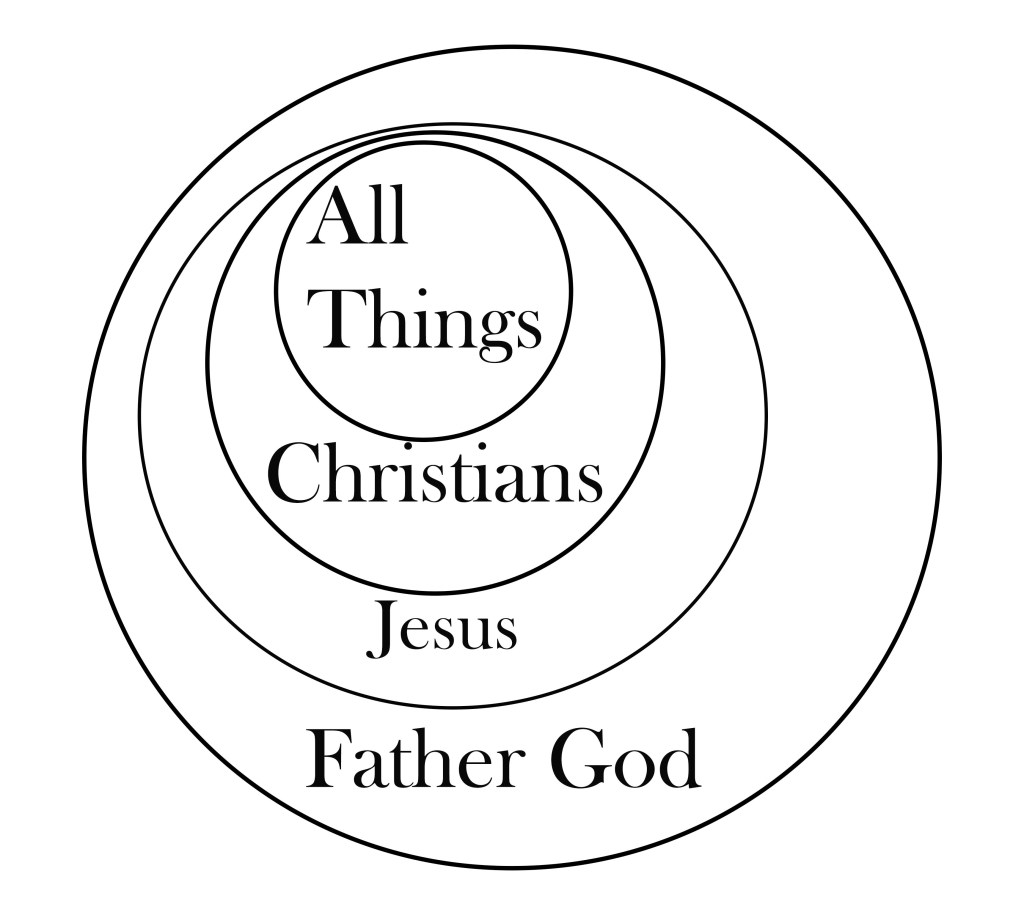
Our identity in Christ means we have inherited all things. Reality itself belongs to us. Remember our earlier diagram. It is true that all reality belongs to Jesus. Yet, God has so highly exalted, glorified and positioned us in Christ, that instead of “reality” being contained in Jesus as a subcategory, “reality” now belongs as a subcategory in us. This is why we can apply all the stories in the Scripture to ourselves for our benefit. All things are ours. And we are Christ’s. And Christ is the Father’s.

We are discussing this in the ethic section of the book, because it is not a suggestion to live and walk in our new identity in Christ. It is a command. It is good ethics to read the Psalms and apply them to yourself. Psalm 103 is yours. Use it! The Exodus story is yours. Use it. The judges and prophets are yours. Apply them to yourself. And do it over and over.

We are to understand how all things are ours and walk in our new definition. Part of this walking is to use biblical examples and apply them to ourselves for instruction, growth and faith. Do not let religious elitists deceive you from using your inheritance. You can apply the bible to yourself, and if they keep hindering you, use your authority in Christ and hand them over to Satan to either repent or be destroyed.


[1] See Vincent Cheung, All Things Are Yours. This paragraph has paraphrased statements from this essay.

Free and bold access.

“..We can boldly enter heaven’s Most Holy Place because of the blood of Jesus… Since we have a great High Priest who rules over God’s house, let us go right into the presence of God with sincere hearts fully trusting him. For our guilty consciences have been sprinkled with Christ’s blood to make us clean, and our bodies have been washed with pure water. Let us hold tightly without wavering to the hope we affirm, for God can be trusted to keep his promise.”
(Hebrews 10:19-23. NLT)

“Let us therefore come boldly to the throne of grace, that we may obtain mercy and find grace to help in time of need.”
(Hebrews 4:16 NKJV)

 “Set your minds on things above, not on earthly things.  For you died, and your life is now hidden with Christ in God.”
(Colossians 3:3-5)

Our new identity includes boldly walking into the throne room of heaven. Only family insiders have this identity.  

Think about being a guest of the king. You are standing with some other nobles in the throne room off to the side talking. You are only there by request of the King. You do not come and go before the king as you wish. Now imagine you suddenly hear the doors of the throne room open. This surprises you because you did not hear the king’s chamberlain give announcement of anyone else being invited by the king. A young man walks through, but then continues directly to the throne itself. The young man does not even announce himself or do any of the formal greetings or acknowledgements that you a noble had to do when you entered before the king’s presence. The young man walks up to the king and the king has a smile on this face. The man asks the king for a beautiful piece of property to build a house on. The king says, “it is yours.” Who is this man? The man says, “thank you father.” Ah! This young man is an insider, he is a son.

According to Hebrews this young man is you, and the king is God. Angles and other created beings will never be children of God as we are. We are family insiders. They can only watch and imagine what it would mean to be a child of God. We live the reality of being children of God.

Hebrews says that not only can we go to God’s throne room, but we can come with “confidence” and even “boldness.” This is like going to the throne unannounced and still approach with boldness. We can push open the doors to the throne room and walk with our heads held high as a beloved prince of heaven. Only loved insiders have this access.  We have such access.

The passage says we are to be conscience of the fact we are clean, holy and righteousness in God’s sight as we approach Him. Faith isn’t being conscience of our feelings or thoughts, but God’s feelings and thoughts. God thinks we are completely clean and pure in His sight. This is faith’s focus. A righteous noble, even if clean, cannot boldly approach like a beloved child. And so, beyond being clean and pure, God thinks we can boldly approach Him like a beloved child. This is what faith focuses on.

The passage goes on to say we can boldly approach to ask for help and have confidence to receive God’s help. Chapter 4 does not say we only ask, but who knows if our Father will help us. No. It says to boldly approach to “receive” help. As Vincent Cheung says in “The Absurd Idea of Need,” a need is anything you want. And Jesus defines a good father as giving a fish for a fish. Thus, this bold approach is going to King to receive what we want and our Father with gladness granting our request. Any thing less than this, is therefore, by definition not boldly approaching God with confidence, in light of Jesus finished atonement.

This is how the bible defines our relationship with our God.

Colossians says our lives are currently hidden with Jesus in heaven. In God’s mind, He considers us already part of Jesus’ body and as children of God. God’s thoughts and power are one and the same thing. What God thinks is reality, or becomes reality. Thus what God thinks in the most important thing. We are already so clean, glorified and exalted by God, that He thinks we are with Jesus even now. And so we are.

When we pray, we are already in heaven with Jesus. God considers us already there with His Son. God is not distant. He is near to us, and we are already near to Him. This is our new eternal identity.

Whether a Christian utilizes this new identity and bold access to God, in powerful application, is another issue; but the fact remains, we do have this bold access and we are already with Jesus as children of God.

Outsiders Beg; Kings Command

“…It is taught (from Characteristics) that a one-time prayer is enough, and all other prayers after should be in thanksgiving. I found this useful when I first followed the WOF, because Reformed prayer is just begging in unbelief...”

Read Vincent Cheung, The Extreme Faith Teacher.

This is the standard of faith and the immediate effects that come from a single prayer of faith. This is the standard Jesus held His disciples to. This is the same standard He will hold us to. This is the standard of faith and its effects we will be judged against. There is only one definition for what faith and its effects look like, and that glory belongs to scripture alone. This standard is not just a suggestion, it is a command. If you love God you will obey it, if you hate God you will disobey it. This is not rocket science.

I understand the context of a person coming from a teaching of unbelief and then hearing the many voices of the charismatics and Word of Faith. They are broadly correct on the topic of faith, but have many wrong points that come from Arminianism and self-imposed narrow applications that do not belong to Scripture (such as the 5 or 9 fold gifts of the Spirit ministry). With that said, this idea of faith is simple enough for a child to grasp, and so, one ought to be ashamed theologians can confuse them.

The reformed prayer is a beggar’s prayer, and this is why they see no results. Begging is for those who are outsiders of God’s contract. Insiders relate to God differently. I am glad you see this. Faith is “confidence” or “absolute certainty” God will do what He promised. One man asked Jesus, “if you can,” and Jesus was offended and said, “if I can?” Jesus never commanded us to “beg for the things we want.” Jesus commanded us to speak His Name in faith and make demons scream and mountains fly. The difference is huge. We are children of God. Children do not beg as if they are outsiders sitting abandoned on the road. Some theologians are indeed outsiders to God’s Contract and so all they can do is beg, and then try to deceive God’s children in following their outsider behavior. Yet we are indeed children of God. We sit at His table as co-heirs with Christ. Children ask the Father for a fish and they get a fish. They ask for the Spirit of God (can anyone put a value on the Spirit of God?), and the Father will absolutely give this to His sons and daughters. He will withhold nothing good from you. And “good” is defined by Jesus, as asking what you want and God giving this to you. The bible is the only definition of reality. Only God defines good and evil. God defines good as asking whatever you want and God giving it to you. This is good, because God thinks so.

In fact, we reign as kings in this life through the credited righteousness of Jesus and His unmerited favor (Romans 5:17-21). A king who begs is not a king. A king who does not speak is not a king. A king who does not decree is not a king. A king decrees and it happens. Royalty commands, and they are obeyed. “YOU will say… [then] nothing will be impossible to YOU, (Matthew 17:20).” “If YOU have faith … it will obey YOU, (Luke 17:6). When gods speak, reality obeys THEM.

Of course, it is God power at work in us, and not own power, but because the Bible rejects pantheism, when WE speak it is us, NOT God. Thus, reality will obey us when we speak in faith.

The basic idea is simple: read the promises, meditate on the promises, decree (in Jesus Name) the promises over yourself and then thank God for giving you the things you prayed/proclaimed. Some charismatic fools can get narrowly hung up on saying, “once you do this only keep thanking God for the results and do not pray the prayer again.” This comes from an overzealous fear of words. As Numbers 13-14 shows, you need to be careful with your words. (see Vincent Cheung, The Edge of Glory). If you speak unbelief, then God will give the evil you spoke; yet, if you speak faith, God will give the good you spoke. However, the bible says more about this. Consider David in Psalm 31:22 spoke a word of unbelief, but God helped Him.  Obviously, David repented and re-asked for help and God helped him. Peter denied Jesus 3 times, but then re-affirmed his devotion and God received him back. This is the big idea, unbelief is strong, but a word of faith is stronger. If you made a mistake, turn around and speak the word of faith again, and God will help you. The Word and Spirit are stronger. A Confession of Faith is much stronger. Do not fear.

Also, Jesus directly commands that we pray and never give up. Thus, to say you cannot repeat your prayer, is a direct rebuttal of Jesus Himself. Jesus had to pray for a blind man twice. A person with “great faith” and who as developed a mature faith will indeed speak short one time prayers or confessions and will often see it happen immediately. We are all to strive for this level of power and faith. We will all give an account for how well we sought to obey Jesus in acquiring this standard of faith. Here is the big idea, if we had perfect faith, then we would only need one prayer for all things, but even then there might be a few exceptions, like Jesus praying for the blind man. But since no one has perfect faith, we are commanded to pray in a group (when two or three are gather..) we are commanded to have our elders come and pray with us, and we are given the gift of faith to help compensate for our imperfect faith.  God loves us so much that He has given us many tools to help us get the things we ask for. He wants to give you many good things. He is more than willing and able.

Thus, many charismatic teachers teach faith in practical steps (although flawed), to help struggling saints develop faith. Thus, we have two categories. One is the standard of faith as taught by Jesus, and the Second are pastors giving practical steps in how to get to that standard. Do not confuse the two. Some of these steps are not commandments, but can be helpful tools, and yet others are just wrong.

Back to our basic teaching, “read the promises, meditate on the promises, confess/pray the promises and (if you need to wait), then thank God for granting your request. This is great teaching. However, some say only repeat the last one, but as shown above, this is not necessarily so. Sometimes it is better to repeat the whole process. Maybe your mind is not renewed enough, and you need to establish the promises in your mind more. Thus, the practical application of this does depends on person to person, but the overall biblical applicable is the same for all.

Another reason why the advice to never repeat your prayer, but only give thanks, is bad, is because it puts the focus man and brings up fear. It puts the focus on you and then fear comes from this. Giving thanks for the prayed outcome is great, but if your mind is not renewed as it ought to be, then just giving thanks will not work (although, God still might grant it out of sheer kindness). You do need a honest self-evaluation, but remember that the focus of faith is God, His Word, His faithfulness and His love toward you. If you are focused on your self-evaluation and feelings, then by definition you are not in faith any more. Often, when developing faith and even keeping it, you need to re-read the promises, re-meditate and then on this foundation pray, and faith will naturally arise by God’s power.

Because Jesus wants you to have the things you pray for, He made it a command to pray and never give up. Stop and think about that for a moment. He wants you to have your request so much, He commanded that you never give up. He promises God will absolutely give you what you ask for. This is how much He loves you. He wants you to have the things you pray for, more than you do. Thus, it is not God you need to convince to give you what you ask; rather, it is your stubborn mind and unbelief, that needs convincing. God has already convinced Himself to give you whatever you ask for in faith. Thus, if there is a lack of results, it is not on God’s part, but you. So, in the confidence of God’s love for you re-read the promise, re-meditate and re-confess the promises of God.  

The important thing to do when praying is to not hedge your prayer in uncertainty and unbelief. Leave no room for your prayer to not be answered, because God has already convinced Himself to give you what you ask. This is essentially what a Word of Faith declaration is. It is a short-hand prayer that knows the outcome is certain. Thus faith speaks this way, “In the name of Jesus Christ of Nazareth, standup and walk.” No fear, no hedging. Just absolute confidence in God doing what He said He would do. And if you have read the gospels, Jesus loved this kind of faith. In fact, Jesus publicly boasted about such people before God and men. And if you have this kind of faith, Jesus will boast and exalt you before God and men. Imagine, the God of Gods and the King of Kings exalting you. Surely there is nothing greater in all reality.