Category Archives: Christian Logic

Logic Lesson – Categorical vs. Hypothetical. James Creighton

By: James Creighton
§ 41. Relation of Categorical and Hypothetical Arguments.
— It is evident that the form of the hypothetical syllogism is very different from that of the categorical. But, although this is the case, it must not be supposed that with the former we have passed to a new and wholly distinct type of reasoning. In hypothetical reasoning, as in categorical, it is the presence of a universal principle which enables us to bring into relation two facts which formerly stood apart. Indeed, in many cases, it is a matter of indifference in which form the argument is stated. Thus, we may argue in hypothetical form: —
.
If a man is industrious, he will be successful,
A is an industrious man,
Therefore A will be successful.
.
The same argument may, however, be expressed equally well in categorical form: —
.
All industrious men will be successful,
A is an industrious man,
Therefore A will be successful.
.
It is clear that, in spite of the different forms in which the argument is expressed, the reasoning is essentially the same in both cases. The middle term, or general principle which makes it possible to unite the subject and predicate of the conclusion, in the hypothetical as well as in the categorical syllogism, is ‘ industrious.’ A will be successful, we argue, because he is industrious, and it is a rule that industrious men are successful.
Moreover, if an argument is fallacious in one form, it will also be fallacious when expressed in the other. The defects of an argument cannot be cured simply by a change in its form. When an hypothetical argument, in which the antecedent is denied, is expressed categorically, we have the fallacy of the illicit major term. Thus, to state the example of denying the antecedent given on page 146, we get: —
.
The case of his being well is a case of his writing,
The present is not a case of his being well,
Therefore the present is not a case of his writing.
.
Similarly, when an argument in which the consequent is affirmed is changed to the categorical form, the defect in the reasoning appears as the fallacy of undistributed middle —
.
If this tree is an oak, it will have rough bark and acorns,
This tree has rough bark and acorns,
Therefore it is an oak.
.
When this argument is expressed in categorical form, it is at once clear that the middle term is not distributed in either the major or minor premise: —
.
All oak trees are trees having rough bark and acorns,
This tree is a tree having rough bark and acorns,
Therefore this tree is an oak.
.
The change from the categorical to the hypothetical form of argument, then, does not imply any essential change in the nature of the reasoning process itself. Nevertheless, it is important to note that hypothetical propositions and hypothetical arguments emphasize one aspect of thinking, which is entirely neglected by the theory of the categorical syllogism. When dealing with the extension of terms (§ 16), we pointed out that every term, as actually used in a proposition, has both an extensive and an intensive function. That is, the terms of a proposition are employed both to name certain objects or groups of objects, and to connote or imply certain attributes or qualities. In the proposition, ‘ these are oak trees,’ the main purpose is to identify the trees given in perception with the class of oak trees. When, on the other hand, we say,’ ignorant people are superstitious,’ the proposition does not refer directly to any particular individuals, but states the necessary connection between ignorance and superstition. Although the existence of ignorant persons who are also superstitious is presupposed in the proposition, its most prominent function is to assert a connection of attributes which is wholly impersonal. We may perhaps say that, in spite of the categorical form, the proposition is essentially hypothetical in character. Its meaning might very well be expressed by the statement,’ if a man is ignorant, he is also superstitious.’ What is here emphasized is not the fact that ignorant persons exist, and are included in the class of superstitious persons, but rather the general law of the necessary connection of ignorance and superstition. The existence of individuals to whom the law applies is, of course, presupposed by the proposition. It is not, however, its main purpose to directly affirm their existence.

Creighton, James Edwin, 1861-1924

An Introductory Logic.

https://archive.org/details/introductorylogi00crei/page/n6

Martin Luther- The Bondage of the Will – Commentary

Martin Luther. The Bondage of the Will.

Quotes from, unless noted are from, Martin Luther, The Bondage of the Will; translated by J. I. Packer and O. R. Johnston; Fleming H. Revell ,1957


Martin’s argument in a quick summary. It seems to me it is constructed like a large fortiori argument. He defends the lesser in greater length, (relative level) to say you ought to accept the greater(ultimate), since the same conclusion is in both, which is, there is no free-will. But if you do, then how much more is the point made?

 God is the ultimate cause of all things directly and absolutely. That is, in philosophy verbiage, Christian ontology is God’s direct causality over all things, even evil. And so God is the author—on the ontological level—of all things including good and evil. God directly causes Satan to will evil, as directly as He causes a Saint to will to do good. However, if this seems too much for you right now, then consider it on the relative level. Man, relative to Satan’ power and their own inward evil heart is not free to will contrary to these masters. Also, the Saints in heaven, are not free to will to do evil. They are under the motion and master of God’s Spirit to do good. Their wills are non-effective to resist the Spirit’s control.  Thus, man’s will is non-effective against relative things such as Satan control, their sin nature’s control, and for saints, the Spirit’s control. Thus, for man’s will to be effective it must be free, but it is non-effective against its masters. Non-effective effective is nonsense. Thus, a non-freewill freewill is nonsense. However, since this is true, then why resist the Scripture’s teaching on the Ultimate level? For it would result in the same conclusion, that man will is non-effective.

Yet, for the God’s chosen they will be saved, sanctified and glorified. They will enjoy happiness without end, for God’s will is indeed very effective toward His chosen ones.

The end result then? Argumentum a fortiori. If man on the lesser “relative level” is not-free to sin and Satan, or to the Spirit of Life, then how much more is man not free on the “ultimate level,” when God is the only direct cause of all things? If man’s will is non-effective on the lesser, then how much more is it non-effective to the greater! Also, if God’s will is so effective when considered on the lesser relative level, and not from His position, then how much more is God’s will effective over all things when considered on the Ultimate level where He alone directly controls all things?


“So that which we call the remnant of nature in the ungodly and in Satan, as being a creature and a work of God, is no less subject to Divine omnipotence and action than all the rest of God’s creatures and works. Since God moves and works all in all, He moves and works of necessity even in Satan and the ungodly (204). [i.e. on the ultimate level God directly works evil in creatures as he does good in creatures.]

Here you see that when God works in and by evil men, evil deeds result; yet God, though He does evil by means of evil men, cannot act evilly Himself, for He is good, and cannot do evil; but He uses evil instruments, which cannot escape the impulse and movement of His power. The fault which accounts for evil being done when God moves to action lies in these instruments, which God does not allow to be idle. In the same way a carpenter would cut badly with a saw-toothed axe. Hence it is that the ungodly man cannot but errand sin always, because under the impulse of Divine power he is not allowed to be idle, but wills, desires and acts according to his nature (204).” [i.e. God created man—after Adam—with an evil nature. So on the relative level man wants evil, but the on ultimate ontology level God picks up this defective hammer, and by direct causality this defective hammer is moved and cannot but move when God moves it. Because it is defective and damaged it hammers badly, and so it is judge and defined as bad by God’s command.]

“So God’s hardening of Pharaoh is wrought thus: God presents from without to his villainous heart that which by nature he hates; at the same time, He continues by omnipotent action to move within him the evil will which He finds there. Pharaoh, by reason of the villainy of his will, cannot but hate what opposes him, and trust to his own strength; and he grows so obstinate that he will not listen nor reflect, but is swept along in the grip of Satan like a raging madman (207) [i.e. on the relative level Pharaoh wants to be bad. On the ultimate level, Pharaoh cannot resist God’s direct causality upon him and upon Satan.]

[Pharaoh’s] evil will would not have been moved or hardened of itself, but as the omnipotent Agent makes it act by means of his own inescapable movement.(207)” [.i.e. Ultimately, God is the author of evil, by direct causation]

“Had there been in Pharaoh any power to turn, or freedom of will that might have gone either way, God could not with such certainty have foretold his hardening” (211). [i.e. God foreknew because God predestined first. ]

“It is true that Judas acted willingly, and not under compulsion, but his willing was the work of God, brought into being by His omnipotence, like everything else.(213)” [i.e. God the author of evil, by direct causation]

“Paul teaches that faith and unbelief comes to us by no work of our own, but through the love and hatred of God (228).” [God the author of all good and evil, of all things by direct causation]

“What I assert and maintain is this: that where God works apart from the grace of His Spirit, He works all things in all men, even in the ungodly; for He alone moves, makes to act, and impels by the motion of His omnipotence, all those things which He alone created; they can neither avoid nor alter this movement, but necessarily follow and obey it, each thing according to the measure of its God-given power. Thus all things, even the ungodly, cooperate with God(267).” [God the author of all good and evil, of all things by direct causation]

“The king’s will cannot escape the action of the omnipotent God by which all men’s wills, good and bad, are moved to will and to act (259).” [God the author of all good and evil, of all things by direct causation]

“I answer: Whether God permit, or whether He incline, that permitting or inclining does not take place without the will and operation of God: because, the will of the king cannot avoid the action of the omnipotent God: seeing that, the will of all is carried along just as He wills and acts, whether that will be good or evil (10c Discussion: Second Part (Sections 114 – 130).” [God the author of all good and evil, of all things by direct causation]

It would certainly be a hard question, I allow-indeed, an insoluble one-if you sought to establish both the foreknowledge of God and the freedom of man together; for what is harder, yea, more impossible, than maintaining that contraries and contradictories do not clash? (215) [ free-will and God’s sovereignty are contradictions]

The apostle, therefore, is bridling the ungodly who take offense at his plain speaking, telling them they should realize that the Divine will is fulfilled by what to us is necessity, and that it is definitely established that no freedom or “free-will” is left them, but all things depend on the will of God alone (215).

What God wills is not right because he ought, or was bound, so to will; on the contrary, what takes place must be right, because he so wills it” (209). [There is no law over God. God’s Ethic is His ‘Choice’ or ‘Decree’ itself]

What does Luther say to Erasmus about this issue of God’s absolute and direct sovereign control, over man’s will and yes, even evil?

I give you hearty praise and commendation on this further account-that you alone, in contrast with others, have attacked the real thing, that is, the essential issue. You have not wearied me with those extraneous issues about the Papacy, purgatory, indulgences and such like trifles. . . . You, and you alone, have seen the hinge on which all turns, and aimed for the vital spot (319).


” Heap together, therefore, out of the large Concordances all the imperative words into one chaos, provided that, they be not words of the promise but of the requirement of the law only, and I will immediately declare, that by them is always shown what men ought to do, not what they can do, or do do. And even common grammarians and every little school-boy in the street knows, that by verbs of the imperative mood, nothing else is signified than that which ought to be done, and that, what is done or can be done, is expressed by verbs of the indicative mood.

Thus, therefore, it comes to pass, that you theologians, are so senseless and so many degrees below even school-boys, that when you have caught hold of one imperative verb you infer an indicative sense, as though what was commanded were immediately and even necessarily done, or possible to be done.[1]

[i.e. God’s command imposes responsibility, not freedom to do. “Ought to do,” is Ethics, and “can do,” or necessarily done,” is ontology.  So that God’s command/ethics does not include the power in man to do it.  These are different categories of systematic theology/philosophy. This phrase, “necessarily done,” is like the sophist’s saying, “necessary immutability,” i.e. ultimate ontology. Thus, Martin did include in this category contrast, Ethics versus ultimate ontology.]


“But what do they effect by this playing upon words” This is no more than saying, the act is not God Himself. This remains certain, that if the action of God is necessary, or if there is a necessity of the consequence, everything takes place of necessity, [then] how much [more] the act be not God Himself. But what need was there to tell us this? As though there was any fear of our asserting the things done were God Himself….” [2] [i.e. God is not what He causes. If God creates a river and directly causes it to move north, then God Himself is not a north flowing river. The same with men and their good and evil choices that God directly causes. Or if God causes a man to choose evil, then God is not that.]

“And what is the design of the apostles in proving their preaching by the Scriptures? Is it that they may obscure their own darkness by still greater darkness? What was the intention of Christ, in teaching the Jews to “search the Scriptures” (John v. 39,) as testifying of Him? Was it that He might render them doubtful concerning faith in Him? What was their intention, who having heard Paul, searched the Scriptures night and day, “to see if these things were so?” (Acts xvii. 11.) Do not all these things prove that the Apostles, as well as Christ Himself, appealed to the Scriptures as the most clear testimonies of the truth of their discourses? With what face then do we make them ‘obscure?’  [.i.e. The Scripture interrupted themselves and are revealed to be clear and precise to man about knowledge of God.]

Are these words of the Scripture, I pray you, obscure or ambiguous: “God created the heavens and the earth” (Gen. i. 1). “The Word was made flesh.” (John i. 14,) and all those other words which the whole world receives as articles of faith? Whence then, did they receive them? Was it not from the Scriptures? And what do those who at this day preach? Do they not expound and declare the Scriptures? But if the Scripture which they declare, be obscure, who shall certify us that their declaration is to be depended on? Shall it be certified by another new declaration? But who shall make that declaration?— And so we may go on ad infinitum.

In a word, if the Scripture be obscure or ambiguous, what need was there for its being sent down from heaven? Are we not obscure and ambiguous enough in ourselves, without an increase of it by obscurity, ambiguity, and darkness being sent down unto us from heaven? And if this be the case, what will become of that of the apostle, “All Scripture is given by inspiration of God, and is profitable for doctrine, for reproof, for correction?” (2 Tim. iii. 16.) Nay, Paul, thou art altogether useless, and all those things which thou ascribest unto the Scripture, are to be sought for out of the fathers approved by a long course of ages, and from the Roman see! Wherefore, thy sentiment must be revoked, where thou writest to Titus, (chap. i. 9) ‘that a bishop ought to be powerful in doctrine, to exhort and to convince the gainsayers, and to stop the mouths of vain talkers, and deceivers of minds.’ For how shall he be powerful, when thou leavest him the Scriptures in obscurity—that is, as arms of tow and feeble straws, instead of a sword? And Christ must also, of necessity, revoke His word where He falsely promises us, saying, “I will give you a mouth and wisdom which all your adversaries shall not be able to resist,” (Luke xxi. 15.) For how shall they not resist when we fight against them with obscurities and uncertainties? And why do you also, Erasmus, prescribe to us a form of  Christianity, if the Scriptures be obscure to you![3]  [ i.e. Erasmus, You contradicted yourself. LOL. This is like saying all propositions are uncertain. If that is the case, then that proposition is uncertain]

“ [Erasmus correctly quotes Martin saying], “That whatever is done by us, is not done by Free-will, but from mere necessity. And that of Augustine also—that God works in us both good and evil: that He rewards His good works in us, and punishes His evil works in us.”[4] [i.e. God ultimately is the only cause, and judges us by His commands, from the causality He worked in us]

“But, by necessity, I do not mean compulsion; but (as they term it) the necessity of immutability, not of compulsion; that is, a man void of the Spirit of God, does not evil against his will as by violence, or as if he were taken by the neck and forced to it, in the same way as a thief or cut-throat is dragged to punishment against his will; but he does it spontaneously, and with a desirous willingness.”[5] [i.e. “necessity of immutability” is saying Ontology on the ultimate level is God’s direct causality over all things. And “not of compulsion,” is saying on the relative level man does what he wants to do from his own soul.]

“Therefore, to say, that the will is FREE, and that it has indeed power, but that it is ineffective, is what the sophists call ‘a direct contrariety.’ As if one should say, “Free-will” is that which is not free. Or as if one should term fire cold, and earth hot. For if fire had the power of heat, yea of the heat of hell, yet, if it did not burn or scorch, but were cold and produced cold, I should not call it fire, much less should I term it hot; unless, indeed, you were to mean an imaginary fire, or a fire represented in a picture.—But if we call the power of “Free-will” that, by which a man is fitted to be caught by the Spirit, or to be touched by the grace of God, as one created unto eternal life or eternal death, may be said to be; this power, that is, fitness, or, (as the Sophists term it) ‘disposition-quality,’ and ‘passive aptitude,’ this I also confess. And who does not know, that this is not in trees or beasts? For, (as they say) Heaven was not made for geese.

Therefore, it stands confirmed, even by your own testimony, that we do all things from necessity, not from “Free-will:” seeing that, the power of “Free-will” is nothing, and neither does, nor can do good, without grace.”[6] [i.e. A contrariety is that the truth of one means the falsity of the other, thus, a non-effective effective will is nothing and nonsense. Like a contradiction they cancel each other out, so that there is no knowledge; there is nothing to affirm or deny, nothing.  Also, if the man’s will is non-effective on the relative level against the sin-nature and Satan, then how much more on the (necessity of immutability) ultimate level where God directly controls man’s mind, directly controls the sin-nature and directly controls Satan’s will?]

“And thus, as soon as he presented to it outwardly, that which naturally irritated and offended it, then it was, that Pharaoh could not avoid becoming hardened; even as he could not avoid the action of the Divine Omnipotence, and the aversion or enmity of his own will.” [7] [ i.e. Martin speaks both of the Ultimate and Relative level regarding man’s will. Man’s will is not free on the ultimate level of God’s directly causality, “could not avoid the action of the Divine Omnipotence.” And man’s will even on the lesser relative level, cannot avoid the “aversion of their own enmity, or if saved, the Spirit’s law of life.” Again, if man on the lesser relative level is not-free to sin and death, or to the Spirit of Life, then how much more is man not free on the ultimate level when God is the only direct cause of all things. That is, if man’s will is non-effective on the lesser, then how much more to the greater!]


Endnote———————

[1] Martin Luther. Bondage of the Will. Translated by Henry Cole. 2009 kindle eBook.

[2] Martin Luther. Bondage of the Will. Translated by Henry Cole. 2009 kindle eBook.

[3]   Martin Luther. Bondage of the Will. Translated by Henry Cole. 2009 kindle eBook.

[4] Martin Luther. Bondage of the Will. Translated by Henry Cole. 2009 kindle eBook

[5] Martin Luther. Bondage of the Will. Translated by Henry Cole. 2009 kindle eBook

[6] Martin Luther. Bondage of the Will. Translated by Henry Cole. 2009 kindle eBook

[7] Martin Luther. Bondage of the Will. Translated by Henry Cole. 2009 kindle eBook

Romans 8:28-30 – Logical Chain Argument

Romans 8:28-30

A logical chain argument, or, a Categorical Sorites.

Rom. 8:28-30 LEB

  1. And we know that all things work together for good for those who love God, for those who are called according to his purpose,
  2. because those whom he foreknew [i.e. Foreloved], he also predestined to be conformed to the image of his Son, so that he should be the firstborn among many brothers.
  3. And those whom he predestined, these he also called, and those whom he called, these he also justified, and those whom he justified, these he also glorified.[1]

[Author’s Note: the ordering below is a combination of logical ordering, (terms 1, and 2), and then historical order of the decrees. I normally do not do this when making a syllogism, because of the added complexity when teaching, but used it this way for the use of the predicate logic.  See end note below for more information.
For more see my post, The Order of the Decrees]

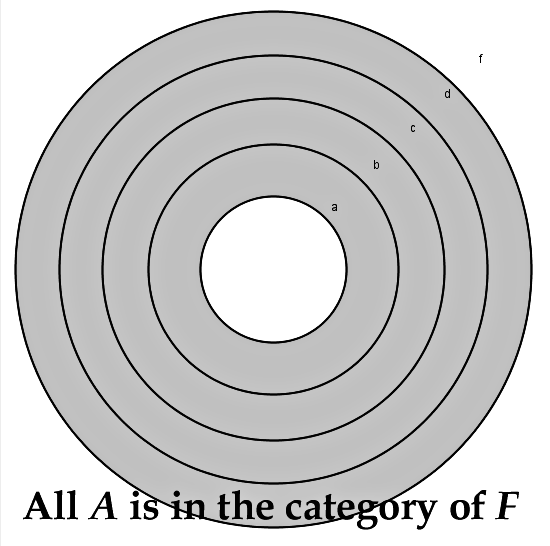
The logical deduction Paul uses here is called a Sorites. This is simply a normal bullseye syllogism (i.e. A.A.A, where A is a proposition that = All Subject is in the Predicate),  but it continues to add additional categories, where the previous category is placed inside the next one.  (All A is inside of B, and all B is inside of C; Thus, all A is inside the category of C.)  What needs to happen is that the predicate of the previous proposition needs to be the subject of the next with affirmative propositions. This will create a circle diagram where one circle will be placed in the next. The circles do not lie; they give a visual demonstration of the deduction; to show if it is invalid or not. In this case, it is valid. Because this is a normal AAA bullseye type syllogism but only longer (i.e. A.A.A.A.A.), one is able (if the sorites is done correctly) to take any two premises and form an independent AAA syllogism.

There are exceptions for a particular premise, for a negative one, and when it is stated in the form of a hypothetical (If P, then Q) but that is for another time.  Also, this type of syllogism may be stated in a reverse format. [2]

The form looks like this with a 6 premise sorites.

All A is inside the category of B

All B is inside the category of C

All C is inside the category of D

All D is inside the category of E

All E is inside the category of F

Thus, All A is inside the category of F.

A to F Sorites

I see examples of other people mentioning this sorites in Romans 8:30, however, they are prone to leave out verse 29, and thus only make this a 4-premise syllogism. This is a mistake, because the first premise comes from verse 29; and thus, the syllogism is in fact 5 premises.

At any rate, the first premise starts with, Those whom God foreloved are those He predestined.” The rest of the verse gives us extra insight as to what this predestination results in for both Jesus and for the ones predestined; however, this is not relevant for the immediate syllogism being made by Paul,  because the next verse simply picks up at the category of,  “whom He predestined … .” The predicate of premise is the subject of the starting premise in verse 30.  Paul does not give the conclusion of this syllogism.  However, in my experience of reading Paul he normally does gives the conclusion. I suspect that he does not here simply because he so exactly spells out the rest of this enthymeme sorites that the conclusion it is not needed, for it is obvious.

In summary, we are told all things work for our good who are called by God in verse 28. Paul then gives a sorites to show the undeniability of this reality. We are told from the initial love of God to glorification the saints are directed by God’s decree to love them, and that this decreeing leads to a good end, without any falling through the cracks or mishaps. Whom God foreloves He glorifies.  God direct and absolute sovereignty is the totality of all Christian metaphysics and ontology.  Soteriology is in fact a sub-category under metaphysics. That is, it is how God uses existence and causality toward this particular group of elect persons.

Also, it is in this syllogism that Paul shows the reality of verse 28’s category of “the called.” Paul shows us that this category needs to be seen in the larger logical and metaphysical reality of God’s decrees.  He desires for them to see it all put together in a chain argument. Here we find being “Called” is in the middle of the decreeing, and that the decree starts with being foreloved first, and then finally ends –without fail—being glorified with Christ.

See my article called,The Order of the Divine decrees to see how this fits together in an even larger view of the Divine Decrees.  Foreloved would be in decree 2. Predestination would be decree 3. Called would be 8. Justification would be 9. And Glorification would be point 10.

(A) Those whom God foreloved are (B) those whom God predestined.

(B) Those whom God predestined are (C) those whom God called.

(C) Those whom God called are (D) those whom God justified.

(D) Those whom God justified are (E) those whom God glorified.

Therefore, (A) those whom God foreloved are (E) those whom God glorified.

Predicate Logic.

Chain syllogism Rule for Natrual Deduction

 HCS = Hypothetical Chain Syllogism rule for Natural Deduction. (see pic)

Terms:

L = Foreloved. g = God. P=predestined. C = Called. J = Justified. G = glorified. s = Sally.

For every x, if x is fore-loved by God, then x is predestined by God; and, if x is predestined by God, then x is called by God; and if x is called by God, then x is Justified by God; and if x is Justified by God, then x is glorified by God.

1. Ɐx (Lgx ⸧ Pgx) • Ɐx(Pgx ⸧ Cgx ) • Ɐx (Cgx ⸧ Jgx) • Ɐx (Jgx ⸧ Ggx )
2. Lgs         ⸫ Ggs
3. (Lgs ⸧ Pgs) • (Pgs ⸧ Cgs ) • (Cgs ⸧ Jgs) • (Jgs ⸧ Ggs )       1,2 UI
4. Ggs         3. HCS

————————

[1] [] added by author.

[2] All A is B,  All C is A, All D is C,  All E is D, Thus, All E is B.


————–End NOTE—————

[cannibalized from the rough draft of my Systematic Theology book]

“Whom He foreknew,” is about fore-loving, and propositional understanding. When looking at where “foreknow,” is used in the bible it is almost exclusively used, (if not only), for God knowing His elect chosen ones and choosing to favor/love them. Therefore, it is said, Adam knew his wife Eve. Therefore, when texts say, the Father foreknew, it means God fore-loved this group of people. God pre-favored this group by choosing to conform them into the image of Christ. This is true both in respect when considering them as sinners, and as a “neutral lump of clay,” before they had done good or evil.

In Romans 8 Paul emphasizes the first original purpose for the Elect was not, the image of Adam, or even, “the image of God.” The First purpose was the “image of Jesus Christ.” The other decrees, came later and were for the supporting of this first one. Man’s image in the garden as the “image of God,” was good and perfect, but basic. Adam was not the “righteousness of God” like Jesus was, yet this is what the original goal of God was for His chosen ones. Thus, Adam the steppingstone, started elect humans in their march to the image of Christ, who is the very righteousness, power, wisdom and glory of God.

Dear Christian, this was God’s original love for you, from the very beginning. He loves you that much. It was always a love of unmeasurable greatness for you. Speaking of the relative level, death, sin and Satan tried to steal this good purpose of God from you. Simply put. Satan failed and lost. Jesus won. God does not know what failure is; Satan does. God winning is like man being warm-blooded. It is God. He purposes, and then He accomplishes. The stronger man Jesus, stormed into Satan’s crib, beat him, bound him and plundered his house. He brought us out of the house of Satan, and conveyed us into the Temple of God. We can stay as long as we like. We are sons of God. We BELONG in God’s house! Think about that. A beloved child in God’s house, this goal is God’s heart and plan all along. He has always seen you in this way! For those who see His nature and plan, they purify themselves.

The “fore-loved” and “predestined” both are referring to the first intention of “these He also glorified.” The elect are covered with the weighty value of God’s lavished goodness for them. They are predestined to obtain this. Starting with Adam, God is molding the lives and choices of the elect to obtain this purpose of God. God favors them so that sin does not defeat them, like it does for the reprobate. God favors them, so that even if God causes them to be born in a bad place, with bad people, God causes them to hear and believe in His revelation. God denies such favor to the reprobate.

Romans 9 and Ephesian 1 tells us God’s first plan was to bless the elect with the riches of His love, grace and mercy. Thus the doctrine of a logical order of the decrees is already established. We are making this point because what will be extracted from this argument will not work unless this is a presupposition. When reading a historical order of God’s decree being executing, we know the reverse was the original logical order.

Thus, to say,

D.1. (A) Those whom God called are (B) those whom God justified.

D.2. (B) Those whom God justified are (C) those whom God glorified.

D.3. Thus, (A) those whom God called are (C) those whom God glorified.

This is a historical order. God calls and elect a person by the summons of the gospel. God then justified them, by erupting faith to believe the gospel. God then glorifies them by preserving them in this world and bringing them to Himself in heaven.

The last “C” term is the first of the logical order. The “A” is the last in logical order, but first in historical execution. Paul starts with “whom he predestined,” because He is establishing the historical execution, with the presupposition of a logical predetermined or “ predestined” goal He already has. The elect are predestined to value by becoming the image of Christ, and their being made the image of Christ, brings value to Christ. Thus, it is perfectly fine as a chain syllogism to start with, as Paul does “whom He predestined,” because the focus is on the numerical amount of a category.

When making a category truth claim the focus can be more on the attribute or the numerical number of something that belongs in that attribute. They both indirectly apply to each other, but they do not emphasis the exact same thing. Paul’s focus is on the same amount that is in the first group is in the last group. He is emphasizing the success of God’s predetermined purposes. God has a goal of a glorified man in Christ first. God logical worked backwards in decrees to make the happen. Next, God started the history of the world to work towards that goal. Paul’s focus is on the fact that with all this planning in logical order first, and working it out backwards in historical execution, God did not have one single mistake or failure. God does not know what failure is. All those predestined to be glorified in God’s plans, were successfully called, justified and glorified.  Therefore, your faith that nothing can separate you from the love of God is unshakable.

The syllogism above is in historical order, and not decreed ordered.  [There is the possibility of “Foreloved to predestined” is one big broad statement, and “predestined to glorification” is another argument showing the details for what “foreloved to predestined” means.] There are a few categorical statements about reality and a conclusion we are to apply to ourselves from this. This syllogism contains more than 3 premises and so it is a sortie, or chain syllogism.

Paul uses this chain of categorical truths as a foundation to say, “If God is for us then who can be against us?” Verse 28 is a very broad but powerful statement of God’s sovereignty over all providence about every aspect of our lives. God works all things for good, for His elect. After this Paul then gives this chain syllogism as summary (as a broad picture) of our salvation to show how this works.

One thing to remember about the order of God’s decrees is to remember that in a basic bullseye syllogism, the last circle is the first decree, and the smallest circle is the first executed/historical application of these decrees. However, Paul appears to use “predestination” in a time execution order in this passage. That is, in history, God’s thoughts of  “foreloving” and “predestination” are, historically in time, first in order before He acts, and therefore, in this way can be used as starting the historical order of the world. It is like an autobiography of a famous person saying, “on this day, I decided to do this or that.”  Thus, even in history, the day and time of an invisible thought or decision, comes first and is part of the history of such events. God’s thoughts are not linear, but when time started, when God created reality, at this earliest point in time, God’s thoughts are decided to forelove and predestine this group.

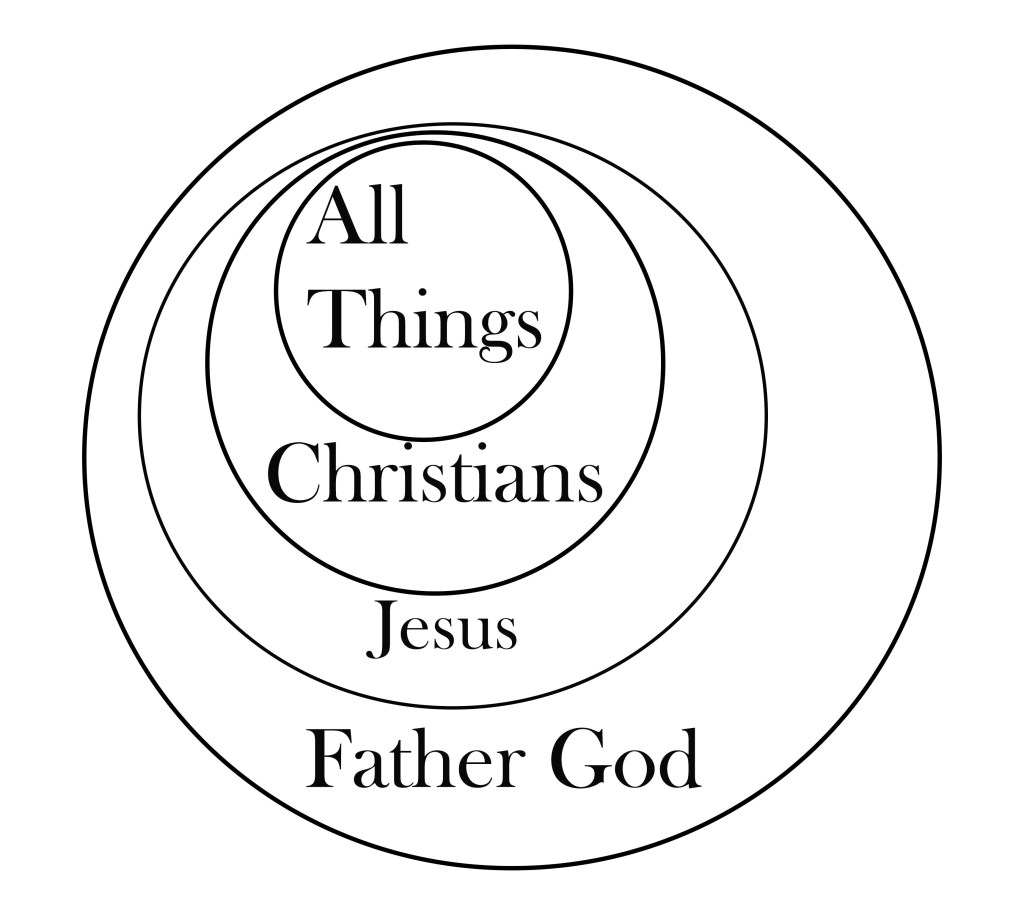
Therefore, this historical chain syllogism, might not be the best syllogism to show the nifty-piffy forward and backward visual of God’s decrees in a chain syllogism, (at least for some who are new to such thoughts). For example the syllogism in 1 Corinthians 2 says “(1) All things are ours. (2) We are Christ. (3) Christ is God’s,” and the conclusion would be “All things are God’s.” The larger circle going down to the smaller circle, is the logical order (the Decrees), but going from smaller to larger, is the historical execution.

Additional exercise. 

Since our focus is seeing the basics of God’s decrees, we will keep the syllogism to a historical order.  Paul speaking on the first-born status of Christ says, “And he is the head of the body, the church; he is the beginning and the firstborn from among the dead, so that in everything he might have the supremacy,” (1 Colossian 1:18 NIV.)  And so, we will use the term “supremacy” for “first born from the dead,” because this supremacy was the first purpose for Jesus that Father had.  Using this we will make a more straight forward historical order and can be used in reverse order for a logical order. 

D.1. (A) Those whom God called are (B) those whom God justified.

D.2. (B) Those whom God justified are (C) Those whom God glorified

D.3. (C) Those whom God glorified, are (D) Those whom God made in Christ’s image.

D.4. (D) Those whom God made in Christ’s image are (E) those whom God uses to display Christ’s supremacy.

D.5. Therefore, (A) those whom God called are (E) those whom God uses to display Christ’s supremacy.

Consider our diagram of from 1 Corinthians 3:23. This looks similar. In general, when said in a historical order (in context) the circles go from small to largest, and the logical purpose starts with the largest and goes to the smallest. Creation is for man’s glory.