
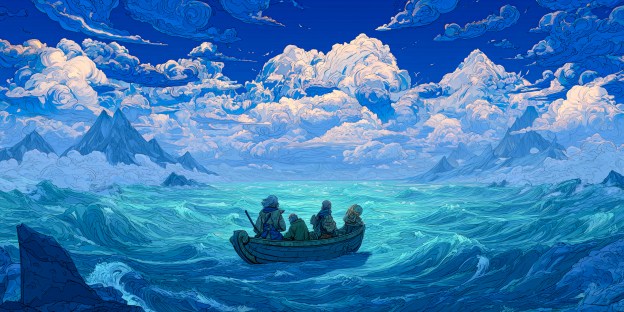
It was a real storm. Waves crashing over the boat. Disciples thinking, “We’re toast.” Jesus? Snoozing like it’s nap time. They wake Him in panic: “Lord, save us! We’re drowning!”
His reply? “Why are you afraid? You have so little faith!”
Then one word from Jesus and the wind and waves shut their mouths. Dead calm.
Humanly speaking, from a starting point of empirical observation, yeah, fear made sense. However, it only makes sense if you are without God and your worldview is human limitations based on human observation. But here’s the punchline they missed—and we can miss too if we are not watchful: you’re not just human anymore. That old man is dead and gone. You’re a child of God, blessed with Abraham’s blessing (Galatians 3:13-14), baptized into the same authority Jesus carried. You carry the Name that makes demons flee, sickness bow, and creation obey. That changes everything.
Picture it: you look up and a tornado is dropping on your house. You cry out, “God, help! Can’t You see I’m about to die?!” And Jesus opens a window to heaven and looks you dead in the eye—in front of your family and friends—and says, “Bro… why are you afraid? Don’t you have any faith?”
Ouch. Here is a question. Would you still follow Him if He rebuked you like this? I mean, Jesus didn’t even acknowledge your intense feelings; rather, Jesus was dismissive of them as stupid. The man Jesus is telling you to calm your emotions down. He says your faith is pathetic; and it is the cause of your fear. Because He’s the same yesterday, today, and forever. That same rebuke is also coming to you when you face a deadly storm or deadly whatever it is. He’s not being frank for mean’s sake—He’s reminding you of your identity in Him.
Here is the kicker. This is before the book of Acts, where we see the matured Peter, baptized in the Spirit and knowing his true identity in the enthroned Jesus, not merely the earthly Jesus, saying in Acts 3, “What I do have, I give, in the Name of Jesus. Get up.” He had the privilege, not as an apostle but as a believer, to use Jesus’ name to do what he so wanted. It was something Peter had and could give as he so wanted. But in the context of the storm, it is before the enthroned Jesus and the baptism of the Spirit. So what was Jesus presupposing to rebuke them for fear?
Psalm 91 specifically says that those who are hidden with God are not to have any fear. The Psalm lists all sorts of dangers and saying you are not to be afraid of them, then gives a situation like a bomb goes off and ten thousand dead bodies surround you, and even this is nothing to fear because God will protect you. The Psalm is not saying for you to bear the pain and destruction of the thing you fear, under the hand of God. No, it confesses you will be protected from them and nothing will touch you.
However, what we have in Jesus, in His promises to ask anything and get it, to do greater works, to speak to mountains and make them obey us, and the baptism of the Spirit with Jesus sitting at the right hand of power is greater.
Jesus’ presupposition is average, not wild: He expects you to stand up, speak to that “deadly” thing, and tell it to chill out and shut up. Because you’re special, a co-heir with Jesus and a royal priest with royal authority to use Jesus’ authority; because the promises already belong to you. Faith isn’t wishful thinking—it is agreeing with God that protection is your legal right to command the mountains to bow.
So next time the waves hit, skip the unbelief panic party. Believe Jesus and rebuke the wind. That’s your new normal as a Christian.
Let me press this deeper because Jesus’ question cuts straight to the heart of our new reality in Him. The disciples saw crashing waves and felt the boat filling with water. From pure human observation that fear felt right. But Jesus did not operate from observation. He operated from the Father’s word and the authority given Him. He expected the same from them even before Pentecost. How much more does He expect it from us now that we are new creations identified with the resurrected and enthroned Christ?
The problem was never the storm’s size. The problem was their little faith. They evaluated the situation from the old human point of view that Paul later condemns in 2 Corinthians 5:16-17. “So we have stopped evaluating others from a human point of view. At one time we thought of Christ merely from a human point of view. How differently we know him now! This means that anyone who belongs to Christ has become a new person. The old life is gone; a new life has begun!” The disciples had not yet fully grasped this shift. They still measured danger by sight and feeling instead of by the finished work and the promises that define us. Jesus slept because He knew reality submits to a man with faith, and it must obey the word of faith. When He rebuked the wind and waves, He was not begging the Father for help. He commanded creation directly. That is the model, and it is now ours in greater measure.
Today we have something far beyond what those disciples possessed in that boat. The old man is dead. We are new creations seated with Christ far above every storm (Ephesians 2:6, Colossians 3:1-3). The same Spirit that empowered Jesus now lives in us for greater works (John 14:12). The promises are all “yes” in Him (2 Corinthians 1:20). Psalm 1 guarantees success in everything when we meditate day and night on God’s word instead of the waves. This includes success over every storm that rises against us—literal or figurative.
Yet many believers still live like those pre-Pentecost disciples. A medical report comes like a sudden gale. A financial crisis hits like rogue waves. Relationship trouble crashes over the bow. And the first response is panic: “Lord, don’t You care that we’re perishing?” Here comes the frank truth—Jesus is still asking the same question: “Why are you afraid? You have so little faith.” He’s not being harsh. He’s being precise. Fear is unbelief wearing emotional makeup, trying to look spiritual while denying every promise God has spoken. It confesses that circumstances are bigger than the promises. It denies that you now carry the authority to speak to mountains and have them obey.
The correction is simple and powerful. Stop focusing on what your eyes see and your body feels. Relentlessly fix your mind on who you are in Christ and the promises that define you. You are the righteousness of God. You are seated far above every storm. The authority to say “peace, be still” belongs to you because it belongs to Him and you are in Him. Jesus did not just start your faith—He is faithful to finish it (Hebrews 12, 1 Corinthians 1:30). Your job is agreement. Speak the word.
This is your new normal. The storm no longer gets a vote. Faith does. When the next wave rises—and it will—remember Jesus’ question. Then give Him the answer He is looking for: bold agreement with His promises that proves great faith. The wind is waiting. Creation is listening. Your words, rooted in His promises, carry the same power that once calmed Galilee.
The disciples were basically giving Jesus a one-star review on the “Miracle Uber” app while He napped through the whole crisis. Meanwhile He expected them to realize the storm was the one that needed to submit. That same expectation lands on us today with even greater force. We are not evaluating Christ from a human point of view anymore. We know Him now as the enthroned King whose Name we carry. Every storm must answer to that Name when we speak it in faith.
So let the storm throw its tantrum. You have the remote control now. Open your mouth and give the same order Jesus gave: “Peace, be still.” The waves will obey because they already obeyed Him, and you are identified with the resurrected Christ who finished the work. Fear has no place here. Faith has the final word. This is the brilliant life God has given us.
 Oshea Davis