Category Archives: Extra Thoughts

Be Good Stewards of Pain, Or God’s Promises?

I read this irritating quote from Jerry bridges the other day.


“….We usually think of Christian stewardship in terms of money. Some churches have ‘stewardship campaigns’ during which they seek to get their membership to pledge toward the annual church budget. Then the concept of stewardship was broadened to include our time and talents—or as one slogan puts it, ‘Be a good steward of your time, talents, and treasure.’ The idea behind these concepts is that whatever resources God has given us, He has entrusted them to us as stewards to use for His glory.
“Now apply that idea to pain, either physical or emotional. If we believe God is sovereignly in control of all circumstances of our lives, then our pain is something He has given to us just as much as our time or talents or treasure. He has entrusted the pain to us as stewards to be used for His glory.
“How can we be good stewards of the pain God gives us? One way … is to trust Him even though we don’t understand the purpose of the pain…… ”
“Joy of Fearing God.” Pg. 225 Jerry Bridges.

Ontology Is Not Ethics

There are a few problems with this. The first main “if…then,” argument only in essence says, “ If God CAUSES all things, then God CAUSES this thing.” It is a broad but correct deduction. So far, so good. This category is only dealing with ontology. Yet, the conclusion he makes that pain is like stewardship, is an implied “ought.” So that we ought to obey God by using pain in such and such a way. This is now a category or ethics—a different category. Ethics is what God commands. However, Jerry provides no command from God (in what I read) clearly showing we “ought” to treat pain the way he seems to imply. It is made up human superstition and disobedience.

Informal Fallacy

This is an inductive argument in the form of arguing from analogy, which is invalid. [ That is, X, R, T, and F all have characteristic 1, 2, and 3. Also, X, R and T have characteristic 4. Thus, F has characteristic 4 as well. ]
The problem with an invalid argument from analogy is when one takes it further. If we see where it leads it would imply that pain is not merely something to “steward,” but even a “gift.” I surely take my “talent” to play music for God as a gift – and money, and time. Some theologies treat pain like a sick religious fetish. The Kingdom of self rules them. The kingdom of human superstitions (induction) and human starting points of knowledge is their idol and god.

Hanna

We do in fact know –broadly speaking—what to do with suffering that GOD CAUSES in us. Everything in reality is explained by God directly causing it. So What? This gives us no command to know what we “ought to do,” when God causes something. Hannah knew what to do when she dealt with the pain of not having a child, she asked for a miracle and received one – a gift. She did not like the pain and wanted it to go away. God gave her a son, as a gift. The pain stopped. God has commanded us to believe in His promises. Christian ethics is not an inductive conclusion taken from some nebulous notion of what one thinks God’s causality is doing at a given moment.

Hannah, therefore, was a hero of faith and ethics. After speaking of God’s sovereignty (“God kills and makes alive”) she proclaims that for the humble who believe in Him, (1 Sam. 2:9,8) “For the foundations of the earth are the LORD’s; on them he has set the world. He will guard the feet of his faithful servants, but the wicked will be silenced in the place of darkness. It is not by strength that one prevails. He raises the poor from the dust and lifts the needy from the ash heap; he seats them with princes and has them inherit a throne of honor.”
Hannah, therefore, was a faithful steward of the promises of God by believing in them – and giving glory to God as a “GOOD” Father by receiving the very thing she asked from Him (a fish for a fish, bread for bread, an egg for an egg, and a son for a son).


God’s Will, Made Me Unwise


First a clarification of Christian categories.

Vincent Cheung has been helpful on this topic to me, and he gives some good examples from Scripture on this distinction of Metaphysics/decree versus the different category of Ethics/God’s Precepts. Notice the “will of God,” in Mark 3 and 1 Peter 3 are used differently.

1 Samuel 2:25

His sons, however, did not listen to their father’s rebuke, [precept] for it was the LORD’s will to put them to death. [decree]…

Mark 3:35, For whoever does the will of God, he is my brother and sister and mother. [precept]

1 Peter 3:17, For it is better to suffer for doing good, if that should be God’s will, than for doing evil. [decree [1]

Paraphrasing Mark and Peter with a more direct meaning of the term “will of God.”

Mark, “Whoever obeys God’s commandments is my brother.”
Peter, “It is better if God causes you to suffer for doing good rather than evil.”

Second. So the advice is if God sovereignly gives you something you accept it? How stupid can you get. God sovereignly gives and causes all things, even all sin. In this metaphysis sense, God is the metaphysical author of sin.[2] So what? This has nothing to do with human ethics, or that is, what we ought to do.

By God’s sovereign will, He make all of us born as unbelievers and sinners. How are we to “steward” this? The question is an “ought” question (not metaphysics); therefore, we need to know what God commands, and not what He has caused. God commands for us to repent and be saved through faith in Jesus Christ. Thus, this is how we steward being born sinners by God’s sovereign will.

If you have a “lack of wisdom,” then God sovereignly caused you to have it. How does one steward this lack of wisdom? This again is asking an ethics question; that is, “what ought I do?” Christian ontology—God sovereignly making you have a lack of wisdom—is not a category of ethics; thus, to conclude from this descriptive premise of ontology into ethics is invalid. Pragmatically speaking it is voodoo and witchcraft.

As for ordinary life difficulties, it is God’s will for victory. James says if you face the common difficulty of lacking wisdom you are to ask in faith, and then God will give it to you. Think about it! It is not God’s will for you to stay in a lack of wisdom. What you “ought” to do is have faith and be victorious over this hardship of confusion by getting wisdom from God. This is not a self-help tip. It is a precept from your Master. The command is that BY YOUR FAITH, YOU are to obtain it.

Give it some thought.

If God directly controls all reality, then everyone who lacks wisdom is due to God’s Will.

(P) If it is God’s will [decree] for me to lack wisdom, (Q) then what I ought to do is accept God’s Will [ethic] and be unwise.

You realize how incredibly moronic this is, right? You realize how disobedient and disrespectful that is toward God, right? What God causes you to experience is not the same category of what you ought to do about it. If you want to know what you should to do, then ask what are God’s commands about this. Obey God. Get some wisdom by your faith. If you do not get wisdom because of your lake of faith, then you are in direct disobedience of God.

James command about healing, since we started about “pain,” is that we not merely pray about it, but that “by your faith” you actually get healed and get forgiven.


——–Endnotes———


[1] Vincent Cheung’s essay, “Ezekiel 18:23 and 33:11.” (www.vincentcheung.com). It is also found in his book, “Sermonettes Vol. 8, chapter 4.” 2015. Pg, 22-32.

[2] I got this phrase, “metaphysical author of sin,” from Vincent Cheung. See, Systematic Theology, And Commentary on Colossians and Reflections on Second Timothy.


Jesus Qualifies us For Answered Prayers

John 15:7 “If you abide in Me, and My words abide in you, you will ask what you desire, and it shall be done for you.”

John 5:38, “you do not have His word abiding in you, because whom He sent, Him you do not believe.”

John 8:31 “Then Jesus said to those Jews who believed Him, “If you abide in My word, you are My disciples indeed.”

John 15:10 “If you keep My commandments, you will abide in My love, just as I have kept My Father’s commandments and abide in His love.”

1 John 2:24 “Therefore let that abide in you which you heard from the beginning. If what you heard from the beginning abides in you, you also will abide in the Son and in the Father.”

John 6:29 (NIV) “The work of God is this: to believe in the one he has sent.”

1 John 3:23, “And this is His commandment: that we should believe on the name of His Son Jesus Christ and love one another, as He gave [a]us commandment.”


Yes, you qualify for the “if my words abide in you and you abide in Me.” Jesus said abiding in Him is being steadfast in His “Word.” What is this word we are to stand in and obey? In John 6 Jesus tells us that God’s work is to “believe in the one who He has sent.” John later in his own personal epistle sums up the first commandment as “believing in the name of His Son Jesus Christ.”  The work of God and command of God, is just 2 additional ways John says that Jesus’ words are to abide in you. John again says in his personal epistle that if what you heard from the beginning (faith in Jesus) is still steadfast in you, then you are abiding(living) in God. John brings in clarity to this by saying it negatively in John 5, “if no faith in Jesus, then proof His words do not abide in you.” That is, basic discipleship faith in Jesus is proof that God lives in you, and you live in God.

Jesus makes it easy to qualify for the “asking anything you wish,” and getting it. The greater miracles in John 14, Jesus makes so that normal believers with faith qualify. Need to be righteousness in order to qualify to get answers to prayers, Check! Jesus gave that to me already. Need direct access to the Throne room of Power? Check! Jesus my high priest made this a category reality for me already. Need faith to believe Jesus is God’s only Son, who in His atonement saved me? Check. God gave me that awesome gift too. I already qualify. And so do you. Jesus elevates our options up to the heavens and beyond.

Yes you qualify. Look at the Canaanite gentile. Seriously, how much did she know about Jesus? Referring to Jesus as the Son of David, showed she knew enough to know the Hebrew God was full of compassion and mercy. With this, she made Jesus do a 180; do a 180 relative to God’s will. And lest we forget, Jesus is God; He was the most God centered man who ever lived. God went from, “God’s Will to you is No,” to “your will be done, woman.”

The issue is that Jesus is still here. He is still alive and still in power. He still commands faith and discipleship.  The other issue is what Jesus said, “when the Son of Man comes, will He really find faith on the earth”? (Luke 18:8 NKJV)

We Know that We Have What We Asked of Him

We know that we have what we asked of him.

“If you remain in Me and My words remain in you, ask whatever you want and it will be done for you. My Father is glorified by this: that you produce much fruit and prove to be My disciples. (John 15:7-8) HCSB

Jesus connects answered prayer (exactly what you ask for, not something different) to “proving” one’s discipleship/ or followership.[1] At this point, some suggest that with the last death of the apostles, things like always answered prayer, the greater miracles of Jesus and the gifts have ceased. However, this conclusion is based of atheism/empiricism, not Scripture.  Jesus did not say, “if the apostles are still alive, and their words abide in you, then ask for what you wish.” If that was the case, then because the apostles are gone, then logically the greater miracles and always answered prayer are gone for me. Not only is that not what Jesus said, but it makes man the focus. It habitually makes man the center.  When I do deduction from scripture and apply them to myself, Jesus is my major premise not men. Jesus is my deduction for my reconciliation, answered prayers, greater miracles, the blessing of Abraham and gifts.

Jesus is defining necessary characteristics of branches connected Him (the Vine); He is not talking about apostleship, or anything about the era of apostleship. What exactly is an “era of apostleship,” other than reconciling people to the truth, fellowship and Power of Jesus Christ?  This is not about the era of man, but the era of Jesus. This is not about focusing on limited men; rather, it is about the limitless victory of Jesus’ atonement.  This is not about being fanboys of men; rather, it is about fearing and worshiping Jesus. Regarding truth claims about reality and deductions applied to me, what do the apostles have to do with me? Do I pray to the apostles? Will the Father give me whatever I ask for in the name of James? Did the apostles themselves say, “in the name of the apostles be healed”? Did the apostles take on my curse and make me righteous? Are demons cast out in the name of “Paul”? Does Peter send the Holy Spirit? Does John give me access to the miracles that the blessing of Abraham gives me (Gal. 3:5)? Eras are identified or characterized by Jesus, not men. Jesus is still on the throne. He is still alive. With Him still, are many sons, whose life is hidden and identified with Him. He is still the righteousness of many sons today. Today, because of Him, many still have direct access to the power on High. The same Jesus who gave a Canaanite woman what she asked, even though she was outside of “God’s will” (covenant plan), is still alive and listening to those who cry out for help. Jesus still abides in people. Today, those with faith still abide in Him. He still commands discipleship, and thus, He still demands you prove your discipleship by getting exactly what you pray for.

The apostle John repeats this passage from his gospel, in his personal letter and applies it to the church at large. That is, John applies getting all the miracles, (even those greater than Jesus (14:12-12)), being defined by getting what we wish for, to the entire church. Apostleship has nothing to do with it. For man-centered men, this might upset them, but it was about Jesus. It was about faith in His Name. He is still alive. He is still in authority, and in fact, is in a greater place of authority. He is the defining factor here. He is still giving out the gift of the Spirit. He is still giving out the spoils of His triumph and plundering of the grave, sin and Satan. The curse of the law is still buried in the grave in His death, and the blessing of the law still clothes Him like a robe; furthermore, we are still identified with Him in both His death and the blessed life He lives. Our death is still buried with Him, and our life is still clothed with the blessing of the law in Him. In fact, we are given the ring, sandals and robe of sonship. We are not only robed with “the blessings of the law” in Christ for us (Deut 28), but we are clothed as heirs of God in Christ. We still have the Mind of Christ. All things are still ours in Christ. It was always about Him, not men.

“Now this is the confidence we have before Him: Whenever we ask anything according to His will, He hears us. And if we know that He hears whatever we ask, we know that we have what we have asked Him for.” 1 John 5:14-15 HCSB.

Note, “God’s Will” here, is defined as God’s commandments, and not decrees. God commands and precepts include all sorts of things such as the command to repent and be reconciled to God; but it also includes things like success, healing and prosperity. Therefore, most prayers (by born again Christians) are in fact according to “God’s Will, or his precepts”. Thus, our confidence is as John says, if we ask in line with God’s commands, we get what we ask for. Some, discovering that their experience does not resemble what John says, will become David Hume empiricist and exchange the truth of God for a lie. They will make truth based off “their” human speculation rather than “Christ’s” revelation. They are practicing atheists, and they like it. However, for believers, we will exchange the lie of our human speculation for the truth of Christ. We will blame our weak of faith, and then in the strength of Jesus Christ grow in sanctification and become victorious. We will submit ourselves to God and obey Him. And so, the issue is often faith or lack thereof, and not a misapplication of God’s Will/ commands when we pray.


[1] I would recommend Vincent’ essay “Miracles and Predestination,” which talks about this passage from predestination.

For further reading I would recommend Vincent Cheung’s essay, “Two Views on God’s Word.” Here he righty says such passages like this is meant to expand our options in life, and not limit them. This can be applied to others passages such as Psalm 34, 37, 91 (etc). [Again, as a reminded for clarification: I do not represent Vincent, I just like reading and recommending his stuff. I might disagree with him on occasion, or because I am not perfect, might misunderstand him.]


Because God Thinks So

Death Came through Adam but Life Comes through Christ.
 
Because of this, just as sin entered into the world through one man, and death through sin, so also death spread to all people because all sinned. For until the law, sin was in the world, but sin is not charged to one’s account when there[h] is no law. But death reigned from Adam until Moses even over those who did not sin in the likeness of the transgression of Adam, who is a type of the one who is to come. But the gift is not like the trespass[i], for if by the trespass of the one, the many died, by much more did the grace of God and the gift by the grace of the one man, Jesus Christ, multiply to the many. And the gift is not as through the one who sinned, for on the one hand, judgment from the one sin led to condemnation, but the gift, from many trespasses, led to justification. For if by the trespass of the one man, death reigned through the one man, much more will those who receive the abundance of grace and of the gift of righteousness reign in life through the one, Jesus Christ. Consequently therefore, as through one trespass came condemnation to all people, so also through one righteous deed came justification of life to all people. For just as through the disobedience of the one man, the many were made sinners, so also through the obedience of the one, the many will be made righteous. Now the law came in as a side issue, in order that the trespass could increase, but where sin increased, grace was present in greater abundance, so that just as sin reigned in death, so also grace would reign through righteousness to eternal life through Jesus Christ our Lord.
LEB. Romans 5:12-21
Notes:
Why is it a correct definition that all people, born after Adam, were born created with a sinful nature and death, when they did not do the sin themselves? Because God thinks so. Why is it a correct definition that sinful people are credited with Christ’s righteousness, life, health, wealth and inheritance, when they did not do it themselves? Because God thinks so. Why is it correct for God’s adopted children, to have the privilege to ask for anything and then get this anything they desire from Almighty God, from the LORD of Angel Armies? Because God thinks so. Why is it a correct definition that adopted children have bold access to the very throne room of heaven, to the only Immortal, Invisible King of Ages, to ask for help and ask for blessings? Because this King of Ages think so. Why is it correct definition, that God’s children have all their sicknesses and diseases taken away? Because God thinks so, and He has written this definition in stripes upon the back of His only Son.

“I am cut off”: Psalm 31

One quick point. David said that in his panic or emotional state, that in haste he spoke in unbelief, “I am cut off.”

Remember the story about being on the doorstep of the Promise Land? There Joshua and the children of Israel both spoke. Joshua spoke a word faith, but the Israelites spoke in their haste a word of unbelief, “we can’t do this.”

God judged the Israelites harshly. David, after realizing his mistake, confesses to God. God helps David according to His promise. If you are one of God’s elect, do not let a hastily spoken word be the end. While it is still today, repent and exchange that word of unbelief for a word of faith, and keep saying it.


Psalm 31
[NLT] God will help. He is faithful to uphold His promises.–
LORD, I seek refuge in You;
let me never be disgraced.
Save me by Your righteousness.
Listen closely to me; rescue me quickly.
Be a rock of refuge for me,
a mountain fortress to save me.
For You are my rock and my fortress;
You lead and guide me
because of Your name.
You will free me from the net
that is secretly set for me,
for You are my refuge.
Into Your hand I entrust my spirit;
You redeem me, LORD, God of truth.
I hate those who are devoted to worthless idols,
but I trust in the LORD.
I will rejoice and be glad in Your faithful love
because You have seen my affliction.
You have known the troubles of my life
and have not handed me over to the enemy.
You have set my feet in a spacious place.
Be gracious to me, LORD,
because I am in distress;
my eyes are worn out from angry sorrow—
my whole being as well.
Indeed, my life is consumed with grief
and my years with groaning;
my strength has failed
because of my sinfulness,
and my bones waste away.
I am ridiculed by all my adversaries
and even by my neighbors.
I am dreaded by my acquaintances;
those who see me in the street run from me.
I am forgotten: gone from memory
like a dead person—like broken pottery.
I have heard the gossip of many;
terror is on every side.
When they conspired against me,
they plotted to take my life.
But I trust in You, LORD;
I say, “You are my God.”
The course of my life is in Your power;
deliver me from the power of my enemies
and from my persecutors.
Show Your favor to Your servant;
save me by Your faithful love.
LORD, do not let me be disgraced when I call on You.
Let the wicked be disgraced;
let them be silent in Sheol.
Let lying lips be quieted;
they speak arrogantly against the righteous
with pride and contempt.
How great is Your goodness
that You have stored up for those who fear You
and accomplished in the sight of everyone
for those who take refuge in You.
You hide them in the protection of Your presence;
You conceal them in a shelter
from the schemes of men,
from quarrelsome tongues.
May the LORD be praised,
for He has wonderfully shown His faithful love to me
in a city under siege.
In my [haste] I had said,
“I am cut off from Your sight.”
But You heard the sound of my pleading
when I cried to You for help.
Love the LORD, all His faithful ones.
The LORD protects the loyal,
but fully repays the arrogant.
Be strong and courageous,
all you who put your hope in the LORD.

Comments on Justification

Jack: The reformed accuse me of being Catholic[1] for not focusing on Justification enough. Yet the devil can make us weak if we focus narrowly on this one issue.

Oshea: Absolutely. Paul (Galatians 3) says Jesus became a curse for us, so that (not merely to be forgiven) we “are” now part of the blessing of Abraham. In context, this blessing includes the Holy Spirit and miracles, according to Paul. Jesus also referred to this blessing as a necessity for healing, for now and here. More could be said about all this blessing gives us now, but time is short.

Also, think about “who” the Holy Spirit is? Paul says (quoting the O.T.) that it is only God’s Spirit knows Him. God’s own advice is His own Spirit.  However, He has already put His Spirit in us, so much so, “we have the Mind of Christ.” We are indeed a new creation. With new rules. With new authority. In a new family.

Also, the reformed forget the doctrine of predestination, such as in Acts 2:38, is mostly about the baptism of the Spirit, not forgiveness of sins. Acts 2:38-39, “Peter replied, “Each of you must repent of your sins and turn to God, and be baptized in the name of Jesus Christ for the forgiveness of your sins. THEN you will receive the gift of the Holy Spirit. This promise is to you, to your children, and to those far away—all who have been called by the Lord our God.” NLT. That is, predestination is about all the goodies we get “now” as part of Abraham’s blessings and filled with God’s Spirit. Jesus mentions this aspect of predestination and answered prayers in John 15 (see Vincent Cheung. Predestination and Miracles.) The reformed’s pet doctrine of predestination, will be used against many of them on Judgment Day.

Justification is a doorway into the next life. But it is also a doorway “now” into all of God’s good blessings. We enter in the Kingdom now by Jesus’ justification, so that we now have access to Abraham’s blessings and the promise of the Spirit. A person who focuses on justification too much, is like a man who is invited to dinner at the king’s house. However, upon entering the doorway, he stays there admiring it. The invitation seems too great for someone like himself. He just stands there talking about how awesome it is that he is even able to just see this great doorway. He starts to debate about it with other guests as they come in, and has plans for a book about it. However, because of this, he never enters in; He never sits down to eat with the King who invited him in. The table (the Spirit, healings, health, wealth, miracles) seems too good to be true; and so it is for him. It is unbelief of the invitation (justification). It is a dishonor and disobedience to the host.

Think about justification as the father receiving the prodigal son back. The proof that the son has received his father’s mercy, is when he puts on the best robe, ring and sandals and marches in the house as if he belongs there! If the son would not do those things, would not enter in the main doorway, to sit down with the signet ring on finger, and order a servant to prepare him some food, then it would mean he did not believe his Father’s word, that He accepted him as a true son, (justification).

Many reformed wrongly feel humble when they refuse “now” to put on the baptism of the Spirit (best robe), put on healing (sandals), and put on the ring (faith for all sorts of miracles and prosperity). They feel unworthy to put on the Father’s best robe, and enter the house, with their face held high, as a true son. And so, as a slave they are still sitting with the pigs behind the father’s house endlessly debating things. (Oh, and the pigs are winning the debate). They have not received the Father’s justification, and those who dare put on the ring, robe and sandals, (as if these things belong to them), they mock and persecute. They are blind to the fact it is about the Father; the Father accepted them; it was the Father that decreed they have the best robe. Because their focus is on men, and they still view themselves as mere men, they cannot understand how someone (like themselves,) could dare put the Father’s best robe on and march in God’s throne room as if they belong there like a prince.


———EndNotes——-

[1] I will only deal with this as a footnote. But this is rich, seeing that the Reformed are halfway Catholics (as Vincent Cheung labels them) themselves. But I digress.

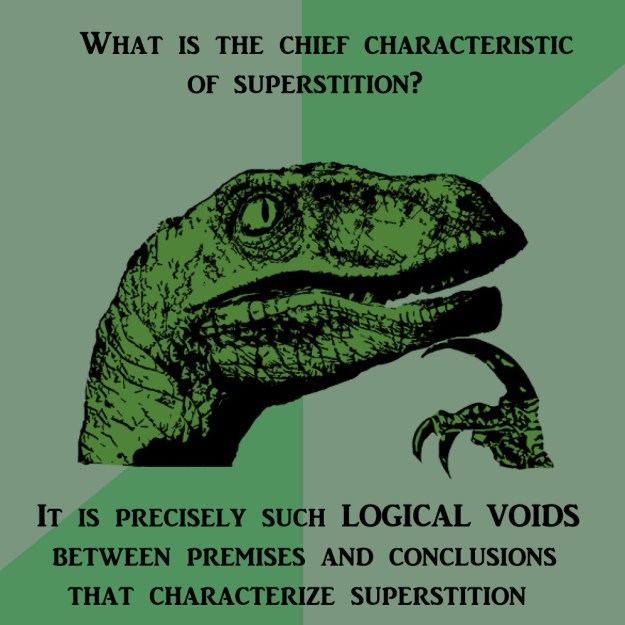
What is the Chief characteristic of Superstition?

Superstition is precisely (such) LOGICAL VOIDS between premises and conclusions that characterize superstition. [1]


Therefore, science by definition is superstitious, in addition to being a triple logical fallacy: empiricism, inductive and affirming the consequent.


Logic Voids


[1] John Robbins, Forward of Gordon Clark’s book, Three Types of Religious Philosophy

Martin Luther- The Bondage of the Will – Commentary

Martin Luther. The Bondage of the Will.

Quotes from, unless noted are from, Martin Luther, The Bondage of the Will; translated by J. I. Packer and O. R. Johnston; Fleming H. Revell ,1957


Martin’s argument in a quick summary. It seems to me it is constructed like a large fortiori argument. He defends the lesser in greater length, (relative level) to say you ought to accept the greater(ultimate), since the same conclusion is in both, which is, there is no free-will. But if you do, then how much more is the point made?

 God is the ultimate cause of all things directly and absolutely. That is, in philosophy verbiage, Christian ontology is God’s direct causality over all things, even evil. And so God is the author—on the ontological level—of all things including good and evil. God directly causes Satan to will evil, as directly as He causes a Saint to will to do good. However, if this seems too much for you right now, then consider it on the relative level. Man, relative to Satan’ power and their own inward evil heart is not free to will contrary to these masters. Also, the Saints in heaven, are not free to will to do evil. They are under the motion and master of God’s Spirit to do good. Their wills are non-effective to resist the Spirit’s control.  Thus, man’s will is non-effective against relative things such as Satan control, their sin nature’s control, and for saints, the Spirit’s control. Thus, for man’s will to be effective it must be free, but it is non-effective against its masters. Non-effective effective is nonsense. Thus, a non-freewill freewill is nonsense. However, since this is true, then why resist the Scripture’s teaching on the Ultimate level? For it would result in the same conclusion, that man will is non-effective.

Yet, for the God’s chosen they will be saved, sanctified and glorified. They will enjoy happiness without end, for God’s will is indeed very effective toward His chosen ones.

The end result then? Argumentum a fortiori. If man on the lesser “relative level” is not-free to sin and Satan, or to the Spirit of Life, then how much more is man not free on the “ultimate level,” when God is the only direct cause of all things? If man’s will is non-effective on the lesser, then how much more is it non-effective to the greater! Also, if God’s will is so effective when considered on the lesser relative level, and not from His position, then how much more is God’s will effective over all things when considered on the Ultimate level where He alone directly controls all things?


“So that which we call the remnant of nature in the ungodly and in Satan, as being a creature and a work of God, is no less subject to Divine omnipotence and action than all the rest of God’s creatures and works. Since God moves and works all in all, He moves and works of necessity even in Satan and the ungodly (204). [i.e. on the ultimate level God directly works evil in creatures as he does good in creatures.]

Here you see that when God works in and by evil men, evil deeds result; yet God, though He does evil by means of evil men, cannot act evilly Himself, for He is good, and cannot do evil; but He uses evil instruments, which cannot escape the impulse and movement of His power. The fault which accounts for evil being done when God moves to action lies in these instruments, which God does not allow to be idle. In the same way a carpenter would cut badly with a saw-toothed axe. Hence it is that the ungodly man cannot but errand sin always, because under the impulse of Divine power he is not allowed to be idle, but wills, desires and acts according to his nature (204).” [i.e. God created man—after Adam—with an evil nature. So on the relative level man wants evil, but the on ultimate ontology level God picks up this defective hammer, and by direct causality this defective hammer is moved and cannot but move when God moves it. Because it is defective and damaged it hammers badly, and so it is judge and defined as bad by God’s command.]

“So God’s hardening of Pharaoh is wrought thus: God presents from without to his villainous heart that which by nature he hates; at the same time, He continues by omnipotent action to move within him the evil will which He finds there. Pharaoh, by reason of the villainy of his will, cannot but hate what opposes him, and trust to his own strength; and he grows so obstinate that he will not listen nor reflect, but is swept along in the grip of Satan like a raging madman (207) [i.e. on the relative level Pharaoh wants to be bad. On the ultimate level, Pharaoh cannot resist God’s direct causality upon him and upon Satan.]

[Pharaoh’s] evil will would not have been moved or hardened of itself, but as the omnipotent Agent makes it act by means of his own inescapable movement.(207)” [.i.e. Ultimately, God is the author of evil, by direct causation]

“Had there been in Pharaoh any power to turn, or freedom of will that might have gone either way, God could not with such certainty have foretold his hardening” (211). [i.e. God foreknew because God predestined first. ]

“It is true that Judas acted willingly, and not under compulsion, but his willing was the work of God, brought into being by His omnipotence, like everything else.(213)” [i.e. God the author of evil, by direct causation]

“Paul teaches that faith and unbelief comes to us by no work of our own, but through the love and hatred of God (228).” [God the author of all good and evil, of all things by direct causation]

“What I assert and maintain is this: that where God works apart from the grace of His Spirit, He works all things in all men, even in the ungodly; for He alone moves, makes to act, and impels by the motion of His omnipotence, all those things which He alone created; they can neither avoid nor alter this movement, but necessarily follow and obey it, each thing according to the measure of its God-given power. Thus all things, even the ungodly, cooperate with God(267).” [God the author of all good and evil, of all things by direct causation]

“The king’s will cannot escape the action of the omnipotent God by which all men’s wills, good and bad, are moved to will and to act (259).” [God the author of all good and evil, of all things by direct causation]

“I answer: Whether God permit, or whether He incline, that permitting or inclining does not take place without the will and operation of God: because, the will of the king cannot avoid the action of the omnipotent God: seeing that, the will of all is carried along just as He wills and acts, whether that will be good or evil (10c Discussion: Second Part (Sections 114 – 130).” [God the author of all good and evil, of all things by direct causation]

It would certainly be a hard question, I allow-indeed, an insoluble one-if you sought to establish both the foreknowledge of God and the freedom of man together; for what is harder, yea, more impossible, than maintaining that contraries and contradictories do not clash? (215) [ free-will and God’s sovereignty are contradictions]

The apostle, therefore, is bridling the ungodly who take offense at his plain speaking, telling them they should realize that the Divine will is fulfilled by what to us is necessity, and that it is definitely established that no freedom or “free-will” is left them, but all things depend on the will of God alone (215).

What God wills is not right because he ought, or was bound, so to will; on the contrary, what takes place must be right, because he so wills it” (209). [There is no law over God. God’s Ethic is His ‘Choice’ or ‘Decree’ itself]

What does Luther say to Erasmus about this issue of God’s absolute and direct sovereign control, over man’s will and yes, even evil?

I give you hearty praise and commendation on this further account-that you alone, in contrast with others, have attacked the real thing, that is, the essential issue. You have not wearied me with those extraneous issues about the Papacy, purgatory, indulgences and such like trifles. . . . You, and you alone, have seen the hinge on which all turns, and aimed for the vital spot (319).


” Heap together, therefore, out of the large Concordances all the imperative words into one chaos, provided that, they be not words of the promise but of the requirement of the law only, and I will immediately declare, that by them is always shown what men ought to do, not what they can do, or do do. And even common grammarians and every little school-boy in the street knows, that by verbs of the imperative mood, nothing else is signified than that which ought to be done, and that, what is done or can be done, is expressed by verbs of the indicative mood.

Thus, therefore, it comes to pass, that you theologians, are so senseless and so many degrees below even school-boys, that when you have caught hold of one imperative verb you infer an indicative sense, as though what was commanded were immediately and even necessarily done, or possible to be done.[1]

[i.e. God’s command imposes responsibility, not freedom to do. “Ought to do,” is Ethics, and “can do,” or necessarily done,” is ontology.  So that God’s command/ethics does not include the power in man to do it.  These are different categories of systematic theology/philosophy. This phrase, “necessarily done,” is like the sophist’s saying, “necessary immutability,” i.e. ultimate ontology. Thus, Martin did include in this category contrast, Ethics versus ultimate ontology.]


“But what do they effect by this playing upon words” This is no more than saying, the act is not God Himself. This remains certain, that if the action of God is necessary, or if there is a necessity of the consequence, everything takes place of necessity, [then] how much [more] the act be not God Himself. But what need was there to tell us this? As though there was any fear of our asserting the things done were God Himself….” [2] [i.e. God is not what He causes. If God creates a river and directly causes it to move north, then God Himself is not a north flowing river. The same with men and their good and evil choices that God directly causes. Or if God causes a man to choose evil, then God is not that.]

“And what is the design of the apostles in proving their preaching by the Scriptures? Is it that they may obscure their own darkness by still greater darkness? What was the intention of Christ, in teaching the Jews to “search the Scriptures” (John v. 39,) as testifying of Him? Was it that He might render them doubtful concerning faith in Him? What was their intention, who having heard Paul, searched the Scriptures night and day, “to see if these things were so?” (Acts xvii. 11.) Do not all these things prove that the Apostles, as well as Christ Himself, appealed to the Scriptures as the most clear testimonies of the truth of their discourses? With what face then do we make them ‘obscure?’  [.i.e. The Scripture interrupted themselves and are revealed to be clear and precise to man about knowledge of God.]

Are these words of the Scripture, I pray you, obscure or ambiguous: “God created the heavens and the earth” (Gen. i. 1). “The Word was made flesh.” (John i. 14,) and all those other words which the whole world receives as articles of faith? Whence then, did they receive them? Was it not from the Scriptures? And what do those who at this day preach? Do they not expound and declare the Scriptures? But if the Scripture which they declare, be obscure, who shall certify us that their declaration is to be depended on? Shall it be certified by another new declaration? But who shall make that declaration?— And so we may go on ad infinitum.

In a word, if the Scripture be obscure or ambiguous, what need was there for its being sent down from heaven? Are we not obscure and ambiguous enough in ourselves, without an increase of it by obscurity, ambiguity, and darkness being sent down unto us from heaven? And if this be the case, what will become of that of the apostle, “All Scripture is given by inspiration of God, and is profitable for doctrine, for reproof, for correction?” (2 Tim. iii. 16.) Nay, Paul, thou art altogether useless, and all those things which thou ascribest unto the Scripture, are to be sought for out of the fathers approved by a long course of ages, and from the Roman see! Wherefore, thy sentiment must be revoked, where thou writest to Titus, (chap. i. 9) ‘that a bishop ought to be powerful in doctrine, to exhort and to convince the gainsayers, and to stop the mouths of vain talkers, and deceivers of minds.’ For how shall he be powerful, when thou leavest him the Scriptures in obscurity—that is, as arms of tow and feeble straws, instead of a sword? And Christ must also, of necessity, revoke His word where He falsely promises us, saying, “I will give you a mouth and wisdom which all your adversaries shall not be able to resist,” (Luke xxi. 15.) For how shall they not resist when we fight against them with obscurities and uncertainties? And why do you also, Erasmus, prescribe to us a form of  Christianity, if the Scriptures be obscure to you![3]  [ i.e. Erasmus, You contradicted yourself. LOL. This is like saying all propositions are uncertain. If that is the case, then that proposition is uncertain]

“ [Erasmus correctly quotes Martin saying], “That whatever is done by us, is not done by Free-will, but from mere necessity. And that of Augustine also—that God works in us both good and evil: that He rewards His good works in us, and punishes His evil works in us.”[4] [i.e. God ultimately is the only cause, and judges us by His commands, from the causality He worked in us]

“But, by necessity, I do not mean compulsion; but (as they term it) the necessity of immutability, not of compulsion; that is, a man void of the Spirit of God, does not evil against his will as by violence, or as if he were taken by the neck and forced to it, in the same way as a thief or cut-throat is dragged to punishment against his will; but he does it spontaneously, and with a desirous willingness.”[5] [i.e. “necessity of immutability” is saying Ontology on the ultimate level is God’s direct causality over all things. And “not of compulsion,” is saying on the relative level man does what he wants to do from his own soul.]

“Therefore, to say, that the will is FREE, and that it has indeed power, but that it is ineffective, is what the sophists call ‘a direct contrariety.’ As if one should say, “Free-will” is that which is not free. Or as if one should term fire cold, and earth hot. For if fire had the power of heat, yea of the heat of hell, yet, if it did not burn or scorch, but were cold and produced cold, I should not call it fire, much less should I term it hot; unless, indeed, you were to mean an imaginary fire, or a fire represented in a picture.—But if we call the power of “Free-will” that, by which a man is fitted to be caught by the Spirit, or to be touched by the grace of God, as one created unto eternal life or eternal death, may be said to be; this power, that is, fitness, or, (as the Sophists term it) ‘disposition-quality,’ and ‘passive aptitude,’ this I also confess. And who does not know, that this is not in trees or beasts? For, (as they say) Heaven was not made for geese.

Therefore, it stands confirmed, even by your own testimony, that we do all things from necessity, not from “Free-will:” seeing that, the power of “Free-will” is nothing, and neither does, nor can do good, without grace.”[6] [i.e. A contrariety is that the truth of one means the falsity of the other, thus, a non-effective effective will is nothing and nonsense. Like a contradiction they cancel each other out, so that there is no knowledge; there is nothing to affirm or deny, nothing.  Also, if the man’s will is non-effective on the relative level against the sin-nature and Satan, then how much more on the (necessity of immutability) ultimate level where God directly controls man’s mind, directly controls the sin-nature and directly controls Satan’s will?]

“And thus, as soon as he presented to it outwardly, that which naturally irritated and offended it, then it was, that Pharaoh could not avoid becoming hardened; even as he could not avoid the action of the Divine Omnipotence, and the aversion or enmity of his own will.” [7] [ i.e. Martin speaks both of the Ultimate and Relative level regarding man’s will. Man’s will is not free on the ultimate level of God’s directly causality, “could not avoid the action of the Divine Omnipotence.” And man’s will even on the lesser relative level, cannot avoid the “aversion of their own enmity, or if saved, the Spirit’s law of life.” Again, if man on the lesser relative level is not-free to sin and death, or to the Spirit of Life, then how much more is man not free on the ultimate level when God is the only direct cause of all things. That is, if man’s will is non-effective on the lesser, then how much more to the greater!]


Endnote———————

[1] Martin Luther. Bondage of the Will. Translated by Henry Cole. 2009 kindle eBook.

[2] Martin Luther. Bondage of the Will. Translated by Henry Cole. 2009 kindle eBook.

[3]   Martin Luther. Bondage of the Will. Translated by Henry Cole. 2009 kindle eBook.

[4] Martin Luther. Bondage of the Will. Translated by Henry Cole. 2009 kindle eBook

[5] Martin Luther. Bondage of the Will. Translated by Henry Cole. 2009 kindle eBook

[6] Martin Luther. Bondage of the Will. Translated by Henry Cole. 2009 kindle eBook

[7] Martin Luther. Bondage of the Will. Translated by Henry Cole. 2009 kindle eBook

Hedging Your Prayer in Unbelief.

Hedging Your Prayer in Unbelief.

But there was no stopping him and he went on praying and there was not a particle of faith in anything he uttered. He did stop at last, and I said, “Brother Clark, it’s now your turn to pray.” He started, “Lord, answer the prayer of my brother and comfort me in this great bereavement and sorrow. PREPARE me to face this great trial.” I [Wigglesworth] cried out, “My God, stop this man.” The whole atmosphere was being charged with unbelief.

Smith Wigglesworth, Ever Increasing Faith.

This man’s prayer might sound like humility in its human sophistry and human philosophy, but it is in fact unbelief hedging itself in because he doubts God will grant the miracle being asked. Regarding life issues, Jesus never prayed like this. In fact, it is a command by Jesus for us to receive the very thing we pray for. Think? Did Jesus ever say to the blind, crippled, or dead, or demon possessed, “Lord help this person face their trail.” No. Nor did the prophets or disciples. Rather they asked for a fish and got a fish, a victory for a victory, a son for a son, a healing for a healing, forgiveness for forgiveness, and a sound mind for a sound mind.
The context of Jesus being “compassionate”, was not in that He asked the Father to help them deal with the trail; rather in context, He was compassionate to these people in that His prayers of help stopped the pain and and stopped the sickness and gave them victory over their trail. This is how the Scripture defined Jesus’ compassion.

A Gospel Elevation Declaration, Smith Wigglesworth

As a child I grew up in churches were they preached on faith in God’s promises (all of them) and the gifts of the Spirit. It is here I first heard biblical arguments for such. Later on, I found Vincent Cheung gave better and more precise arguments for such, but I first heard them from the founders of the Church of God and people I read like Smith Wigglesworth. I wish I could quote these COG founders’ arguments (in a resource like a book), but they were given to me as a child in scattered preaching, and so I do not have a way to do so. I remember, for example, the founding pastor Westmore COG (Sr. Floyd Lee McClung), making the argument from Peter’s Sermon in Acts that maturity is not merely receiving forgiveness but going on to receive the promise of God’s Spirit and all the power, healing and partaking that comes from this.

Acts 2:38, “Peter replied, “Each of you must repent of your sins and turn to God, and be baptized in the name of Jesus Christ for the forgiveness of your sins. Then you will receive the gift of the Holy Spirit,” NLT.

Below are a few experts from Wigglesworth book, Ever Increasing Faith, and titles that I put in. Here I show the basic teaches and arguments Wigglesworth taught. Some of these arguments I still use today, and with the help of Vincent Cheung teaching, with more precision.  This older generation might not have had the precision, but their basic arguments were correct on many points.


Ever Increasing Faith.

By. Smith Wigglesworth

Do not measure God by your unbelief, or that is, by your speculations and your superstitions

“Another preacher said, “It was an easy thing for Jesus to feed the people with five loaves. The loaves were so big in those days that it was a simple matter to cut them into a thousand pieces each.” But He forgot that one little boy brought those five loaves all the way in his lunch basket.

There is nothing impossible with god. All the impossibility is with us when we measure God by the limitations of our unbelief.”

Unbelief Robs

Unbelief robs them of these blessings. It is possible to hear and yet not conceive the truth. It is possible to read the Word and not share in the life it brings.”

The Atonement produces forgiveness and healing by the same Blood

“He wants to encourage you to believe Him. If thou canst only believe, thou canst be saved and healed. Dare to believe that Jesus was wounded for your transgressions, was bruised for your iniquities, was chastised that you might have peace, and that by His stripes there is healing for you right here and now. You have failed because you have not believed Him. Cry out to Him even now, “Lord, I believe, help Thou mine unbelief.”””

….We have a Jesus that heals the broken-hearted, who lets the captives go free, who saves the very worst. Dare you, dare you, spurn this glorious Gospel of God for spirit, soul and body? Dare you spurn this grace? I realize that this full Gospel has in great measure been hid, this Gospel that brings liberty, this Gospel that brings souls out of bondage, this Gospel that brings perfect health to the body, this Gospel of entire salvation. Listen again to this word of Him who left the glory to bring us this great salvation, “Verily I say unto you, That whosoever shall say unto this mountain, Be thou removed, . . . he shall have whatsoever he saith.” Whatsoever!

Hedging your prayer in Unbelief.

“But there was no stopping him and he went on praying and there was not a particle of faith in anything he uttered. He did stop at last, and I said, “Brother Clark, it’s now your turn to pray. He started, “Lord, answer the prayer of my brother and comfort me in this great bereavement and sorrow. Prepare me to face this great trial.” I cried out, “My God, stop this man.” The whole atmosphere was being charged with unbelief.

[ i.e. This man’s prayer might sound like humility in its human sophistry, but it is in fact unbelief hedging itself in from the fact, that he doubts God will grant the miracle being asked. Regarding life issues, Jesus never prayed like this.  In fact, it is a command by Jesus for us to receive the very thing we pray for. ]

I had a glass bottle full of oil and I went up to the woman and poured the whole lot on her in the name of Jesus. Suddenly Jesus appeared, standing at the foot of the bed. He smiled and vanished. The woman stood up, perfectly healed, and she is a strong woman today.

We have a big God. We have a wonderful Jesus. We have a glorious Comforter. God’s canopy is over you and will cover you at all times, preserving you from evil. Under His wings shalt thou trust. The Word of God is living and powerful and in its treasures you will find eternal life. If you dare trust this wonderful Lord, this Lord of life, you will find in Him everything you need.

So many are tampering with drugs, quacks, pills and plasters.  It is sufficient to believe God. You will find that if you dare trust Him, He will never fail. “The prayer of faith shall save the sick, and the LORD shall raise him up.” Do you trust Him? He is worthy to be trusted.

Elevation Declaration

“The purpose of all Scripture is to move us on to this wonderful and blessed elevation of faith where our constant experience is the manifestation of God’s life and power through us.

Peter goes on writing to these who have obtained like precious faith, saying, “Grace and peace be multiplied unto you through the knowledge of God, and of Jesus our Lord.” We can have the multiplication of this grace and peace only as we live in the realm of faith. Abraham attained to the place where he became a friend of God, on no other line than that of believing God. He believed God and God counted that to him for righteousness. Righteousness was imputed to him on no other ground than that he believed God. Can this be true of anybody else? Yes, every person in the whole wide world who is saved by faith is blessed with faithful Abraham. The promise, which came to him because he believed God, was that in Him all the families of the earth should be blessed. When we believe God there is no knowing where the blessing of our faith will end.

Some are tied up because, when they are prayed for, the thing that they are expecting does not come off the same night. They say they believe, but you can see that they are really in turmoil of unbelief. Abraham believed God. You can hear him saying to Sarah, “Sarah, there is no life in you and there is nothing in me, but God has promised us a son and I believe God.” And that kind of faith is a joy to our Father in heaven.”

Exceedingly Great Partakers of God, Manifesto

“Peter goes on to say, “According as His divine power hath given unto us all things that pertain unto life and godliness, through the knowledge of Him that hath called us to glory and virtue.” God is calling us to this realm of glory and virtue where, as we feed on His exceeding great and precious promises, we are made partakers of the divine nature. Faith is the substance of things hoped for right here in this life. It is right here that God would have us partake of His divine nature. It is nothing less than the life of the Lord Himself imparted and flowing into our whole beings, so that our very body is quickened, so that every tissue and every drop of blood and our bones and joints and marrow receive this divine life. I believe that the Lord wants this divine life to flow right into our natural bodies, this law of the spirit of life in Christ Jesus that makes us free from the law of sin and death. God wants to establish our faith so that we shall lay hold on this divine life, this divine nature of the Son of God, so that our spirit and soul and body will be sanctified wholly and preserved unto the coming of the Lord Jesus Christ.

When that woman was healed of the issue of blood, Jesus perceived that power had gone out of Him. The woman’s faith laid hold and this power was imparted and immediately the woman’s being was surcharged with life and her weakness departed. The impartation of this power produces everything you need; but it comes only as our faith moves out for its impartation. Faith is the victory. If thou canst believe, it is thine”


Sickness- Dumb about Scripture

“It is as your heart goes out to the needy ones in deep compassion that the Lord manifests His presence. You are able to locate their position. It is then that you know that you must be filled with the Spirit to deal with the conditions before you.

Where people are in sickness you find frequently that they are dense about Scripture.

They usually know three scriptures though. They know about Paul’s thorn in the flesh, and that Paul told Timothy to take a little wine for his stomach’s sake, and that Paul left someone sick somewhere; they forget his name, and don’t remember the name of the place, and don’t know where the chapter is. Most people think they have a thorn in the flesh. The chief thing in dealing with a person who is sick is to locate their exact position. As you are ministering under the Spirit’s power the Lord will let you see just that which will be more helpful and most faith-inspiring to them.”

Healing needs compassion.

“There is a fruit of the Spirit that must accompany the gift of healing and that is longsuffering. The man who is going through with God to be used in healing must be a man of longsuffering. He must be always ready with a word of comfort. If the sick one is in distress and helpless and does not see everything eye to eye with you, you must bear with him. Our Lord Jesus Christ was filled with compassion and lived and moved in a place of longsuffering, and we will have to get into this place if we are to help needy ones.”

Elisha – Where is the God of Elijah?

“I will explain to you the most perfect way to receive the gift. Come with me to the second chapter of 2 Kings and I will show you a man receiving a gift. Elijah had been mightily used of God in calling down fire and in other miracles; and Elisha is moved with a great spirit of covetousness to have this man’s gifts. You can be very covetous for the gifts of the Spirit and God will allow it. When Elijah said to him, “I want you to stop at Gilgal,” Elisha said, “As the Lord liveth and as thy soul liveth, I will not leave thee.”

There was no stopping him. When Elijah wanted Elisha to stop at Jericho he said in substance, “I am not stopping.” The man that stops gets nothing. O, don’t stop at Jericho; don’t stop at Jordan; don’t stop anywhere when God would have you move on into all of His fullness that He has for you.

They came to Jordan and Elijah took his mantle and smote the waters. They divided; and Elijah and Elisha went over on dry ground. Elijah turned to Elisha and said in substance, “Look here, what do you want?” Elisha was wanting what he was going to have, and you may covet all that God says that you shall have. Elisha said, “I pray thee, let a double portion of thy spirit be upon me.” This was the plowboy, who had washed the hands of his master; but his spirit got so big that he purposed in his heart that, when Elijah stepped off the scene, he would be put into his place.

Elijah said, “Thou hast asked a hard thing: nevertheless, if thou see me when I am taken from thee, it shall be so unto thee.” May God help you never to stop persevering till you get what you want. Let your aspiration be large and your faith rise until you are wholly on fire for God’s best.

Onward they go, and as one steps, the other steps with him. He purposed to keep his eye on his master until the last. It took a chariot of fire and horses of fire to part them asunder, and Elijah went up by a whirlwind into heaven. I can fancy I hear Elisha crying out, “Father Elijah, drop that mantle!” And it came down. Oh, I can see it lowering, lowering and lowering. Elisha took all of his own clothes and rent them in two pieces, and then he took up the mantle of Elijah. I do not believe that, when he put on that other mantle, he felt any difference in himself; but when he came to Jordan, he took the mantle of Elijah and smote the waters and said, “Where is the Lord God of Elijah?” And the waters parted and he went over on dry ground. And the sons of the prophets said, “The spirit of Elijah doth rest upon Elisha.”

It is like receiving a gift; you don’t know that you have it till you act in faith. Brothers and sisters, as you ask, BELIEVE.”