Tag Archives: Decree

The Will OF GOD is Irrelevant

The bible teaches that God has absolute and direct control over all things. He is the only real cause for all things, and there is no such thing as secondary causes. God is the metaphysical author of sin and evil. God has predestined all things by His own goals and choices, and decrees all reality in a logical order in relation to His goals (supralapsarianism).  There is no such thing as free-will. Man is responsible because he is not free but under God’s sovereign control and command.  Because God absolutely and directly causes all things, He absolutely and directly causes the predestination of the elect and reprobate. Logic and deduction are so easy. As Romans 9 says, God takes from the neutral lump (before good or evil) and by the same power and choice makes some to be evil reprobates and some to be righteous elect.  God has not given up some of His control to man, because free-will does not exist, because the bible never says He made this choice, and because the nature of God insures that there is no difference in how direct and absolute He causes one thing or another in creation. God’s thoughts, power and choice are one and the same. Because He thinks about it and decides on it, it is reality. Therefore, in the ultimate sense, God Will is the only relevant issue.

I say all of this to state a broad and correct doctrine of God’s sovereignty, so that I am not misunderstood in my following comments.

When we pray for healing, miracles or forgiveness the “will of God,” (referring to His causality, not commands), is irrelevant. As Vincent Cheung points out in “Healing: The Will of Man,” to talk about the “will of God” in this context is already a partial defeat, because the bible talks about man’s will, not God’s will.

The bible’s positive doctrine is that healing is about the will of man, not the will of God. This is how the scripture presents the subject. Jesus never asked the Father if it was God’s will to heal a particular person; rather, He always asked if it was the man or woman’s will to be healed.  Jesus then said to his disciples and followers, “you heal the sick.” The will of God (referring to His decrees/causality) was never brought up; only “man’s will,” was brought up. The will of God was simply irrelevant. Jesus, who is more God-centered than you or your favorite pastor, taught us the “will of God,” was irrelevant, and that “man’s will” was the relevant issue.

Some are more accustomed to think about the atonement and forgiveness and so we will start here. The big idea, is that healing (Isaiah 53, Matth 8, James 5, Gal. 3) is as much the gospel and substitutionary atonement as forgiveness is, if not more so.

So here is the question: is the “will of God,” relevant for salvation or conversion? It is not relevant, if I am the one answering it. I am not asking a broad doctrinal question. I am asking it as Jesus would ask a person, “do you want to be healed”? Do you want to be forgiven? I am asking it the way Moses says, “I have presented to you life and death,” now make a choice. I am asking it the way the bible personally addresses me with its promises and commands, telling me that I must respond to it.

The “will of God” is irrelevant for my salvation, because what God decrees and causes is irrelevant in my response to obey the command of God to repent. Paul in Acts 17 commands us to repent of our sins. It is not a choice or suggestion. When I evaluate how I should behave I only use the commands of God to do this, not God’s secret decrees or causality. For example, in Romans 5 Paul says God caused me to be born a sinner, with a sinful heart, because of what Adam did. If I were to use the “will of God,” as a relevant factor in my decision to repent of my sins or not, then I would recognize it was the will of God to decree and cause me to be born a sinner, thus I will choose to stay a sinner until God decrees and causes me to repent.

I will assume most will see the error of this.  It is obvious that God’s Will is irrelevant in my consideration if I should repent of my sins. The relevant issue is God’s command for me to repent.  If a person uses the “will of God” as a relevant issue to exempt them from having to repent of their sins, we would see this as an excuse to be rebellious and unbelieving.

The same is for healing and other various miracles and supernatural experiences.  Healing is provided by the same atonement that provided forgiveness. Both are already accomplished and both are received on the demand of faith. God is sovereign over our faith, but on the demand of faith God always does what He promises. Faith always receives, and God is sovereign over faith. However, even though God is sovereign over faith (God’s Will), we are never told to consider it as relevant knowledge when we choose to believe a promise or not.  When we are in the context of a “should” or “ought” the category is always about God’s command.

In John 15 Jesus uses God’s predestination as an encouragement to ask whatever we want and get it.  Peter does the same thing in Acts 2 about the baptism of the Spirit for power. And so the Will of God is relevant in the topic of valuing God’s encouragement and explanation. Even though God’s Will is used by scripture to encourage our confidence for miracles and answered prayer, yet, when dealing with the topic of the scripture commanding me to repent and commanding me to receive healing and the gospel (James 5:15, John 14,15, Gal.3, Acts 2) the only relevant category is God’s command, not God’s Will.

Thus, when we pray for healing, God’s Will is irrelevant. The Will of God, is a non-issue. To have the Will of God, pop up into your head when praying for healing, is like having the decree of God that made you a sinner(Rom 5), pop into your head as a relevant issue if you should repent or not, and question if God would forgive if you had faith in Jesus.  It is insane and delusional.

The Will of God is irrelevant when considering if God will save you if you repent in faith; it is a non-issue. The Will of God is irrelevant when considering if God will heal you if you command sickness to leave with faith; it is a non-issue.

“Oh, God, please forgive me. I am powerless. You have done nothing yet, but you could do something, Oh powerful and eternal God. You made me a sinner because of Adam’s sin, and so, I don’t know if You have decreed me to be saved or not, and so, If it is your Will, please forgive my sins.”

This insane prayer is how many pray about healing. They are stupid and sinful. The bible never tells us to pray like this. Such a person should not expect to be forgiven of their sin. And if they pray for healing like this, they should not expect to be healed. To pray, while using the Will of God as a relevant issue, will divorce you from being forgiven and healed; It is a prayer of death.

When Peter said, “What I have, I give, in Jesus Name, walk,” the Will of God never came up, because the Will of God is irrelevant. Jesus commanded His followers to heal the sick. This command is the relevant issue, not the Will of God. The Will of God is a non-issue in the context of my healing, or your healing. When you bring in the Will of God as a relevant issue for healing or forgiveness the end results in God’s command being negated. The category of God’s decree and command are different and so should never be used to void each other out, or mixed together.

“Oh God, by Your Will I was made sick, and so I don’t know if I should be healed or not, but please, heal me if it is Your Will.”

 This is a prayer of death. It is a prayer of insanity and disobedience. This prayer uses God’s decree as an excuse to avoid obeying God’s command to be healed.  To use God’s decree to excuse yourself from obeying any of God’s commands such as receiving forgiveness or receiving healing, is stupid and wicked.

Although, there is nothing wrong for a salvation prayer to “ask God into your heart,” yet there are more precise ways to describe it.  Peter in his Pentecost sermon gives direction for a salvation prayer. He instructs the audience to ““Repent and be baptized, in the name of Jesus Christ.” Notice Peter did not instruct them to “ask” God to forgive them; rather, he tells them to repent in Jesus’ Name to be saved. Why? Because Jesus already died and was resurrected. The forgiveness already happened. We are not asking God to crucify His Son again to forgive us, because it already happened.  We are not asking God to do anything in the present tense to forgive us, because Jesus already accomplished it. Because it has been accomplished all we do is repent.  In this context we do not ask or beg. It is when a person has confidence in Jesus’ finished atonement, they repent of their sins in Jesus’ Name. Salvation in this sense is a confession, and not asking and begging. We confess our sins and that is all it takes. Faith is about God letting you know He has already forgiven you, and by repenting you are agreeing with God.  It is foundationally about agreeing and confessing and not asking.

Other gospel benefits such as a healing, and the authority to cast out demons and cast down mountains is the same. They have been accomplished by Jesus’ finished atonement. We do not ask and beg for them, because they have been accomplished by Jesus and given to us. It is irrational to beg for something that already belongs to you.  It was the stripes on Jesus’ back that healed us. And so, it is irrational to ask God to heal us, as if He needs to break out the whip again and start slashing Jesus in the throne room. God accomplished our healing in Jesus’ atonement. Thus, we don’t beg for it, because it is already ours.  As with salvation, we repent as a confession of confidence in Jesus finished atonement, rather than beg and ask forgiveness. The same with healing. It is the Will of Man to command sickness to leave. We confess and agree with God, rather than beg and ask. This is why Jesus tells us to “heal the sick, and cast out demons.” When we command healing and command demons to leave, we are giving a confident confession in the finished atonement of Jesus, which has given us the healing and authority to do such things.

The Gospel Is The Baptism Of The Spirit For Miracles

If Jesus sitting on the throne is the foundation eschatology, and His commands for power still stand, then applied eschatology for Christians is baptism in the Spirit, faith and miracles.

“Always remember that Jesus Christ,
a descendant of King David, was raised from the dead.
This is the Good News (GOSPEL) I preach,”
 2 Timothy 2:8 (NLT).

Tradition and men have a tendency to limit God, man and the gospel. In this case they limit Jesus’ nature, His position of authority and glorification of man in the gospel. Imputed righteousness and being declared righteous is an awesome doctrine, but there is more that the bible defines that belongs to “good news,” than a few narrowly selected pet doctrines. Men are habitually and systematically man-centered, and this leads to limiting God, His gospel and the elect. This happens because their worldview, despite having many scriptural terms, starts with themselves. They see the world from their limited human experience and then force God, the gospel and the elect into this limitation. We know who they serve.

Paul teaches in this passage that the gospel includes that Jesus was raised from the dead “as a descendant of King David.” This refers to the promise God made to “King” David about a descendant that will come from him. There are two aspects of this promised person. One, he will be the saving Messiah. The second, is that He will be a “King” on a throne, ruling in power and authority.

This descendant of King David, according to Paul, is connected to the fact that Jesus was raised. When you and I are resurrected, it is not necessarily connected to us sitting at God’s right hand as King and Judge over all things as what is inherit in us; however, this is precisely what it means for Jesus. Because we are connected to Jesus as part of His body, by God’s decision, then we share in His power and authority. Not as the head, but we do indeed share in what Jesus’ experienced. We are not just sub-heirs, but co-heirs. Jesus judges in authority, and likewise we will also one day judge angels, etc. The point is that what happens to Jesus in resurrection, also happens to us. For example, Paul argues in 1 Corinthians 15 because Jesus had bodily resurrection, we to will have a bodily resurrection.

Jesus is raised as the promised King, from King David, who sits on a throne of power. That is, Jesus’ resurrection by the Father from the grave, cannot be disconnected from the fact that His rising is a rising to sit on a throne. The doctrine of Jesus rising from the grave is the same thing as His rising to sit at the right hand of the Power, because the two cannot logically be separated. One cannot separate Jesus’ resurrection from His sitting on the throne as a King. Jesus raised from the grave is not to some nebulous place in the clouds. We are told and know where He was raised to. He was raised to the right hand of the Power. This doctrine for Paul, is “the gospel he preached.”

Also note, this is Paul to Timothy. Furthermore, this is the gospel Paul preached to the gentiles; thus, is not a specific doctrine for Jews or something like that.

Peter, in the first recorded apostolic gospel sermon, harps on this aspect of Jesus being King David’s descendant, who was raised to the position of throne power and authority. Peter devoted a good amount of space to make this point about Jesus. 

Peter sums up Jesus’ rising as the seated King from David as,

“both messiah and King.”

Thus, this promised descendant from David, according to Peter includes both the “saving Messiah” and “King” aspect to it. The resurrection is part of the gospel, most would admit, but the resurrection cannot be separated from that fact that it is a resurrection as a King to a throne. This last part of the gospel is the focus of eschatology, as it pertains to this side of eternity and Jesus ruling. This power the Father “worked in Christ, raising him from the dead and seating him at his right hand in the heavenly places,  above all rule and authority and power and lordship and every name named, not only in this age but also in the coming one, and he subjected all things under his feet,” Ephesians 1:20-22. Again, Peter does not separate the saving and Throne aspect of Jesus Christ as the risen descendant of David. It was the gospel Paul preached and it was also the gospel Peter preached. The promise included both, and thus cannot be separated by theologians without blaspheme.

Peter then makes connection to the baptism of the Holy Spirit. His argument is this. Jesus as the descendant from King David, was raised to the right hand of God. What does Jesus do, sitting at the right hand of the Power?  Peter argues that in His position of power, has poured out power on His chosen ones, through the baptism of the Spirit. What does this newly seated King do with His position of Power? Well, He starts to empower His people. What will this seated descendant King of David do with all this authority and power? Peter’s answer is this: He gives us His power and authority so that we can overcome the world and spread His kingdom to every corner. Jesus gives us power to cast out demons, to heal the sick, and make mountains obey us. This is what Jesus does with power.

Thus, to say, “the gospel is the baptism of the Spirit, for speaking in tongues, casting out demons and healing the sick,” is true and should have no resistance. Jesus had to be cut up into a bloody pulp, under the Father’s wrath, and then resurrected to the right hand of Power, in order to have a contractual right to pour out the Spirit for power.  Thus the gospel is the baptism of the Spirit for miracle power; the gospel includes more, but not less than this. It is no less the gospel than the forgiveness of sins, because both are produced by the same thing, which is the blood, death and resurrection of Jesus to the right hand of the Power. To be against the statement, “The gospel is the baptism of Spirit for miracles,” is to trample the blood, death and resurrection of Jesus to God’s right hand.  To be against the baptism of the Spirit for speaking in tongues and power, is to be against the blood, death and resurrection authority of Jesus Christ. To be against the baptism of the Spirit for miracles, is to mock how the reigning Jesus Christ uses His authority from the right hand of the Power.

Paul said if you deny the resurrection then your faith is destroyed, and your hope is vain. However, there are more subtle ways to deny the resurrection rather than doing it directly. In the logic of Modus Ponens it would be resurrection as the antecedent and the manifestation and effects and application of resurrection would be the consequent. But the logic of Modus Tollens is also valid. If you deny the consequent, then you deny the antecedent. If you deny the baptism of the Spirit for miracles and speaking tongues, then you deny the resurrection of Jesus to God’s right hand.

Men and tradition, who use many scriptural terms, mock the gospel continually. You need to remove such a faithless mocker from your life. They spit on the blood of Jesus, trample on His death and make a mockery of His decisions made from His position of authority. Do not even eat or wash your hands with such people. Instead, honor the decisions that Jesus made, as He sits in all authority, at the Father’s right hand. We must seek to be baptized by the Spirit and to be constantly growing in Spiritual power for miracles and spiritual physics. The Spirit will become your personal instructor, as if Jesus Himself were right there with you, giving you instruction. The baseline spiritual power, as recorded in Acts that all get for being baptized, is speaking in tongues for inward edification (1 Corin 14:4,18). If you must start, then start there, and then seek more than more power. I have heard many ministries say they started after they first had a season of increased speaking in tongues. This gift is a spiritual gateway to other spiritual gifts. In my experience this gift is not utilized as it ought, and many have paid harsh price for its neglecting. And if you don’t care about yourself, then have some compassion and care for others and God’s kingdom expanding. Praying in tongues will help you have power to expand God’s kingdom.

Outsiders Beg; Kings Command

“…It is taught (from Characteristics) that a one-time prayer is enough, and all other prayers after should be in thanksgiving. I found this useful when I first followed the WOF, because Reformed prayer is just begging in unbelief...”

Read Vincent Cheung, The Extreme Faith Teacher.

This is the standard of faith and the immediate effects that come from a single prayer of faith. This is the standard Jesus held His disciples to. This is the same standard He will hold us to. This is the standard of faith and its effects we will be judged against. There is only one definition for what faith and its effects look like, and that glory belongs to scripture alone. This standard is not just a suggestion, it is a command. If you love God you will obey it, if you hate God you will disobey it. This is not rocket science.

I understand the context of a person coming from a teaching of unbelief and then hearing the many voices of the charismatics and Word of Faith. They are broadly correct on the topic of faith, but have many wrong points that come from Arminianism and self-imposed narrow applications that do not belong to Scripture (such as the 5 or 9 fold gifts of the Spirit ministry). With that said, this idea of faith is simple enough for a child to grasp, and so, one ought to be ashamed theologians can confuse them.

The reformed prayer is a beggar’s prayer, and this is why they see no results. Begging is for those who are outsiders of God’s contract. Insiders relate to God differently. I am glad you see this. Faith is “confidence” or “absolute certainty” God will do what He promised. One man asked Jesus, “if you can,” and Jesus was offended and said, “if I can?” Jesus never commanded us to “beg for the things we want.” Jesus commanded us to speak His Name in faith and make demons scream and mountains fly. The difference is huge. We are children of God. Children do not beg as if they are outsiders sitting abandoned on the road. Some theologians are indeed outsiders to God’s Contract and so all they can do is beg, and then try to deceive God’s children in following their outsider behavior. Yet we are indeed children of God. We sit at His table as co-heirs with Christ. Children ask the Father for a fish and they get a fish. They ask for the Spirit of God (can anyone put a value on the Spirit of God?), and the Father will absolutely give this to His sons and daughters. He will withhold nothing good from you. And “good” is defined by Jesus, as asking what you want and God giving this to you. The bible is the only definition of reality. Only God defines good and evil. God defines good as asking whatever you want and God giving it to you. This is good, because God thinks so.

In fact, we reign as kings in this life through the credited righteousness of Jesus and His unmerited favor (Romans 5:17-21). A king who begs is not a king. A king who does not speak is not a king. A king who does not decree is not a king. A king decrees and it happens. Royalty commands, and they are obeyed. “YOU will say… [then] nothing will be impossible to YOU, (Matthew 17:20).” “If YOU have faith … it will obey YOU, (Luke 17:6). When gods speak, reality obeys THEM.

Of course, it is God power at work in us, and not own power, but because the Bible rejects pantheism, when WE speak it is us, NOT God. Thus, reality will obey us when we speak in faith.

The basic idea is simple: read the promises, meditate on the promises, decree (in Jesus Name) the promises over yourself and then thank God for giving you the things you prayed/proclaimed. Some charismatic fools can get narrowly hung up on saying, “once you do this only keep thanking God for the results and do not pray the prayer again.” This comes from an overzealous fear of words. As Numbers 13-14 shows, you need to be careful with your words. (see Vincent Cheung, The Edge of Glory). If you speak unbelief, then God will give the evil you spoke; yet, if you speak faith, God will give the good you spoke. However, the bible says more about this. Consider David in Psalm 31:22 spoke a word of unbelief, but God helped Him.  Obviously, David repented and re-asked for help and God helped him. Peter denied Jesus 3 times, but then re-affirmed his devotion and God received him back. This is the big idea, unbelief is strong, but a word of faith is stronger. If you made a mistake, turn around and speak the word of faith again, and God will help you. The Word and Spirit are stronger. A Confession of Faith is much stronger. Do not fear.

Also, Jesus directly commands that we pray and never give up. Thus, to say you cannot repeat your prayer, is a direct rebuttal of Jesus Himself. Jesus had to pray for a blind man twice. A person with “great faith” and who as developed a mature faith will indeed speak short one time prayers or confessions and will often see it happen immediately. We are all to strive for this level of power and faith. We will all give an account for how well we sought to obey Jesus in acquiring this standard of faith. Here is the big idea, if we had perfect faith, then we would only need one prayer for all things, but even then there might be a few exceptions, like Jesus praying for the blind man. But since no one has perfect faith, we are commanded to pray in a group (when two or three are gather..) we are commanded to have our elders come and pray with us, and we are given the gift of faith to help compensate for our imperfect faith.  God loves us so much that He has given us many tools to help us get the things we ask for. He wants to give you many good things. He is more than willing and able.

Thus, many charismatic teachers teach faith in practical steps (although flawed), to help struggling saints develop faith. Thus, we have two categories. One is the standard of faith as taught by Jesus, and the Second are pastors giving practical steps in how to get to that standard. Do not confuse the two. Some of these steps are not commandments, but can be helpful tools, and yet others are just wrong.

Back to our basic teaching, “read the promises, meditate on the promises, confess/pray the promises and (if you need to wait), then thank God for granting your request. This is great teaching. However, some say only repeat the last one, but as shown above, this is not necessarily so. Sometimes it is better to repeat the whole process. Maybe your mind is not renewed enough, and you need to establish the promises in your mind more. Thus, the practical application of this does depends on person to person, but the overall biblical applicable is the same for all.

Another reason why the advice to never repeat your prayer, but only give thanks, is bad, is because it puts the focus man and brings up fear. It puts the focus on you and then fear comes from this. Giving thanks for the prayed outcome is great, but if your mind is not renewed as it ought to be, then just giving thanks will not work (although, God still might grant it out of sheer kindness). You do need a honest self-evaluation, but remember that the focus of faith is God, His Word, His faithfulness and His love toward you. If you are focused on your self-evaluation and feelings, then by definition you are not in faith any more. Often, when developing faith and even keeping it, you need to re-read the promises, re-meditate and then on this foundation pray, and faith will naturally arise by God’s power.

Because Jesus wants you to have the things you pray for, He made it a command to pray and never give up. Stop and think about that for a moment. He wants you to have your request so much, He commanded that you never give up. He promises God will absolutely give you what you ask for. This is how much He loves you. He wants you to have the things you pray for, more than you do. Thus, it is not God you need to convince to give you what you ask; rather, it is your stubborn mind and unbelief, that needs convincing. God has already convinced Himself to give you whatever you ask for in faith. Thus, if there is a lack of results, it is not on God’s part, but you. So, in the confidence of God’s love for you re-read the promise, re-meditate and re-confess the promises of God.  

The important thing to do when praying is to not hedge your prayer in uncertainty and unbelief. Leave no room for your prayer to not be answered, because God has already convinced Himself to give you what you ask. This is essentially what a Word of Faith declaration is. It is a short-hand prayer that knows the outcome is certain. Thus faith speaks this way, “In the name of Jesus Christ of Nazareth, standup and walk.” No fear, no hedging. Just absolute confidence in God doing what He said He would do. And if you have read the gospels, Jesus loved this kind of faith. In fact, Jesus publicly boasted about such people before God and men. And if you have this kind of faith, Jesus will boast and exalt you before God and men. Imagine, the God of Gods and the King of Kings exalting you. Surely there is nothing greater in all reality.

The Decrees of God, vs, Demonic Fatalism

This is from the forthcoming book: Systematic Theology

As said before, affirming God’s absolute sovereignty can be said in one simple deduction and applied in every instance. It is so simple a 2nd grader could do it. The whole section you just read could have been said in one page, if not for wicked, stupid and lazy people resisting the doctrine.

God is absolutely and directly sovereign over all things; thus, God is sovereign over x, y and z (etc.). Why do I need to hold people’s hands to apply this?

I often in this context, refer to this as “God’s causality over all things.” Or in philosophy, Christian metaphysics and ontology. The Scripture usually refers to this in two terms, God’s sovereignty, or God’s decrees. And in particular with the term “decrees,” we are dealing with what is the central issue or the biblical focus on God’s sovereignty. The reason for this is simple, it is a no-brainer, easy to affirm God is totally sovereign over this moment as I write, or as I do anything, whether I sin or do acts of faith. This is painfully easy to understand and affirm. However, sense we are not dealing with mere abstracted fatalism, or pantheism, but an intellectual God, then the core issue of affirming God’s sovereignty is knowing what He decreed. The focus is on an intellectual Mind that had a goal for what He wants and with perfect control over His mind and infinite understanding, set goals and worked the order of reality to accomplish His purposes and intentions.

 Blessed is the God and Father of our Lord Jesus Christ, who has blessed us with every spiritual blessing in the heavenly places in Christ, 

 just as he chose us in him before the foundation of the world, that we should be holy and blameless before him in love,

 having predestined us to adoption through Jesus Christ to himself according to the good pleasure of his will, to the praise of the glory of his grace that he bestowed on us in the beloved, 

 in whom we have redemption through his blood, the forgiveness of sins, according to the riches of his grace, 

 that he caused to abound to us in all wisdom and insight, making known to us the mystery of his will, according to his good pleasure that he purposed in him, 

 for the administration of the fullness of times, to bring together all things in Christ, the things in the heavens and the things on the earth, in him 

 in whom also we were chosen, having been predestined according to the purpose of the One who works all things according to the counsel of his will, 

 that we who hoped beforehand in Christ should be for the praise of his glory, 

 in whom also you, when you heard the word of truth, the gospel of your salvation, in whom also when you believed you were sealed with the promised Holy Spirit,  who is the down payment of our inheritance, until the redemption of the possession, to the praise of his glory.

Ephesians 1:3-14 LEB

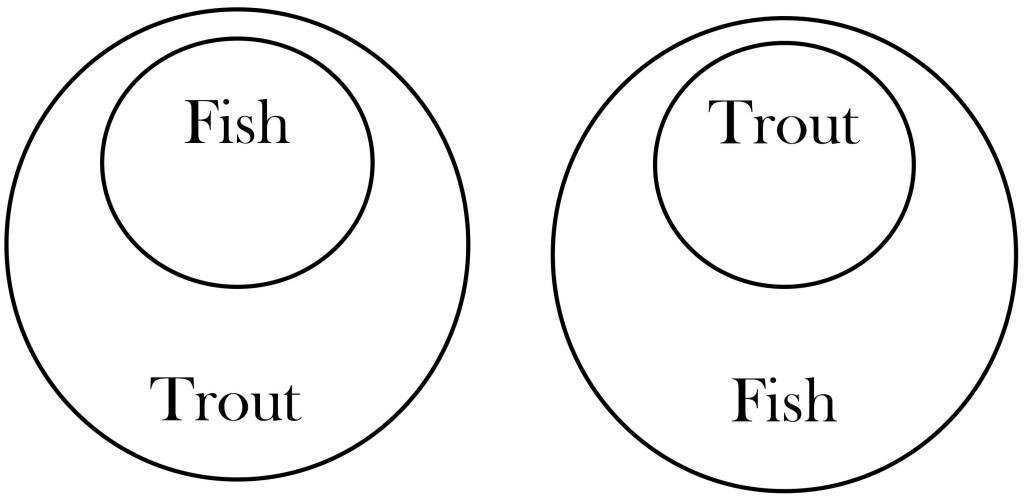
An understanding of some basic logic and understanding of category statements could be helpful here. For example, if I say, “all fish are trout,” is categorically different than saying “all trout are fish.” (See picture for a simple circle diagram.)

When dealing with categories, if all the subject, (not just some) is numerically or by attribute belongs to the predicate, then subject is a smaller circle fully inside the larger predicate circle. Thus, the subject is universally contained in the predicate. The logic is simple.

The first one is false, the other is true. In Genesis God established categories of the things He created. Thus, even if we mix in some specific induction, we know as infallible truth, God created fixed categories for animals, fish, vegetation, and etc.. We know there are many types of each in each of the broad categories. Thus, we know to say, “all fish are trout,” or, “all birds are sparrows,” is false, for there are many types of fish and birds, not just trout and sparrows. Thus, to casually flip the subject and predicate, of categorical truth claims is against Biblical teaching.

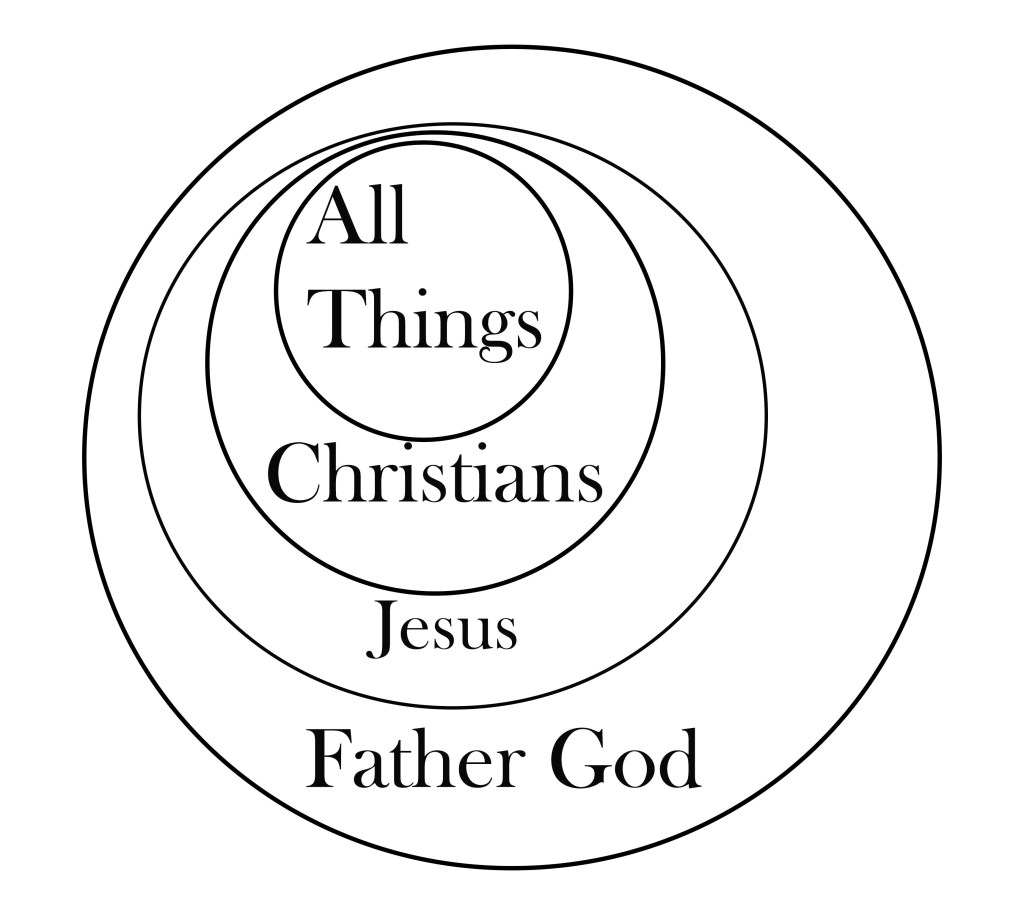
This is important to remember, because we are dealing with the ORDER of God’s decrees. It is important not to flip things around. If God decrees “x” as first, then it is not second or seventh. Congratulations, we just left second grade and now we can finally move on to forth grade teaching on God’s sovereignty. It is not bear control. An intelligent Mind ordered the world for His own goals. As we saw with an early circle diagram from 1 Corinthians 3, the order of multiple categories is crucial.

People who keep saying—God is in control, God is in control of my life, God is in control of this situation and even those who affirm with more boldness, God is in control and He is even the author of sin and evil—are spiritual infants. They never left second grade. They are mentally stunted. The question is, “how is God in control,” and “what has God commanded you to do, in light of His control of it.” Just saying God is in control, is of little help if it is applied like pantheism or fatalism. The decrees of God show His control is determinism in accordance to His own good purposes. Knowing God is in control is not boiled down to having a pagan, “Zen state of mind” about life; it is not boiled down to being calm. God was in sovereign control, when He directly and absolutely caused all those people in the gospels to be sick, blind, dead, leprous and demon possessed. What did Jesus do about this, as a man born under the law of God? He healed, resurrected and set those people free by the power of God. He commands us to do the same. If you do not do this, then the doctrine of God’s sovereignty is both wasted on you, and it shows you never believed above an infant level understanding of God’s sovereignty.

To say God is in control is not an ethic. It does not tell you what to do. However, if we say God has used this sovereign control, to DECREE us to be children of God, and DECREED we have bold access to His throne of grace, well then, this actually has huge implications for the person stating it. To say God has used His sovereign control, to DECREE for us to have power over sickness and demons, has huge implications. This shows us how God is in control. And some basic ordering of His control. It gives us understanding about our definition of Christians. God is not pantheism. His control over the world is explained and understand as His ordered decrees about all things.

What good is it for a sinner to realize they are a born a sinner by God’s control over their life, and say, “well, God is in control”? Do they forget God has used His control over reality to DECREE that there is salvation in Jesus Christ, and for those with faith, then a new life, a new soul and a new world is theirs for the taking.

In my experience, when I hear Christians say, God is in control or God’s Will, it has more in common with pagan fatalism than it does with God’s decrees of determinism. They are spiritual perverts and liars. God has used His sovereign control to DECREE that the elect are to be victorious (in everyday life difficulties) over sin, besetting sins, sickness, diseases, terrors of the night or day, demons and poverty. This so-called Christian appeal to, “God is in control,” is in reality an appeal to fatalism, and thus they let the sickness and demons roll right over them. In such acts these spiritual losers, are prostrating themselves to demons and their doctrines. These people are part of Reformed churches as much as they are part of Pentecostal churches. They falsely claim to assent to God’s sovereign control, but in reality they are liars. They believe in fatalism, and use this equivocation to negate the commandments of God. God’s specific descriptions of His sovereign control in His decrees, because of their detailed nature, are often accompanied with commands. That is, with detailed decrees, which are usually about the church, God gives commandments about the specific descriptions of reality He has ordered.  For example, God had decreed salvation for the elect in the atonement of Christ. God therefore commands repentance and faith in the gospel. God is in control, even when He directly caused the elect to be born sinners. However, by the decree of God, the elect believe what God has revealed. They believe by faith in Jesus they are saved. And so they are.  Also, God has decreed healing to be part of the atonement for the elect. With this specific description of God’s decree, God then commands us to have faith to be healed. God is in control, even when He directly caused the elect to have sickness and troubles. However, by the decree of God, the elect believe what God has revealed. They believe by faith in Jesus they are healed and delivered. And so they are.

Fatalism comes in and negates these commands, because God is in control, or, God’s will. Because God is in control, and thus, is ultimately in control over the fact you are sick and diseased, thus, you will pray, but what will happen by God’s control, will happen. This sounds humble and religious to spiritual perverts, but not to God. It is applying a demonic doctrine of fatalism over God’s determinism. God has used His sovereign control to decree that those with faith, will be healed, will cause Satan to depart and be victorious.

Fatalism is used to negate the details of God’s sovereign decrees. These people might be those who are quick to point out how the religious leaders in the gospels negated the commands of God by their traditions. Well, fatalism is a human made doctrine with its own traditions. Our religious leaders of today, mask their human doctrine with a biblical sounding topic—God’s sovereign control—but their wicked and sinister goal is to negate the commandments of God with it. They are sons of hell, leading others to be even greater sons of hell than they are.  

———————Endnotes——————–

Picture diagram of 1 Corinthians 3:23