Tag Archives: faith

All Things Are Yours to Moralize.

“All things are yours,  whether Paul or Apollos or Cephas or the world or life or death or the present or the future—all are yours,  and you are of Christ, and Christ is of God.”
(1 Corinthians 3:21:23 NIV)

They were all baptized into Moses in the cloud and in the sea. 3 They all ate the same spiritual food 4 and drank the same spiritual drink; for they drank from the spiritual rock that accompanied them, and that rock was Christ. … 6 Now these things occurred as examples to keep us from setting our hearts on evil things as they did. … 11 These things happened to them as examples and were written down as warnings for us, on whom the culmination of the ages has come.”
( 1 Corinthians 10:3-4,6,11 NIV)

“And the prayer offered in faith will save the one who is sick, and the Lord will raise him up, and if he has committed sins, they will be forgiven him… The effective prayer of a righteous man can accomplish much. Elijah was a man with a nature like ours, and he prayed earnestly that it would not rain, and it did not rain on the earth for three years and six months. Then he prayed again, and the sky gave rain and the earth produced its fruit.”
(James 5:15-18)

As Vincent Cheung points out in “All Things Are Yours,” the bible moralizes itself. We use the word “moralize” to mean a deductive application of the truth and promises to oneself. The bible moralizes Elijah prayer for rain (natural weather) to be used to pray for healing and forgiveness of sins. The bible moralizes Elijah to the horizon and back.[1]

Paul directly tells us in 1 Corinthians 10 that moralizing Old Testament stories is good biblical interpretation. These stories are for our example to learn from and apply to ourselves. If you are a Christian, then these stories can be moralized. This is what keeps the bible from being used in a broad way for everyone to find ethical stories and apply them as a secular teaching. Only if you are a Christian can you apply them. Only if you are a Christian can you moralize Elijah praying for rain as an ethical story to apply to yourself to pray for healing. Non-Christians do not have the right, intelligence, or faith to do so.

Only if you are a Christian and you have inherited all things are you allowed to do this, well, because all things are indeed yours. This is not advanced calculus. Because all things are yours, of course you can moralize all these examples for yourself. As Paul says, they are yours, and you are allowed to use them.  

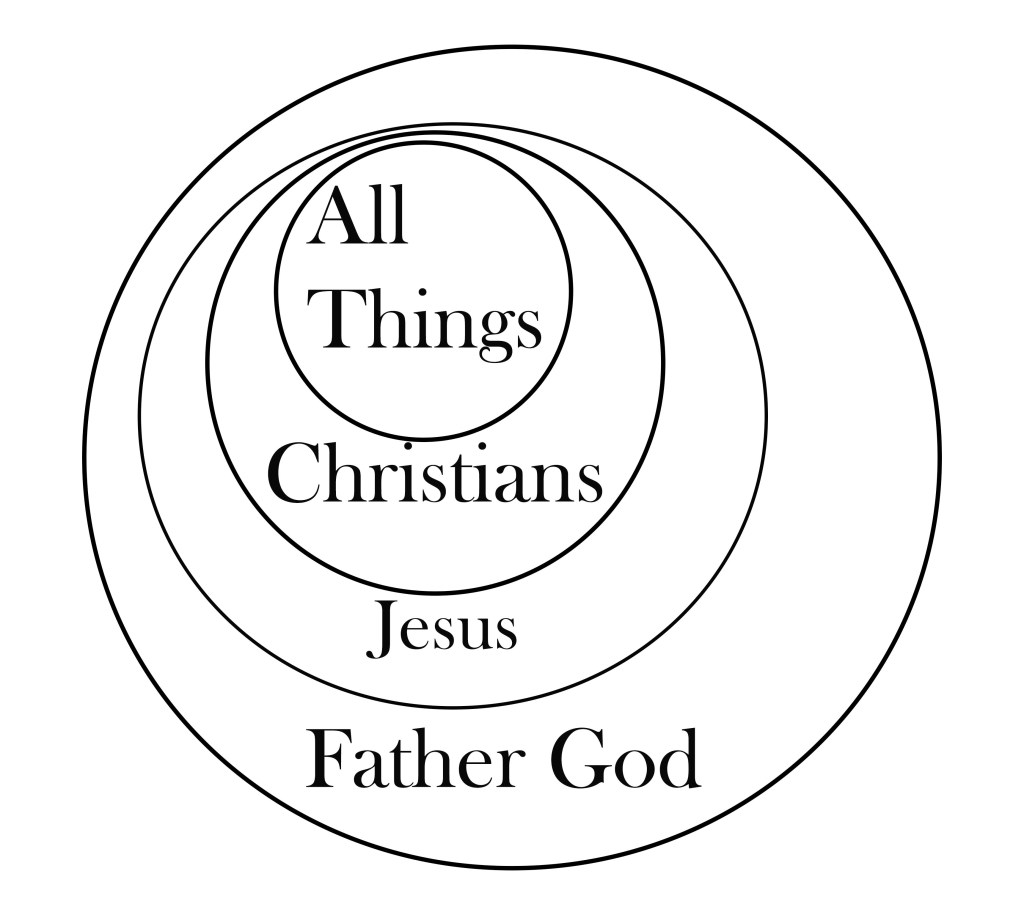
Our identity in Christ means we have inherited all things. Reality itself belongs to us. Remember our earlier diagram. It is true that all reality belongs to Jesus. Yet, God has so highly exalted, glorified and positioned us in Christ, that instead of “reality” being contained in Jesus as a subcategory, “reality” now belongs as a subcategory in us. This is why we can apply all the stories in the Scripture to ourselves for our benefit. All things are ours. And we are Christ’s. And Christ is the Father’s.

We are discussing this in the ethic section of the book, because it is not a suggestion to live and walk in our new identity in Christ. It is a command. It is good ethics to read the Psalms and apply them to yourself. Psalm 103 is yours. Use it! The Exodus story is yours. Use it. The judges and prophets are yours. Apply them to yourself. And do it over and over.

We are to understand how all things are ours and walk in our new definition. Part of this walking is to use biblical examples and apply them to ourselves for instruction, growth and faith. Do not let religious elitists deceive you from using your inheritance. You can apply the bible to yourself, and if they keep hindering you, use your authority in Christ and hand them over to Satan to either repent or be destroyed.


[1] See Vincent Cheung, All Things Are Yours. This paragraph has paraphrased statements from this essay.

Health, Long Life & Promises Verses

(The blessing of Abraham, which we have today through Jesus, (Galatians 3) includes the baptism of the Spirit and healing. Healing, long and strong life, the Spirit and miracles is part of the ancient promise of God, and not even the law, which came after, or the atonement of Jesus can negate it; rather, Jesus’ resurrection makes it accessible to the whole world. Jesus also carried our curses on the cross, so that we have the blessing of Abraham today.
The blessings and curses of the law teach us about the blessing of Abraham, they do not negate it. The blessings of the law is nothing less than the Blessing of Abraham based on works and merit, rather than grace and promise. Yet, the blessing of Abraham came first, based on grace. In Christ the curses are gone and the blessing of Abraham is already active for the believer.)

(Always remember the promises are not just suggestions; rather, they are your new identity and they are God’s command. God is telling you this is how He has created and defined you in Christ. You are to agree with Him that what He say is true. You are to obey God by walking in the definition He has revealed to you in His word, which is in the blessing of Abraham and the substitution and life of Jesus.)

(Although the focus here is mostly on healing and strong life, it is for any type of miracle.)

“And Yahweh said to Abram, “Go out from your land and from your relatives, and from the house of your father, to the land that I will show you. And I will make you a great nation, and I will bless you, and I will make your name great. And you will be a blessing.””
Genesis 12:1–2 LEB.[1]

After this, the word of the Lord came to Abram in a vision: “Do not be afraid, Abram. I am your shield, your very great reward.”
… He took him outside and said, “Look up at the sky and count the stars—if indeed you can count them.” Then he said to him, “So shall your offspring be.”
Abram believed the Lord, and he credited it to him as righteousness.
-Genesis 15 NIV

“This is my covenant with you: I will make you the father of a multitude of nations!  What’s more, I am changing your name. It will no longer be Abram. Instead, you will be called Abraham, for you will be the father of many nations.  I will make you extremely fruitful. Your descendants will become many nations, and kings will be among them! “I will confirm my covenant with you and your descendants after you, from generation to generation. This is the everlasting covenant: I will always be your God and the God of your descendants after you.”
-Genesis 17 NLT

(The sicknesses of the law included things like skin problems, arthritis, cancers and even being feeble in old age.)

“And said, If you will diligently listen to the voice of the LORD your God, and will do that which is right in his sight, and will give ear to his commandments, and keep all his statutes, I will put none of these diseases upon you, which I have brought upon the Egyptians: for I am the LORD that heals you.”
Exodus 15:26

“And you shall serve the LORD your God, and he shall bless you bread, and your water; and He will take sickness away from the midst of you.”
– Exodus 23:25

“O LORD my God, I cried unto you,
and you have healed me.”
-Psalm 30:2

“Many are the afflictions of the righteous:
but the LORD delivers him out of them all.”
-Psalm 34:19

Do not be afraid of the terrors of the night, nor the arrow that flies in the day. Do not dread the disease that stalks in darkness, nor the disaster that strikes at midday. Though a thousand fall at your side, though ten thousand are dying around you, these evils will not touch you.
– Psalm 91:5–7 (NLT)

(This “satisfying long life,” is the life and favor promised to Abraham. If we follow in his steps of faith, we have the same blessing. Moses, Joshua and Caleb had faith like Abraham and so they walked in the same strong life, even in old age. God did not promise forgiveness to Abraham; rather God promised favor, fame, blessings, prosperity, health. Abraham believed God would do all these good things He promised. God then declare Abraham righteous in His sight. We to are righteous in God’s sight when we believe God will do all the good things He promised for us, including healing, satisfying long life, miracles and prosperity. If we do not have this type of faith we are not children of Abraham.)

With long life I will satisfy him, and show him My salvation.
– Psalm 91:16

“He sent his word, and healed them, and delivered them from their destructions.”
-Psalm 107:20

“He heals the broken in heart, and binds up their wounds.”
-Psalm 147:3

(The bible shows that health is not rewarded for right eating; rather, health and long-strong life is rewarded for righteousness. In Jesus we are already the righteousness of God. God Himself has already declared us righteous in His sight.
George Muller said it was verses like these in Proverbs, and confessing them continually, that lead him to live a long life with vigor. The same faith he used to bring in 100s of millions of dollars for the orphans is the same faith he said he used to bring strong life to his body. Faith.)

“Do not be wise in your own eyes; Fear Yahweh and turn away from evil.
It will be healing to your body And refreshment to your bones.
-Proverbs 3:7-8 LSB

My son, pay attention to my words; Incline your ear to my sayings.
Do not let them deviate from your eyes; Keep them in the midst of your heart.
For they are life to those who find them And healing to all his flesh.
-Proverbs 4:20-22 LSB

(Isaiah 53:4-5 uses the word “nasa.” It means to carry or lift-up. It is the Levitical word for substitutionary atonement as taught on the Day of Atonement (Lev. 16). The escape goat had the sins “nasa” transferred from the people to it and the goat carried them away, and in exchange the people carry purity. Isaiah 53 uses this for “sickness” and “disease” (Matthew 8:17). Healing is a substitutionary exchange with Jesus. He bore our sickness so that we do not. Matthew 8:17 shows this healing is for this present life, and not the next one. Healing can only happen now, because in the next life we will have a new body that does not require healing. It is now or never. Jesus carried our sickness, we carry His health and life. Remind Him of this, He likes to hear you confess your faith in His finished work.)

(Absolutely,) our sicknesses He Himself carried(substitution),
And our diseases He carried;
..But He was pierced through for our(substitution) transgressions,
He was crushed for our(substitution) iniquities;
The chastening for our(substitution) peace fell upon Him,
And by His wounds(substitution) we are healed.
-Isaiah 53:4-5 (modified from the LSB)

“In order that what was spoken through the prophet Isaiah would be fulfilled, who said, “He himself took away our sicknesses, and carried away our diseases.”
-Matthew 8:17 LEB

“Then your salvation will come like the dawn, and your wounds will quickly heal. Your godliness will lead you forward, and the glory of the Lord will protect you from behind.”
Isaiah 58:8 NLT

For I will restore health to you. And heal you of your wounds,’ says the Lord,
‘Because they called you an outcast saying: “This is Zion; No one seeks her.”
Jeremiah 30:17 NKJV

(Everyone who came to Jesus was Healed. Every last one of them.)

And Jesus went about all Galilee, teaching in their synagogues, preaching the gospel of the kingdom, and healing all kinds of sickness and all kinds of disease among the people.
– Matthew 4:23

News about Him spread as far as Syria, and people soon began bringing to Him all who were sick. And whatever their sickness or disease, or if they were demon-possessed or epileptic or paralyzed—He healed them all.
Matthew 4:24 (NLT)

When Jesus had entered Capernaum, a centurion came to him, asking for help. “Lord,” he said, “my servant lies at home paralyzed, suffering terribly.” Jesus said to him, “I will go and heal him.”
Matthew 8: 5–7 (NIV)

…Then Jesus turned to the paralyzed man and said, “Stand up, pick up your mat, and go home!” And the man jumped up and went home!
– Matthew 9:6–7 (NLT)

Then great multitudes came to Him, having with them [the] lame, blind, mute, maimed, and many others; and they laid them down at Jesus’ feet, and He healed them.
– Matthew 15:30

Jesus had compassion on them and touched their eyes. Immediately they received their sight and followed Him.
– Matthew 20:34 (NIV)

And He entered the synagogue again, and a man was there who had a withered hand. So they watched Him closely, whether He would heal him on the Sabbath, so that they might accuse Him. And He said to the man who had the withered hand, “Step forward.” Then He said to them, “Is it lawful on the Sabbath to do good or to do evil, to save life or to kill?” But they kept silent. And when He had looked around at them with anger, being grieved by the hardness of their hearts, He said to the man, “Stretch out your hand.” And he stretched [it] out, and his hand was restored as whole as the other.
– Mark 3:1–5

A woman in the crowd had suffered for twelve years with constant bleeding. She had suffered a great deal from many doctors, and over the years she had spent everything she had to pay them, but she had gotten no better. In fact, she had gotten worse. She had heard about Jesus, so she came up behind Him through the crowd and touched His robe. For she thought to herself, “If I can just touch His robe, I will be healed.” Immediately the bleeding stopped, and she could feel in her body that she had been healed of her terrible condition.
– Mark 5:25–29 (NLT)

Jesus stopped and said, “Call him.” So they called to the blind man, “Cheer up! On your feet! He’s calling you.” Throwing his cloak aside, he jumped to his feet and came to Jesus. “What do you want Me to do for you?” Jesus asked him. The blind man said, “Rabbi, I want to see.” “Go,” said Jesus, “your faith has healed you.” Immediately he received his sight and followed Jesus along the road.
– Mark 10:49–52 (NIV)

When the sun was setting, all those who had any that were sick with various diseases brought them to Him; and He laid His hands on every one of them and healed them.
– Luke 4:40

And the whole multitude sought to touch Him, for power went out from Him and healed [them] all.
– Luke 6:19

A funeral procession was coming out as He approached the village gate. The young man who had died was a widow’s only son, and a large crowd from the village was with her. When the Lord saw her, His heart overflowed with compassion. “Don’t cry!” He said. Then He walked over to the coffin and touched it, and the bearers stopped. “Young man,” He said, “I tell you, get up.” Then the dead boy sat up and began to talk! And Jesus gave him back to his mother.
– Luke 7:12–15 (NLT)

(Jesus is healing her based on the promise to ABRAHAM. Jesus thinks this ancient promise of God makes it necessary for her to be healed. Not Jesus’ ministry, not signs to confirm His ministry, not a foretaste of gospel things to come, but on God’s old promise, it is necessary. It is necessary for God to do what He promised, no matter how ancient the promise is. Through Jesus, we are part of Abraham’s blessing today. Our healings are therefore, necessary, because God is a God of truth and faithfulness.)

When he saw her, Jesus called her to him and said, “Woman, you are set free from your sickness.”  He placed his hands on her and she straightened up at once and praised God.
…Isn’t it necessary that this woman, a daughter of Abraham, bound by Satan for eighteen long years, be set free from her bondage on the Sabbath day?”
– Luke 13:12-15 (CEB)

(Because Abraham’s blessing is in full force for us today, then passages like Isaiah 51 can be applied to us, today. They are part of your inheritance. Yes, Look to Abraham because he belongs to you by right and necessity.)

“Listen to me, you who pursue righteousness and who seek the Lord:
Look to the rock from which you were cut and to the quarry from which you were hewn; look to Abraham, your father, and to Sarah, who gave you birth.
When I called him he was only one man, and I blessed him and made him many.
The Lord will surely comfort Zion and will look with compassion on all her ruins; he will make her deserts like Eden, her wastelands like the garden of the Lord. Joy and gladness will be found in her, thanksgiving and the sound of singing.
-Isaiah 5:1-3 NLT

“…how God anointed Jesus of Nazareth with the Holy Spirit and with power, who went about doing good and healing all who were oppressed by the devil, for God was with Him.”
– Acts 10:38

(Again Abraham’s blessing is important. The children Jesus is referring to is Abraham’s children. He says healing is like daily bread. That is how common healing it is for Abraham’s children. Jesus says if a son ask for bread a good father will give him bread for bread, or healing for healing. Even though it was not her time, by faith she took some bread anyway, and Jesus approved of it. Faith always gives you direct access to God and always gives you bread when you as for bread.)

The woman came and knelt before him. “Lord, help me!” she said.
He replied, “It is not right to take the children’s bread and toss it to the dogs.”
“Yes it is, Lord,” she said. “Even the dogs eat the crumbs that fall from their master’s table.”
Then Jesus said to her, “Woman, you have great faith! Your request is granted.” And her daughter was healed at that moment.
Matthew 15:25-28

(Jesus was the greatest and most extreme faith teacher there ever lived. Faith for everything and anything, which therefore includes healing and strong life. Jesus, the most God centered man who ever lived, said things like, “nothing will be impossible for YOU.” With faith a tree will plant itself in the dead sea and it will “OBEY YOU.”
Jesus puts you in the driver’s seat, not the “will of God.” Jesus puts you in control for your health and miracles and not some nebulous “will of God.” If you have faith, you will get what you ask for, if you do not have faith, you will not get what you ask for. It is this extreme faith teacher, it is this Jesus whom we will all face one day for Judgement. If you appeal to the will of God on Judgement day, Jesus will reply by appealing to your faith or unbelief.)

“Whoever believes in me will do the works I have been doing, and they will do even greater things than these, because I am going to the Father.  And I will do whatever you ask in my name, so that the Father may be glorified in the Son.  You may ask me for anything in my name, and I will do it.
– John 14-12-13 NIV

“But if you remain in me and my words remain in you, you may ask for anything you want, and it will be granted!
This brings great glory to my Father.”
– John 15:7-8 NLT

Jesus said, “You (unbelieving perverts)! How long must I be with you? How long must I put up with you? Bring the boy here to me.”  Then Jesus rebuked the demon in the boy, and it left him. From that moment the boy was well.
Afterward the disciples asked Jesus privately,
“Why couldn’t we cast out that demon?”
“You don’t have enough faith,” Jesus told them. “I tell you the truth, if you had faith even as small as a mustard seed, you could say to this mountain, ‘Move from here to there,’ and it would move. Nothing would be impossible (for you).”
– Matthew 17:17-20 NLT

He replied, “If you have faith as small as a mustard seed, you can say to this mulberry tree, ‘Be uprooted and planted in the sea,’ and it will obey you.
-Luke 17:6

 (The first mention of this binding and losing, is in Matthew 16, when Peter confesses Jesus is the Son of God. Jesus responds that on this confession the church will march forward, and the gates of hell cannot stop its advancement. It is on this foundation Jesus says, what you unlock and lock, bind or lose on earth will be so in heaven. If you have the same confession Peter did, that Jesus is the Son of God, this authority belongs to you.)

“Truly I tell you, whatever you bind on earth will be bound in heaven, and whatever you loose on earth will be loosed in heaven.
“Again, truly I tell you that if two of you on earth agree about anything they ask for, it will be done for them by my Father in heaven.
– Matthew 18:18-19 NIV

(We are righteous already in Christ; thus, we pray as righteous people in God’s sight. The promise is not that you might, but that God will heal you, just as absolutely as God will forgive you. Think about that. James connects the absolute surety of forgiveness and faith, to healing and faith.)

“And the prayer offered in faith will make the sick person well;
the Lord will raise them up. If they have sinned, they will be forgiven.
The prayer of a righteous person is powerful and effective.”
– James 5:15-16

[1] Unless noted the scripture is from the KJV (I did modernize “thee or you”) or NKJV. I did supplement some words in a few verses, with the footnote option, provided by the translation.
() by author.

Also, I what to give thanks to Vincent Cheung, and his essay, The Edge of Glory, for helping me understand the importance of God’s promise to Abraham.

What is an Evil Report?

And they spread among the Israelites a bad report about the land they had explored. They said, “The land we explored devours those living in it. All the people we saw there are of great size.” (Exodus 13:32 NIV)

Notice the evil report was not because they said, “What God promised, He cannot do. God promised this Land but God is too weak to drive them out by our hand.” Rather what they said was focused on empiricism, or what they can see. They saw giants. They saw they were small compared to them in height. They saw the fortified cities and armies and saw they destroyed their enemies.

They did not directly attack God’s promise; rather they only reported what they could see, touch and hear. They gave testimony of sight. And God called this an evil report. God wanted to destroy them right there on the spot. Moses had to step in and plead with God, not to kill them right there. God relented but promised they would never see the Promise Land, and they would all die in the wilderness. God rejected them as reprobates saying, “You will never enter My rest.”  They reported they were too weak and the others were too strong, based on their sensation and observation. God said, you will therefore be bound to this report based on sight. You are too weak for them, and they are too strong for you; you do not have the strength to enter into my good land.

Based on their five senses, human observation, and inductive calculation, it was true that they were weaker than the inhabitance. They did not lie about what they saw. Thus, all they did was give a report based on sight. They testified correctly to what they saw and touched. And yet, God wanted to destroy them for giving a correct testimony of what they saw.

These people truthfully testified about what they saw, and God called them evil and rejected them over it. Think carefully about that.

It was evil and bad because “we live by faith not sight,” 2 Corinthians 5:7. If we see a contradiction with what we see and what God has said, God considers it evil to testify correctly to what you observe. God expects you to testify to what He has said. Because there is a contradiction, if you affirm one and just leave it at that, then you in essence deny the other. This is an either-or logic, where the two terms are a known contradiction and thus if you affirm one you deny the other (fulfilling the requirements of the deduction). It is two testimonies that contradict one another. It is like two people who give two contradictory answers: “2 + 2 = 4,” and “2 + 2 =7.” If you pick one, then you are denying the other. As Jesus said, if you are not with Him, you are against Him. If you do not directly choose Him, then you are against Him. If you do not confess the promise against what you see, then you are against God. If you do not confess faith against your observations, you are God’s hated enemy. 

The command of God is to speak faith. Abraham’s very name was a constant spoken confession of faith in God’s promise. We prove ourselves to be children of Abraham if we do the same.

An evil report is speaking what you see (empiricism/observation), rather than God’s promise. Even if your testimony truthfully describes what you observe, if there is a promise about the same circumstance, you are evil. You are the type of person who spreads evil reports. The more people who see you publicly confess your observations (even if true) rather than the promise, the more wicked the report becomes, and as a consequence the more guilt you heap on yourself. 

I can hear these self-righteous Israelites saying, “but we only testified to what we saw! They are bigger and stronger, with more weapons. They are aggressive people. WHY is God angry with us for speaking the truth?”  The same happens today. “I only testified to what the doctor and I saw. I spoke the truth. The cancer was stage four, all over my body. Why does God call my observation an evil report?”

Yet, God has commanded us to speak His word. He has commanded us to trust His promise. He has commanded us to agree that His word is permanent, faithful and true. He commands us to not only believe in our hearts, but to confess with our mouth.

Adam and Eve had a problem with this. God told them something, and they faced the contradiction that the tree looked good to eat. The first school lessen for mankind was one of faith in God’s word. Faith, as Vincent Cheung says, is the first primordial orthodoxy for man. No other doctrine revealed later will override faith. Faith overrides all doctrines because all other doctrines came after the orthodoxy of faith.[1]

Abraham had a similar situation. Romans 4 said he believed against all hope. That is, he believed against what he saw, felt and observed.  His name, “father of many nations, was a contradiction to reality itself. Yet, it is God’s word that creates and controls reality. If you have faith in God’s word, the Word will always prevail over your observations. This is why we live by faith, not sight.

It is not as if you cannot under any circumstances say what the reality is, but it needs to be said in a way that does not negate your confession that God’s promise is true over what you observe. Jesus said that Lazarus was only asleep. But then when pressed He admitted he was dead, yet again affirmed Lazarus was as good as being alive.

People want to see themselves like Caleb and Joshua, while they still speak like the Israelites who gave a bad (correct) report on what they saw. They read God’s promises of healing in the bible, but then they will get a doctor’s report. They will then give a true testimony of what the doctor saw and spoke. “The cancer is strong, and my old body is weak.” This is exactly what the Israelites said, and God was so furious He wanted to kill all of them, right there and then. If you want to be like Joshua, who received God’s approval, then be like Joshua. Say, “the doctor saw the cancer, but it is food for me. Jesus left my sickness on the cross because it died there with Him. The Father considers Jesus as a substitute atonement for my sickness in my place, and therefore, I do not bear it. By His stripes I am healed. I declare in Jesus’ name, “I am healed.” His promise is more real than what I feel or observe.”

The only way to be obedient is to directly and constantly speak the promise of God against what you see. If you merely omit this and only speak what you see, you are an evil person who spreads evil reports. You will partake in the same destiny as the Jews who died in the wilderness. You will not enter into the good land, into the good promises, into the good things God has. They will be denied to you, if you give correct testimony of your observation over God’s promise.

But why stay silent? If you only believe, then the promise land of blessings are yours for the taking. God has already spoken and revealed His promises. Stand up and agree with Him. Be like Abraham your father and speak the contradiction to all you see and observe. Speak the confession of God’s promise and receive it like Abraham did. The only way to speak good reports and spread good reports is public confession of absolute certainty in God’s promise over reality.  Be a super spreader of faith confessions, and you will have God’s approval. Men, especially church men will hate you, and even try to stone you for good faith reports, but God will approve of you. He will give you what you ask of Him. Joshua and Caleb was delayed from entering the promise land as God rejected that current generation, but they did finally enter. The good report they confessed is the reality they lived and experienced.

God is not the one holding you back. The unbelief spoken by the Israelites is what held them back from entering the promise land. The faith Joshua spoke what allowed him to enter the good things of God.  Unbelief or faith is what will cause you to be held back or move forward into God’s good things.


[1] See Vincent Cheung, “Faith Override.”

When are my Prayers Meaningful?

“The way “sovereignty” is taught today can be a real faith killer. If God controls everything, then our actions are irrelevant, and our efforts are meaningless.”
Andrew Wommack

This has to be one of the dumbest and meaningless objections to God’s absolute sovereignty I come across. The objection is answered in the very statement the critic uses.

For example. “All men have sinned.” If it is true that all men have sinned then to say, “Oshea has sinned” is a logical deduction and thus is true. But if I say, cats have sinned, then we know we have a category fallacy, and thus the conclusion is irrational. Deduction is application of knowledge. “Oshea has sinned,” is knowledge contained in the original statement, “all men have sinned.” All I did was point out this specific knowledge and bring it to your attention.

Unfortunately, basic deduction is lost with most pastors and theologians so that if you say “All men have sinned,” they can say “therefore black cats have sinned.” They are then called intelligent and given a book deal.  Strangely, if I put forward an argument that mixes up categories like the able, that says, “All apples are eatable,” therefore, “because the sun is round like an apple the sun is eatable,” people would mock me? Maybe I should give it a religious terminology and I could get a book deal myself. Maybe something like this, “if God is sovereign over all things, then God does not control squires and human thoughts.” I see millions of copies already being sold.

As for the objection above the major premise is saying “God is sovereign over all things.” Wommack is saying this as the Reformed tradition would mean it. Martin Luther in Bondage of The Will says God is as directly sovereign in causing faith as He is unbelief or sin, as in the Elect or Satan. Thus, we will mean God is sovereign over all things as truly an “all” statement. A category statement is “all,” “some,” or “none.” Here we mean God directly and absolutely controls all things.  When the bible says the category statement “all have sinned and fallen short,” it does not mean only “some,” but “all” have.

And so “if God is sovereign over all things,” then according to Wommack the conclusion is that “our actions are meaningless.” His conclusion has new information in it that is not contained in the premise(s), thus it is irrational and stupid. He makes a category error with the term “meaningless.” It is a fourth term that is thrown in the conclusion with a slight of hand.

I will add an additional premise here that I believe the Bible easily teaches and is presupposed by the statement “God is sovereign over all things.” This premise is that “if God does something, it is meaningful by definition that God is the one who does it.” If not, am I to presuppose that God doing something is not meaningful because He is the one doing it? But I digress.

If God is sovereign over all things and whatever God does has infinite meaning and value, then God controlling my choice is by definition infinitely meaningful and valuable.

God is the only one with intrinsic worth and whose value is without measure. God’s Will, Word and Power are one in the same. As Vincent Cheung says in Only  Believe, “God can never lie, not because there are things that omnipotence cannot perform, as some would put it, but because lying is inapplicable to God, since the will, the power, the word, and the truth are one in him. If God says something, then even if it was not true before, it would become the truth.” Thus God who alone has value creates and controls all things by His thoughts.

Whatever God does by definition is “just” “good” and “meaningful or valuable.”

This should not be a surprise. Even with humans we are similar. When I played in the sand, or played with my Legos and made things and new people and new made up stories, it was meaningful to me, precisely because I was the one doing it.

Wommack is so arrogant that he thinks God’s sovereign control over him is the very thing that makes his choices meaningless, when it is the only thing making them meaningful. He supposes his choices apart from God’s sovereignty control have intrinsic value. I will ignore the issue of ontology on this, for it is impossible for any created thing to move without God’s doing it. God is the only real cause for everything; there is no such thing as secondary causes in the ultimate sense. God is the only real cause. God’s thought and power are the same thing in essence, or there is no dividing them. If God does not think of something, then it does not happen. If God thinks of something and wills it, then it happens. There is no other real causality other than this.

We are responsible and accountable because we are not free relative to God’s command and His sovereignty over us. Romans 9 answers the question why we are responsible even though God can harden or soften our hearts. The answer is that He is the Potter and we are the clay. He does this from a neutral lump of clay, that is neither good or bad. Thus, the Scripture’s answer for why we are accountable is because God sovereignly controls us.

As Vincent says in “More than A Potter,” if you say man is more than a pot, then God is infinitely more than a Potter.  And so the sovereign control aspect is therefore made infinitely stronger. The fact that we are accountable to God is therefore a limitation of our freedom, in the sense it makes it nonexistent. God controls us like a Potter over a pot. Does God form a good pot from a good lump? No. Does God take a nasty lump of clay and form a nasty toilet with it? No. God takes from the same lump of unformed (before they were born) clay and molds it to His own design (good or bad). Thus, there is no paradox, because Divine sovereignty negates human freedom and is the very thing that makes accountability work. The fig tree did not have any freedom, but Jesus held it accountable. Even without freedom, the everything that made it accountable was Jesus being sovereign over it and holding it to a standard. Freedom had no relevance to accountability. Romans 9 refers to our accountability in the same way. This is the opposite of how most understand it; thus, many are in direct public rebellion against God.

God is not accountable because of the very reason He is free.

In summary, God is the ultimate cause of everything. There are no other real causes. We are accountable to God because He has complete control over us. We are like clay in the hands of a potter. God’s sovereignty is what makes us responsible.

The criticism is essentially this, “if I am not the one who ultimately determines my reality then it is not meaningful.” Arrogance. That is, “if God does not give me His divinity then I will hate Him.” They don’t like that fact God has such exhaustive control and they don’t. What fool told you that meaningfulness is by your ultimate determination? The bible? The bible that says God hated Esau and love Jacob before they had made any choices and before they were born. The bible teaches what God does is meaningful, because God does it.

So prayer in the ultimate sense does not change anything. But this is true for all created things. However, on the relative level my prayers moves the heart of God, uproots mountains and makes the waves obey me.

Even though the Scripture informs me of God’s sovereignty over me, God mostly addresses me on the human or relative level. That is, God moving the chess pieces is the very thing that makes such things meaningful. However, God mostly addresses me on the relative level of “(Oshea) went to space b4,” rather than saying, God moves “White Knight to space b4.” Because God is mostly addressing me on this level, it is therefore good, just and meaningful by definition of God doing it. Because God wants me to mainly have relationship and fellowship with Him on this level, then it is good, just and meaningful.

What God has done is atone for all our sins by His only Son Jesus and gave us His Son’s righteousness. What He has done is commanded us to be forgiven and blessed by receiving His Son and all the glorious benefits contained therein. Therefore when I use faith and receive forgiveness, healing and miracles, then it is good and has immeasurable value.

Don’t You Dare Sit there and Only Sip on Some Water

“Therefore do not be anxious, saying, ‘What will we eat?’ or ‘What will we drink?’ or ‘What will we wear?,’ for the pagans seek after all these things. For your heavenly Father knows that you need all these things. But seek first his kingdom and righteousness, and all these things will be added to you.”

Matthew 6 31-33.

The Bible is always true. Jesus teaches that pagans want the good material things on earth. Pagans seek more than just getting by in terms of wealth. Thus it is true that pagan seek wealth, because Jesus presupposes that they do.

Wealth as a blessing, is lesser if compared to forgiveness and sonship, yet Jesus wants and promises to give them to His covenant insiders. Because He wants to give pagan-level-seeking wealth to us, then it is good by definition because He says it and does it. To resist this is evil, wicked and rebellious. We are not seek pagan-level-seeking wealth by our strength and time, and neglect our God and family. Rather we seek pagan-level-seeking wealth by seeking God’s kingdom first. Even though it is by this indirect way, yet, we understand God wants us to have it. Thus, we seek it in order to please God. We get this wealth by God’s command and ordained way.

I received a response to this saying that “because material wealth is a lesser blessing then we should not seek it, but seek a relationship with God instead.”

This passage in Matthew 6 is only level one regarding how to receive God’s blessings of wealth. There is more to it. Matthew 6 is only an indirect way to receive it, but there are direct ways to receive wealth by faith.

Galatians 3 tells us Jesus became our curse so that we have the blessing of Abraham. This blessing included financial increase. Jesus was nailed to our curses of financial lack (which was in the law as curses) and gave us the blessing of Abraham. Paul says in Corinthians 8-9 that Jesus was a substitute atonement for us in the aspect of our poverty, so that He gave us His wealth in exchange. In context of Paul’s dialog it was not about spiritual wealth but material wealth.  

Also, since James and Paul moralizes Old Testament examples for us to use for ourselves, to use the prayer of Jabez is more than fair game to use for us. Because it was by faith, as an inheritor of Abraham’s blessing Jabez is for us, because we have the same blessing and faith.  

Thus, God gave us His one and only Son, His only Son, to bleed and gasp to death on a cross, hour after hour, to take our property away and give us His material wealth. If you look, there are blood stains on that money, and it is belongs to God’s only Son, Jesus Christ.

Also, Jesus made material substance multiply that would equate to over a year’s wages in money. He made fish to come in an abundance for financial gain and picked money out of fish. Jesus said that “whosoever believes in Me, will do the same works, and even greater.”

Thus, even if material wealth is a lesser blessing as compared to being born-from-above and reconciled to God, it is still a blessing with Jesus’ blood stained on it. To receive wealth is thus part of the gospel, if we define the gospel as all the good things Jesus accomplished, at that time and place, by His substitutionary death and resurrection. To reject any command of God is to be rebellious and wicked. It does not matter the priority of the command. To be disobedient is to be disobedient.

God commands and promise over and over that the righteous will increase with wealth to be blessed and be a blessing, particularly to the ministry. It is not a suggestion to partake of Abraham’s blessing. It is a command to walk in your identity and live it. Thus, to reject seeking wealth to be blessed and to bless the ministry is to treat the blood of Jesus Christ as a common thing, to spit on the Christian identity in Christ, and to reject God’s command as a reprobate.

If you have so much god-centered humility, then the Bible promises to exalt you. Thus, if you are so godly, and you don’t need wealth, you should have some compassion and think about getting 1000 houses to give to those who need it? How awesome would it be to give a billion dollars to ministries and missionary groups? But you are so godly you cannot even strain out a gnat to give, because you are too busy seeking a relationship with God first. How spiritual of you. But this same God says if you do this, then He will give you the level of wealth the pagans seek after, and we know pagans seek a large amount of wealth. No, the fact that you do not have pagan-level-seeking wealth, is because the way you have defined a “relationship with Jesus” is anti-Christ and blaspheme. And thus, you do not seek God first. A correct relationship with Jesus would include gaining such wealth because God wants to give this to us “in our relationship with Him”; He has commanded; His Son bleed for it.

Who else other than Satan preaches and teaches and trolls all over the internet telling people to not accept the blood-stained blessings of God? Paul was right, Satan disguises himself as a messenger of light. Satan disguises himself as Christians who spend much time trying to convince Christian to reject the blessings of God. I am still amazed so-called Christians spend time convincing others to reject God’s goodness. Blessings that Jesus died for and blessings God has commanded that we receive in faith. Surely, no person in their right mind would do such a thing? Only someone possessed or influenced by demons could participate in such rebellious and stupidity. Such people are imprisoned in a demonic stronghold.

Jesus, in Mark 1:23 starting casting out demons with a demon who was comfortable attending church. It is our job to do the same. We need to start our judgment with the church and begin to cast out Satan and demons. Its time to set the prisoners free and expel the darkness.

The only way out is to obey God and receive all His gospel blessings in faith and without qualifications or excuses. This is the type of relationship God wants with His chosen ones. Those who reject this are in fact without a relationship with God. They are outsiders to Him and His covenant. They are reprobates, and this is why they reject God’s command and reject His relationship.

Let us who enjoy obeying God, or that is enjoy having a relationship with Him, enjoy all the benefits of this relationship. Our Father has invited us to His rich table. He has spared no expense and wants everyone to know how lavish it is. He wants all to know that He paid for all it. He wants you to thank Him by sitting down and enjoying all the good things He has prepared for you. Don’t you dare sit there and only sip on some water and think you are honoring your God. The more you partake, the more you honor Him.

hao-qin-csu26tj-8bq-unsplash.jpg

Drive Out and Take Possession

When you cross the Jordan River into the land of Canaan,  
you must drive out all the people living there. … 
Take possession of the land and settle in it,
because I have given it to you to occupy. Exodus 33:51-53 NLT

In Salvation Jesus saves us and we do nothing. This is typified with Israel crossing the Red Sea. God defeated their enemies, and they did nothing. All Moses did was wave his staff around a little. When they passed through the water, their baptism was one of freedom; they were no longer slaves. However, there was another baptism at the Jordon. (see Vincent Cheung, The Edge of Glory). God commanded two things after this second baptism into power. They were to “Drive Out” the inhabitants and then “Take Possession,” of the mike and honey, houses, gold and vineyards.

This archetype is realized in the baptism of the Spirit in Acts 1:4-8.
The decrees of God are logical (supralapsarian), and thus what we see in history is a reverse of the decrees. The book of Acts is the original, the promise land and Joshua was reversed engineered from the story of the church as described in Acts. They were the illustration, and Acts the original. Thus, the 2 baptisms in Exodus was the illustration for God’s original 2 baptisms of water and the Spirit.

Thus, we see Jesus and the disciple “Driving Out” demons and the religious leaders. Jesus and his disciples “took possession” of the good things, such as health, money, knowledge, spiritual powers, lands, leaderships and even kings.


This is where many Christians fail. They are like the people of Israel and are still stuck in the desert. They are there not because of persecution for the gospel sake, but because of their unbelief in God’s promises. God commanded Israel that the second baptism was one of power. Instead of God doing all the work Himself, He would empower them drive out and take possession. Because Israel had no faith they rebelled against God and refuse to be used by Him.

The issue is that good things like healing, prosperity, good relationships and so forth are in the promise land ready for God’s people to take procession of them. These are not like conversion and freedom, where you did nothing for it. The Spirit, like the wind blowing wherever it wants, gives new-birth and you were freed and started to believe. This is again like the Red Sea baptism. But after conversion God’s commands us to be baptized in the Spirit, which is seen in the Jordan. When Joshua and Israel come out of Jordan they had swords and shields. They were going to fight with God’s power, unlike with Pharaoh, when they did nothing.  In order for Jacob to grab his inheritance he must take up a sword.

God as already given healing and blessings in the finished atonement of Jesus. But unlike conversion, you must drive out Satan and take possession of these blessings by the fight of faith. Some are still in the desert and claim it is the will of God they are not healed. Like Israel, they put all the blame on God and overlook their unbelief. It is the same story over and over again. Some step into the promise land for 17 steps and claim they cant get healed because of the will of God, yet they haven’t faced one city or driven out one demon to take possession. Jesus commands us to pray and never give up. We are to keep driving out and take procession.

To be a good soldier one must develop internal power of faith, and be clothed with the power of the baptism of the Spirit.  When these are developed properly, there is no giant that can stop you from driving out and taking hold of any promise of healing, prosperity, relationships and moving mountains that Jesus said, no matter how big and glorious the promise.

The Hittites were the first Israel faced. Their name symbolizes fear. This is how demons, the old man and the 2 million Israelite unbelievers will try to pressure you to not go and take possession. But faith is stronger than fear, because faith has absolute confidence in God’s Word and not man’s sight or feelings.

As Strange as it Sounds, the Bible is For You

“I Can Do All Things Through Jesus who Strengthens Me”

Critics say this is only about suffering, so you cannot use this verse for prosperity, for example. However, Paul also mentions in context that Christ strengthens him for prosperity and good things as well.

Even if we narrow it down Paul’s own life, the “good” would include all his miracles, favor, visions, resurrections, powers and one supernatural thing after another. To teach at that school for a few years, is a supernatural success.

Thus, it would mean God gives strength for miracles, visions, resurrections, powers and one supernatural thing after another. If the critic cannot agree to at least this, then they are the ones ignoring the context.

Paul spoke how he was a shied to his churches, taking on the persecution of Christ for them. Thus, it is wrong to say all Christians should expect to suffer “like Paul.” We should expect some sufferings “for the gospel sake,” but “like Paul” is a different category. Most Christians can apply the promise of the Psalms to themselves, where it says to “seek God and He will give you the desires of your heart.” Paul was an exception to this in that God said He as called him to a specific type of ministry that will include much suffering. Most Christians are not in this type of binding ministry that Paul was in, and so some make composition fallacy at this point with Paul.

With that said, why would God, who who gave us His only Son, and who will freely give us all things, only strengthen us for suffering but not success? The Spirit strengthens us to have faith for all scripture, including when Jesus said, “whosoever believes in me, will do even greater things.” Thus I am strengthened to ask and receive all types of success and miracles. Because the Spirit was a promise of the gospel, then I can say, “by Christ.”

Also, the bible speaks of God empowering His children and promises to do so in many ways and in for all types of situations. The critics act as if God’s many promises to help and strengthen His children only apply to Paul when He suffers? How does that work? The fact is, many (if not a super majority) of the promises are for strength for good things like salvation, healing, prosperity, relational blessings, productivity in life and spiritual power and fruit.

And lastly, this whole thing can simply be dealt with one brut slap. The bible moralizes itself. (see Vincent Cheung. All Things are Yours) James moralizes Elijah to the horizon and back, and Paul does so in Corinthians 10. Thus, even if I were to moralize the text for myself to be wealthy, there is nothing wrong with it. If you are are Christian, then Paul and Peter are yours: yes, even time itself belongs to you; even the world belongs to you, that is, reality belongs to you. And as strange as it sounds, even the bible is for you to be strengthened for all things and be victorious over all things in this world.

Outsiders Beg; Kings Command

“…It is taught (from Characteristics) that a one-time prayer is enough, and all other prayers after should be in thanksgiving. I found this useful when I first followed the WOF, because Reformed prayer is just begging in unbelief...”

Read Vincent Cheung, The Extreme Faith Teacher.

This is the standard of faith and the immediate effects that come from a single prayer of faith. This is the standard Jesus held His disciples to. This is the same standard He will hold us to. This is the standard of faith and its effects we will be judged against. There is only one definition for what faith and its effects look like, and that glory belongs to scripture alone. This standard is not just a suggestion, it is a command. If you love God you will obey it, if you hate God you will disobey it. This is not rocket science.

I understand the context of a person coming from a teaching of unbelief and then hearing the many voices of the charismatics and Word of Faith. They are broadly correct on the topic of faith, but have many wrong points that come from Arminianism and self-imposed narrow applications that do not belong to Scripture (such as the 5 or 9 fold gifts of the Spirit ministry). With that said, this idea of faith is simple enough for a child to grasp, and so, one ought to be ashamed theologians can confuse them.

The reformed prayer is a beggar’s prayer, and this is why they see no results. Begging is for those who are outsiders of God’s contract. Insiders relate to God differently. I am glad you see this. Faith is “confidence” or “absolute certainty” God will do what He promised. One man asked Jesus, “if you can,” and Jesus was offended and said, “if I can?” Jesus never commanded us to “beg for the things we want.” Jesus commanded us to speak His Name in faith and make demons scream and mountains fly. The difference is huge. We are children of God. Children do not beg as if they are outsiders sitting abandoned on the road. Some theologians are indeed outsiders to God’s Contract and so all they can do is beg, and then try to deceive God’s children in following their outsider behavior. Yet we are indeed children of God. We sit at His table as co-heirs with Christ. Children ask the Father for a fish and they get a fish. They ask for the Spirit of God (can anyone put a value on the Spirit of God?), and the Father will absolutely give this to His sons and daughters. He will withhold nothing good from you. And “good” is defined by Jesus, as asking what you want and God giving this to you. The bible is the only definition of reality. Only God defines good and evil. God defines good as asking whatever you want and God giving it to you. This is good, because God thinks so.

In fact, we reign as kings in this life through the credited righteousness of Jesus and His unmerited favor (Romans 5:17-21). A king who begs is not a king. A king who does not speak is not a king. A king who does not decree is not a king. A king decrees and it happens. Royalty commands, and they are obeyed. “YOU will say… [then] nothing will be impossible to YOU, (Matthew 17:20).” “If YOU have faith … it will obey YOU, (Luke 17:6). When gods speak, reality obeys THEM.

Of course, it is God power at work in us, and not own power, but because the Bible rejects pantheism, when WE speak it is us, NOT God. Thus, reality will obey us when we speak in faith.

The basic idea is simple: read the promises, meditate on the promises, decree (in Jesus Name) the promises over yourself and then thank God for giving you the things you prayed/proclaimed. Some charismatic fools can get narrowly hung up on saying, “once you do this only keep thanking God for the results and do not pray the prayer again.” This comes from an overzealous fear of words. As Numbers 13-14 shows, you need to be careful with your words. (see Vincent Cheung, The Edge of Glory). If you speak unbelief, then God will give the evil you spoke; yet, if you speak faith, God will give the good you spoke. However, the bible says more about this. Consider David in Psalm 31:22 spoke a word of unbelief, but God helped Him.  Obviously, David repented and re-asked for help and God helped him. Peter denied Jesus 3 times, but then re-affirmed his devotion and God received him back. This is the big idea, unbelief is strong, but a word of faith is stronger. If you made a mistake, turn around and speak the word of faith again, and God will help you. The Word and Spirit are stronger. A Confession of Faith is much stronger. Do not fear.

Also, Jesus directly commands that we pray and never give up. Thus, to say you cannot repeat your prayer, is a direct rebuttal of Jesus Himself. Jesus had to pray for a blind man twice. A person with “great faith” and who as developed a mature faith will indeed speak short one time prayers or confessions and will often see it happen immediately. We are all to strive for this level of power and faith. We will all give an account for how well we sought to obey Jesus in acquiring this standard of faith. Here is the big idea, if we had perfect faith, then we would only need one prayer for all things, but even then there might be a few exceptions, like Jesus praying for the blind man. But since no one has perfect faith, we are commanded to pray in a group (when two or three are gather..) we are commanded to have our elders come and pray with us, and we are given the gift of faith to help compensate for our imperfect faith.  God loves us so much that He has given us many tools to help us get the things we ask for. He wants to give you many good things. He is more than willing and able.

Thus, many charismatic teachers teach faith in practical steps (although flawed), to help struggling saints develop faith. Thus, we have two categories. One is the standard of faith as taught by Jesus, and the Second are pastors giving practical steps in how to get to that standard. Do not confuse the two. Some of these steps are not commandments, but can be helpful tools, and yet others are just wrong.

Back to our basic teaching, “read the promises, meditate on the promises, confess/pray the promises and (if you need to wait), then thank God for granting your request. This is great teaching. However, some say only repeat the last one, but as shown above, this is not necessarily so. Sometimes it is better to repeat the whole process. Maybe your mind is not renewed enough, and you need to establish the promises in your mind more. Thus, the practical application of this does depends on person to person, but the overall biblical applicable is the same for all.

Another reason why the advice to never repeat your prayer, but only give thanks, is bad, is because it puts the focus man and brings up fear. It puts the focus on you and then fear comes from this. Giving thanks for the prayed outcome is great, but if your mind is not renewed as it ought to be, then just giving thanks will not work (although, God still might grant it out of sheer kindness). You do need a honest self-evaluation, but remember that the focus of faith is God, His Word, His faithfulness and His love toward you. If you are focused on your self-evaluation and feelings, then by definition you are not in faith any more. Often, when developing faith and even keeping it, you need to re-read the promises, re-meditate and then on this foundation pray, and faith will naturally arise by God’s power.

Because Jesus wants you to have the things you pray for, He made it a command to pray and never give up. Stop and think about that for a moment. He wants you to have your request so much, He commanded that you never give up. He promises God will absolutely give you what you ask for. This is how much He loves you. He wants you to have the things you pray for, more than you do. Thus, it is not God you need to convince to give you what you ask; rather, it is your stubborn mind and unbelief, that needs convincing. God has already convinced Himself to give you whatever you ask for in faith. Thus, if there is a lack of results, it is not on God’s part, but you. So, in the confidence of God’s love for you re-read the promise, re-meditate and re-confess the promises of God.  

The important thing to do when praying is to not hedge your prayer in uncertainty and unbelief. Leave no room for your prayer to not be answered, because God has already convinced Himself to give you what you ask. This is essentially what a Word of Faith declaration is. It is a short-hand prayer that knows the outcome is certain. Thus faith speaks this way, “In the name of Jesus Christ of Nazareth, standup and walk.” No fear, no hedging. Just absolute confidence in God doing what He said He would do. And if you have read the gospels, Jesus loved this kind of faith. In fact, Jesus publicly boasted about such people before God and men. And if you have this kind of faith, Jesus will boast and exalt you before God and men. Imagine, the God of Gods and the King of Kings exalting you. Surely there is nothing greater in all reality.

“What I’m about to tell you is true.

What I’m about to tell you is true.
What you lock on earth will be locked in heaven.
What you unlock on earth will be unlocked in heaven.
(Matthew 18:18)

In context of Matthew 18 it does mention forgiveness, but it also mentions faith to ask for anything and then get this anything. This is also said in Matthew 16, in context of Jesus saying He will build His church with Peter’s declaration that He is the Son of God, and this expansion of His kingdom will be so unstoppable that the gates of hell will not prevail against it. Thus, the context allows for a broad use of this. It is an all encompassing power that belongs to followers of Jesus who have faith; this is the same faith one uses to be saved, to be healed, to move mountains, to expand His kingdom, to forgive, and ask for anything you desire. Think about it: you have faith to receive a miracle of wealth, and then use this to fund the gospel mission. Not only did you unlock a financial door here on earth, but by sowing this back into God’s work you have unlocked treasure for yourself in heaven. Faith opens doors on earth, in heaven and in other dimensions. Faith is the master key. Jesus says give to Caesar what belongs to “him.” He says if you tell this mountain to be cast into the sea with faith, it will obey “you,” and etc. Thus, “you” cast out demons and “you” free an enslaved soul who receives Jesus, then what “you” loosed on earth will also be loosed in the next life.

matheus-ferrero-TkrRvwxjb_8-unsplash

Father, You LOVE them as much as you Love Me

I want to highlight how Jesus concentrated on His love toward us, when He was focusing on the doctrine of asking whatever we want in prayer and getting it. The two passages are from John 14-17, and Ephesians 3.

Jesus says as much as the Father loved Him, He (Jesus) loves us.
He says as much as the Father loves Him, the Father loves us.
He says the glory/value the Father gave Jesus, He has given to us.
Jesus says the peace He has, He has given to us.
Jesus says the house He dwells in, He has given us real estate there.
Jesus says the Joy that He has, He has given to us.
Jesus says the word the Father gave him, He has given to us.
Jesus says the Spirit and Power for ministry He has, He has given to us.
Jesus says the authority the Father gave Him, He has given to us.
Jesus says He is our friend.
Jesus says He wants to be with us.
Jesus says He wants us to be with Him.
As if this is not enough, He says He wants to be in us the way the Father is in Him and us in Him.

This is both an action doctrine, in how God acts toward us, but also a definition of our identity in Jesus Christ.

In context of all things Jesus kept saying, ask whatever you want and you will get it.

Thus, when Paul prays for the church in Ephesians, the prayer is basically about them knowing about God’s love and then also experiencing God’s love. The conclusion of knowing and experiencing God love leads to two things. One, is that we are made full with God’s ablity and life. Second, is that in our prayers for good things, God gives to us exceedingly beyond what we ask or think. Think about the 12 large baskets left over from the feeding of the five thousand.

Think about how Jesus and the Apostles focus seems so different from how some preach on this topic. They always talk about the will of God this and that, in regards to prayer. Yet, Jesus does not even mention this, if only indirectly by suggesting God’s will is that prayers are based on man’s will. Jesus’ emphasis is about how loving God is toward us. Thus, when we pray, we presuppose the greatness of our Father’s love, so that “whatever” we ask for, we get it. A person who receives the truths of their beloved, superior identity, as Jesus taught us above, will obviously approach the throne of God will boldness and gratitude. They will ask and they will receive.

“In My Father’s house are many mansions; if it were not so, I would have told you. I go to prepare a PLACE for you.” (14:1)

 “Most assuredly, I say to you, he who believes in Me, the works that I do he will do also; and greater works than these he will do, because I go to My Father. 13 And WHATEVER you ASK in My name, that I will DO, that the Father may be glorified in the Son.  If you ask anything in My name, I will do it. (14:12-14)

“Because I live, you will LIVE also. At that day you will know that I am in My Father, and you in Me, and I in you. (14:19-20)

“Jesus answered and said to him, “If anyone loves Me, he will keep My word; and My Father will LOVE him, and We will come to him and make Our HOME with him. (14:23)

“PEACE I leave with you, My peace I give to you; not as the world gives do I give to you. Let not your heart be troubled, neither let it be afraid. (14:27)

“If you abide in Me, and My words abide in you, you will ASK what you desire, and it shall be DONE for you. By this My Father is glorified (15:7-8)

“As the Father LOVED Me, I also have LOVED you; abide in My love. (15:9)

 “These things I have spoken to you, that My JOY may remain in you, and that your joy may be full.” (15:11)

“Greater LOVE has no one than this, than to lay down one’s life for his FRIENDS.” (15:13)

“No longer do I call you servants, for a servant does not know what his master is doing; but I have called you FRIENDS, for all things that I heard from My Father I have made known to you” (15:15)

 “You did not choose Me, but I CHOSE you and appointed you that you should go and bear fruit, and that your fruit should remain” (15:16)

“If they obeyed my teaching, they will obey yours also.” (15:20)

“However, when He, the Spirit of truth, has come, He will guide you into all truth; for He will not speak on His own authority, but whatever He hears He will speak; and He will tell you things to come.” (16:13)

“Ask, and you will receive, that your JOY may be full.” (16:24)

 In that day you will ASK in My name, and I do not say to you that I shall pray the Father for you;  for the Father Himself LOVES you, because you have loved Me, and have believed that I came forth from God.” (16:26-27)

 “I have told you these things, so that in me you may have PEACE. In this world you will have trouble. But take heart! I have overcome the world.” (16:33)

“They know that everything you have given me comes from you. For I gave them the words you gave me and they accepted them. They knew with certainty that I came from you, and they believed that you sent me.  (17:7-8)

“GLORY has come to me through them.” (17:10)

“I say these … that they may have the full measure of my JOY within them.” (17:13)

“For them I sanctify myself, that they too may be truly sanctified.” (17:19)

“I have given them the GLORY that you gave me, that they may be one as we are one— I in them and you in me” (17:22-23)

“That you LOVE them as much as you love me” (17:23 NLT)

“Then your LOVE for me will be in them, and I will be in them.” (17:26)

“I pray that from his glorious, unlimited resources he will empower you with inner strength through his Spirit. Then Christ will make his home in your hearts as you trust in him. Your roots will grow down into God’s LOVE and keep you strong. 18 And may you have the power to understand, as all God’s people should, how wide, how long, how high, and how deep his LOVE is.  May you experience the LOVE of Christ, though it is too great to understand fully. Then you will be made complete with all the fullness of life and power that comes from God.

Now all glory to God, who is able, through his mighty power at work within us, to accomplish infinitely more than we might ask or think.”
(Ephesians 3:16-20 NLT)