Tag Archives: God

The Decrees of God, vs, Demonic Fatalism

This is from the forthcoming book: Systematic Theology

As said before, affirming God’s absolute sovereignty can be said in one simple deduction and applied in every instance. It is so simple a 2nd grader could do it. The whole section you just read could have been said in one page, if not for wicked, stupid and lazy people resisting the doctrine.

God is absolutely and directly sovereign over all things; thus, God is sovereign over x, y and z (etc.). Why do I need to hold people’s hands to apply this?

I often in this context, refer to this as “God’s causality over all things.” Or in philosophy, Christian metaphysics and ontology. The Scripture usually refers to this in two terms, God’s sovereignty, or God’s decrees. And in particular with the term “decrees,” we are dealing with what is the central issue or the biblical focus on God’s sovereignty. The reason for this is simple, it is a no-brainer, easy to affirm God is totally sovereign over this moment as I write, or as I do anything, whether I sin or do acts of faith. This is painfully easy to understand and affirm. However, sense we are not dealing with mere abstracted fatalism, or pantheism, but an intellectual God, then the core issue of affirming God’s sovereignty is knowing what He decreed. The focus is on an intellectual Mind that had a goal for what He wants and with perfect control over His mind and infinite understanding, set goals and worked the order of reality to accomplish His purposes and intentions.

 Blessed is the God and Father of our Lord Jesus Christ, who has blessed us with every spiritual blessing in the heavenly places in Christ, 

 just as he chose us in him before the foundation of the world, that we should be holy and blameless before him in love,

 having predestined us to adoption through Jesus Christ to himself according to the good pleasure of his will, to the praise of the glory of his grace that he bestowed on us in the beloved, 

 in whom we have redemption through his blood, the forgiveness of sins, according to the riches of his grace, 

 that he caused to abound to us in all wisdom and insight, making known to us the mystery of his will, according to his good pleasure that he purposed in him, 

 for the administration of the fullness of times, to bring together all things in Christ, the things in the heavens and the things on the earth, in him 

 in whom also we were chosen, having been predestined according to the purpose of the One who works all things according to the counsel of his will, 

 that we who hoped beforehand in Christ should be for the praise of his glory, 

 in whom also you, when you heard the word of truth, the gospel of your salvation, in whom also when you believed you were sealed with the promised Holy Spirit,  who is the down payment of our inheritance, until the redemption of the possession, to the praise of his glory.

Ephesians 1:3-14 LEB

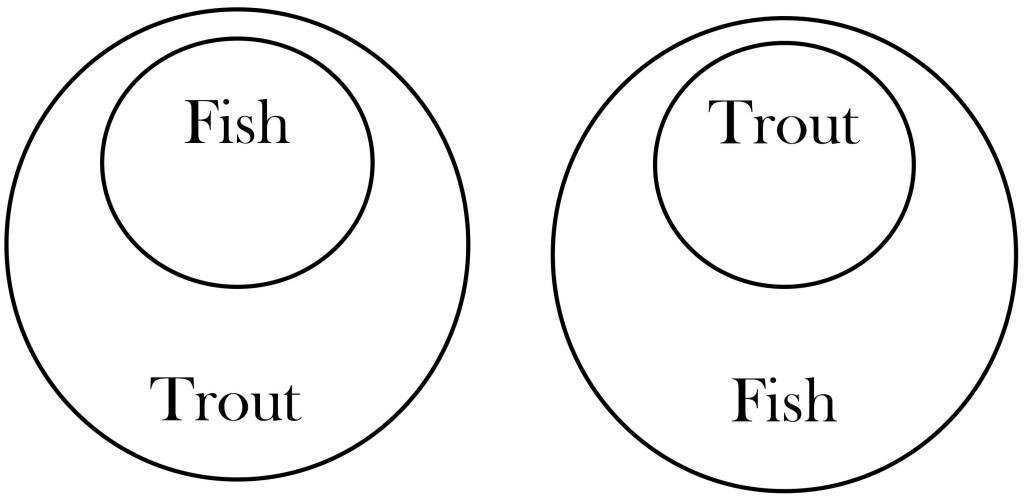
An understanding of some basic logic and understanding of category statements could be helpful here. For example, if I say, “all fish are trout,” is categorically different than saying “all trout are fish.” (See picture for a simple circle diagram.)

When dealing with categories, if all the subject, (not just some) is numerically or by attribute belongs to the predicate, then subject is a smaller circle fully inside the larger predicate circle. Thus, the subject is universally contained in the predicate. The logic is simple.

The first one is false, the other is true. In Genesis God established categories of the things He created. Thus, even if we mix in some specific induction, we know as infallible truth, God created fixed categories for animals, fish, vegetation, and etc.. We know there are many types of each in each of the broad categories. Thus, we know to say, “all fish are trout,” or, “all birds are sparrows,” is false, for there are many types of fish and birds, not just trout and sparrows. Thus, to casually flip the subject and predicate, of categorical truth claims is against Biblical teaching.

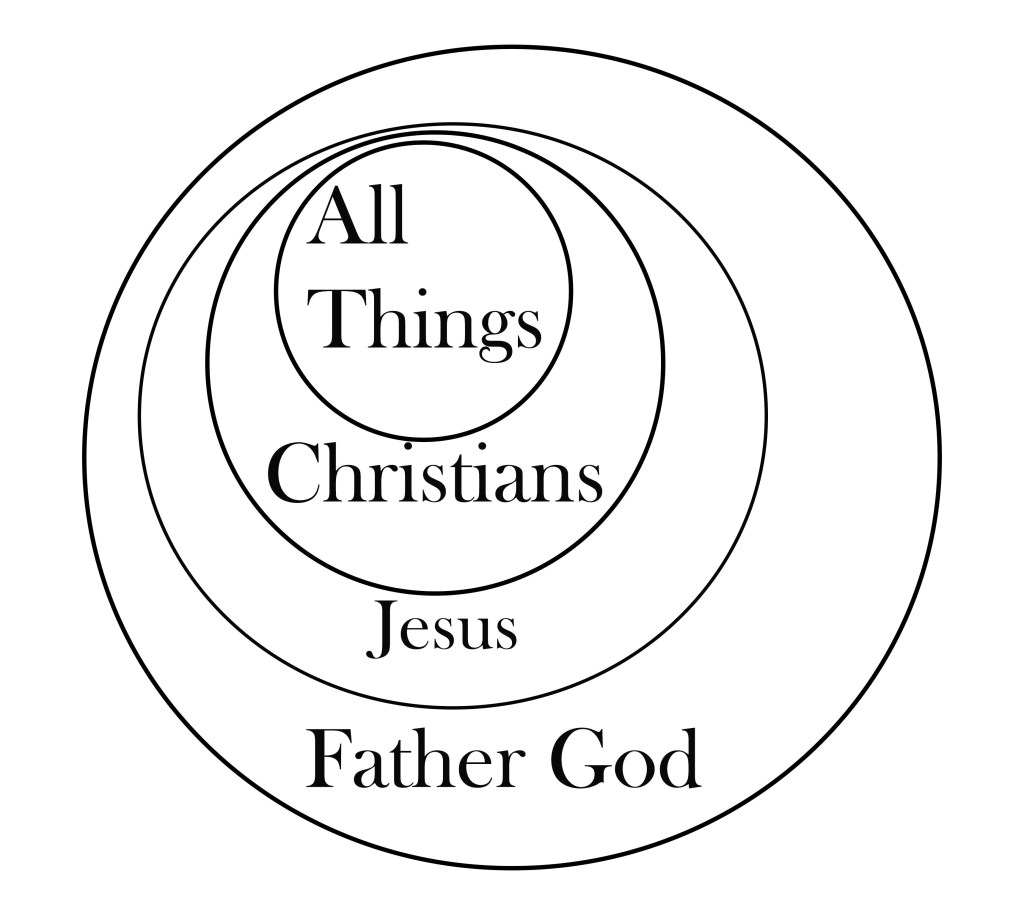
This is important to remember, because we are dealing with the ORDER of God’s decrees. It is important not to flip things around. If God decrees “x” as first, then it is not second or seventh. Congratulations, we just left second grade and now we can finally move on to forth grade teaching on God’s sovereignty. It is not bear control. An intelligent Mind ordered the world for His own goals. As we saw with an early circle diagram from 1 Corinthians 3, the order of multiple categories is crucial.

People who keep saying—God is in control, God is in control of my life, God is in control of this situation and even those who affirm with more boldness, God is in control and He is even the author of sin and evil—are spiritual infants. They never left second grade. They are mentally stunted. The question is, “how is God in control,” and “what has God commanded you to do, in light of His control of it.” Just saying God is in control, is of little help if it is applied like pantheism or fatalism. The decrees of God show His control is determinism in accordance to His own good purposes. Knowing God is in control is not boiled down to having a pagan, “Zen state of mind” about life; it is not boiled down to being calm. God was in sovereign control, when He directly and absolutely caused all those people in the gospels to be sick, blind, dead, leprous and demon possessed. What did Jesus do about this, as a man born under the law of God? He healed, resurrected and set those people free by the power of God. He commands us to do the same. If you do not do this, then the doctrine of God’s sovereignty is both wasted on you, and it shows you never believed above an infant level understanding of God’s sovereignty.

To say God is in control is not an ethic. It does not tell you what to do. However, if we say God has used this sovereign control, to DECREE us to be children of God, and DECREED we have bold access to His throne of grace, well then, this actually has huge implications for the person stating it. To say God has used His sovereign control, to DECREE for us to have power over sickness and demons, has huge implications. This shows us how God is in control. And some basic ordering of His control. It gives us understanding about our definition of Christians. God is not pantheism. His control over the world is explained and understand as His ordered decrees about all things.

What good is it for a sinner to realize they are a born a sinner by God’s control over their life, and say, “well, God is in control”? Do they forget God has used His control over reality to DECREE that there is salvation in Jesus Christ, and for those with faith, then a new life, a new soul and a new world is theirs for the taking.

In my experience, when I hear Christians say, God is in control or God’s Will, it has more in common with pagan fatalism than it does with God’s decrees of determinism. They are spiritual perverts and liars. God has used His sovereign control to DECREE that the elect are to be victorious (in everyday life difficulties) over sin, besetting sins, sickness, diseases, terrors of the night or day, demons and poverty. This so-called Christian appeal to, “God is in control,” is in reality an appeal to fatalism, and thus they let the sickness and demons roll right over them. In such acts these spiritual losers, are prostrating themselves to demons and their doctrines. These people are part of Reformed churches as much as they are part of Pentecostal churches. They falsely claim to assent to God’s sovereign control, but in reality they are liars. They believe in fatalism, and use this equivocation to negate the commandments of God. God’s specific descriptions of His sovereign control in His decrees, because of their detailed nature, are often accompanied with commands. That is, with detailed decrees, which are usually about the church, God gives commandments about the specific descriptions of reality He has ordered.  For example, God had decreed salvation for the elect in the atonement of Christ. God therefore commands repentance and faith in the gospel. God is in control, even when He directly caused the elect to be born sinners. However, by the decree of God, the elect believe what God has revealed. They believe by faith in Jesus they are saved. And so they are.  Also, God has decreed healing to be part of the atonement for the elect. With this specific description of God’s decree, God then commands us to have faith to be healed. God is in control, even when He directly caused the elect to have sickness and troubles. However, by the decree of God, the elect believe what God has revealed. They believe by faith in Jesus they are healed and delivered. And so they are.

Fatalism comes in and negates these commands, because God is in control, or, God’s will. Because God is in control, and thus, is ultimately in control over the fact you are sick and diseased, thus, you will pray, but what will happen by God’s control, will happen. This sounds humble and religious to spiritual perverts, but not to God. It is applying a demonic doctrine of fatalism over God’s determinism. God has used His sovereign control to decree that those with faith, will be healed, will cause Satan to depart and be victorious.

Fatalism is used to negate the details of God’s sovereign decrees. These people might be those who are quick to point out how the religious leaders in the gospels negated the commands of God by their traditions. Well, fatalism is a human made doctrine with its own traditions. Our religious leaders of today, mask their human doctrine with a biblical sounding topic—God’s sovereign control—but their wicked and sinister goal is to negate the commandments of God with it. They are sons of hell, leading others to be even greater sons of hell than they are.  

———————Endnotes——————–

Picture diagram of 1 Corinthians 3:23

Let Man’s Will be Done on Earth

Matthew 15:28 (LEB)

Then Jesus answered and said to her, “O woman, your faith is great!

Let it be done for you as you [will].”

The Greek here is similar to what Jesus says later in Matthew 26 in His prayer to the Father about letting this cup of the cross pass from Him.

Matthew 26:42 (NKJV) Jesus said, “Your will be done.”

For some reason, the translators, which almost always translates ‘thelo’ and ‘thelema’ (Strongs 2307 and 2309) as “will” puts Jesus’ words to the Canaanite woman as “desire.” (Maybe bias?) Nothing wrong with the word “desire,” but it might hide the fact it is the same meaning that Jesus uses in His own prayer. And thus, to make sure we do not miss the impact of this, we will use the same word of “will” for both verses. It is the same used in the Lord’s prayer, “Your Will be done on earth.”

Jesus referring to the broad category of God’s plan to only minister to the Jews, and not the gentiles, says by implication that it is “not God’s will” to heal her daughter. Jesus further argues that it is wrong to take what belongs to someone else, and then give it to another person. As Vincent Cheung states, she “asserts an argument of faith.”[1]  Jesus, God in the flesh, God’s Will in the flesh, the most God centered man who ever lived, does a 180 concerning God’s will.  Jesus ignores God’s will and says, “woman, your will be done.”  Jesus declares, “let man’s will be done on earth.”

When people have faith in God’s promises, Jesus over and over, affirmed the will of man. This is not some overly makeup guy, sitting in a gold chair on TBN. This was God Himself, in direct verbal revelation, affirming the “will of man,” when man engages God’s promise with faith. Your theology must deal with this. Your theology must include “man’s will being done on earth,” is as God-centered as Jesus Christ is God-centered, because He is the one who taught the doctrine. The issue people have man’s will being done on earth, is that Jesus is too God-centered for them. There is just too much God involved. They hate that God gets to do whatever He wants, and what He wants is man’s will to be done. 

When James says in chapter one of his letter that if you have faith you will be given wisdom, he does not say, “only if it is God’s will.” Rather, he says it is man’s accountability to get wisdom from God. If you lack faith, then you will lack wisdom when you ask. And if you failed to get the wisdom, then the accountability is on “your” lack of faith, not the will of God. That is, if you have faith, and you are in a trouble of life that you need some wisdom and you ask, then God’s response is that the will of man (“Lord, I want wisdom”) is to be done on earth. James says the same thing about healing and forgiveness in chapter 5:15. When man’s faith engages the promises of God, then God Himself affirms “let man’s will be done.”

————Endnotes————-

For more see on this topic, see the essay by Vincent Cheung. (Healing: The Will of Man)
(I am not affiliated with Vincent Cheung.) 

[1] Vincent Cheung. Faith Override. 2016

God’s Authority & Not Man’s Freedom Makes Man Accountable

Before going over a more positive stating of God’s sovereignty, we will deal with this idea of man’s responsibility and accountability to God, since the wrong doctrine of this is used to negate what the Bible says about God’s sovereignty and man.

This is both an ultimate question about God’s sovereignty and Christian ethics, and so, this will be dealt with more in that section.

Man is responsible and accountable to God, not because man is free from God’s direct control; rather it is the complete opposite. Man is accountable, because man is not free to God’s sovereign authority to hold man accountable.[1] Accountability does not presuppose freedom; rather, it presupposes a sovereign authority that you cannot escape from. Without a parent, how is child (if you can still call them that) responsible? Without teachers, students (if you can still call them that) are not accountable. Without a government of some sort, citizens (if you can still call them that) are not responsible.  

The point is, if you take the authority away, accountability is not merely partially removed, it is completely removed. On the other hand, I can hold my clay vase accountable for not talking to me, by slamming against the wall, and then throwing it into the fire. Whether or not you like this, is not the question. The issue is painfully obvious, even without freedom, my sovereign authority over the clay vase, is all that is needed to make it accountable. 

And in fact, this is exactly what Paul says in Romans 9 when the issue of how is man being accountable to God, when man is not free from God controlling man (like how God controlled Pharaoh, by hardening his heart).

Also, if you recall earlier comments about God’s transcendence, God is not merely above being accountable; God is categorically not even related to such a category. There is nothing above God. There is no other power. There is no other causality. There is no possibility for God not to be absolutely sovereign, and so it is impossible for there to even be a possibility or another power or metaphysical dualism. Because the possibility is not even possible, it means God is categorically separate from such a term. Is color above the concept of numbers, or do they have no necessary relation to even be considered in such a way? Because God is transcendent to man in this regard, we therefore know, when a person tries to apply accountability to God, by relating how it works with man, just made a metaphysical, intellectual and ethical no, no (to say it nicely).

First, Paul brings in the example of the twins who were, one chosen for mercy and the other damnation—before they were born or had done good or bad choices—to show God’s choices and His resulting causation from these choices includes both good and bad; both light and dark; both mercy and damnation. Paul then brings in additional examples of the old testament regarding a positive choosing and then also a negative choosing. Moses is the example for mercy and the Pharaoh is the example of damnation.

This is classic systematic theology. Paul is bringing in different passages ranging over the Scripture that address the same theological category. From this Paul then gives a summary of a doctrinal statement that is to be believed and obeyed. “God chooses to show mercy to some, and he chooses to harden the hearts of others, so they refuse to believe.” And this doctrinal comprehension includes what Paul stated before in the formation of it: “before they are born or had done good or evil.

If some say that the twins were a representation of nations, then Paul’s point is made even more so, for then it would mean, before millions were born or had made choices of good or evil that God chose some would obtain mercy and some damnation.[2] This point, logically therefore, is a point of non-relevance. However, this objection shows that such a person not only is defective in their objection but demonstrates they miss the entirety of what Paul is doing here. Paul is doing systematic theology. He brings many individuals and then asserts with logic and divine inspiration, that these are not an exception of God’s power and active; rather, Paul shows this is how God uses this power of causality over all humans for all time. That is, categorical premises of “all,” not some. 

Back to Paul’s doctrinal statement. He does not wish for people to miss the point. One can see how Paul bracketed the part about the twins (before they had made choices of good or evil) in the verse. Paul wanted to head off the misinterpretation that despite being born, God looked ahead and considered the twins choices of good or evil, to then decide who to show mercy and who to dam to hell. And so, Paul stops the flow of the statement to clarify that God did not consider their choices in determining their future of heaven or hell. 

God punishes the Pharaoh after saying He first hardened (first mention in Exodus) the Pharaoh’s heart. To this Paul’s opponent says,

if Pharaoh went along with God’s causality(ontology)

—that is, to be hard hearted and resist God’s command(ethic)

—then why is Pharaoh punished?”

This objection is bottom of the barrel stupid and displays a mind that is spiritually broken and mentally faulty.  Again, this is like saying trees and cats are the same, therefore, why don’t’ trees walk? It is a category fallacy.  All Christian ethics are God’s commandments. The Pharaoh was a lawbreaker by disobeying God’s command to let His people go. He is guilty, not because He did or did not resist God’s causality, but because He resisted obeying God’s command.

Some say that man is “more than a clay pot.” This is true, but only if whole analogy is taken up together.[3] Thus, if man is more than clay, then God is infinitely much more than a mere potter. Therefore, as much as man is more than clay, it is not a true infinite. God however is truly infinitely more than a mere man. Thus, if the analogy is taken up then the point of God’s sovereign control over man’s destinies apart from man’s choice is literally made “infinity” stronger.

This clay analogy reminds of how teachers and preachers today directly contradict the Scriptures teaching. They are blasphemers who would rather suffer the Scripture to nonsense, than let their cowardly souls suffer from confessing their unbelief. It appears popular in many Christian traditions to say God takes a wicked clay lump and God chooses to let some remain in this wicked lump state and make them into wicked pots. In addition, God chooses to take some of this wicked clay lump save them and make them into a good clay pot.  How obvious that this is not what the verse says. The lump is not already wicked or good. It is unformed, without choices of good or evil. It is a neutral unformed lump. It is like what is said about Jacob and Esau, “before they had done good or evil,” God decided to love one and hate the other.

This lines up with the objection Paul’s opponent brings up.

“If the Creator takes me from a neutral clay lump(that is not already bad) and makes me into a wicked pot, and I obviously go along with God’s causality, then why does God find fault with me, even if He commanded me to do good?”

This question of “responsibility” is precisely what Paul’s opponent asks in Romans 9:19.

…Therefore you will say to me, “Why then does he still find fault? For who has resisted[o] his will? (LEB)

…Well then, you might say, “Why does God blame people for not responding? Haven’t they simply done what he makes them do?” (NLT)

We will now put into the verse the clear terms for command(responsibility) and God’s absolute causality: or Christian ethics and Christian ontology.

“Why does God [hold people responsible] for not responding [to His command]?

Haven’t they simply done what [He absolutely directly causes them to do]?

or

“Why then does he still find fault? [Ethics]

For who has resisted[o] his will? [Ontology]

Thus, Paul’s opponent is dealing with the issue of man’s responsibility when man is considered relative to God controlling and causing man to do. Paul’s opponent correctly restates Paul’s position about God’s absolute sovereignty saying “who has resisted God’s will (causality/sovereign control). Paul’s opponent understands that Paul position is that God is actively and absolute controlling man. The opponent says that “no person has resisted God’s will.” God’s will here is defined in context to me God’s causality not command, because it is painfully obvious people resist obeying God’s commands.

Thus, the opponent is saying,

Paul, your position is that no person has never resisted God’s causality, in causing them to make good or evil choices; but, if that is true, then why does God still hold us responsibly for things He sovereignly caused us to do?”

On the contrary, O man, who are you who answers back to God? Will what is molded say to the one who molded it, “Why did you make me like this”? Or does the potter not have authority over the clay, to make from the same lump a vessel that is for honorable use and one that is for ordinary use?
(Romans 9:20-21 LEB)

Paul’s reply is interesting because it ignores the fallacy of the opponent, and simply gives a positive answer about God’s authority and power. The fallacy of the opponent lies in what we disused earlier about God’s transcendence over commands given to man.  God is not merely above the laws; rather, laws do not categorically apply to Him. The Bible defines sin and evil as lawlessness. Thus, you cannot accuse God of sin or a wrong, without a law being transgressed by God. But laws do not categorically apply to God. Thus, it is categorically impossible for God to do sin or evil. It is not that God can do evil but chooses not to. No. The possibility does not even exist.

Who are you who answers back to God?” Paul ignores this, in that He does not address it directly; rather, Paul rebukes the opponent in this way: “as a man you are acting like God and as a man are trying to put God under a law.” The opponent has the role of God and man flipped. That is, the opponent’s position is not merely a little bit wrong, it is upside-down wrong.

The potter [has] AUTHORITY over the clay, to make from the same lump…” Remember the context is about why is man responsible. If ever there was a time for the Bible to say man’s accountability is based on freedom or freewill, now is the time. Now is the foundational issue or linchpin about man’s responsibility. Paul gives his positive answer to why man is responsible to God. God is an AUTHORITY OVER THE MAN. The answer given is NOT “God gave man freedom.” NO. The contradiction of this is given. Man is NOT free from God’s AUTHORITY to make man however He wants.

The way Paul does answer this presupposes what we just went over; that responsibility presupposes a higher authority and not freedom. If you are responsible, then it means you are not free, but under an authority. Paul’s answer to why people are responsible—even like Pharaoh, by performing the works God causes them to perform—is that God is an authority over them. That is, Paul appeals to that fact that God is a sovereign authority over us. We are responsible precisely because we are not free, but under God’s authority.

It can be said that God makes it—as an additive—that having more knowledge makes us guiltier. This can be said about metaphysics on a relative level when said about us. That is, we are led away by “OUR” own desires. However, both additives only work as adding to our responsibility because God as an “authority” over us commands it so! That is, without us being free from God’s sovereign authority and control over us, He adds additional rewards and condemnation if we have more knowledge (knowledge that He chose to give or not give us).

For the God’s elect children, the point is that though Jesus Christ’s imputed righteous (ethics) they have completed the requirement of obeying God. They have been credited with a perfect Christian ethic that is fulfilled and the receipt printed off. After new birth they are given the Holy Spirit that causes(ontology) them to behave in accordance with the perfect obedience already credited to their accounts. That is, as Pharaoh could not resist God causing him to reject His command, the Elect cannot resist the Holy Spirit causing them to be sanctified


—-Endnotes——

[1] I learned to say this doctrine in this way from Vincent Cheung (and some from Gordon Clark). See Vincent’s many mentions of this in his books. (www.vincentcheung.com)

[2] I learned this argument from Vincent Cheung. See, “More than a Potter.”

[3] This basic idea of taking the analogy up with both parts was brought to my attention by an essay of Vincent Cheung, “More Than A Potter.” Found in “Author of Evil.” 2014. Ch.18.

Always God’s will To Heal Someone

Joe Carter at TGC, when talking about Bill Johnson at Bethel Church says,

The Johnsons are frequently criticized for their teachings, which often veers from the suspect to the outright heretical. A prime example is Bill Johnson’s….it is always God’s will to heal someone:”[1]

Some educated people, like the famous Erasmus, who was defeated by Martin Luther over an informal fallacy of a category error[*], are dumb at the most fundamental level. Or as Luther says, dumber or less educated than grammar school children, swinging on the monkey bars.

The gospel they use to condemn others of being heretical would make them twice as guilty, if not more. To shoot their opponent with their bb gun, they must shoot themselves with a .50 cal. pistol. Yet they do it anyway, somehow thinking they, “got them”?

I do not know the whole teaching of Bill, and so will not comment on him, but only on this one thing being said.  What Bill said is correct, if “God’s Will,” is meant as ethics, since “God’s Will” can mean either Christian ontology or ethics. And from my limited exposure, it seems to me, this is how Bill means it. (Let me give this quick side note. If Bill meant “God’s Will,” as God’s precept and when you criticize him, taking it to be ontology, then congratulations, you just committed the sin of slander and bearing false witness.) When asking what God’s will is for me, then the context is about ethics. Christian ethics is what God commands us to do. The bible commands us to have faith to be healed. It is not a suggestion, just as it is not a suggestion to repent of your sins in Jesus name, in faith. It is a command. James 5 says if you are sick then pray in “faith.” James is not merely saying to pray if you are sick, and then “see what happen.” James command is to get healed by faith, and if you have sinned you will also be forgiven.

Because it is always God’s command for healing when you are sick, then it is always God’s Will for healing.

When the disciples failed to heal the boy in Mark 9, due to their lack of faith, Jesus went behind them and healed the boy anyway. Why? Because it is always God’s Will to heal by faith. It is always God’s will to forgive sins, because it is His commandment to us. God is still alive, even if some Christians do not like this fact. Thus, God’s commandments still stand today.  If it is always God’s will for His commandments to be believed and obeyed, then healing and forgiveness is always God’s will.

On ultimate level causality, God causes all things. This is sometimes referred to as, God’s will. God caused, Thomas the Twin, to doubt Jesus resurrection; this was “God’s Will,” on the ultimate or only real level of causality. But God’s Will in regards to ethics, (what you ought to do) is to believe God. And so, Jesus rebuked Thomas, even though Thomas went along with God’s Will (causality) by not believing in Jesus’ resurrection. Even when God causes us to sin, for God causes all things, it is invalid to conclude this is what we “ought to do.” Paul clearly says in Romans 5 that God caused all people to be born as guilty sinners, and causes them to do sin. However, God’s commands all to repent, despite that He causes all to be born sinners, separate from their freedom and choice, (Acts 17 “he now commands all people everywhere to repent”). You cannot conclude, “Because God caused me to be born guilty and caused me to be control by sin, that it is “God’s Will,” for me to be a sinner.” No, what God causes and what He commands are not the same category. Color and numbers are not the same category. Why do I need to say this to grown adults?

Jesus rebuked Thomas, not on grounds of God’s causality, but of ethics. Jesus told him to do God’s revealed command, which is to believe in the Son of God.

Look, what happens if we mix categories up?

G.1. (~P) If God caused(ontology) the Apostle Thomas to not believe Jesus’ resurrection, (~Q) then it is right(ethics) for Thomas to not believe what Jesus commanded.
G.2. (~P)
G.3. Thus. (~Q).

Or in a simply form:

B.1. If God planned unbelief, then ok to not believe.
B.2. God planned unbelief.
B.3. Thus, it is ok to not believe.

Again, this is unsound and false. It does not matter if it is ontology level 1, regarding God’s sovereign plan about reality, or if it is level 2, regarding God’s direct causality right now. To go from ontology to ethics is not a necessary connection. It is invalid and a false description of reality. It is invalid to conclude an “ought” from your observations, which is an “is.” What you observe is at best what something “is”; although, I would be cautious to even affirm this, due to the logical fallacy of empiricism and induction. There is not a necessary connection (p), to an (q) ought. Those who practice this fallacy, practice a doctrine of witchcraft and divination. It is a demonic stronghold over the mind. It has similarities to ouija board practitioners.

God caused the Pharaoh to not obey His command, by making the Pharaoh’s soul hard. However, this secret causality of God, does not negate His command(ethic), to let His people go. The same is with the gospel call to repentance. God might decree, and then cause human reprobate F or H or O, to not believe the gospel; however, what they “ought” to do is what God commands and not what God causes or decrees. The Pharaoh was a lawbreaker by disobeying God’s command to let His people go; therefore, He is accountable. Now, Responsibility is not based on Pharaoh’s freedom, but on God’s sovereign control to hold Pharaoh accountable to His command, period. Pharaoh did not resist God’s causality, because nothing can. Pharaoh is guilty because he disobeyed God’s command.

This is a similar stupid mistake that Erasmus made in mixing up ontology with ethics. Even if God hardened Pharaoh’s heart, Pharaoh is judged by God’s Will, that is, by God’s command to let His people go. We are also judged by this same impartial standard. We are judged by God’s commands.

This gospel of Jesus Christ is not narrowly about the forgiveness of sins, for that is only the doorway into the life of the Spirit. This gospel is about all the benefits it acquired, at that time and place (not another time, and another place), in Christ’s atonement. Galatians says that faith in Jesus grafts one into the promised blessing of Abraham. What does this promise of God mean? This promise includes, according to Paul, the Spirit and miracles. And let us not be naïve; if Paul is mentioning the Spirit and miracles, in context of the New Testament, it must be presupposed this is a common experience in the Galatian church. Yet, Scripture argues this common miracle experience is based on the very old promise that God gave to Abraham. God is merely letting His “Yes be Yes.” He is being faithful to His promise. God is not like man; God does what He promises, even if it is thousands of years later; and even if the people to who God promise did not realize this promise meant an abundant/common experience of miracles and Spirit in the New Testament Church; yet God knew, and He is faithful to do what He promised.

Thus, Jesus’ death and intercession grants this blessing for all individuals who have faith in Him. This is said on the relative level ontology. On ultimate level ontology, it was not accomplished by their faith; rather, Jesus’ atonement did, and it was accepted and declared as final and good by the Father. As stated earlier about God’s direct and arbitrary-sovereignty that gives all things their definition, the same is true here as it is for all things. God’s sovereign choice decided that based on Jesus’ work the Elect are righteous and worthy to be adopted as His son’s. This act is good and righteous for God the judge to do so, because God thinks it is so. Therefore, faith as a purchased gift is sovereignly worked in those to whom this reconciliation was for. The Elect’s souls are far too weak to resist God’s power to awaken their tiny souls into the unstoppable power and life of His Spirit.

Isaiah says that Jesus as a High Priest, accomplished healing for His elect. In fact, Matthew 8:17 quotes this passage as demonstrating Jesus fulfilling what God promised. The point is that the blood and intercession of Jesus purchased this healing gift for those who take it by faith. Thus, it is not surprising to discover that faith for forgiveness of sins is accomplished by the same way. Jesus’ blood and intercession purchased it and all individuals predestined to be in the Covenant, will have faith to take it. Jesus says in John 15 we are “appointed,” or that is predestined for good works.[2] To Jesus this predestination of fruit includes loving others and having faith to ask and get anything from God.

Hebrews 10:29  (NLT)
“Just think how much worse the punishment will be for those who have trampled on the Son of God, and have treated the blood of the covenant, which made us holy, as if it were common and unholy, and have insulted and disdained the Holy Spirit who brings God’s mercy to us.”

“To say you can have faith, but God still might not heal you,” logically means, you trample the bloodshed of Christ as trash. It despises the compassionate nature of God. Healing is a provision of the Blood of Jesus as a High Priest, which is stated in Isaiah 53, and reaffirmed in the New Testament (Matt 8:17).  At the time and place of Jesus’ atonement (not something else), both forgiveness of sins and healing was accomplished.  Furthermore, the blessing of Abraham was accomplished by the same means. Both are based on the finished atonement of Jesus Christ. Therefore, if you negate “faith healing,” because it is produced by the bloodshed of Jesus as a high priest, then you logically negate “faith forgiveness,” because the bloodshed of Jesus is the cause of both. If you throw out one, you throw out the other. Bye, bye, forgiveness of sins: see you later.  There is only one Bible and one definition of the atonement. And this definition makes both healing and forgiveness based on the finished work of Jesus and received by faith.”[3]

The truth of the matter is the God is “obligated,” to answer our prayers once God makes a sovereign promise to do so. (i.e. Obligated to His nature that cannot lie.) 1 John says that God is “just,” to forgive us our sins, not “merciful.” 1 John 1:9 (LEB), “If we confess our sins, he is faithful and just, so that he will forgive us our sins.” Because of God’s sovereign promise to honor Jesus’ atonement and honor the promise of forgiveness of sin, when one asks in faith, God therefore, is “just” and “faithful” to forgive. You could be weird and call it, “forcing God to do our will,” but that would be a strange way to say it. God cannot lie. God is faithful. When God makes a promise, then He must fulfill it, or contradict His own nature. It was in God’s own freedom and sovereignty to make the promise to begin with. And so, He will sovereignly and happily keep His sovereignly made promise.  To sovereignly break the promise, would be to deny Himself.

What pathetic moron will say, “even if you believe in faith for salvation in Jesus, because God is sovereign, He might not forgive you, because it is arrogant to assume, God’s Will.” Lord forbid, we believe in “faith-forgiveness,” because it would mean God is not sovereign, right?”

Despite their rhetoric, the Bible is not their (non-faith-people, traditionalist, atheist) first principle for knowledge. Rather, it is their experiences, emotions, traditions and human empiricism. The kingdom of self dominates their tiny souls, because they start with their human speculations first, rather than God’s word. They would do us all a favor if they came out from the closet and just said, “Sola Empiricism,” and “David Hume alone.”

However, some do not even try to hide the fact that they are spiritual sluts with empiricism and human speculation and human superstition. With a straight face they ask me, “why do we not see so many miracles today, unless God does not want it?” They are like the people from Jesus’ hometown who said, “This is Joseph’s and Mary’s son,” and then in unbelief demand He prove by miracles who He claims to be. But their unbelief made that impossible. These peers did not start with God’s revelation; rather, their starting point for knowledge was their human observations. Scripture records it was due to their lack of faith, and not the lack of Jesus being willing and able to heal. With such people I am asking myself, what happen to starting with God’s revelation for knowledge? Where did God go? Why is it so automatic for them to start with a “human” speculation and “human” superstition? If they only mean to do a personal attack (a logical fallacy) by saying, “Oshea (or Johnny), how many miracles have you done,” then why do they default to argumentation that the politicians use?  Is it because politicians are such good examples for how to argue for truth?  They are like the religious leaders who slapped Jesus and demanded He prove His claim as God by prophesying. They harlot themselves with David Hume’s empiricism in the open streets, and then march back in their pulpits, and after wiping off their sweaty faces, they say with a straight face, “solo scriptura.”  Maybe if they could stop humping on empiricism for just a few seconds, they might wake up and realize the disgrace they are committing against their own souls, and against those who hear them.

But for you. Start with God’s revelation and believe Him. He wants you to know about all His benefits and to rely on Him to be faithful to fulfill all His promises, including both the spiritual and material one. Paul says in the prayer in Ephesians 3 that as we trust in Jesus’ great love for us, He will make our souls His home, and by this we become strong in the inner man. Trust in God’s policy of thought and action of favor to you[4], that always triggers on the highest, lowest, longest and widest application of life.

——-END NOTES——-

[1] Joe Carter, “9 Things You Should Know About the Bethel Church Movement.” www.thegospelcoalition.org

[*]Martin Luther’s point about confusing the category of an imperative and indicative is the first I know of who shows a category mistake with God’s causation and command. Vincent Cheung has been a help to me to understand this is greater clarity. See his, Systematic Theology, Healing and Atonement, and the essay called, “Ezekiel 18:23 and 33:11

[2] Vincent Cheung helped me to see this clearly in this passage. See, Vincent Cheung, Predestination and Miracles.

[3] Oshea Davis. Intercession and Predestination.

[4] This definition, I do not know if it is original to Vincent or not, but I learned it from him in his Systematic Theology book. “Love is God’s policy of thought and action of favor.”

The Transcendence and Nearness of God

Transcendence of God:

Attributes that describe God’s existence (such as, Infinity, Immutability, Timelessness (etc.)), show God’s existence to be Transcendent to every other type. This is where the base idea of holiness comes from, in the broadest sense. Holiness means God is a cut-above all others in a said category. However, God’s transcendence is a step greater than this, in that God is all together different in these categories. To be cut-above the competition does not “necessarily” mean a whole new category; it might, but does not necessarily donate that. The context will define how to understand it. At the very least, sometimes God Holiness does refer to His metaphysical attributes in the transcendent way.

“For thus says the high and lofty One—He Who inhabits eternity, Whose name is Holy: I dwell in the high and holy place, but with him also who is of a thoroughly penitent and humble spirit, to revive the spirit of the humble and to revive the heart of the thoroughly penitent [bruised with sorrow for sin].”
(Isaiah 57:15 AMP)

At other times God’s holiness refers to His moral perfection, in Justice, Mercy and His ability to help. In this light God’s Holiness is the internal value of His nature. Glory, is this (internal) value, shinning out in the public (external).

He is holy.
…They called to Yahweh, and he answered them.
…you answered them.
You were a forgiving God to them,
but an avenger of their wrong.
(Psalm 99:6-8 LEB)

Furthermore, this is like God being Ex Lex. Or that God is above all ethical laws. This is indeed true in a sense; however, God is more than merely above the law. God is categorically different (transcendent) from the laws even being applied to Him. Again, the idea of category errors come up. God’s laws are not so much below Him, as they are applied to the category of man. It is not so much that God is above moral laws commanded to man; they do not categorically apply to Him.

As said before God is the Foundation of theology, not something else. The foundation of how or if laws apply to God, is God; it does not start with man, inductively making up superstitions about it. No. God is the foundation. God is the foundation that gave laws to man. Not the other way around, despite how badly man wants it to be. God’s law is commanded to man, not to Himself. If man tries to say, “well this means, God must also behave this way,” is man starting with something not revealed in scripture. It is man starting with man, and using man’s induction to command laws on God. It is the height of rebellion and arrogance. God is the foundation for laws, not man.

Back to the point. Is the category of humans above the category of “subjects and predicates,” or do they have no necessary category relation to even ask such a question? Is red above the category of odd numbers, or is there no necessary connection to even ask such a question?

In a publication that I cannot presently find at Vincent Cheung’s website, called, Better than Ex Lex, he says something to the effect of, “my position is not merely ex lex; rather, the transcendence of God is that he doesn’t even have to be ex lex.”

If God has infinite wealth and supply, and owns everything, and even owns the persons who owns things, then God is categorically different from a billionaire, and not merely in degree.

If God has infinite propositions and infinite connections about these propositions, and understands them, not in a mutable linear way, but in an immutable all at the same time understanding, then God’s mind is not merely different in degree, but is categorically different from man’s mind.

The Nearness of God:

This doctrine of the Nearness or imminence of God is put right next to God’s Transcendence because the Bible often does so to show the value of God.

Though the Lord is exalted,

He regards the lowly [and invites them into His fellowship]; But the proud and haughty He knows from a distance,” Psalm 138:6. AMP

Although God is separate from His creation and Transcendent to it, yet, God has made man in a special way; namely, spirit and intellectual/rational. When you combine with this that in Jesus Christ, God has given us His very own Spirit, then you have an incredibly, special result. The Saints know God in the same way God knows Himself. This does not mean the saints are God, or become infinite and timeless; rather, it means that the way God knows Himself, intellectual and Spirit—by His very own Spirit—God causes the saints to know Him in this way. God is near to them, in the way God is near to Himself, that is, in a rational and spiritual way, even by the Spirit who knows Himself.

“No one can know a person’s thoughts except that person’s own spirit, and no one can know God’s thoughts except God’s own Spirit. And we have received God’s Spirit (not the world’s spirit), so we can know the wonderful things God has freely given us.

When we tell you these things, we do not use words that come from human wisdom. Instead, we speak words given to us by the Spirit, using the Spirit’s words to explain spiritual truths. But people who aren’t spiritual can’t receive these truths from God’s Spirit.”
1 Corinthian 2:11-13

There are two main ways God is near to those who He favors/loves. Nearness in relationship (intellectually and spiritually), and nearness in participation in God’s supply (receiving all His benefits).

In both the section on Epistemology and Metaphysics we have already dealt in a broad way, definitions for how God and saints are close spiritually and intellectually. God is the original. God made man in His image. God in Jesus, truly makes man in His image, by giving them not only truth, but also His Spirit. By this man gets to know and communicate with God directly, in precision, immediately and intellectually.

The second part of God’s nearness, is something many churches have decided to make war against God. They wish to be the foundation of theology and dictate to God, what gospel accomplishments they want and others they wish to trample under their filthy feet. However, despite their protest, God is still the foundation of the gospel and Jesus’ victory from the grave is still available to those with faith. As with every war, this is one God will also win along with the saints, and those who oppose will be trampled under God’s foot as worthless trash.

Our passage says after being near to God in spirit and intellect (or the inner man), the result is another necessary nearness. It is a nearness of practical blessings and goodies (outer-man).

“..so we can know the wonderful things God has
freely given us.”

I will chase this point for a little bit, since it is denied. I will end up going over some points about salvation, which will be explored more in a later chapter.

Many at this point, foam at the mouth like demons, about a doctrine called, “already-but-not-yet.” They are correct in the strictest sense of the definition. There are some benefits of Jesus’ finished atonement and New Covenant that are available now, and some are later. For example, healing is for now, and a new transformed body, that does not need healing, is for later. So far, so good. However, I mostly see pastors and lay people use this doctrine to emphasize what we do not get now. The problem with this is that the Bible contradicts this emphasis. The prophets, apostles and Jesus Himself, used this doctrine to emphasize the super-abundance of what we get here and now! Thus I am in agreement with Vincent Cheung that this doctrine when mainly used, is a logical/exegetical fallacy.[1] It is sad to see the elites of orthodoxy, who boast of their knowledge and intellect, act like demons by turning a biblical doctrine into a convoluted fallacy.

The Psalmist said in Psalm 103 to remember how God gives you so much free forgiveness, goodies, blessings and helps. We are not to remember God’s benefits for person x over there, or remember them to be given to us in another place or another time; rather, we are to remember God’s benefits us now, in the land of the living, for us.  This is not a suggestion. These are precepts and commands; and thus, they are Christian ethics. God commands you to not forget all the ways He benefits you, today, in this place. He forgives you, He heals you, He provides prosperity to you, He delivers you, and gives you an abundance of good things. God gives to you freely and unearned. You do not give to God.

This is similar to how Jesus gives proof to John the Baptist that He is the Messiah who is bringing in the Kingdom of God. Not the Kingdom of God later, but now. He says, “healing, healing, healing, healing, resurrection and truth proclaimed.” That is, healing is a physical not invisible reality, such as forgiveness and a cleansed soul. It is a miraculous physical reality. As to resurrection, Jesus meant it, as a second time for a present tense physical reality.  Thus, Jesus’ Kingdom now is referred to by Jesus as “miraculous physical, miraculous physical, miraculous physical, miraculous physical, miraculous physical and truth (which is invisible/spiritual). Thus, those who overemphasize the now part of Jesus’ Kingdom as the invisible, spiritual realities are enemies of Jesus, because they are working against His Kingdom and command. They are rebellious and disobedient.

Vincent shows how even Jesus Christ Himself, rebuked this ‘already-not-yet’ fallacy, when people used this nonsense on Him.

When Jesus went to raise Lazarus from the dead, Martha said to him, “Lord, if you had been here, my brother would not have died.” So the theologians tell us, “These things had happened in the past.” Jesus answered, “Your brother will rise again.” But Martha said, “I know that he will rise again in the resurrection on the last day.” So the theologians tell us, “These things will happen in the future.” Jesus answered, “I am the resurrection and the life.” The sisters applied the “already / not yet” principle on Jesus, but rather than displaying their theological education, it revealed their unbelief and ignorance. They did not even know Jesus very well. For Jesus, it is always a good time for a miracle. In the theology of Jesus, it is not a matter of time, but a matter of faith. He said to Martha, “Did I not tell you that if you believed you would see the glory of God?” And Lazarus was raised from the dead.[2]

The new covenant is active because, as Hebrews says in chapter 9, the death of the tester makes the testament active. The new covenant is active for you here, and now. This eating at the lord’s table, is eating the benefit that God is our God, and we are His people. God takes the tab for this table. You do not give to God; God gives to you. God want you to know about this. He wants you to know what a great benefactor He is to you in Christ, today, here in this place.  By Christ, in faith, it is freely given to you. It is already yours in Christ. Receive and eat.

God’s table of His best benefits is not given to the reprobates or even to clean angels; rather, it is only given the people He is nearest to. To you. To His redeemed, beloved children.

Hebrews points out in more than one place that the result of “God’s Will,” (for us to be holy), is for us to approach His throne of grace and receive what we ask of Him

The first mention is in Hebrews 4. What is the application for knowing our high priest has redeemed us? The idea of having peace with God is the ability and position to approach God, in His throne room of grace, to ask and then to receive the help we are asking for. There is no way to spiritualize this away. It is about receiving what we are asking for.

Jesus, when talking about prayer to God, teaches us something that opposes eastern religions like Buddhism (etc.). Such paganistic religions teach us that even if we do not change God’s will in our prayer, we have changed inwardly for the better, by seeking God. People who say such things are spiritual perverts. They are deceived and blind. Jesus contradicts this superstition about prayer and God, by teaching us that God gives a fish for a fish, and the Spirit for the Spirit. Let Buddha be damned, and Jesus and His teaching be highly valued.

“Ask and it will be given to you; seek and you will find; knock and it will be opened for you. For everyone who asks receives, and the one who seeks finds, and to the one who knocks it will be opened. Or what man is there among you, if his son will ask him for bread, will give him a stone? Or also if he will ask for a fish, will give him a snake? Therefore if you, although you* are evil, know how to give good gifts to your children, how much more will your Father who is in heaven give good things to those who ask him? Matthew 7:7–11 (LEB)

Since it is God’s, and not man’s definition that a “good” God gives you the very thing you ask for, anyone who teaches otherwise is spouting a doctrine of demons. Some bark up like mad dogs that, “what if you ask for something bad?” So what? What does this logically have to do with what I am saying? This is not a relevant point, because James says if you ask God for evil things (“God help me murder this person”), then you are God’s “enemy,” and so prayer is the least of your concerns. Since I am addressing Christians or those who at least claim to be so, and not sworn enemies of God, I will ignore logically non-relevant points.

Back to Jesus. He says, if you ask in faith you will get what you ask for. Jesus even says this in more than one way, in case we missed it. What Jesus is doing here with prayer, is the same He is doing throughout the “Sermon on the Mount.” You have heard it said “do not murder your brother, but I say to you, do not do it, even in your heart.” When Jesus teaches on judging people, His point presupposes that you are able to judge your brother, and to do it without hypocrisy. You do this by removing the wood from your own eye first. Some morons say, “you cannot judge without hypocrisy or bias”; yet, Jesus contradicts this in His sermon. He teaches the true ethical standard God demands for judging, and He expects His disciples to do it. It is good news to see in the new covenant, God promising to give us ethical power, “I will write my laws in your hearts.”

In this context of Jesus repeatedly correcting the low opinion of people’s thinking on God’s commands and standards, Jesus talks about “prayer and faith.” Thus, when we see Jesus saying, “if you ask God in faith, you get the very thing you ask for,” then we can infer the presupposition behind it, at least in the broad sense; and so, Jesus’ teaching is in opposition to the people’s low opinion of what they think prayer and faith should accomplish. It seems little has changed in 2000 years, for who can find a person who values and does prayer the way Jesus demands it? The Jews had a perverted and low view of prayer. From the Mount, Jesus corrects their error and describes the true ethical standard that God commands about faith. Whatever the low valuation of prayer the Jews had, it was not to the standard of, “if you ask in faith, you will get what you ask for.”  Jesus is expecting and demanding, (just like He demands us to not even lust in our hearts after another woman), to pray and get what we pray for.  Jesus in essence says, “You have heard it said, if its God’s will, then you might get what you pray for. But I say to you, It is God’s Will for prayer, if you ask in faith, you will get the very thing you ask for, because God is the good Father.” This is the type of Being we are dealing with. You must deal with Him and not someone else. Do you know Him?

Back to the two passages in Hebrews.

“So let us come boldly to the throne of our gracious God. There we will receive his mercy, and we will find grace to help us when we need it most,”
(NLT Heb 4:16).

Next, after several chapters of doctrine and theology about how Jesus accomplished salvation, Hebrews 10, starting in verse 19 gives us the conclusion or result.

“And so, dear brothers and sisters, we can boldly enter heaven’s Most Holy Place because of the blood of Jesus.

And since we have a great High Priest who rules over God’s house, let us go right into the presence of God with sincere hearts fully trusting him. For our guilty consciences have been sprinkled with Christ’s blood to make us clean, and our bodies have been washed with pure water.

Let us hold tightly without wavering to the hope we affirm, for God can be trusted to keep his promise,”
(Hebrews 10:19–23 NLT)

This is said as an application for learning how Jesus as the high priest of eternal power, has destroyed our sin and already made the New Covenant active in His blood.

In “context” of Hebrews 4 defining approaching God’s throne, as getting answers to our prayers for help, it therefore, does not mean the opposite in Hebrews10:19-23. The end says, “for God can be trusted to Keep His promise.” The promise that He will not remember our sins, and that He will be our God, who lovingly gives us help when we ask for it. The emphasis is on two points here by the preacher. One is the category fact or truths. You are holy in Jesus right now. You are beloved and stand before God, without Him remembering your sins against you.[3]

The second, is that you stand firm, believing these truths. You stand believing you are categorically holy, righteous and a child of God. That you believe you can boldly walk into heaven and push the door of God’s throne room open, and then you ask like a beloved son, for Him to help you. And that you stand believing He is the Good Father as He defined Himself to be in His word, so that He will indeed give you bread for bread.  The first part is always true, due to Christ’s finished work, whether or not a particular Christian has weak faith about it. However, if one has strong, unmoving faith about Jesus’ finished work, then truly you stand before God and He will answer your prayers.

The point is that Scripture makes the logical (or necessary) connection from Jesus’ atonement that makes us holy, to boldly going to God and getting “fish for fish, healing for a healing,” when we pray for help. Because the connection is not merely sufficient but necessary, then it is a “modus ponens” logical connection. If Jesus made you holy by His body, then you necessarily have access to boldly receive the things you ask for in faith.

If these two are necessarily connected, and they are according to Hebrews, Jesus and the apostles, then the logic of modus tollens applies. That is, if you deny the consequent you deny the antecedent. If you negate the application, you negate the foundation. If you negate getting our requests answered at God’s throne, then you negate being made holy by Jesus’ body. Novices play with the Bible like its play-dough. Their pet theories and traditions are not harmless when they make mistakes. They condemn themselves and turn the body of Christ into spiritual trash, in order to be fanboys of the past.

So to summarize, Hebrews knows no gospel that does not bring a person who is already perfected and “holy” to the throne of God, to ask and receive what they ask for. “God’s will,” is thrown around much today, but rarely do I see it used how the Scripture uses it. The preacher says it was “God’s Will,” to make us holy; however, we learn more. There was a pre-determined point why God desired to make us holy and perfected. The necessary result (or a previous in order Decree of God) is a person who by faith (who assents they have been made ‘holy’), stands at God’s throne, to ask and receive what they ask for. The conclusion is obvious, it is “God’s Will” for you to stand in faith, with your head held high, before His throne, to ask and receive a fish for a fish, mercy for mercy, son for a son, health for health, wisdom for wisdom, wealth for wealth, inner strength for inner strength, protection for protection in your time of need. To say this is “not God’s will,” is to logically say it is “not God’s will” for us to be made holy by the body of Jesus Christ.

Many educated people feel proud of their intellect and academia, but in their fanboy affirmation of the past—such things as cessationism and things like “only if it is God’s will” (negating God’s promises)—they expose themselves as plus ultra perverts. They think they know logic and knowledge; however, deductive logic, like math and truth, is not flexible. They try to bend the sword of truth to pervert it; however, they only end up impaled on it. Leave these voodoo practitioners, and return to standing firm in the truth that you are holy, and standing before the throne of grace. God made the world and defines His world as He wants. His Word defines you as already a holy child, who when you ask for help, then you will get the type of help you asked for. God is near to you, and you are near to Him. You are so near to God that you are sitting at His table. If you want some bread, reach for it. If you want some meat, then get a piece.

“In the same way, he took the cup of wine after supper, saying, “This cup is the new covenant between God and his people—an agreement confirmed with my blood. Do this in remembrance of me as often as you drink it.”

For every time you eat this bread and drink this cup, you are announcing the Lord’s death until he comes again.
( Corin. 11:25-26).

What does this proclaiming His “death,” mean in relation to Jesus saying the New Contract is “an agreement confirmed in my blood”?

Think about Hebrews 9 where this connection is made:

Now when someone leaves a will, it is necessary to prove that the person who made it is dead.  The will goes into effect only after the person’s death.

…Then he said, “This blood confirms the covenant God has made with you. (Heb 9;16-17, 20)

So, in the Lord’s supper we are proclaiming the new contract, by a death in blood, that is made active. Once there is death/blood it is active at the moment, not later. In the previous chapter, Hebrew 8, he says the new contract in addition to saying we are forgiven, says “I will be their God, and they will be my people.” Thus, this is already active by the death of the Tester, Jesus.

This phraseology in the Bible, is always about God blessing and prospering the inner and outer man.

Consider Lev. 26

“I will look favorably upon you, making you fertile and multiplying your people. And I will fulfill my covenant with you. 10 You will have such a surplus of crops that you will need to clear out the old grain to make room for the new harvest! 11 I will live among you, and I will not despise you. 12 I will walk among you; I will be your God, and you will be my people. 13 I am the Lord your God, who brought you out of the land of Egypt so you would no longer be their slaves. I broke the yoke of slavery from your neck so you can walk with your heads held high.” (NLT)

The death of Jesus not only is a negative, where our sins, sickness, poverty, abandonment and stupidity were transferred off of us, and conveyed onto Jesus, where he carried them away from us to the place of the skull. Jesus death, because it makes active the new covenant is also positive. It makes God our God, and we become His people.  This is always defined as God blessing the whole man in all areas of life.  This is active now, not later.  Jesus’ death has already put the new covenant into play. God is already ours as our beloved God, and we are already God’s.

Reading how the Bible at the beginning defines terms is important. God first defines what “I will be your God and you My People,” to Abraham (Genesis 15:1 “… I am your shield, and your reward shall be very great.” Genesis 17:7-8,”…I will establish My covenant between Me and you and your descendants after you in their generations, for an everlasting covenant, to be God to you and your descendants after you. …I will be their God.”). This promise to “be God to Abraham and his descendants” conveys spiritual blessings for being counted righteous for his faith, getting future promises, and much health, prosperity and favor in Abraham’s lifetime.

This will be explored more later, but Paul says in Galatians that miracles and the gift of the Holy Spirit (most likely referring to the baptism of the Spirit) is part of the Covenant of Abraham. Paul says, Jesus’ atonement grafts gentiles into this blessing of Abraham. Therefore, miracles, in the majority mode, is not to confirm Jesus (which is only a minority use of miracles) but God being faithful to perform the ancient blood oath to Abraham. Doing something to “prove” a future contract you intend to make (a sign), and performing an action that you are already bound by contract to perform, are two different categories.  For those who are savvy with logic, will see the implication of this. So what if the miracles for signs have ceased? Who cares? Miracles and the Power of the Spirit, (and the presupposition is that these are a common thing for the Galatian church, and those in Paul’s ministry) is part of the blood oath to Abraham. Has God negated His promise to Abraham? Then this majority mode of miracles and the power of the Spirit, as a common experience for Abraham’s descendants, is still active. Thus, if a church does not reflect what Paul teaches here, they are not spiritual descendants of Abraham. They do not have Abraham’s faith. They have not inherited Abraham’s blessing of miracles and the Spirit. They are damned and reprobates.

Leviticus 26 gives a summary of this same definition, as contained in the Mosaic Covenant; or as Paul says in Galatians, in the temporary covenant or tutor. The point to remember is that Jesus fulfilled this Mosaic covenant for us. In the gospel of Christ, we are unmeritedly and undeservedly credited as if we performed the stipulations of righteousness of Mosaic covenant.

This is a shadow of the New. That is, what you see here (lev.26) is much more so in the new blood oath, by Jesus Christ. The freedom from the slavery of Egypt in the New Contract, is about us being freed from sin. Freedom from the conscience of sin and from Satan’s oppressive accusations. God remembers them no more against us. So much so, we can march in the throne room of heaven to ask from God what we wish, “with our heads held high.” But that is just one part of “God being our God, and we being His people.” As being freed from Egypt is the foundation for the other blessings, so too within the New Covenant.

God’s promise is NOT blessing them with surplus crops in Egypt, but in the promise land. Their blessings awaited them in the promised land, not in Egypt. They needed freedom from the yoke of slavery first. Jesus does this for us in the New Contract. He frees us from sin and its guilt, so that He has a righteous foundation to lavish all His other blessings. Our promise land is not so much a place, for it is foundationally being brought near to God. The best land is nearest to God. There is however, a place for Jesus’ throne, and yet, the scripture says we have already (past tense) been raised and set with Jesus at God’s right hand. In 1 John 3 he goes so far as to command us to keep our thoughts where our lives are at, and our lives are not on earth, but are already hidden in Jesus, who is at the Power’s right hand. Thus, even if one wishes to make the promise land heaven, our lives are there. God is the foundation of theology and reality, and He considers us already with His Son. That is the only important point for us. So what, if you feel distant? What does that have to do with anything. Man is not the foundation of theology and reality; God is the foundation. He considers you as already with His Son, and therefore, you are.

John also says in chapter 4 that “as Jesus is, so are we in this world.” Jesus with awesome power, frees us from the law and Satan’s oppressive accusations against us. Now, He gives us a surplus of the Holy Spirit for miracles and healings; which is to say, since we are already in the promise land through Christ, Christ therefore, pours the promise land’s and kingdom’s power into us on earth, by the Spirit. Paul even says Jesus became poor for us, so that we might become rich, by His substitutionary death (in context it is decisively about money). Thus, Jesus multiplies our bank accounts and barns, because, in Jesus, our lives are already connected to the promise land. Our lives are even connected right up next to the Power, because our lives are connected to the valuable Person who sits at the Power’s right hand. If the blessings were so great in the Old Contract, then much more, when the Promise Land we are connected to now, is the true heavenly one! He pours over us an ocean of unmerited favor that is all for the taking by faith. How could someone be so depraved, so as to despise the oath of God, confirmed by the blood of His Son?

You cannot talk about “God’s Will,” and make it to be whatever you want it to be. If the Scripture makes certain effects as necessary connections, then the logic of modus ponens and modus tollens are now in play. Hebrews, as with other Scriptures make approaching God’s throne, to get the yes for your prayers, a necessary connection to God’s Will that made you holy. If you negate the consequence you negate the antecedent, which is the atonement.

“For God’s will was for us to be made holy by the sacrifice of the body of Jesus Christ, once for all time.”

MADE holy. This causality is God’s doing, and it is His promise. To be holy relative to or “before God,” is more than not being punished. In Ephesians 1 it says holy and “beyond reproach.” This means we are perfectly moral and flawlessly ethical before God, so much so, we are beyond even the hint of an accusation against the demand for absolute perfection. By the body of Jesus, this is now our reality, “BEFORE GOD.” Even if our sanctification is not perfect, it is a non-logical point, because God considers you holy and righteous before Him. And God is not fickle or emotional like man. He promised to treat you as holy and righteous, not something else. Thus, He interacts and treats you as perfectly and morally righteous. However, our holiness and righteousness by the body of Jesus, which we have now, is a God-level holiness, because it was performed by Jesus Christ and freely given to us. Our position with God is not us standing somewhere in the back corner of God’s throne room or somewhere even farther; rather, our position NOW, is with Christ at God’s right hand. Do you understand the position you have now in Christ and before the Power?

Christ being at God’s right hand, presently enjoys and partakes of the goodness that rightfully belongs to being in that position. Yet, we are now with Christ! Thus, to be made holy by Jesus, is to be a partaker of the holy God, now.

To be made holy is similar to how Paul said that we were made righteous in Christ in Romans 5:19.

“For just as through the disobedience of the one man,
the many were made sinners,
so also through the obedience of the one,
the many will be made righteous (LEB).”

By God’s sovereign control over His own creation, He authored and caused Adam to sin, and then by this He caused all mankind to be made into sinners by His direct and absolute causality. But the reverse is also true, but much more. God sent His Son and by His righteousness (holiness) God caused the elect to be made righteous. God is sovereign. Man has no free choice relative to God’s control on the ultimate level. God without asking humanity, and humanity not being free from God’s causality, made them sinners. Then God made some of them into His righteousness. However, there is even more to this sovereign control of God. In the New Covenant, God, without our consent and without us not being free to do otherwise, also made Himself to “be our God” and “made us to be His people.”  This New Contract is a packaged deal. If you negate one part, then you negate the rest.

To see what this means, consider the woman bent over for 18 years. Jesus said, because she was a daughter of Abraham it was “necessary” for God to heal His daughter. God was God to Abraham, and Abraham was God’s people. This is why Abraham was victorious when he defeated the 5 kingdoms and was blessed by Melchizedek, and why the other non-people of God were defeated. To be a true child of Abraham, means God is your God. We are so today in Christ (Galatians 3). This is a categorical truth. Recall an earlier comment about logical connections. A logical connection is only about “necessary” connections; logic is not about sufficient ones, for there is no valid inference with only sufficient connections.  Thus, Jesus said it was “necessary” for God to heal this woman, and not merely a good or sufficient reason. If God promises to be your God and you are part of His family, it is “necessary” for Him to benefit you with the goodness He promised.

This is what it means for “God to be your God, and You His people,” in the new covenant; and if you are a Christian, you partake of this benefit now. This is how the Bible over and over, defines what nearness to God means. If you do not know this you do not have nearness to God, or you are just really bad at being a child of God.

Not in another place, or in a different time, but here and now, “God is our God, and we are His people.” Act like it. Receive from your Father’s table. If God put you at His table (i.e. in Christ at God’s right hand) then it is God’s Will for you to partake of the fatness of His table. God is not a demon. God does not put you at His table, and then make you watch others enjoy a good meal, while you starve. David did not bring Mephibosheth to his table to torture him, like a demon, by making him watch but not partake. Mephibosheth sat at David’s table to enjoy the free supply of David’s bounty. You have heard it said that God disciplines His legitimate children, and this is true; however, the other side of the coin is also true. Taking food from your Father’s table is necessary for you to prove you are His legitimate child. Illegitimate children cannot ask and get what they want from God. You, take and eat. This is what the sovereign God has done. This is the type of Being He is. These things already belong to you.  It is His will, that you ask and receive what you ask for, knowing God is your God and you are His holy beloved child.  It’s God’s will that you behave like legitimate children and receive from your Father, who is NEAR to His children in spiritual and material benefits.

Through the atonement of Jesus, God is near to us in power, supply, blessings, healings, and “yes” to all our prayers, made in faith.

We will sum up this section with our systematic theology maximum. God is the foundation of theology, not man, not something else. God defines His nearness as intellectual and (inward) spiritual, as much as He does material, with the whole life of man blessed with His benefits.

ENDNOTES——————-

[1] Vincent Cheung. “The Already / Not Yet Fallacy.” Found in TRACE. 2018. Chapter 2.

[2] Vincent Cheung. The Already not Yet Fallacy.  From, “Trace,” 2018, chapter 2, page 8-9.

[3] God is all-knowing, so and it is not that God has spiritual forgetfulness; rather, God has a policy of thought and promise not to apply the consequence against you. He already did that on His beloved Son, Jesus. That is, for all practical, not intellectually knowing, purposes, God does not remember your sins.

No Threshold too High or too Low, for God’s Policy of Favor

I pray that from his glorious, unlimited resources he will empower you with inner strength through his Spirit. Then Christ will make his home in your hearts as you trust in him. Your roots will grow down into God’s love and keep you strong. And may you have the power to understand, as all God’s people should, how wide, how long, how high, and how deep his love is. May you experience the love of Christ, though it is too great to understand fully. Then you will be made complete with all the fullness of life and power that comes from God. (Ephesians 3:16-19 NLT)

Paul says you grow stronger by understanding and having faith in God’s limitless love for  you.

Vincent gives a great definition for God’s love,

“…[Love and hate] are policies of [God’s] thought and action. Since God is impassable, and his mind cannot be disturbed, it means that divine love is not a disturbance of the mind, but an intellectual disposition of favor and mercy. And hate is a disposition of disfavor and judgment…”[1]

Also, God’s has absolute mastery and control of His mind. He only “does what He wills.” Or that is, He only does the polices of thought, He has will do to.

“…Love is not an emotion in the Bible, but a volition. The spiritual man is marked by self-control, and has achieved mastery over his emotions. The mind of God is so integrated that he does only what he wills. As we increase in faith and holiness, our emotion should increasingly come under our conscious control, so that we become excited because we decide to become excited, become angry because we decide to become angry, and we can stop when we decide to stop…”[2]

If we add that to what was just said: Paul says that you grow stronger by believing God’s policy of thought and action of favor for you in Christ.

As in most things a “policy” might have a highest or lowest threshold that triggers the policy. Like a computer program, you might have thresholds that trigger a particular a program to execute. However, the Scripture defines God’s policy of thought and action of favor for His elect as not having something to small or to high that would escape His favor for them from being triggered and applied.

The death of God’s own Son, did not negate God’s policy of thought and action to give favor to His elect, to trigger and engage.

 “God showed his great love for us by sending Christ to die for us while we were still sinners,” (Romans 5:8 NLT).

Paul argues from this that if God’s policy of favor triggers for such a huge thing, then how much more for the little things.

“Since he did not spare even his own Son but gave him up for us all, won’t he also give us everything else,” (Romans 8:32 NLT)”

Jesus also affirms this truth.

Thus, even the smallest things, like counting the your hairs, is not too small to trigger God’s policy of thought and action of favor to His elect.

What is the price of two sparrows—one copper coin[k]? But not a single sparrow can fall to the ground without your Father knowing it. And the very hairs on your head are all numbered. So don’t be afraid; you are more valuable to God than a whole flock of sparrows,” Math 10:30-31)

Thus, no matter what trouble of life today you find yourself in, if you cry out in faith to God, it triggers God’s policy of thought and action of favor. You realize you do not deserve such love? Great! It is unmerited. Your faith qualifies you. Your faith gives you direct access to heaven, to trigger God’s favor for you.

— Endnotes —

[1] Vincent Cheung. Systematic Theology. 2010. 78 [] -added by author.

[2] Vincent Cheung. Systematic Theology. 2010. Pg 61.