
Tag Archives: logic

Reclaiming What the Enemy Stole

You’ve asked a question that cuts right to the heart of the spiritual battle many believers face: how to recover what the devil has stolen, particularly in areas like health, family relationships, and finances. I appreciate that you did not put on the polished pretense some folks adopt when they’re hurting. That’s refreshing—no time for sleight of hand when the fight is real.

The enemy doesn’t play fair; he slithers in like the serpent he is, aiming to devour and destroy, as Jesus described in John 10:10. Some might forget there is a real fight, a real kingdom battle. Once you sign on to join God’s kingdom, Satan has more reason to steal, kill and destroy you, because of how great of a potential danger you represent if you ever realize how powerful you are. Jesus says Satan does this, not humans. The kingdom of demons are after you. Peter starts the gospel message to the gentiles on this basic contrast of Jesus the good guy, freeing us from the bad guy called the devil (see Vincent Cheung “The Dividing Line”). But here’s the good news, straight from the Scriptures: the thief comes to steal, kill, and destroy, yet Jesus came that we might have life, and have it abundantly. That abundance isn’t some vague spiritual fluff; it’s tangible, covering every area Satan has touched. We’ll unpack this biblically, drawing from God’s Revelation, because human observation is just a fancy way to peddle unbelief. If we’re not swinging the sword of the Spirit with precision, we’re just shadowboxing while the devil laughs at our pathetic swings.

First, understand the source of the theft. The Bible doesn’t mince words: sickness, broken relationships, and lack aren’t badges of piety from a loving Father; they’re Satan’s bit@h slaps across your face. Sickness is Satan’s glory, not God’s. Peter put it plainly in Acts 10:38, describing how Jesus went about healing all who were oppressed by the devil. Oppressed—that’s the key word here. Sickness isn’t God’s mysterious will; it’s demonic victimization pure and simple. Jesus saw it as a direct affront to His Father’s kingdom, smashing it wherever He encountered it, except where unbelief blocked the flow, as in Mark 6:5-6. If sickness were from God on the relational level—where He deals with us through the New Covenant—then Jesus would be a minister of sickness, pain, and oppression. That is a ministry, alright, but that’s Satan’s priesthood, not Jesus’.

He was demolishing the works of the devil (1 John 3:8). The same goes for family strife and financial drought; they’re echoes of the curse in Deuteronomy 28, which Christ redeemed us from, as Galatians 3:13 declares. The Father decided that my curses were taken off me and nailed to Jesus. I agree that God is correct. I don’t bear curses of sickness, financial lack, and relational distress anymore. That old man died with Jesus and my new creation has already been raised with Jesus.

Satan steals health to sideline you, relationships to isolate you, and finances to impoverish your testimony and limit your impact. But God has decreed restoration through faith in Christ’s finished work. And that is the point. Jesus already finished our righteousness, healing, and wealth. We don’t work or earn this, but receive it by faith. Our work is to rest in what Jesus has already worked, and already given to us as part of our identity and definition in Him.

Now, how do we receive it back? It starts with epistemology—our foundation of knowledge. God’s Word is the self-authenticating first principle, the only starting point of knowledge that connects us to reality. Without it, we’re building on less than nothing. Therefore, we can deduce application to ourselves, including faith to move mountains. We know all things are possible for those who believe (Mark 9:23). This isn’t wishful thinking; it’s a syllogism—or the biblical way to say syllogism is faith. Jesus didn’t say “some things” or “spiritual things only”—He said all things. The context was about healing and casting out a demon. Thus, all healing and casting out demons are possible for the one who believes without wavering.

That includes your health, your family bonds, and your wallet. But receiving requires faith without doubting, not passive resignation as a fatalist. We need to have a relentless focus on our healing, on the word of God about healing day and night. We are not to focus on our sickness; we are to focus on the healing already accomplished by Jesus in His finished atonement. Extend that to every stolen area: don’t rehearse the loss; confess dauntless confidence in God’s promises. I mean exactly that and not some passive begging or pleading for God to help. You need to renew the mind on the word of God, day and night, particularly on the good promises in the areas you need miracles. Then hear yourself speak them out loud by bold confessions. That is, confessing them without hedging for any possibility of you not getting what you are saying. The woman stretched out and said, “If I might only touch the edge of his clothes, I WILL BE HEALED.” Bold confession and no hedging whatsoever. Your heart might want to still hedge, but that is irrelevant. You are not confessing your feelings, but faith in the word of God. Hedging is just doubt in a tuxedo—kick it out; God’s promises don’t need a plan B.

Let’s apply this to health first, since it’s often the most immediate battleground. Isaiah 53:4-5 is prophecy fulfilled in Christ’s atonement. Matthew 8:17 confirms it: Jesus took our infirmities and bore our diseases. In the substitutionary atonement, Jesus took 39 stripes in exchange for our healing. It is already done. In the Father’s mind, He decided our sicknesses were taken off us and put on Jesus as those 39 stripes. Satan stole your health? Ok, but it’s not his to keep—demand it back. Command it back in Jesus’ name, with faith that doesn’t waver. Speak to the mountain—be it cancer, chronic pain, or fatigue—and tell it to go (Mark 11:23). If you’re praying for healing while secretly thinking, “Well, maybe God’s teaching me something,” you’re double-minded, and James 1:6-8 says don’t expect to receive anything. God wants your health more than you do; He’s not the cosmic sadist some theologians paint Him as. Those “pseudo-sovereignty” excuses are Satan’s bedtime stories to keep you sick.

Shifting to family relationships, the devil loves to fracture what God designed for unity and strength. Broken bonds aren’t just emotional wreckage; they’re strategic hits to hinder your ministry and your joy. God gave Rebekah to Isaac to comfort him in his grief from Sarah’s death. The blessing of Abraham gives good relationships. Scripture ties this to the blessing of Abraham, which Galatians 3 extends to us Gentiles through faith. Jesus called the bent-over woman a “child of Abraham” (Luke 13:16), using her covenant status as the reason she must be loosed from Satan’s bondage—not optional, but necessary and mandatory. Apply that here: as heirs of Abraham’s blessing, which includes relational harmony under God’s favor, you have authority to bind the enemy’s division and loose forgiveness, reconciliation, and love. If you need to ask forgiveness then ask them. If not plausible for you to talk to them, stand before the presence of God, because you are already seated there with Christ. In God’s mind you are already in the throne room before Him. You need to catch up to your true identity in Christ. So, stand before God and ask for help. Stand before God, in the Spirit, and confess that you have forgiven and if you need to do something, that once God opens the door, you will do what God has asked you to do. Tell God, as you stand before Him, that you consider the relationship reconciled and healed.

If you need to forgive, then forgive them outright. Ephesians 4:32 says, forgiving as Christ forgave. This doesn’t mean to open the door to abusive people; but the context is for a relationship you want restored. Jesus not only became our sins to give us righteousness but also He is our “sanctification.” It’s His responsibility to sanctify us. Rest and confess in His power to soften your heart. Pray in faith for softened hearts, commanding peace in Jesus’ name. If you’re harboring bitterness, that’s your disobedience handing Satan more rope to hang you with. And when he does it, don’t you dare blame God for your own stupidity—own it. When you are doing something wrong you won’t receive a complete or permanent miracle if you keep sinning. Sin won’t keep a miracle from you, because Jesus healed all who came to Him, but the miracle won’t last if you don’t address the root of the disobedient behavior. Sin didn’t stop anyone from receiving their healing miracle, but if not stopped, it can reopen the door to allow the devil to harass you with more sickness again. This can happen back and forth for a while, but eventually the reopening door can give birth to death; the devil can sling such a fast sickness on you, you die before you can focus your faith. But with faith you can always receive your miracle on demand, no matter what; every single time.

Finances follow the same pattern—Satan steals provision to mock God’s promises, to keep you unhappy, to keep you from your inheritance in Christ and restrict God’s kingdom from being financed properly. However, the Bible counters with abundance. Deuteronomy 28:1-14 lists prosperity as part of obedience’s blessing. The good news is that Jesus was obedient for us in our place and then credited His righteousness to our account, so that we are perfectly obedient and righteous in God’s sight. Forever and irrevocable. We’re not under the law’s curse but under grace, where God supplies all needs according to His riches in glory (Philippians 4:19). Not us supplying it, no. God supplies it to us. It’s His responsibility. We receive it by faith.

God’s covenant with Abraham included supernatural healing, not sickness. If sickness or financial lack happens, God did not send it (Isaiah 54). Someone else sent it, not God.

Broaden that to provision; Abraham’s blessing encompasses material wealth (Genesis 13:2), and we’re heirs (Galatians 3:29). To receive back stolen finances, sow in faith—tithe, give generously—and confess Scriptures like Psalm 23:1, “The Lord is my shepherd; I shall not want.” Confess, “I agree with you Jesus. You are correct. You took on my poverty and already gave me your wealth. You give me wealth transfers from the wicked and give me the power to gain wealth. My experience of lack is a lie against your truth; forgive me. I declare my lack broken. Thank you.”

Command increase in Jesus’ name, believing it’s already yours. “Whatever is hindering my finances I command you to stop. I command wealth to find its way into my bank account.” Ask God for wisdom in how to gain wealth, and for ideas for a new product to sell. God will give liberally.

Don’t fall for the prosperity-gospel-lite nonsense. Paul says Jesus took on our poverty. That is, in God’s eyes, my lack was transferred on Jesus, like the scapegoat, and Jesus carried away my poverty to the cross, where He died with my poverty. I don’t have it, because Jesus took it away, in the mind of God. And God’s mind is the only mind that matters. But it also says Jesus gave us His wealth. This is the same Paul who spoke of substitutionary atonement as, Jesus took on our sins and gave us the righteousness of God. This is true, because God thinks it is true in His mind. It is a true exchange. Not later in heaven, but right now I am the righteousness of God. Because I am righteous I am already seated in the heavenly places with Christ and my prayers are powerfully effective. Paul says the same about financial wealth. I already have the wealth of Jesus. If I don’t see it, it is because I am so lazy there is nothing for God to increase the work of my hands. You have to do something. But it is also lack of knowledge and faith. The normal or regular way to gain wealth is God supernaturally giving you favor and power to gain wealth in what you do. But there are many other ways as well. God causes the pagans to freely give wealth to the righteous, such as Egypt giving their riches to the Israelites. Or kings giving ransoms to Abraham. You can have faith to multiply material substance. The list goes on and on for many various ways for miracle money to bless you. Satan’s financial purse snatch? More like a speed bump for the faithful—run him over.

God has given us this wealth in Jesus to simply bless us with joy and happiness. The other reason to bless others and finance the Kingdom of God. Satan wants to cockblock the saints from their inheritance and many allow him to do so. But you, do not allow it for a moment. Grab Satan by the head and slam his face in the ground over and over, and tell him he will get the same treatment if he shows his ugly face again.

This is Christianity 101. It’s what we all should have been doing all along. Immerse yourself in Scripture day and night, as Joshua 1:8 commands, meditating on promises until you automatically find yourself speaking the word and promise of God, rather than your circumstance or feelings. You will know when your mind keeps replaying God’s promises, seeing yourself in a good future of the promise, rather than fear of the future. Confess them aloud—faith comes by hearing (Romans 10:17). For health, declare Isaiah 53 daily; for family, pray unity from Psalm 133; for finances, claim 3 John 2’s prosperity in soul and body. Etc. I have made many lists over the years of promise verses and have pounded them in my head to the point I wanted to scream, but I kept at it until my mind changed.

Avoid unbelief peddlers who say, “Maybe it’s God’s will”—that’s devil dogmatics, staining their hands with the blood of God’s saints. Chase prophecy and spiritual gifts too, as Paul urged Timothy (1 Timothy 1:18, 4:14); they empower the fight. If needed, seek elders for anointing (James 5:14-15), but your own faith is the key. There is no substitute for your own faith in the promises of God.

Remember your identity: seated with the resurrected Christ, far above all powers (Ephesians 2:6). Your new creation isn’t a refurbished version of your old self; it’s a total reboot, a supernatural species upgrade. Satan stole? Big deal—Jesus stripped him at the cross (Colossians 2:15). Due to our imperfect faith, it’s not always instant, but it’s inevitable for the believer who stands firm. Mature faith will see constant and instant results. We are all to strive to get to that place of maturity. And if doubt creeps in, laugh it off—Satan’s the ultimate loser, after all, a cosmic joke with no punchline left.

Do Not Expect a Small Payout

The Bible doesn’t let thieves off easy; in fact, it demands restitution that multiplies the loss, turning the tables on the enemy with divine justice. Take Exodus 22:1-4, where a thief caught stealing an ox must repay fivefold, and for a sheep, four times over—God’s law embedding a principle that wrongdoers don’t just return what’s taken but cough up extra to make the victim whole and then some. Proverbs 6:31 ramps it up, declaring that even if a thief steals out of desperation, once nabbed, he must restore sevenfold, even if it costs him everything in his house.

This isn’t just Old Testament law; it’s a shadow of the greater reality in Christ, where Satan, the ultimate thief, gets hit with the same demand—hard.

Joel 2:25 captures God’s prophetic heart: “I will restore to you the years that the swarming locust has eaten, the hopper, the destroyer, and the cutter, my great army which I sent among you.” What the “worm” or locust devoured—those seasons of health drained, relationships frayed, finances stripped—God promises to repay in abundance, not stingily but lavishly. Don’t you dare limit God and look for a small payout. Isaiah 43:19-20 echoes this turnaround: “Behold, I am doing a new thing; now it springs forth, do you not perceive it? I will make a way in the wilderness and rivers in the desert… to give drink to my chosen people.”

Picture it—streams gushing in barren wastelands, life where death once reigned. As a new creation in Christ (2 Corinthians 5:17), this restoration kicks in automatically, because our new creation is already a reality. Our new creation is already us, already here. We are new creatures in Christ. Not going to be, we are. Thus, many things happen automatically to some degree; the old barren life is gone, and the abundant one has begun, with blessings already deposited in your spiritual account. Ephesians says that all spiritual blessings (which is the foundation for all material blessings) have already been given to us. Not later, we already have ALL blessings given to us. But to unlock that hundredfold return on these blessings already given—you’ve got to receive it through faith. There is no substitute for this or a way to skip this part. Paul said in Galatians 3 that by faith they had been experiencing the power of the Spirit and miracles, which Paul then says was given to them as the blessing of Abraham in Jesus’ exchange for taking our curses. The point is this, by faith the Galatians received the blessings of Abraham in miracles, but the miracles stopped because they stopped using faith and tried using the works of the law. Thus, even though they already had the blessing of Abraham they could forfeit receiving the benefits of miracles by lack of faith. You need faith to receive them—no shortcuts.

Renew your mind with Scripture (Romans 12:2), make bold faith confessions like commanding mountains to move (Mark 11:23), persist in prayer (James 5:15), build yourself up by praying in tongues, keeping yourself in God’s love (Jude 1:20), and straight-up order the devil to release what’s yours, wielding the authority Christ gave over all the enemy’s power (Luke 10:19). We don’t beg like we once did. Now it’s enforcing the court order from heaven’s throne—and frankly, if Satan’s been joyriding in your stolen goods, it’s high time he pays the premium price with interest.

Baptism in the Holy Spirit isn’t some optional upgrade; it’s the power surge that turns faith from a flickering candle into a blazing inferno, equipping you for the ministry battles the disciples themselves couldn’t tackle without it. Jesus didn’t mince words in Acts 1:4-5,8, instructing His followers to wait in Jerusalem for the promise of the Father: “John baptized with water, but you will be baptized with the Holy Spirit… you will receive power when the Holy Spirit has come upon you, and you will be my witnesses.” The disciples, fresh from resurrection encounters, still needed this empowerment before launching into global ministry—think about that, if those eyewitnesses required it, how much more do we in our doubt-prone age? This baptism ties directly to Jesus’ exaltation, seated at the right hand of Power (Mark 14:62), from where He pours out the Spirit as Acts 2:33 describes: “Being therefore exalted at the right hand of God, and having received from the Father the promise of the Holy Spirit, he has poured out this that you yourselves are seeing and hearing.”

We’ve got access to the same explosive force that shook Pentecost, manifesting in miracles, healings, and prophecies to demolish Satan’s strongholds. But here’s where it gets practical and, yeah, a bit relentless: pray in tongues day and night! Yes, you heard that right—day and night, as 1 Corinthians 14:18 shows Paul thanking God he spoke in tongues more than anyone. When it feels excessive, like you’re overdoing it, don’t back off; ramp it up even more, because as Jude 1:20 puts it, you’re building yourselves up on your most holy faith, praying in the Holy Spirit, and it keeps you in God’s love. I would say keeping yourself in God’s love is important—crucial, even. Thus, pray in tongues. Tongues is charging your spirit, aligning with God so that His awesome power floods into your life. Ask boldly for interpretations to unlock deeper insights (1 Corinthians 14:13), and crave more manifestations—word of knowledge, gifts of healing, workings of miracles (1 Corinthians 12:7-11)—in God’s presence. Without this power meshed with your faith, you’re swinging a sword with no edge; but dive in, and watch the supernatural become your everyday reality, just as Jesus intended. Tongues isn’t weird—it’s Zues’ lightning bolt. You need it to win the battles.

Slam Satan’s Face in the Ground

Lastly, it’s time to get violent with Satan, that slimy defeated foe who’s been bluffing his way through your life like a poker player with a pair of twos. And yet, you have a royal flush in your hand, and you act like you have no backbone? Ephesians 2:6 spells it out: you’re already seated in the heavenly places in Christ Jesus, far above all rule and authority, power and dominion, not groveling below like some spiritual doormat. You already have rivers of living water flowing from your belly. It is already happening. The devil defied the saints of God. But Jesus with one stone, killed Satan and cut off his head. The reason Satan has been beating you up is because he lied to you. He has been whispering how small and weak you are, but now that you’ve awakened to this deception and are striving to be strong in the Lord, passivity is out—done.

By the explosive force of the Holy Spirit and unyielding faith, grab Satan by the back of the head, and start to slam his smug face into the pavement over and over until it’s a bloody pulp, and then keep going for good measure. If he whimpers and begs for mercy, don’t you dare let up—laugh in his face. Satan wants God’s elect to be in pain, and time-constrained with sickness and then an early death. But you’re holding all the cards: he’s already stripped and shamed at the cross (Colossians 2:15), you wield the raw, rivers-of-living-water power of the Spirit (John 7:38-39), Jesus’ name is etched on your tongue as a royal heir so that you can speak and command mountains to move. You are a royal priesthood backed by God’s unassailable authority (1 Peter 2:9), His gifts and callings are irrevocable (Romans 11:29). You always have this authority and firepower—it’s your birthright in the new creation—so unleash it relentlessly, turning harassment into humiliation for that cosmic loser, because not doing this is exactly why he’s lingered like a bad odor all these years.

Slam his face in the ground and praise God that He has given you the victory, power and authority in Jesus Christ.

May God bless you as you reclaim your inheritance. May the kingdom of darkness scream in terror at your approach. And may the Kingdom of God advance when you advance.
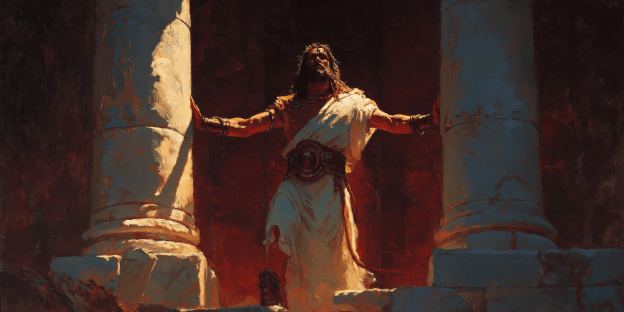

Samson Is Honey On God’s Lips

Samson, the muscle-bound judge who could bench-press city gates in faith but couldn’t find one believing friend in the entire land. You’ve heard the Sunday school version: Samson the strongman, brought low by a haircut and a honey trap. But let’s cut through the atheistic interpretation that too many preachers pile on. The real story isn’t a cautionary tale about lust or bad hair days; it’s a stark expose on faith versus unbelief, where even pagans grasp God’s power better than His own people. As Vincent Cheung aptly sums it up in The Shadow of Christ, “His parents misunderstood him, his wife betrayed him, his countrymen abandoned him, and his enemies hounded him.” That’s the setup, but the punchline? The enemies got the theology right, while the faithless in Israel fumbled it like a greased pig.

The story of Samson teaches that when power is needed, then only faith to work superman power will get the job done. It’s great to have an honourable marriage bed, but it will not rip city gates out of the ground. Holiness cannot compensate for miracle working faith, when miracles are needed. There is no substitute for this. It teaches that God stamps his sign of approval on people who have faith. This is why Samson is a hero of faith. God honors Samson in Hebrews 11 alongside Moses and David, not for flawless morals, but for faith that moved mountains—or in his case, temple pillars. God spotlights Samson’s faith with a smile on His faith. His name is gravel in mouth of the faithless, but Samson is honey on God’s lips.

Let’s rewind to Judges 13-16, where the drama unfolds. God handpicks Samson from the womb, announcing through an angel that this Nazirite kid will “begin the deliverance of Israel from the hands of the Philistines” (Judges 13:5, NIV). No small task—the Philistines are oppressing Israel, and oppression isn’t just bad luck; it’s a slap in the face to God’s promises. Remember, God swore to Abraham an “exceedingly great reward” (Genesis 15:1), blessing his descendants with land, prosperity, and victory over enemies. For Israel to cower under Philistine thumbs wasn’t mere hardship; it was disobedience, a failure to showcase God’s glory. They were meant to be a billboard for divine favor, not a doormat. Yet, when Samson steps up—ripping lions apart, torching fields with fox-tails, and slaying a thousand with a donkey’s jawbone—his own people treat him like a liability. The faithless do the same today. If you have faith, they treat you like a liability. This is the same game.

Take Judges 15:9-13. After Samson unleashes holy havoc on the Philistines, burning their crops in retaliation for their treachery, the men of Judah—three thousand strong—march up to bind him and hand him over. “Don’t you realize that the Philistines are rulers over us?” they whine. “What have you done to us?” (Judges 15:11, NIV). These are God’s chosen, the descendants of Abraham, moaning like defeated slaves. Gideon routed Midian with 300 faithful; Samson could’ve turned the tide with a fraction of that if Israel had believed. But no—they betray their own deliverer, tying him up like a sacrificial lamb. It’s not just abandonment; it’s a betrayal of God Himself, who publicly revealed Samson’s calling. Israel refuses to believe their own God can help them. Unbelief doesn’t just blind; it turns you into a traitor. Unbelief in God’s word makes you blind and stupid. Jesus had these type statements after both multiplication miracles, ‘Why is it that you still do not understand?’ Then we are told why the disciples were so stupid. “For they had not understood about the loaves, because their heart was hardened.” Being amazed at miracles isn’t a compliment—it’s a diagnosis of heart so hard with unbelief it makes granite stone envious.

Samson becomes a lone ranger not by choice, (as Vincent helped me understand better) but because faithlessness forces it on him. His family? They misunderstand him. (Judges 14:4). His wife? Betrays him for silver, weeping him into revealing his riddle (Judges 14:16-17). His countrymen? They abandon him in masse, preferring chains to change. Even Jeremiah had a scribe to jot down his prophecies, but Samson? Utterly alone, because no one else had faith in God—to join the fight.

And so, the legacy of the faithless is trash: they abandon God’s man, force him into isolation, then blame him for going solo. Worthless garbage, is putting it mildly without crossing into outright comedy. It’s like watching a team bench their MVP because they’re afraid of winning, and then blame MVP for not winning. This is all too common among the unbelieving. To have doubts in God’s promises for victory is to assign yourself to loss and misery.

Now, contrast this with the Philistines, those Dagon-worshipping heathens. They drag a blinded Samson to Gaza—the very city where he once uprooted the gates and hauled them off like oversized luggage (Judges 16:3)—to mock him in a grand religious bash. Thousands pack the temple, praising Dagon for handing over “our enemy… who laid waste our land and multiplied our slain” (Judges 16:23-24, NIV). Here’s the irony that stings: the Philistines recognize Samson as God’s weapon against them. They see his strength as divinely sourced, his victories as assaults from Israel’s God. Capturing him? That’s Dagon triumphing over Yahweh in their minds—a worldview clash where gods duke it out through human proxies. In modern terms, they grasp the theological stakes: this isn’t just personal beef; it’s cosmic warfare. “Our god has given our enemy into our hand, the ravager of our country” (Judges 16:24, ESV). They attribute Samson’s power to divine favor, even if misdirected to the wrong deity.

Meanwhile, Israel? Crickets on the theology front. Their own church-going peers—yes, Israel was the church then, God’s assembly—lack the faith to see Samson as God’s hammer. They’re so busy not believing, they miss the obvious. The Philistines, enemies though they are, have better theology here: they understand the implications of a God-empowered man wreaking havoc. It’s like the demons in the Gospels who recognize Jesus as “the Holy One of God” (Mark 1:24) while the Pharisees scoff. Unbelief dulls the senses worse Pharisee compassion.

This isn’t ancient history; it’s today’s mirror. Faithless Christians peddle unbelief like it’s gospel, sidelining miracles, healing, and power because “that’s not for us.” They mock bold faith as a liability, just as Israel handed over Samson as if he was the danger, and not their own unbelief. But our enemies? Atheists, skeptics, even cults—they often see the worldview clash clearer. They know if Christianity’s claims are true, their wisdom and power are a facade. We claim a God who parts seas and raises dead; they call our bluff when we settle for mediocrity.

The faithless have no redeeming qualities, because they make our enemies look enlightened. The are salt, with not even a hint of saltiness left. Worse than trash.  

I give you permission to leave the Philistine camp of unbelief. Join God in approving Samson as a faith giant. Believe big, fight hard, and watch reality obey. After all, if pagans can spot divine power, shouldn’t we? Let’s not be the ones hardening hearts while enemies applaud the show. Faith isn’t optional; it’s the hammer that crushes oppression.

Wield it, or get out of the way.

[See “The True Story of Samson, by Vincent Cheung, who has helped me understand this story better.]

The Devil Works All Things for Your Bad

Romans 8:28

This isn’t the ear-tickle many folks are after—oh no, they much prefer cherry-picking Romans 8 like it’s a cosmic vending machine: “God works all things for your good.” They sling it around like fatalists at a blame-dodging convention, faithless folks shrugging off responsibility faster than they can say, “did God really say?”

In the trusty grip of a true believer, this verse is pure gold— a rock-solid anchor showing God’s sovereignty flexing its muscles through grace to shower blessings automatically. It unfolds in a few proven ways. One, is our identity in Christ and His finished work (you know, the plot twist where the hero already wins). That’s the doctrine we geek out over here, aptly dubbed “You Already Got It.” Another is the autopilot perks of God’s goodness raining down, no strings attached because of our new creation already being reality, and because we are sons of Abraham’s blessing (Galatians 3, Luke 13:10-17). Thus, even when we’re fumbling the ball—imperfect, half-hearted, or binge-watching instead of Bible-studying—He keeps those sweet promises and covenant goodies flowing like a divine subscription we didn’t earn.

That said, the faithless take this verse and wreck it: They twist this gem into a get-out-of-jail-free card, or worse, snooze through the fine print that not every blessing hits the auto-apply button. Spoiler: Many promises and benefits require us to use our faith.

There are many blessings of our Christianity that come automatically, but others only come by active faith in God’s promises. It is the difference between a partial victory and a full victory. Full victories happen when we apply our faith to specific promises and these get piled on top of the automatic ones God is always working in us.

Folks love to trot out Romans 8:28 like it’s a get-out-of-jail-free card for every mess life throws at them. “And we know that in all things God works for the good of those who love him, who have been called according to his purpose.” They quote it with a shrug, as if God’s sovereignty means we just sit back and let the chips fall—good or bad; I mean, it’s all part of the plan, right? But that’s fatalism dressed up in Bible verses, a lazy dodge that shirks responsibility and starves faith. It’s not what Paul meant, and it’s sure not how Scripture paints the picture. The truth? The devil is out there working all things for your bad, stealing, killing, and destroying like the thief he is (John 10:10). God flips the script for His elect, but only when we grab hold by faith, resisting Satan and boldly claiming what’s ours. Ignore that, and you’re not just missing out—you’re complicit in the enemy’s playbook.

Let’s start with the basics, straight from God’s Word. Paul doesn’t toss Romans 8:28 into a vacuum; he builds it on the rock of God’s decrees for His chosen ones. As I lay out in Systematic Theology: 2025, “Take for example when Paul says in Romans 8 ‘He works all things for our good.’ God plans for a big good, and so He creates (and causes) temporary evil for the Elect to overcome, and then by this receive this big good. This can be seen in the story of Joseph. What they meant for evil, God meant it for good. This only applies to God’s elect” (p. 114). See that? It’s not a blanket promise for anyone breathing; it’s laser-focused on those God foreloved, predestined, called, justified, and glorified in that unbreakable chain (Romans 8:29-30). God’s working all for good isn’t automatic like gravity—it’s sovereign grace unleashed through faith, turning Satan’s schemes into stepping stones.

But here’s where the rubber meets the road, and where so many faith-fumblers veer off into the ditch. Satan doesn’t twiddle his thumbs while God orchestrates. No, he’s proactive, a roaring lion seeking whom he may devour (1 Peter 5:8). Sickness? Poverty? Broken relationships? That’s his handiwork, not some divine mystery. Take healing, for instance. In Acts 10:38, Peter nails it: Jesus “went around doing good and healing all who were under the power of the devil, because God was with him.” Sickness isn’t God’s autograph—it’s Satan’s graffiti on your life. Sickness Is Satan’s Glory, Not God’s. The Bible has no issue saying sickness isn’t from God; it is from Satan or the curse. This matters because if we think sickness comes from God, we won’t fight it. That is one reason Jesus battled sickness so hard while tradition doesn’t. Jesus saw sickness as Satan’s direct attack on Him, His Father, and His people. So, He smashed it wherever He found it. Sickness is Satan flipping the bird at Jesus’ atonement. Healing is Jesus slamming His fist into Satan’s face, again and again. There’s a real war here.

Think about it: if a sick person in Jesus’ crowd stayed back, nursing unbelief instead of pressing in by faith, was God “working all for good” or was Satan working all things for their misery? If you can’t tell the different, you are not one team Jesus. That was Satan working all for bad, oppressing them unchecked. The woman with the issue of blood didn’t get her miracle by quoting Romans 8:25 and waiting passively for the mysterious will of God, to show up in her life. No. She stretched her faith like a lifeline, grabbing Jesus’ hem (Mark 5:25-34). Faith activates God’s good; unbelief lets Satan run roughshod. I’ve seen it play out too many times: Christians limp along with ailments, chalking it up to “God’s will,” when Scripture screams otherwise. Isaiah 53:4-5, Matthew 8:17—Jesus bore our sicknesses on the cross, just like our sins. To call disease divine is to blur Jesus and Satan, like mistaking the Shepherd for the wolf in a police lineup. And folks who can’t tell the difference want to lecture on theology? That’s rich, like a blind man critiquing Picasso.

This isn’t just about healing; it’s the whole kit and caboodle. Poverty? Satan loves keeping you scraping by, but God promises abundance through faith in His covenant (Deuteronomy 28:1-14, Galatians 3:14). Broken relationships? The enemy sows discord, but faith claims reconciliation and peace (Ephesians 2:14-16). Lack in any area? It’s the devil grinding you down, but God’s working for good kicks in when you repent of unbelief and ask boldly. Peter includes healing in Jesus’ “doing good” (Acts 10:38). Yet unbelievers redefine God’s goodness as handing out cancer then forcing Romans 8:28 down your throat. Why does their definition of God sound like Satan; why does it sound like paganism? Pagan gods are fickle; our God is faithful to His promises when we believe.

Paul’s golden chain in Romans 8 isn’t a passive conveyor belt—it’s a call to live in the reality of God’s decrees. “And those he predestined, he also called; those he called, he also justified; those he justified, he also glorified” (Romans 8:30). This sorites shows the certainty. The conclusion is: ‘All those God foreloves are those He glorifies. God’s direct and absolute sovereignty is Christian reality and causality. But on the human level, where we live and fight, faith is the key that unlocks it. Without it, you’re letting Satan work overtime for your bad. James 4:7: “Submit yourselves, then, to God. Resist the devil, and he will flee from you.” Resistance isn’t optional—it’s commanded. And how do you resist? By faith alone, speaking to mountains, commanding demons, claiming healing (Mark 11:23, James 5:15).

God’s sovereignty undergirds it all. Even temporary evils, like Joseph’s betrayal, God means for good (Genesis 50:20). But that’s no excuse to wallow. Faith turns the tide. When you ask for healing, and God heals your cancer, this healing makes you stronger than ever: you grow stronger in your inner man, mature as a Christian, and get more complete with God’s fullness.  Receiving by faith—miracles, provision, breakthroughs—that’s experiencing God’s love poured out (Romans 5:5), and it grows the inner man. It’s not arrogance; it’s agreement with His Word. Vincent Cheung, puts it sharp: mature doctrine is “not what we do for God, but what God does for us” (from his essay “What Is Mature Doctrine”).

Imagine standing in the crowd as Jesus passes by, your body wracked with some chronic ailment that’s drained your strength and hope for years. You’ve heard the stories of His power, yet there you linger at the edges, too timid or doubtful to push forward and claim what’s yours. In that moment, calling your suffering “God working all things for your good” is a flat-out misrepresentation, like confusing a thief’s raid with a father’s provision. No, that’s Satan grinding away at you, stealing your vitality and joy while you stand idle, essentially handing him the reins. Romans 8:28 isn’t a passive blanket over every hardship; it’s God’s sovereign promise activated in the lives of those who love Him through bold action. But if you hang back, refusing to stretch your faith like the woman who grabbed the hem of Jesus’ robe in faith, you’re willingly aligning with the devil’s agenda—letting oppression linger when deliverance is within reach. It’s as if you’re at a banquet, starving because you won’t pick up the fork, all while blaming the host for your hunger, saying, “my host is working all my hunger for my good.” No, that’s just you being stupid and hypocritical.

The instant you shatter that unbelief and cry out in faith for healing, that’s when Jesus steps in to rework that slice of your existence for your ultimate good, much like how salvation dawns only upon repentance, ushering in those refreshing times Peter preached about in Acts 3:19. On our human level, where God engages us relationally, many facets of His benevolent orchestration remain unmoved until we exercise faith—stretching it out, as that bleeding woman did amid the throng, her touch drawing power from Him and turning her torment into God’s testimony (Mark 5:25-34). It’s not that God’s power is stingy; it’s that He’s predestined it this way, honoring faith by giving us the world. Think of forgiveness: the cross already paid the price, but the “working for good” ignites when you confess and receive. So, don’t just quote Romans 8 like a talisman against trouble; live it by resisting Satan fiercely, claiming healing as your inheritance, and watching how faith transforms the devil’s bad intentions into God’s brilliant turnaround—like turning a battlefield rout into a victory parade, with a wink from heaven saying, “See what happens when you believe?”

If there is part of your life you have lived in unbelief for 30 years, then it’s 30 years wasted in the area. We must be honest about that. But once you turn your faith to God to receive purchased gospel blessings and miracles, then at that point God begins to work it for your good, in 100-fold. Sure, even in your lack of knowledge and unbelief, God’s grace still kept you from much harm that you didn’t even see, and helped you in ways you did not notice, but you will not fully experience God working all things for your good until you stop the unbelief and have faith for miracles.

Picture this: Jesus, our ultimate High Priest, locked Himself into an unbreakable covenant with us—a divine deal sealed in the blood of His gospel, doling out every last goodie it promises. That’s His lane, His unbreakable priesthood. He shows up exclusively as the ultimate Good News Delivery Guy, not some cosmic prankster promising healing but sneaking in cancer in the backdoor.

Sickness? Nah, that’s not in His portfolio: it’s not his ministry, it’s not part of His contract with us. That’s Satan’s shady side-hustle, his knockoff priesthood peddling misery like bad infomercials. If you’re gunning for that Romans 8 remix—”all things working for your good”—you’ve gotta strut up to your High Priest with the confidence of a kid raiding the cookie jar. Boldly claim those promises: ask big, receive huge. Skip that step? Congrats, you’re handing Satan the reins on the sickness parade, the poverty pity party, the relationship trainwrecks, and the “why me?” lack attacks. And labeling that mess God’s handiwork. That’s like accidentally calling Jesus “Satan” at a family reunion. Face-slap city.

Want the full God-orchestrated glow-up? Then resist Satan like your life depends on it, because it does. Step up in faith, swing for the fences with audacious asks, and watch supernatural miracles rain down like confetti at a victory bash. No detours, no Plan B hacks. But hey, why chase shortcuts when this is the VIP route? God’s blueprint; its the one where faith alone hands you the keys to the kingdom, the Spirit’s turbo boost, and a lifetime supply of every good thing. All of it? Working overtime for your epic win, in every plot twist of your story.

Why settle for another way? This is God’s way—the good way, where by faith alone you possess the world, the Spirit, and all good things, with every part of life worked for your ultimate victory. Satan plots your downfall, but faith lets God rewrite the story. Choose faith, and watch the devil’s bad become God’s grand slam. After all, if God’s for us, who can be against us? (Romans 8:31).

Your Peace

In Luke 10:5-9 and Matthew 10:12-13, Jesus lays out a blueprint for His disciples that’s as straightforward as it is revolutionary to the faithless. “Whatever house you enter, first say, ‘Peace be to this house.’ And if a man of peace is there, your peace will rest on him, but if not, it will return to you. Stay in that house, eating and drinking what they give you; for the laborer is worthy of his wages. Do not keep moving from house to house. And whatever city you enter and they receive you, eat what is set before you; and heal those in it who are sick, and say to them, ‘The kingdom of God has come near to you,’” (Luke 10:5-9 LSB). Matthew echoes this: “As you enter the home, give it your greeting. If the home is deserving, let your peace rest on it; if it is not, let your peace return to you,” (Matthew 10:12-13 NIV).

Jesus operated as a man born under the law, anointed with the Spirit’s power for ministry—not relying on His divine nature, but showing us how a Spirit-empowered human crushes Satan’s works. He didn’t do miracles in “Jesus power” as God incarnate flexing; no, He modeled what a man filled with the Spirit could achieve. And here’s the kicker: that same Spirit, that same authority, He handed off to His followers. On the relative level—the human level where we live, fight, and pray—it’s “your peace,” not God’s. Once bestowed, it’s ours to wield, to give or withdraw as we see fit. Luke ties it to faith with that simple “first say”—a command spoken in confidence, expecting results because God’s sovereign mind integrates His power so seamlessly into our reality that when we declare it, heaven backs us up.

Think about it deductively. Premise one: God is sovereign, decreeing all things, including the authority He delegates to His elect (Matthew 28:18-20; Acts 1:8). Premise two: Jesus, post-resurrection, pours out this authority on believers through the Spirit, commanding us to heal the sick and advance His kingdom (Luke 10:9; Mark 16:17-18). Conclusion: If you’re born from above, this power isn’t locked in heaven waiting for a divine mood swing—it’s yours now, on the human level, to command peace over homes, sickness, and even demonic strongholds. Deny that, and you’re not just short on faith; you’re slapping the Spirit who anoints us for battle.

“On the human level, Jesus, the most God-centered man ever, said about both healing and forgiveness, ‘Your faith saved you.’ In Acts 10:38, Peter says all the sick people Jesus healed were ‘victimized’ or oppressed ‘by the devil.’ So, the Bible has no issue saying sickness isn’t from God; it is from Satan or the curse” (ST. p. 658). As God says in Isaiah 54, If someone attacks you, I did not send them. Or in today’s terms, if sickness attacks you, I did not send it. Jesus didn’t point to ultimate metaphysics every time He healed—He almost always pointed to the person’s faith. Why? Because that’s how God relates to us: through covenants, promises, and His good nature. Satan offered Jesus authority over kingdoms (Luke 4:5-6), but Jesus reclaimed it all at the cross, triumphing over principalities (Colossians 2:15). Now, seated at the right hand of Power, He says, “All authority has been given to Me” (Matthew 28:18 LSB), and then commissions us to use it.

But what about us today? If we don’t want to blaspheme the Spirit, our response must be that we have more than the disciples pre-Pentecost. They operated under Jesus’ direct commission, but post-resurrection, the fullness of the Spirit is poured out for power (Acts 2:33). It’s impossible to claim we have less without insulting the Spirit’s outpouring. Unlike the faithless who center on man—”Oh, that was for apostles only”—it was never about them; it was about God anointing humans to smash Satan’s works. Peter preached the baptism of power at Pentecost, and in Acts 3, he declared, “What I have, I give” (Acts 3:6 LSB)—the Name of Jesus, which we all wield. Jesus hammered it in John 14-16: ask in My name, and it’ll be done. This power mirrors binding and loosing (Matthew 18:18)—authority for any who confess Jesus as the Son of God.

Vincent Cheung nails it: “Faith trumps everything. Faith is immune to even correct theological arguments. This is not because faith could contradict sound theology, but because faith can override it” (Faith Override, Sermonettes Vol. 9, 2016, p. 14). The disciples’ peace wasn’t some ethereal vibe; it was Spirit-backed authority to bless or withhold, healing the sick as proof the kingdom’s near. Today, we don’t dust off sandals—we command peace over chaos, sickness, and oppression. If it sticks, great; if not, it returns to us, undiminished. Most Christians treat this like a loaded gun they won’t fire, begging God to pull the trigger while Satan laughs. Newsflash—He gave you the authority; use it, or you’re playing church while the kingdom stalls.

Apply this systematically. First, epistemology: Start with Scripture as God’s truth that is revealed and self-authenticating. God defines peace not as absence of trouble but victory over it—”I have told you these things, so that in Me you may have peace. In the world you have tribulation, but take courage; I have overcome the world” (John 16:33 LSB). Jesus says the peace He has, He has given to us. In God’s sovereign mind there as a substitute in Jesus. He bore the chastisement that has brought us peace. In God’s mind we already have this peace. It is given freely by grace and received by faith. Our Faith assents to this—declare peace over your home, and watch demons flee or blessings flow. Metaphysics: On the ultimate level, God decrees all; relatively, our words release it. The power of the Spirit’s peace was with the disciples; once God gave it to them, then on the human level, it is their peace, not God’s, just as my arm and my legs are mine, not God’s.

Anthropology: We’re remade as overcomers. “By faith we understand that the entire universe was formed at God’s command” (Hebrews 11:3 NIV), so speak to storms, sickness—reality obeys. Ethics: Command it. “Heal those in it who are sick” (Luke 10:9)—not optional. Reject this, and you’re siding with faith-fumblers, peddling unbelief like those who taught bad doctrine to my twin brother Joshua. They’ll be caught trying to wash blood off their hands when the Big Guy’s gavel drops.

When many seem to be fighting for all their lives to get peace, to find peace, to drive out the depression and stress and replace it with peace, Jesus offers an entirely different worldview. He expects us to have His peace. If we can give away our peace like a divine magic spell, then Jesus is presupposing we have this peace already. Jesus says, “Do not let your hearts be troubled, because I have overcome the world.” God’s peace is beyond all that we can measure. It is not merely a psychological crutch in the mind. It is peace with God. It is God’s sovereign decision to make things all around you to treat you well, so that even your enemies are at peace with you. It is blessing that surrounds you like a divine magical ward of luck. It is based on the thoughts of God’s good pleasure toward you. And God’s thoughts are reality; they create reality itself.

This peace isn’t some fragile inner calm that crumbles under the weight of life’s chaos; it’s the unshakeable reality of God’s victory invading our everyday existence, turning potential disasters into divine footnotes of rest. The idea of having peace with God is the ability and position to approach God, in His throne room of grace, to ask and then to receive the help we are asking for. Jesus Himself models this when He declares, “Peace I leave with you, My peace I give to you; not as the world gives do I give to you. Let not your heart be troubled, neither let it be afraid” (John 14:27, as quoted on p. 141). Think about it— if God’s presence shows up, as it did in Acts, it’s not content to whisper sweet nothings; it erupts in miracles, healings, and prophecies that bulldoze sickness and troubles. After destroying the troubles we can rest from them. This is God’s peace and it affects the whole life of the man who belongs to God. “Peace is not a chemical feeling in the brain. It is when you can rest from troubles.” Frankly, if your version of peace leaves you grinding through endless stress without supernatural breakthroughs, you’re settling for a counterfeit—Satan’s cheap knockoff, not the real deal that Jesus paid for with His blood. God’s thoughts toward us aren’t wishful thinking; they’re the blueprint of reality, decreeing enemies silenced and blessings overtaking us, as Isaiah 54 promises no weapon formed against us will prosper.

Yet, this peace demands we align our minds with God’s sovereign script, not man’s empirical rewrites. God’s peace flows from His unchanging nature—He doesn’t dabble in shadows or half-measures, as No ‘shadow’ of turning, for a shadow would contradict light. It’s the peace that Jesus bore our chastisement to secure: “The chastisement for our peace was upon Him, and by His stripes we are healed” (Isaiah 53:5). God’s presence is a contradiction to suffering. For a child of God, suffering’s greatest enemy and contradiction is God’s presence. If you’re still battling for peace like it’s an uphill slog, perhaps it’s time to stop playing defense and start commanding the mountains to move—because Jesus didn’t overcome the world so we could tiptoe around it. He overcame it, so that we have peace and rest. He overcame the world so that we also overcome, and storm the gates of Hell and expand His kingdom. God creates a reality where peace isn’t pursued; it’s possessed, permeating every corner until even your foes wave the white flag.

Your peace isn’t God’s passive pat on the back—it’s delegated rest that packs more power than a nuclear bomb. Post-Pentecost, we’ve got the upgrade: baptism for power, faith to command. Don’t blaspheme the Spirit by claiming less; grab God’s peace and declare it, and watch the kingdom expand. If critics call this extreme, point them to Jesus—the original faith zealot. But for those with faith? Peace rests, kingdoms fall, and glory goes to the One who armed us for victory.

The Vileness Of Cross-Centered Theology

Oshea Davis

You know, it’s almost comical how some folks wear “cross-centered” like a badge of spiritual humility, as if staring endlessly at Calvary’s bloodied hill makes them the real deal—authentic, raw, untouched by the glitz of glory. But flip through the New Testament, and you’ll see the apostles weren’t playing that game. No, they were throne-centered to the core, laser-focused on Jesus exalted, enthroned at the Father’s right hand, wielding authority that crushes enemies and empowers His people. And if there’s one Old Testament verse that screams this truth louder than any other, it’s Psalm 110:1: “The Lord says to my Lord: ‘Sit at my right hand until I make your enemies a footstool for your feet.'” This isn’t some obscure poetic flourish—it’s the heavyweight champion of OT quotes in the NT, referenced or alluded to over two dozen times. That’s more than any other verse from the Hebrew Scriptures, a fact that ought to make us pause and ask why the inspired writers couldn’t get enough of it.

Consider the sheer volume: Jesus Himself quotes it in Matthew 22:44, Mark 12:36, and Luke 20:42-43 to stump the Pharisees on the Messiah’s identity. Peter blasts it out in his Pentecost sermon (Acts 2:34-35), tying Jesus’ resurrection directly to this enthronement, and the present reality of the baptism of the Spirit for power. Paul echoes it in 1 Corinthians 15:25 and Ephesians 1:20, emphasizing Christ’s dominion over all powers. And Hebrews? That book’s practically a love letter to Psalm 110, quoting verse 1 in 1:13 and weaving its themes throughout chapters 1, 5, 7, 8, and 10 to hammer home Jesus as the eternal Priest-King. Allusions pop up everywhere else—Romans 8:34, Colossians 3:1, Hebrews 12:2—painting a picture not of a perpetually suffering Savior but of a victorious Lord reigning now, subduing foes under His feet. If the NT writers were scripting a highlight reel, they’d skip the slow-motion cross scenes and cut straight to the throne room coronation. Why? Because that’s where the action is—the present reality that defines everything from salvation to spiritual warfare.

The most quoted verse is not Isaiah 53, concerning of the suffering servant. No. The most quoted passage is about the enthroned Jesus, ruling, empowering the saints with the Spirit’s baptism and enemies being subdued under Him. This was the greatest focus of the NT writers, and it will also be ours.

This throne obsession flips the script on what it means to be gospel-centered. Too many today think humility demands a perpetual gaze at the cross, as if fixating on our sins and Jesus’ suffering keeps us grounded, preventing some imagined drift into arrogance. But that’s a subtle trap, isn’t it? It turns the gospel into a somber memorial service rather than a triumphant declaration of regime change. The cross was the battle won, the atonement secured, but the throne is the victory applied—the ongoing rule where Jesus pours out the Spirit, answers prayers, and expands His kingdom through us.

To be truly Christ-centered is to lock eyes on the exalted Christ, the one Hebrews 1:3 describes as “sustaining all things by his powerful word” after purifying us from sins. Sure, we remember the cross—Jesus commanded it in the Lord’s Supper—but that very command assumes we’re not stuck there. Why tell someone to “remember” something if they’re already obsessing over it? No, the presupposition is that our default posture is throne-focused, living in the reality of His reign, occasionally glancing back to marvel at the love that got us here. It’s like a king reminding his heirs of the war that won the crown; they don’t relive the battlefield daily—they rule from the palace, grateful, but forward-focused.

Take Peter’s Pentecost powerhouse in Acts 2. He doesn’t linger on the crucifixion details, though they’re fresh wounds. Instead, he rockets to the throne: “God has raised this Jesus to life, and we are all witnesses of it. Exalted to the right hand of God, he has received from the Father the promised Holy Spirit and has poured out what you now see and hear” (Acts 2:32-33). Boom—resurrection leads straight to enthronement, which unleashes the Spirit’s power. No wonder the crowd’s cut to the heart; they’re not just hearing about forgiveness but about a King who’s actively dismantling Satan’s hold, starting with tongues of fire and miracles galore. If Peter were cross-centered in the modern sense, he’d have camped out on guilt and repentance alone. But he’s throne-centered, so the application is power—baptism in the Spirit for all whom the Lord calls, no expiration date.

This echoes what I’ve written before about the disciplined son in the Father’s house: even in correction, we’re not exiled beggars but insiders sitting inside the Father’s palace, waiting in our room while the Father prepares greater things. Discipline stings, but the throne room door stays open, grace flowing unhindered.

Hebrews takes this even further, using Psalm 110 to redefine our entire approach to God. In chapter 1, it quotes verse 1 to prove Jesus’ superiority over angels: “To which of the angels did God ever say, ‘Sit at my right hand until I make your enemies a footstool for your feet’?” (Hebrews 1:13). The point? Jesus isn’t just a messenger—He’s the enthroned Son, heir of all things. By chapter 10, this throne reality empowers us to “draw near to God with a sincere heart and with the full assurance that faith brings” (10:22), holding unswervingly to hope because He’s faithful. No cowering in false humility; we’re commanded to storm the throne boldly for mercy and help (4:16).

Frankly, this throne-centered vibe exposes the poverty of cross-centered theology. It’s like celebrating a wedding by fixating on the proposal—sweet, but missing the marriage feast. Jesus’ command to remember His body and blood during communion presupposes we’re feasting in the kingdom now, not starving in perpetual Lent. If we’re already cross-fixated, why the reminder? No, it’s because our eyes are meant for the horizon, the exalted King who intercedes for us (Romans 8:34), making our prayers as potent as His. Paul in Ephesians 1:19-23 prays we’d grasp the “incomparably great power for us who believe”—the same power that raised Christ to the throne, putting everything under His feet for the church’s benefit. That’s not humble pie; that’s dominion delegated, enemies footstooled.

Take that tired trope: “For every look at your sin, take ten looks at the cross.” Sounds pious, right? But it’s a faith-killer in disguise, pumping unbelief like steroids. Sure, recall the atonement—it’s foundational—but fixating there keeps you sin-conscious, not righteousness-aware. Hebrews 10:2 slams perpetual guilt: once purged, no more sin-consciousness. Instead, 1 John 3:2-3 ties purification to throne-vision: “We know that when He appears, we shall be like Him… Everyone who has this hope in Him purifies himself, just as He is pure.” See yourself already enthroned with Christ (Ephesians 2:6), not perpetually crucified. That’s what scrubs the soul clean—not rubbernecking at a roman torture rack. Cross-gazers barely believe they’re forgiven, let alone righteous. They see a bloody mess, not a crowned King. But throne-gazers? They behold the Victor at the Father’s right hand, mirroring His purity by faith. No wonder they strut boldly for help (Hebrews 4:16)—they know their spot’s secure.

Romans 4 seals it: justification isn’t just cross-won; it’s resurrection-sealed. “He was delivered over to death for our sins and was raised to life for our justification” (Romans 4:25). The cross paid the debt, but the throne declares us as the very righteousness of God. Without resurrection to the right hand, no vindication of righteousness—no proof the atonement stuck. Abraham’s faith credited righteousness pre-cross (Romans 4:3), but Jesus’ rising to the throne, enthrones it for us. Cross-only folks limp with half a gospel, doubting they truly are the very righteousness of God. Their constant reminder of the sins makes it hard to believe themselves as God’s righteousness. They see nails, not the empty tomb’s triumph. But resurrection-gazers? They know: if Christ reigns, we’re co-heirs—righteous, pure, empowered, dominated by grace and unstoppable. Unbelief keeps the faithless cross-bound; but faith catapults Christians throne-ward, purified as He is.

The gospel is total salvation, making us clean, righteous, co-heirs with Christ, empowered to judge the world and angels. All things are ours because Jesus defines reality from the throne. To downplay this is to peddle unbelief, staining hands with the blood of those who could’ve thrived but settled for scraps. But for us? We’re sons in the Father’s house, rooms prepared. Even in besetting struggles, we draw from Christ’s continuing growth in us, eyes fixed on the Champion who authors faith from His seat of power. Our eyes are not fixed on Jesus on the cross, but as Hebrews says, on the Jesus the author of or faith, who is sitting on the throne. Anything less? Well, that’s just spiritual slumming when you’ve got palace keys.

So, if Psalm 110:1 reigns supreme in NT citations, it’s because the apostles got it: the gospel’s climax isn’t the empty tomb—it’s the occupied throne. Cross-centered? That’s the doorway for newbies to enter. Throne-centered? That’s full armor, advancing the kingdom with miracles, healings, and unshakeable faith. Remember the atonement, yes—but live with your eye locked on the present ruling Jesus, where He lives, and pours out power, and answered prayers. To focus on a cross is to focus where Jesus is not. To focus on the throne, is to meet the very eyes of Jesus looking back at you. Maybe that’s why the faithless remain cross-focus, because they can’t bear the living Jesus locking eyes with them, less their unbelief gets exposed. But for us who are the righteousness of God, we love to lock eyes with Jesus.  And when you see His eyes turn to lock back on you, you will hear Him say, “Ask anything in my name and you will have it.”

Welcome to the gospel. The real one. Not the one with a cross as the symbol.
But the one with a crown

The Gospel Is Jesus Sitting on a Throne

Listen, if you’re still camping out at the cross like it’s the whole story, you’ve missed the main point—and Hebrews straight-up calls you out on it. The cross was the doorway. The resurrection, the hallway. But the throne room? That’s the destination, the present-tense reality, the place where the gospel actually lives and breathes and swings a sledgehammer at every sickness dumb enough to stick around. The writer of Hebrews doesn’t waste time: “Now this is the main point of the things we are saying: We have such a High Priest, who is seated at the right hand of the throne of the Majesty in the heavens” (Heb. 8:1). Main point. Not side note. Not optional extra credit. The main point.

Most Christians treat the gospel like a get-out-of-hell-free card and stop there. Forgiveness? Wonderful. However, the gospel is Jesus—resurrected, ascended, crowned, and actively reigning—pouring out the Spirit on everyone who dares to believe that He’s not still bleeding on a Roman pole. Paul told Timothy the gospel he preached was “Jesus Christ, raised from the dead, descended from David” (2 Tim. 2:8). Why David? Because David means King. The resurrection wasn’t just Jesus getting a pulse back; it was God installing His King on Zion’s hill while the nations rage in vain (Ps. 2).  That’s the gospel Paul risked his neck for. Anything less is a truncated, neutered, half-gospel that leaves believers limping around like spiritual invalids.

Think about Pentecost. The disciples had seen the resurrected Jesus—walked with Him, touched Him, ate fish with Him. And Jesus still said, “Not yet. Stay in the city until you’re clothed with power from on high” (Luke 24:49). Why? Because seeing the out-of-the-grave Jesus wasn’t enough. They needed the enthroned Jesus to blast the Spirit through them like a divine firehose. Exalted to the right hand of God. Acts 2:33, “Exalted to the right hand of God, he has received from the Father the promised Holy Spirit and has poured out what you now see and hear.” Peter didn’t preach “Jesus died for you—now go be nice.” He preached “God has made this Jesus, whom you crucified, both Lord and Christ—and He’s currently sitting on the throne pouring out everything you just saw.” Tongues, prophecy, miracles—that’s the enthroned Jesus flexing. If your gospel doesn’t include that, you’re preaching a dead man’s biography instead of a living King’s decree.

We approach a throne, not a torture device. Hebrews 4:16 doesn’t say “come crawling to the cross.” It says come boldly to the throne of grace. Why? Because there’s a Man on it—our Man—who already settled the sin issue and now rules everything for the church (Eph. 1:22). The cross is finished. The grave is empty. The throne is occupied. And—get this—we’re seated there with Him right now (Eph. 2:6). Not “will be someday.” Are seated. Present tense. God has already positioned you above every sickness, demon, and circumstance because you’re in the Son and the Son is on the throne. That’s not hoping to be. You are. The only question is whether you’ll start acting like it or keep groveling like a spiritual orphan.

Sickness Is Satan’s Glory, Not God’s. Jesus saw sickness as Satan’s direct attack on Him, His Father, and His people. So, He smashed it wherever He found it. The only time He didn’t stomp out sickness—which Satan was causing—was when unbelief blocked Him. Think about that: unbelief stopped Jesus, but Satan couldn’t.

If Jesus is currently seated at the right hand of Power—session complete, enemies becoming His footstool (Heb. 10:12-13)—then why are we letting Satan cockblock the saints from the benefits of the atonement? Because too many Christians are still mentally kneeling at an empty cross begging for crumbs when they ought to be seated on a throne commanding mountains to move. The atonement purchased healing; the ascension enforces it. Isaiah 53:4-5 isn’t a suggestion—it’s a paid-in-full receipt. Jesus bore (nasa) our sicknesses the same way He bore our sins. Same word. Same substitution. Same finality. If you’re still sick, it’s not because the bill hasn’t been paid; it’s because you’re refusing to cash the check from the throne room.

People love to quote “by His stripes we are healed” and then act like it’s a nice sentiment instead of a legal reality enforced by the enthroned King. That’s like having a signed presidential pardon in your pocket and still sitting in prison because you “feel guilty.” Feel guilty all you want—Jesus is not on the cross; He is sitting in absolute victory, and He’s made you bone of His bone and flesh of His flesh. Your feelings don’t change the throne’s power to ensure His atonement.

The same goes for every promise. Prosperity? Yes—because the King owns everything, H has already bore our poverty and He has made us co-heirs with Him as a present living reality. Power? Yes—because the One who spoke galaxies into existence now lives in you and has authorized you to use His name like it’s your own (because legally, it is). Miracles? Greater works than Jesus did in His earthly ministry, because now He’s not limited to one body in one location—He’s multiplied Himself in millions of believers worldwide doing greater miracles than Him, all seated with Him far above every power (John 14:12, Eph. 1:21).

Those who deny this stuff aren’t just mistaken—they’re insulting the King on His coronation day. The King has spoken: “All authority in heaven and on earth has been given to me—therefore go.” Not “go and be barely saved.” Go and disciple nations. Go and heal the sick. Go and cast out demons. Go and raise the dead. Go and speak to mountains until they jump into the sea. This is how the present Jesus rules from this throne (Mark 11:23-24). We believe the King.

The gospel is not Jesus hanging bloody and defeated—it’s Jesus crowned and commanding. It’s not “maybe He’ll help if He’s in a good mood.” It’s “He always helps because He’s already won and He His love for His bride is not measurable. The cross reconciled us; the throne empowers us. The cross saved us from sin; the throne saves us into dominion. If you’re still living like the story ended at Golgotha, you’re reading the Bible with the last chapters ripped out.

All things are yours. Not some things on Sundays if the worship team is on point. All things. Jesus is not pacing heaven worried about your problem—He’s laughing at His enemies (Ps. 2:4) while handing you the keys to the kingdom. Your job is to stop acting like a slave and start acting like royalty.

Stop praying beggar prayers from the foot-of-the-cross theology. Start issuing throne-room decrees from ascended-Christ reality. Speak to cancer, poverty, depression, demons—whatever—and watch reality rearrange itself around the word of the King coming out of your mouth. Not because you have power. Because He has all power and has made you His mouth, His hands, His feet on the earth.

The gospel is Jesus sitting on a throne—and you sitting there with Him, right now, laughing at the devil’s pathetic attempts to cockblock you out of your inheritance. The enthroned Christ isn’t here to comfort you in your unbelief. He’s here to push you into the throne room until you finally realize you’ve been royalty all along.

Welcome to the gospel. The real one. Not the one with a cross as the symbol. But the one with a crown

Our Identification With Christ

We live in a time when too many Christians treat Jesus like a historical figure trapped in the pages of an old book—as if His ministry was a one-and-done spectacle for the crowds in Galilee. But Scripture paints a far different picture: one where our connection to Him is so profound, so ontologically woven into the fabric of reality, that when God looks at us, He sees the exalted Christ. “God did all this to give us unshakable confidence to ask and receive, by showing us how intellectually, relationally, and ontologically we are identified with Jesus” (S.T., page 654). This isn’t some feel-good theology; it’s the bedrock of how we operate in ministry today. Because we’re united with Him—not the earthly Jesus under the law, but the resurrected King pouring out His Spirit—we do the works He did, and even greater, in the same power. Let’s unpack this, drawing straight from God’s Word, and expose the faith-bumblers who’d rather limit God than let Him loose. Limiting God is like trying to cage a cosmic supernova—spoiler: it doesn’t end well for the cage.

Consider the closeness Scripture describes between Jesus and His body, the church. It’s not a loose association, like distant relatives at a family reunion. No, it’s as intimate as a head to its limbs—where the head goes, the arms follow; what empowers one, surges through the other. Paul captures this in Ephesians 2:6, declaring that God “raised us up with Him and seated us with Him in the heavenly places in Christ Jesus.” Think about that: right now, in God’s sovereign mind, you’re not scraping by down here; you’re enthroned above every principality, every sickness, every obstacle. This identification means that when God sees you, He sees Jesus. God thinks that right now, I am seated with Jesus in the heavenly places. As Jesus is, so am I in this world. The only reality is the reality that God’s Word creates and sustains. There is no other truth or reality. God thinks I am identified with Jesus, as part of Him. Would God deny Jesus a request? Of course not. Thus, God would not deny me a request, because in God’s mind He considers me as part of Jesus. If we miss this, we mock the gospel, trampling the finished work of Christ as if it left us half-redeemed—not identified with Jesus as part of His body—and limping along until heaven. Frankly, that’s not just bad theology; it’s a cosmic insult, like handing back a gift from the King because you prefer your old rags. Ouch—talk about a divine facepalm.

This union isn’t abstract metaphysics for theologians to debate in ivory towers. It is reality because reality is based on God’s thoughts and words. He considered the old Oshea to have died with Jesus, and a new created Oshea is defined as part of Jesus. By God merely thinking this about me is what creates, shapes, and upholds reality. You cannot get more reality than “God thinks so.” Thus, this has direct implications for ministry. Look at how Jesus Himself operated. In Luke 4:14-19, after His baptism, “Jesus returned in the power of the Spirit to Galilee… He stood up to read… ‘The Spirit of the Lord is upon Me, because He has anointed Me to preach the gospel to the poor; He has sent Me to heal the broken-hearted, to proclaim liberty to the captives and recovery of sight to the blind, to set at liberty those who are oppressed.’” Here’s the key: Jesus, as a man born under the law (Galatians 4:4), didn’t rely on His divine nature for miracles. He ministered through the anointing of the Holy Spirit, just as Acts 10:38 confirms: “God anointed Jesus of Nazareth with the Holy Spirit and with power… healing all who were oppressed by the devil.” Even the Son of God modelled dependence on the Spirit’s power for healing, deliverance, and proclamation. Why? Because He was born under the law and operated miracles as a man would; by this, He was the forerunner showing the church how to operate as humans empowered by the Spirit. “Jesus came as a man, born under the law, and even ministered God’s power as a saint does—by the power of the Spirit” (p. 654). He wasn’t flexing inherent deity in isolation; He was demonstrating how Spirit-empowered humanity crushes Satan’s works. Picture Jesus as the ultimate tutorial video: “How to Wreck the Devil’s Plans in Three Easy Steps.”

Now, fast-forward to the ascension. Jesus doesn’t leave us orphaned or downgraded. Instead, He commands the disciples in Acts 1:4-8: “Do not leave Jerusalem, but wait for the Promise of the Father… for John truly baptized with water, but you shall be baptized with the Holy Spirit… But you shall receive power when the Holy Spirit has come upon you; and you shall be witnesses to Me.” This isn’t optional equipment for apostles only—it’s the same Spirit, the same power, poured out on all believers for ministry. Peter echoes this in Acts 2:33, noting that the exalted Jesus “received from the Father the promise of the Holy Spirit” and poured it out. The result? The early church exploded with miracles, healings, and bold proclamation, far beyond what one man in one place could do. “After His resurrection, Jesus commanded the disciples not to minister or spread the news until they were clothed with the same power of the Spirit.” If Jesus needed the Spirit’s anointing to start His ministry, how much more do we? Yet some theologians act like this power fizzled out after the apostles, as if God got bored with miracles. That’s not cessationism; that’s Satanism, limiting the Holy One of Israel like the Israelites did in the wilderness (Psalm 78:41). God bored? As if the Creator of quantum physics and kittens runs out of ideas.

Jesus promised we’d do “greater works” than He did (John 14:12). Not because we’re superior, but because He’s now on the throne, multiplying His power through a global body. In His earthly ministry, He was localized; now, through us, His reach is exponential. “As great as it would be to be identified with Jesus under the law in His earthly miracle ministry, it is still a limitation, because what we have is greater. This is why Jesus promised we would do greater works!” Imagine: the same Spirit that rested on Jesus now rests on you, empowering you to command mountains (Mark 11:23), heal the sick (James 5:15), and cast out demons (Mark 16:17). It’s not arrogance; it’s obedience. Faith isn’t wishing; it’s assenting to God’s definition of reality. When you speak in Jesus’ name, reality bends because you’re so identified with Him that your decree carries His authority. This is true and it is reality because God’s sovereign mind thinks so.

Satan trembles at this, which is why he peddles doctrines that sideline the Spirit—calling miracles “for then, not now,” or faith “presumptuous.” But as Vincent Cheung might say, such views are just human pride masquerading as piety. Critics will cry, “But we’re not Jesus!” Exactly the point—we’re better off now, identified with the glorified One. Paul warns in 2 Corinthians 5:16, “From now on, therefore, we regard no one according to the flesh. Even though we once regarded Christ according to the flesh, we regard him thus no longer.” If you evaluate Jesus—or yourself—from a human viewpoint, you’ll cap God’s power at what your carnal senses perceive. You’ll pray timidly, heal sporadically, and witness anemically. But embrace your union: you’re a new creation (2 Corinthians 5:17), co-heir with Christ (Romans 8:17), partaker of the divine nature (2 Peter 1:4). This means ministry isn’t imitation; it’s reality based on how God’s sovereign mind thinks about His own creation. Heal like Jesus did—lay hands, command sickness to flee—because the Spirit’s power flows through you as it did Him. Preach with authority, knowing demons flee at His name through your lips. And yes, expect greater: more salvations, more miracles, across more territory. “The power of the Spirit is so contested by many… When Jesus on His throne becomes central, the baptism of the Spirit for power becomes central” (S.T., page 399).

The same Spirit who empowers also convicts of sin (John 16:8). But what was the sin the Spirit comes to convict the world of? All? No. The Spirit’s ministry is to convict the world of the sin of unbelief—because they do not believe in Jesus. They do not believe He is God’s Son. And because they do not believe He is God’s Son, they do not believe the things He preached and did. What are some things Jesus said? “Jesus answered, ‘Truly I tell you, if anyone says to this mountain, “Go, throw yourself into the sea,” and does not doubt in their heart but believes that what they say will happen, it will be done for them. Therefore I tell you, whatever you ask for in prayer, believe that you have received it, and it will be yours’” (Mark 11:23-24). The Spirit comes to convict us of the greatest sin, which started with Satan’s temptation to Eve: “Did God really say?” It is the sin that leads and opens the door to all other sins. It is the defining sin of the faithless; they refuse to believe God and they refuse to believe Jesus Christ.

Unbelief stopped Jesus in Nazareth (Mark 6:5-6), not besetting sins and not Satan. If sickness lingers or prayers seem unanswered, it’s not God’s will changing—it’s our faith needing sharpening, or perhaps a fresh infilling of the Spirit’s power. Pray in the Spirit (Jude 1:20), building yourself up in God’s love. “Sickness is Satan’s victory lap. Jesus did not just patch up boo-boos; He threw haymakers at the devil’s disease factory” (Systematic Theology, page 648). Join the fight; wield the power. Because who doesn’t love a good spiritual smackdown?

Look at how Jesus kicked off His Galilean ministry in Luke 4:14-15—He returned “in the power of the Spirit,” and suddenly news spread like wildfire, with Him teaching in synagogues and getting glorified by everyone. This isn’t some vague spiritual high; it’s raw, divine dynamite exploding into action. Jesus, as a man born under the law, didn’t launch His world-shaking work until after His baptism, when the Spirit descended like a dove and empowered Him to heal, cast out demons, and preach with authority that left jaws on the floor. The Holy Spirit wasn’t just tagging along; He was the engine, turning Jesus’ steps into a kingdom invasion that demolished Satan’s strongholds. And here’s the kicker—Jesus didn’t hog this power. In Acts 1:8, He promises His followers the same deal: “You shall receive power when the Holy Spirit has come upon you,” turning ordinary folks into unstoppable witnesses from Jerusalem to the ends of the earth. This isn’t optional fluff; it’s the blueprint for Christian life. If we’re co-heirs with Christ, why settle for powerless piety when the Spirit’s ready to supercharge us for miracles and bold proclamation? God’s not stingy—He’s lavishing this power on anyone hungry enough to receive it. Without the Spirit’s baptism, we’re just playing church while the devil throws a party.

The faithless treat this power like an ancient relic gathering dust in some theological museum, when Scripture screams it’s for now. Jesus returned in the Spirit’s power after fasting and facing down Satan, emerging not weakened but weaponized for ministry—teaching that silenced critics and healings that restored the broken. That same Spirit, poured out at Pentecost, isn’t a one-time fireworks show; it’s the ongoing promise for Abraham’s kids through faith (Galatians 3:14). When Acts 1:8 hits, it’s Jesus saying, “Wait for the download—then go conquer.” This power isn’t about flashy showmanship; it’s God’s sovereignty flexing through us, making the impossible routine. Think about it: if Jesus needed the Spirit’s anointing to crush the devil’s works (Acts 10:38), how much more do we? Yet, some peddle a gutless gospel, ignoring this dynamite because it messes with their unbelief. Nah, the Spirit’s power is our birthright—grab it, and watch reality bend as we advance the kingdom, just like our Lord did. Anything less is selling short the God who turns water-walkers into world-changers. Pro tip: Don’t be the guy who brings a squirt gun to a divine water fight.

In closing, our identification with Christ isn’t a doctrine to shelve; it’s dynamite for daily living. Because we’re one with Him, we minister in the same way—Spirit-anointed, faith-fueled—and with the same power, only amplified. Don’t know Him from a human viewpoint anymore; know Him as the enthroned Lord, and yourself as seated there too. Speak to storms, sickness, and souls; watch heaven invade earth. If that sounds radical, then it exposes that your heart is hard. As Scripture says regarding the disciples’ surprise at Jesus’ miracles: they were surprised “because they did not consider the loaves.” Jesus expected them to extrapolate the miracle of multiplication of material substance to be a regular activity. Their inability to see miracles as common and regular indicated their hearts were as hard as stone. Let us cast off any stony parts of our hearts and put on a heart of faith and the Spirit. Miracles, the Spirit, and healing are the gospel. And if critics scoff, well, they’re just cheering for the wrong team in this cosmic showdown. Don’t wash your hands with them, unless you wish to partake of their judgment.

How to Authenticate You are a Moron

Let’s get straight to the heart of the matter, because dancing around defective doctrine only gives it more room to spread like a theological weed. The idea that miracles were merely signs to authenticate Jesus’ message—and that they’ve since packed up and left the building once the canon closed—is not just misguided; it’s intellectually bankrupt, biblically incoherent, and frankly, a bit embarrassing for anyone claiming to handle Scripture with care. If the gospel message is brimming with promises of physical healing, deliverance from oppression, and the unleashing of resurrected power through faith, then how on earth does it make sense to say the signs pointing to that message deliver more substance than the message itself? It’s like advertising a feast with mouthwatering samples, only to serve up empty plates at the main event. The authentication would end up wielding more power than the finished atonement or even Jesus Himself, seated in glory at the Father’s right hand. That’s not divine logic; that’s nonsense on stilts, the kind that makes you wonder if some theologians skipped the class on basic reasoning.

Consider this: the miracles Jesus performed weren’t roadside billboards meant to fade into irrelevance once the destination was reached. They were previews of the kingdom’s reality, embodying the very essence of the atonement’s victory over sin, sickness, and Satan. Isaiah 53:4-5 doesn’t mince words—Jesus bore our infirmities and carried our diseases, a truth Matthew 8:17 applies directly to physical healing during Jesus’ ministry. Peter echoes it in 1 Peter 2:24, linking those stripes to our wholeness. If these acts were just to confirm the message, but the completed work of the cross somehow provides less healing—or hitches it to some mysterious “will of God” lottery even when faith is locked in—then the signs overshadow the substance. The pointer becomes mightier than the pointed-to, the herald greater than the king. In “Sickness Is Satan’s Glory, Not God’s,” I explain: “In the substitutionary atonement, Jesus took 39 stripes in exchange for our healing. It is already done. In the Father’s mind, He decided our sicknesses were taken off us and put on Jesus as those 39 stripes. Jesus carried our sickness in our place.” If the authenticating miracles promised healing but the finished product withholds it, we’re left with a gospel that’s all sizzle and no steak—a cruel joke that dishonors the risen Christ’s authority.

And if that reversal wasn’t absurd enough, the cessationist claim commits a glaring logical fallacy, one that’s as transparent as it is sloppy. Arguing that miracles were only for authenticating the apostolic message and thus ceased once the Bible was complete is like saying, “All dinosaurs are animals. All dinosaurs have ceased to exist. Therefore, all animals have ceased to exist.” It’s the classic error of composition and division, assuming that because some miracles served a confirmatory role (like in Acts 2:22, where Peter notes Jesus was “attested to you by God with miracles, wonders, and signs”), all miracles must be pigeonholed into that category and then vanish wholesale. But Scripture never draws such a narrow boundary. Miracles aren’t a monolithic bloc; they’re multifaceted expressions of God’s power, often untethered from authentication. In John 14:12, Jesus promises that believers will do His works and greater ones simply because they believe—not as signs for a message, but as the fruit of faith in Him. This has nothing to do with canon closure or apostolic credentials; it’s about ongoing discipleship. In “Ultimate Stupid Cessationist Arguments #1m” it says “For sake of argument, let us say sign gifts have ceased. So what? What logical relevance does that have to do with healing and miracles on demand of faith. It has no connection whatsoever. Just because a pizza does not have olives, does not mean it stops being a pizza.”

This fallacy isn’t just academic nitpicking—it’s a direct assault on the gospel’s fullness. Abraham’s blessing, as Paul unpacks in Galatians 3, shatters the notion that miracles were mere temporary props. The promise to Abraham wasn’t a fleeting endorsement; it was an eternal covenant of abundant increase, including supernatural favor, health, and victory over curses. Jesus became the curse for us (Galatians 3:13) precisely to unlock this blessing for all who believe, complete with the Spirit’s power for miracles (Galatians 3:5,14). It’s not about confirming a message but about God being God—faithful, unchanging, and extravagantly generous. In Luke 13:16, Jesus declares healing “necessary” for the bent-over woman because she was Abraham’s daughter, not because it authenticated anything. Satan bound her, but the covenant demanded her freedom. Similarly, to the Syrophoenician woman in Matthew 15:28, healing is “children’s bread”—daily sustenance for covenant heirs, not a one-off sign. As I emphasize in Systematic Theology 2025 under “The Structure or Thesis for this Systematic Theology Book,” the gospel’s logic flows from God’s self-authenticating truth: “If God has revealed a self-authenticating first principle with substantial truth for all of life… then all things are possible for the one who believes.” Miracles aren’t add-ons; they’re the natural outworking of God’s fidelity to His word.

To peddle cessationism as if miracles were disposable training wheels is to limit the Holy One of Israel, much like the Israelites did in the wilderness, confessing defeat before giants instead of claiming promised land. It’s faith-fumbling at its finest, staining hands with the blood of unbelief: “For those who taught you bad doctrine and didn’t repent or back off, may their hands stay stained with your blood—along with all who peddle unbelief—on judgment day, before the Son who sits at the right hand of Power.” If God swore by Himself to bless Abraham’s seed (Hebrews 6:13-18), and that blessing includes the Spirit’s miraculous empowerment, who are we to declare it expired? Paul curses any gospel that deviates from this (Galatians 1:8-9), and rightly so. Miracles persist because God persists—being Himself, faithful to His oath. Anything less turns the Almighty into a cosmic bait-and-switch artist, promising power but delivering powerlessness. That’s not the God I serve; that’s a caricature born of defective theology.

In wrapping this up, remember that the New Covenant amplifies, not diminishes, the old promises. We’re not limping along in a miracle drought; we’re seated with Christ in heavenly places (Ephesians 2:6), wielding His name like a sledgehammer against every stronghold. God wants to give more than you want to receive. When we are sick, we need to have a relentless focus on our healing, on the word of God about healing day and night… Sickness is from the devil, it is a curse of the law and Jesus started to demolish it in His ministry and has commanded all His disciples to continue this battle. Cessationism doesn’t just err; it robs saints of their inheritance, sidelining them with sickness Satan has no right to inflict. Embrace Abraham’s gospel in full, and watch mountains move at faith’s command. After all, if the signs were that potent, imagine what the substance unleashes.

Claim Your Daily Bread

The notion that Jesus’ miracles—or those of the apostles—were merely signposts to authenticate the gospel message is a theological sleight of hand that crumbles under scrutiny. It’s a convenient excuse for those who prefer a powerless Christianity, but it doesn’t hold water when you pour in the full context of Scripture. If miracles were only for validation, why did Jesus tie them so inextricably to the core of the good news? Think about it: the gospel proclaims that “by His stripes we are healed” (Isaiah 53:5, as Peter echoes in 1 Peter 2:24) and that Jesus “took away our sicknesses” (Matthew 8:17, quoting Isaiah 53:4). Jesus didn’t perform healings as some divine footnote; He used them to embody and confirm the very essence of salvation—a total rescue from sin’s curse, including disease and demonic oppression. To suggest that these miracles evaporate once the message is “authenticated” is laughable. It’s like Jesus waving a banner of healing to draw folks in, only to yank it away post-conversion, saying, “Just kidding—now suffer for My glory.” That’s not the God of the Bible; that’s a bait-and-switch straight from devil dogmatic playbook.

Jesus’ ministry was a demolition derby against sickness and devils, not a one-time spectacle. He healed multitudes, cast out demons, and raised the dead as previews of the kingdom’s power breaking in. The apostles continued the rampage, with signs and wonders marking their steps (Acts 5:12-16, 19:11-12). If these were just credentials, why command believers to do the same—and greater (John 14:12)? Why include healing in the Great Commission (Mark 16:17-18)? The gospel isn’t a historical artifact; it’s living power for today. It is “living power” as Jesus Christ is living power sitting at the right hand of Power, pouring out the power of the Spirit. Now Denying ongoing miracles isn’t humble theology; it’s unbelief masquerading as piety, limiting the Holy One of Israel just like the wilderness wanderers did, “oh no, we are to small and they are too big.” If healing was only for authentication, the gospel would be half-baked, promising deliverance from sickness but delivering excuses. No, the miracles confirm a gospel that includes healing as a core benefit, not an optional add-on.

Moving beyond that tired error, we hit the heart of the matter: the doctrine of Abraham’s blessing, sealed by Jesus’ blood. This isn’t some peripheral perk; it’s the gospel Paul defends with fire in Galatians. In Galatians 3, Paul hammers home that the promise to Abraham—”all nations will be blessed through him” (Genesis 12:3)—is fulfilled in Christ. Jesus became the curse for us, redeeming us from the law’s penalties (Galatians 3:13-14), so that “the blessing given to Abraham” comes to the Gentiles through faith. What is that blessing? Abundant increase in all things—land, descendants, victory over enemies, and yes, supernatural provision, including health and miracles. Paul doesn’t leave it vague; he ties it directly to the Spirit: “so that by faith we might receive the promise of the Spirit” (Galatians 3:14). And what does the Spirit bring? Miracles, healings, prophecies—the works of power that marked Abraham’s covenant life.

But here’s the question that exposes the wafflers: how much miracles and healing does Abraham’s gospel guarantee? Is it a sprinkle here and there, a “maybe if it’s God’s will” lottery ticket, even when faith is firing on all cylinders? Absolutely not. Scripture paints a picture of abundance, not scarcity. Consider Jesus’ encounter with the Canaanite woman in Matthew 15:21-28. She’s begging for her daughter’s deliverance from a demon—essentially a healing from torment. Jesus initially deflects, saying, “It is not right to take the children’s bread and toss it to the dogs.” Bread? Not some fancy dessert for special occasions, but bread—the staple, the daily necessity. Healing, in Jesus’ words, is the children’s bread, meant for Abraham’s offspring. The woman persists in faith, and Jesus commends her: “Woman, you have great faith! Your request is granted.” Her daughter is healed instantly. No hesitation, no “let’s see if it’s My will today.” Rather, Jesus does an opposite faith confession: he doesn’t confess by saying, “God’s will be done,” No, He confesses, “Woman your will be done.”

Jesus doubles down in Luke 13:10-17 with the woman bent over for eighteen years. He calls her forward on the Sabbath, lays hands on her, and declares, “Woman, you are set free from your infirmity.” When the synagogue leader gripes about the timing, Jesus retorts: “Should not this woman, a daughter of Abraham, whom Satan has kept bound for eighteen long years, be set free on the Sabbath day from what bound her?” Notice: it’s “necessary” (as some translations render the implication) for her to be healed because she’s Abraham’s daughter. Not optional, not probabilistic—necessary. Sickness is Satan’s chain, not God’s tool. Jesus didn’t quiz her on repentance or catalog her sins; He saw her Abraham covenant status and that alone made it necessary to heal her. This is the same Jesus who healed all who came to Him (Matthew 8:16, 12:15; Luke 6:19), rejecting none except where unbelief blocked the flow (Mark 6:5-6). Despite the crowds’ many flaws—sins unconfessed, hearts divided—faith was the key, and healing flowed like manna in the desert.

This isn’t hyperbole; it’s the pattern. Jesus healed relentlessly, embodying the Father’s heart for wholeness. In the gospel of Abraham, now ours through Jesus’ curse-bearing death, miracles aren’t rare treats but daily sustenance. Paul makes it plain in Galatians 3:5: “He who supplies the Spirit to you and works miracles among you—does He do it by works of the law, or by hearing with faith?” Miracles are the norm for faith-filled heirs, as average as breakfast. This means in context of the New Testament Galatians church in Galatians 3, the amount of the Spirit’s power and miracles Paul was referring to, was substantial, and it was based on Abraham’s gospel. This also destroys any attempt to say sign miracles have ceased therefore regular healings and miracles have ceased. Such as stance is blasphemy and deserves immediate curses, and excommunication. The healings and miracles we have been reviewing are about God fulling His old promise to Abraham, not to prove or authenticate something. Those are two different categories, and to be so stupid to confuse the two is a sign of God’s reprobation on you. Logically it is the same as saying, “Dinosaurs are animals. Dinosaurs are ceased. Therefore, animals have ceased.”

To say healing is a cosmic lotto, hit-or-miss even with mountain-moving faith—is to peddle a different gospel. Paul doesn’t mince words: “If anybody is preaching to you a gospel other than what you accepted, let them be under God’s curse!” (Galatians 1:9). Those who dilute the promise, chalking up unanswered prayers to “God’s mysterious will” rather than our need for undiluted faith, deserve the same rejection. They’re not protecting sovereignty; they’re peddling unbelief, complicit in letting Satan sideline saints with sickness.

This isn’t about earning miracles through perfect behavior. Abraham’s blessing is by faith, not merit, just as justification is. Jesus didn’t demand spotless lives from those He healed; He demanded faith in His willingness and power. In our New Covenant, superior to the old (Hebrews 8:6), the Spirit empowers us for even greater works. Sickness isn’t God’s autograph on our lives; it’s the enemy’s graffiti, defacing Jesus’ body, His temple. As co-heirs with Christ (Romans 8:17), we inherit the world—all things are ours (1 Corinthians 3:21-23). That includes health, provision, and victory over every curse. If you’re Abraham’s child by faith (Galatians 3:7), claim your bread daily. Meditate on the promises relentlessly, confess them boldly. Unbelief might whisper “not today,” but faith shouts back with Jesus: “Your faith has healed you—go in peace” (Luke 8:48).

In the end, this gospel of abundant miracles isn’t optional fluff; it’s the power of God for salvation in full (Romans 1:16). Reject the naysayers who shrink it to fit their experience rather than expanding their faith to match God’s Word. Curse that different gospel, as Paul commands, and embrace the one secured by Jesus’ blood—one where healing flows as freely as grace itself. After all, if God gave us His Son, won’t He freely give us all things (Romans 8:32)? That’s not a question; it’s a promise. Grab your loaf and eat up.

The Gospel is God Showing Off, Not Man

The stark contrast between the gospel’s essence and the mindset of the faithless religious crowd couldn’t be clearer, like night refusing to mingle with day. In the Lord’s Supper, we witness God’s extravagant generosity on full display—He pours out righteousness, healing, wealth, and peace without demanding a dime from us, as if to say, “Watch Me lavish My riches on you, because that’s who I am.” Jesus doesn’t hand us a bill for His broken body or spilled blood; instead, He declares, “This is for you,” echoing the one-way flow from Isaiah 53 where He bears our griefs and carries our pains, swapping our curses for His blessings. The faithless, however, flip this divine script upside down, strutting like peacocks in their self-imposed sufferings, boasting about what they “give” to God as if their meager, self-inflicted sufferings, sicknesses and sacrifices could impress the Almighty. They twist communion into a showcase of their piety—enduring sickness as “God’s will” or poverty as proof of devotion—forgetting that such posturing mocks the cross, where God did all the giving so we could freely receive.

This inversion isn’t just a minor theological hiccup; it’s a worldview war, pitting God’s sovereign supply against man’s arrogant striving. Scripture hammers this home in Romans 5, where God demonstrates His love by dying for us while we were still powerless enemies, not waiting for us to scrape together some spiritual currency. The religious types, peddling their “sacrifices” like vendors at a flea market, essentially claim God needs their input to be glorified, as if the Creator of the universe relies on our loneliness or pain to pad His resume. But Ephesians 2 flips that delusion: We’re saved by grace through faith, not works, so no one can boast—God gets all the glory for the rescue operation. The faithless cling to their “contributions,” finding God “useful” only as a platform for their ego trips, while the gospel invites us to revel in His usefulness to us, paying every bill and piling on blessings. It’s like showing up to a royal banquet and insisting on washing dishes to “earn” your seat—what a comical insult to the King’s hospitality.

Dig deeper, and the contrast exposes a rotten core in the religious facade: They honor God with lips but hearts far from Him, as Jesus quotes Isaiah in Matthew 15, substituting human traditions for divine commands. God’s showing off in communion reminds us we’re recipients, not donors—He enriches us with Abraham’s blessings in Galatians 3, not because we tithe our way to favor, but because Christ redeemed us from the curse. The faithless, meanwhile, parade their “giving” as if suffering rejection or upheaval somehow blesses God, ignoring that He endured those for us so we could enjoy acceptance and peace. This fundamental clash boils down to humility versus hubris: Embrace God’s lavish giving, or cling to your “sacrifices” and miss the feast—after all, who turns down infinite upgrades from the ultimate Provider?

When we gather around the Lord’s table, breaking bread and lifting the cup, it’s not a somber ritual of our meager offerings to Him—it’s a vivid reminder of His boundless giving to us. As I’ve emphasized in my systematic theology, the gospel isn’t a transaction where we scrape together scraps to appease a distant deity; it’s God lavishing His riches on undeserving sinners, making us heirs to blessings that stagger the imagination. Picture it: God, the ultimate showman, orchestrating the cross not just to forgive but to flood us with health, wealth, peace, and power—all sealed in Christ’s blood. Communion verses drive this home, flipping the script on the faithless who twist it into a showcase of human sacrifice. With a wink of divine irony, it’s as if God says, “Watch this,” and unleashes a cascade of goodies we could never earn.

Start with the foundational scene in 1 Corinthians 11:23-26 (NLT): “For I pass on to you what I received from the Lord himself. On the night when he was betrayed, the Lord Jesus took some bread and gave thanks to God for it. Then he broke it in pieces and said, ‘This is my body, which is given for you. Do this in remembrance of me.’ In the same way, he took the cup of wine after supper, saying, ‘This cup is the new covenant between God and his people—an agreement confirmed with my blood. Do this in remembrance of me as often as you drink it.’ For every time you eat this bread and drink this cup, you are announcing the Lord’s death until he comes again.” Paul doesn’t frame this as our pious duty to God but as a proclamation of what Christ has done—His body broken and blood spilled as the ultimate act of divine generosity. The focus isn’t on our remembrance as a work we perform; it’s on Christ’s self-giving, activating the new covenant where God pledges to be our God and us His people (Hebrews 8:10). This isn’t mutual back-scratching; it’s God initiating, funding, and fulfilling every promise, from forgiveness to flourishing.

Deductively, if the gospel is rooted in substitutionary atonement—where Christ bears our curses so we inherit His blessings—then communion celebrates this one-way flow from heaven to earth. Isaiah 53:4-5 (NLT) lays it bare: “Yet it was our weaknesses he carried; it was our sorrows that weighed him down… He was beaten so we could be whole. He was whipped so we could be healed.” Here, the prophet doesn’t depict us clambering up to God with offerings; instead, Christ shoulders our infirmities, exchanging His wholeness for our brokenness. Matthew 8:17 applies this directly to physical healing during Jesus’ ministry, confirming it’s no metaphor—Christ’s stripes secure our health as surely as His blood our pardon. Galatians 3:13-14 extends this to the broader Abrahamic blessing: “But Christ has rescued us from the curse pronounced by the law. When he was hung on the cross, he took upon himself the curse for our wrongdoing… Through Christ Jesus, God has blessed the Gentiles with the same blessing he promised to Abraham, so that we who are believers might receive the promised Holy Spirit through faith.” Paul calls this exchange the gospel preached to Abraham—miracles, the Spirit’s power, and prosperity flowing freely, not earned by our sweat but gifted through Christ’s sacrifice. To partake in communion is to affirm this reality: God shows off by supplying what we lack, turning paupers into princes without a dime from our pockets.

Contrast this with the upside-down worldview of the faithless and religious, who peddle a gospel of human striving. They love to parade their sacrifices—enduring sickness as “God’s will,” scraping by in poverty to prove piety, or boasting in loneliness as spiritual badge. But as John 15:16 (NLT) declares, “You didn’t choose me. I chose you. I appointed you to go and produce lasting fruit, so that the Father will give you whatever you ask for, using my name.” Jesus doesn’t summon us to grovel; He appoints us to ask and receive, echoing the Father’s love mirrored in His own. The religious flip this, imagining God delights in our offerings more than His. It’s like showing up to a feast hosted by a billionaire and insisting on washing dishes to “earn” your seat. 1 John 4:10 (NLT) nails it: “This is real love—not that we loved God, but that he loved us and sent his Son as a sacrifice to take away our sins.” The faithless invert this, making communion a somber tally of their deeds, but Scripture insists it’s God’s showcase: He loved first, gave first, and keeps giving without tally.

Romans 5:6-10 (NLT) amplifies this divine extravagance: “When we were utterly helpless, Christ came at just the right time and died for us sinners. Now, most people would not be willing to die for an upright person, though someone might perhaps be willing to die for a person who is especially good. But God showed his great love for us by sending Christ to die for us while we were still sinners. And since we have been made right in God’s sight by the blood of Christ, he will certainly save us from God’s condemnation. For since our friendship with God was restored by the death of his Son while we were still his enemies, we will certainly be saved through the life of his Son.” Here, Paul doesn’t spotlight our repentance or works; he spotlights God’s initiative—dying for enemies to make them friends, reconciling while we rebelled. This isn’t quid pro quo; it’s God overwhelming our helplessness with His abundance. In communion, we proclaim this death, not as a dirge for our failings, but as triumph over them—God’s love proven in blood, guaranteeing “how much more” we’ll receive now as reconciled heirs.

Yet, the religious mindset recoils, fearing such grace cheapens holiness. They cling to a theology where suffering showcases their devotion, but 2 Corinthians 8:9 (NLT) dismantles that: “You know the generous grace of our Lord Jesus Christ. Though he was rich, yet for your sakes he became poor, so that by his poverty you could become rich.” Paul ties this directly to financial generosity, urging the Corinthians to give from abundance secured by Christ’s impoverishment. It’s not our poverty glorifying God; it’s His supply enabling us to be rich, so that in our wealth we can both be blessed and fund His kingdom. Isaiah 53:5 extends this to peace: “The punishment that brought us peace was on him.” Christ absorbed chaos so we inherit shalom—wholeness in body, mind, and circumstances. Begging for peace amid turmoil mocks this exchange; faith claims it as done. The faithless, by contrast, parade endurance as virtue, but that’s human showing off, not God’s. As if God needs our grit to shine—He’s the star, we’re the beneficiaries.

John 15:9-15 (NLT) weaves love, joy, and answered prayer into this tapestry: “I have loved you even as the Father has loved me. Remain in my love… I have told you these things so that you will be filled with my joy. Yes, your joy will overflow! This is my commandment: Love each other in the same way I have loved you. There is no greater love than to lay down one’s life for one’s friends. You are my friends if you do what I command… You didn’t choose me. I chose you. I appointed you to go and produce lasting fruit, so that the Father will give you whatever you ask for, using my name.” Jesus doesn’t demand we earn His love; He pours it out, commanding us to abide in it for overflowing joy. Friendship with God isn’t forged by our sacrifices but His—laying down life for us. The fruit? Answered prayers, not as reward for our efforts but as evidence of His choosing. Communion echoes this: We remember His laying down, not ours, receiving joy and provision as appointed heirs.

In 2 Corinthians 5:14-21 (NLT), Paul underscores reconciliation as God’s initiative: “For the love of Christ controls us… And he died for all, so that we who receive God’s new life will no longer live for ourselves. Instead, we will live for Christ… This means that anyone who belongs to Christ has become a new person. The old life is gone; a new life has begun! And all of this is a gift from God, who brought us back to himself through Christ… For God made Christ, who never sinned, to be the offering for our sin, so that we could be made right with God through Christ.” The new creation isn’t our makeover project; it’s God’s gift, swapping our sin for His righteousness. No room for self-flagellation here—God reconciled the world to Himself, not counting sins against us. Communion proclaims this death, celebrating the swap that makes us whole, not wallowing in what’s already buried.

Leviticus 26:6-12 (NLT) foreshadows this in covenant language: “I will give you peace in the land, and you will be able to sleep with no cause for fear… I will look favorably upon you, making you fertile and multiplying your people. And I will fulfill my covenant with you… I will walk among you; I will be your God, and you will be my people.” God doesn’t promise peace as our achievement; He grants it, fulfilling His covenant through Christ. The faithless invert this, enduring fear as spiritual discipline, but that’s demonic sleight-of-hand. God is showing off peace now.

Hebrews 9-10 ties it to Christ’s once-for-all sacrifice: “Under the old covenant, the priest stands and ministers before the altar day after day, offering the same sacrifices again and again, which can never take away sins. But our High Priest offered himself to God as a single sacrifice for sins, good for all time. Then he sat down in the place of honor at God’s right hand… For by that one offering he forever made perfect those who are being made holy” (Hebrews 10:11-14 NLT). No endless striving—Christ’s offering perfects us, activating the new covenant where God writes laws on hearts and remembers sins no more. Communion isn’t reliving guilt; it’s rejoicing in perfection already secured.

In conclusion, communion verses paint the gospel as God’s grand spectacle of giving—righteousness, healing, wealth, peace—all flowing from Christ’s cross to us. The religious, with their self-showcasing sacrifices, peddle a counterfeit, but Scripture demands we receive boldly, glorifying God by enjoying His bounty. As Romans 5:11 (NLT) sums it: “So now we can rejoice in our wonderful new relationship with God because our Lord Jesus Christ has made us friends of God.” God shows off by friending enemies. Lift the cup, break the bread, and revel in His generosity. After all, who turns down a divine upgrade?

Communion Verses

Below is a common list of verses I go over before communion.

(1 Corinthians 11)
For I received from the Lord what I also passed on to you: The Lord Jesus, on the night he was betrayed, took bread,  and when he had given thanks, he broke it and said, 

“This is my body, which is for you; do this in remembrance of me.”

 In the same way, after supper he took the cup, saying, 

“This cup is the new covenant in my blood; do this, whenever you drink it, in remembrance of me.” 

 For whenever you eat this bread and drink this cup, you proclaim the Lord’s death until he comes.

 (John 15)
If you remain in me and my words remain in you, ask whatever you want and it will be done for you. 

 “Just as the Father has loved me, I also have loved you. … I have spoken these things to you in order that my joy may be in you, and your joy may be made complete. …  No one has greater love than this: that someone lay down his life for his friends.  You are my friends…
 You did not choose me, but I chose you and appointed you that you should go and bear fruit, and your fruit should remain, in order that whatever you ask the Father in my name he will give you.

(John 4)
 In this is love: not that we have loved God, but that he loved us and sent his Son to be the propitiation for our sins.

  
And we have come to know and have believed the love that God has in us. God is love, and the one who resides in love resides in God, and God resides in him.  

By this love is perfected with us, so that we may have confidence in the day of judgment, because just as that one is, so also are we in this world.  There is no fear in love, but perfect love drives out fear..


(Romans 5)
You see, at just the right time, when we were still powerless, Christ died for the ungodly. Very rarely will anyone die for a righteous person, though for a good person someone might possibly dare to die. But God demonstrates his own love for us in this: While we were still sinners, Christ died for us. Since we have now been justified by his blood, how much more shall we be saved from God’s wrath through him!  For if, while we were God’s enemies, we were reconciled to him through the death of his Son, how much more, having been reconciled, shall we be saved through his life! 

(1 Corinthians 1)
Therefore does the one who gives you the Spirit and who works miracles among you do so by the works of the law, or by the hearing of faith?

 Just as Abraham believed God, and it was credited to him for righteousness,  then understand that the ones who have faith[a], these are sons of Abraham. And the scripture, foreseeing that God would justify the Gentiles by faith, proclaimed the good news in advance to Abraham: “In you all the nations will be blessed.” So then, the ones who have faith are blessed together with Abraham who believed…

Christ redeemed us from the curse of the law by becoming a curse for us, because it is written, “Cursed is everyone who hangs on a tree,” in order that the blessing of Abraham might come to the Gentiles in Christ Jesus, so that we might receive the promise of the Spirit through faith.

 But of Him you are in Christ Jesus, who became for us wisdom from God—and righteousness and sanctification and redemption— that, as it is written, “He who glories, let him glory in the Lord.

(Isaiah 53) 
Surely He has borne our griefs (sicknesses, weaknesses, and distresses) and carried our sorrows and pains [of punishment], yet we [ignorantly] considered Him stricken, smitten, and afflicted by God [as if with leprosy].But He was wounded for our transgressions, He was bruised for our guilt and iniquities; the chastisement [needful to obtain] peace and well-being for us was upon Him, and with the stripes [that wounded] Him we are healed and made whole.

For He shall bear [the responsibility for] their sins.

Yet He Himself bore and took away the sin of many,
And interceded [with the Father] for the transgressors.

(Isaiah 54)
If anyone attacks you, it’s none of my doing.
    Whoever attacks you will fall because of you.

 No weapon fashioned against you will succeed,
    and you may condemn every tongue that disputes with you.
This is the inheritance of the Lord’s servants,
    whose righteousness comes from me.

(Hebrews 9-10)
For by the power of the eternal Spirit, Christ offered himself to God as a perfect sacrifice for our sins. 

The will goes into effect only after the person’s death.

Then he said, “This blood confirms the covenant God has made with you.”

If they could have provided perfect cleansing, the sacrifices would have stopped, for the worshipers would have been purified once for all time, and their feelings of guilt would have disappeared.

(Hebrews 10)
But this is the new covenant I will make
    
I will put my laws in their minds,
    and I will write them on their hearts.
I will be their God,
    and they will be my people…’
For everyone, will already know me.
 And I will forgive their wickedness,
    and I will never again remember their sins.”

But our High Priest offered himself to God as a single sacrifice for sins, good for all time.
Then he sat down in the place of honor at God’s right hand. 
There he waits until his enemies are humbled and made a footstool under his feet. 
For by that one offering he forever made perfect those who are being made holy.

(2 Corinthians 5)
And he died for all, in order that those who live should no longer live for themselves, but for the one who died for them and was raised.

So then, from now on we know no one from a human point of view, if indeed we have known Christ from a human point of view, but now we know him this way no longer.  

Therefore if anyone is in Christ, he is a new creation; the old things have passed away; behold, new things have come.  

And all these things are from God, who has reconciled us to himself through Christ, …God was in Christ reconciling the world to himself, not counting their trespasses against them, …

  He made the one who did not know sin to be sin on our behalf, in order that we could become the righteousness of God in him.

 (2  Corinthians 8-9)
For you are recognizing [more clearly] the grace of our Lord Jesus Christ [His astonishing kindness, His generosity, His gracious favor], that though He was rich, yet for your sake He became poor, so that by His poverty you might become rich (abundantly blessed).  
And God is able to make all grace [every favor and earthly blessing] come in abundance to you, so that you may always [under all circumstances, regardless of the need] have complete sufficiency in everything [being completely self-sufficient in Him], and have an abundance for every good work and act of charity.

(Levitus 26)
“‘I will grant peace in the land, and you will lie down and no one will make you afraid. I will remove wild beasts from the land, and the sword will not pass through your country. You will pursue your enemies, and they will fall by the sword before you. Five of you will chase a hundred, and a hundred of you will chase ten thousand, and your enemies will fall by the sword before you.

“‘I will look on you with favor and make you fruitful and increase your numbers, and I will keep my covenant with you. You will still be eating last year’s harvest when you will have to move it out to make room for the new. I will put my dwelling place among you, and I will not abhor you.  I will walk among you and be your God, and you will be my people.  I am the Lord your God, who brought you out of Egypt so that you would no longer be slaves to the Egyptians; I broke the bars of your yoke and enabled you to walk with heads held high.