Category Archives: Christian Axiology

My Power My Choice

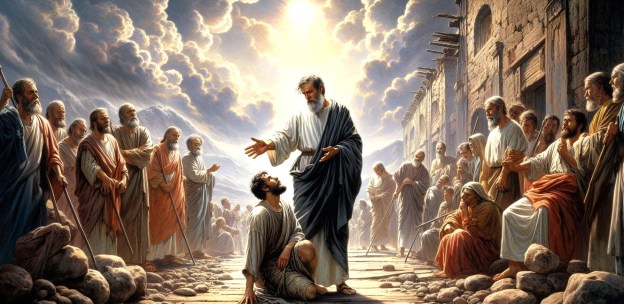
Acts 3:4-6 NIV

Then Peter said, “Look at us!” 

….what I do have I give you.
In the name of Jesus Christ of Nazareth, walk.

First. Peter said, “look at us.”  I thought we were to direct attention away from us and point to Christ? Why is Peter so focused on himself?

Second. Peter says “what “I,” have, “I,” give to you.” I thought it was, “what God has, He will sovereignly will or choose to give?” I thought it was God’s power, and God’s choice, not Peter’s power and Peter’s choice?

Peter said it was Peter’s power, “what I have,” and it was his choice, “I give.” Peter claims it was his power and his will. Why does Peter pray in a contradictory way as compared to the theologians? Who is right?

The Bible rejects pantheism. God is not what He creates; He absolutely and directly controls all things, but He is not what He controls. God gave his followers the power to heal the sick, and cast out demons. He did not give this power to Himself. Jesus commanded both the apostles and followers to heal the sick. Jesus commanded both is disciples and 77 others to “heal the sick and cast out demons.” Some stop at Matthew 10:7 when Jesus command them to “preach the kingdom of heaven.”  Jesus is commanding them, and us by extension, to preach the gospel. So far, so good. But Jesus continues by saying, “heal the sick, cast out demons, and raise the dead.” Jesus was not going to do this; He was commanding them to do it. If someone was going to get healed, it was up to their power and choice.  Thus to heal the sick and raise the dead is as much as a command as it is to preach the gospel. If it was not clear enough Jesus after His resurrection, commanded them to receive power, Acts 1:8. Most of them were not apostles, because it had nothing to do with the apostles, but Jesus sitting as the right hand of the Power.  Not only did they have the power, it was their will or choice to administer it. It was not up to God’s power and will to heal, it was their power and will.

This is how Jesus spoke on this topic and it was how Peter spoke on it. However if I spoke like Jesus and Peter in most American churches I would be labeled a heretic.

Yes, on the ultimate level the power is God’s, just as the power in my hand to type this essay is ultimately God’s power and by His direct control. However, Jesus and the Bible rarely mention this ultimate level; they mostly speak on the human level. I will do the same.  Thus, it was not God who typed this, but it was I, who typed with my power and choice. Likewise , the sick are not healed by God’s power and choice, but my power and my choice.  Anyone who has a problem with this rejects a doctrine directly taught by Jesus and the Holy Spirit. Cut such a person out of your life. They are servants of demons.

Peter sums this up by saying faith in Jesus name brought the healing. It was a person’s will to have faith that brought the healing, not God’s will. For more on this topic see, Vincent Cheung, “Healing, The Will Of Man.”

Also, Peter did not even pray, at least not in the traditional way. He simply commanded the healing. This is what Jesus told us to do. “You heal the sick.” It was the same with Moses and the Red Sea. God said, “You divide it.” Many do not pray by commanding and this is why their prayers go unanswered. This is why many have died before their time by sickness and troubles. Jesus commanded us to do the healing, not God.

Jesus’ faith doctrine is extreme. He does not instruct us to pray to God and tell Him about our mountain; rather, Jesus tells us to move the mountain by using faith and commanding it to move.  Jesus said, “it will obey you.”

This is not a suggestion. It is a command from our God. Because of this, when many pray they are in rebellion against God. Jesus commands us to move and heal. However, many respond back saying, “No, God, You do it, if You are willing.” By praying like this, they have ensured their sickness has already gained victory over them. On rare occasions God might still heal such a prayer, out of extreme pity, but it would be an exception. If you are sick and pray like a beggar, asking God to heal, you have already lost. You are a dead man walking. Sickness has already defeated you for the glory of Satan.

When some pray, they pray confessing unbelief rather than faith. If you are born-again then you are not a worm, not a beggar, not a nobody and you are not a sinner. James says the prayer of a righteous person is very effective; however, if your prayer is confessing how pathetic you are, then of course you will not pray knowing how righteous you are, and thus, your prayers will not be effective.  Prayer is a good confession of faith in God’s truths and promises; and yet, people often pray confessing who they were, before they were born-again. They say, “I am a worn and sinful and nothing, but God is everything and powerful.” This takes no faith; it is a coward’s way out. It is a religious maneuver to remove you from God’s command and responsibility. If you are nothing and sinful then you need to get born-again so that you become righteous and have privileges that come from being a son of God.

To illustrate this think about asking God for the forgiveness of sins, or a salvation type prayer. Although, there is nothing wrong for a salvation prayer to “ask God into your heart,” yet there are more precise ways to describe it.  Peter in his Pentecost sermon gives direction for a salvation prayer. He instructs the audience to ““Repent and be baptized, in the name of Jesus Christ.” Notice Peter did not instruct them to “ask” God to forgive them; rather, he tells them to repent in Jesus’ Name to be saved. Why? Because Jesus already died and was resurrected. The forgiveness already happened. We are not asking God to crucify His Son again to forgive us, because it already happened.  We are not asking God to do anything in the present tense to forgive us, because Jesus already accomplished it. Because it has been accomplished all we do is repent.  In this context we do not ask or beg. It is when a person has confidence in Jesus’ finished atonement, they repent of their sins in Jesus’ Name. Salvation in this sense is a confession, and not asking and begging. We confess our sins and that is all it takes. Faith in this sense, is about God letting you know He has already forgiven you, and by repenting you are agreeing with God.  It is foundationally about agreeing and confessing and not asking.

Other gospel benefits such as a healing, and the authority to cast out demons and cast down mountains is the same. They have been accomplished by Jesus’ finished atonement. We do not ask and beg for them, because they have been accomplished by Jesus and given to us. It is irrational to beg for something that already belongs to you.  It was the stripes on Jesus’ back that healed us. And so, it is irrational to ask God to heal us, as if He needs to break out the whip again and start slashing Jesus in the throne room. God accomplished our healing in Jesus’ atonement. Thus, we don’t beg for it, because it is already ours.  As with salvation, we repent as a confession of confidence in Jesus finished atonement, rather than beg and ask forgiveness. The same with healing. We confess and agree with God, rather than beg and ask. This is why Jesus tells us to “heal the sick, and cast out demons.” When we command healing and command demons to leave, we are giving a confident confession in the finished atonement of Jesus, which has given us the healing and authority to do such things.

Some people are asking God to do things that He told us to do. They have it flipped upside down. And yes, we see examples of Jesus in John 14-16 telling us to ask in His name. However, in my experience it is only those who already know their authority in Jesus, who already are healing the sick, who are able to ask God for things in prayer, without asking as if they are a beggar or outsider.  Those how can heal the sick and cast out demons are better equipped to march boldly to God’s throne of grace and confidently ask for things as a son who belongs there.

Christian Sex Ought To Be the Envy Of The World

A few quick thoughts on sex.

I have never heard a pastor preach a sermon on sex and how much sex we ought to have, without negating the scripture with their experience. Imagine me saying, “after you have worked through your emotional history and talked out your disappointments and after you have visited the doctor, then you are to obey God and repent of your sins.” Or imagine if I said, “after a person has warmed you up with nice words, then you are to love them as yourself.” Most would recognize the error of this. We are to obey God’s commands regardless of our feelings, history or any other excuse. The compassionate thing to do, is to tell someone to obey God regardless of anything else. We are promised if we obey, God will reward and bless us.

When you read “breaking of bread” it sometimes refers to the church taking the lord’s supper, such as Acts 2:42. When you take of the Lord’s supper you are remembering His substitutionary atonement for you. Jesus in John 17 refers to His sanctifying work results in Him and His people becoming “one,” and prays that we become one with Him and the Father. We are also told we are “one spirit” with Jesus in Corinthians 6. The context of this passage is about sex. We are warned not to be one flesh with someone not our spouse, because we are one spirit with Jesus. Sex is the act of being one flesh. It is the only way to be one flesh. Although this chapter is spoken of in the negative we can draw out some general presuppositions or doctrines.

The way the New Testament speaks of breaking of bread, as referring to communion, we understand they did it often, if not daily. By partaking of the Lord’s supper, it is a reminder we are one spirit with God. By faith, when we partake of the Lord’s supper, we do, or behave as one spirit with Him. However, beyond the Lord’s supper, every time we focus our faith on Jesus Christ, every time we praise Him in faith, every time we have our morning devotional, every time we pray in tongues, every time we approach God’s throne to ask and receive, we behave as one spirit with God. Faith in God is our acting like one spirit with God. A Christian who is faithful in His love to God, frequently behaves as one spirit with God.

If we consider the commandment of God to be one flesh, unlike the multitude ways to apply faith with God, there is only one way to be one flesh. This is sex. It is not mainly about having children, but the command is firstly and simply, to be one flesh in pleasure. Imagine only having faith in God one time a week? How about once a month? I would be hard pressed to say a person who only had one moment of faith in God a month, could still be called a Christian. A healthy disciple of Jesus is frequently placing their faith in God, and by this, they are constantly being one spirit with God.

The amount of sex is only determined by one thing, as it is for everything else regarding Christian ethics. It is determined by the command of God. The command is to be and act like one flesh. There is only one way to do one flesh. There is no excuse to make God’s commands not apply to you.

There is an entire book in the bible about sexual attraction and sex. Solomon is like the protagonist of a hero story. His heroic adventure is about sex with his wife. A husband’s sexual escapades with his wife is the bible’s hero story. Solomon gives a public call for us to gather in the public square to hear Solomon describe his sexual adventures with his wife. This book is to be our example as well. It is a command to follow the biblical examples. Also, if we consider that most fasts are only a day, or a few days, we realize the presupposition of scripture is frequent sex, because it says to come back quickly so that Satan does not tempt you (1 Corin. 7:5).

So far, we have mainly focused on the positive way to obey God’s command to be one flesh by sex; however, there is more. The scripture says that when you are married you give up the rights of your body and give those rights to your spouse. If one spouse wants sex, the other spouse has given up the rights to say no. You cannot say, “well, then I want my spouse’s body not to want sex.” If you play that game, then you have an infinite regress, and the verse has no meaning. If you cannot obey God, then it is better not to marry. The reason we repent of our sins and ask God to save us, is because God commands us (Acts 17:30). Christian behavior and ethics is determined by only one thing, which is God’s command.

In all this we never negate the situation where a spouse is sick and needs help. If one gives selfish demands in this situation, they are worse than an unbeliever. However, to be sick is a curse and an attack of Satan (Acts 10:38). One reason the devil attacks us with sickness, is that we are busied helping our family, rather than devoting our time to serve God and expand His kingdom. One strategy used in war is to injure soldiers rather than kill them, because healthy soldiers are taken away from fighting to help the wounded. Satan does the same in his fight against Christians with sickness, injuries, and cancers. We are commanded to be healed, just as much as we are commanded to praise God, James 5:15. James is not commanding that we pray, but is commanding we get healed. It is not optional to apply or reject the gospel, and healing is part of the gospel. Other things can be the gospel, such as forgiveness, however something cannot be more gospel than healing is. Because healing is the gospel and we are commanded to be healed, it is wrong to stay sick. It is wrong to allow Satan to steamroll over you with sickness and pains, and by this force others in prolonged care of you, when they could use their time in serving God. You are commanded to do the opposite. You are to storm the gates of hell and tear them down. You are to heal the sick, cast out demons, raise the dead, and set the prisoners free. Thus, staying sick or in pain is no excuse to not have sex. It is wrong not to constantly be one flesh for the act of pleasure.

If you read Song of Solomon you realize Christian sex and orgasms, ought to be the envy of the world.

You Said Something

There is nothing wrong in the statement, “I was once a sinner who was saved by grace.” However, if you stop there it is unbelief. The same gospel that saves is the same gospel that gives me a new identity in Jesus and baptizes me in the Spirit. Therefore, I am the righteousness of God. I am not affirming God is God’s righteousness, but that “I,” am God’s righteousness. God gave it to me and it is now mine. I am righteous like God is righteous. This is who I am.  This is important because the gospel is not mainly a negative belief. It is not mainly about past forgiveness. It is mainly a positive belief. I am righteous. I am empowered by the Spirit for miracles. I have authority to cast out demons and heal the sick. I am a child of God. I boldly march in God’s throne room and ask and then receive.

This is important for prayer. James says that the prayer of a righteous man is effective. If your focus is that “I am a sinner saved by grace,” then according to James, your prayers will not be effective. I am not a sinner. I am righteous. The focus is that I am present tense, righteous. The focus is not a negative belief of my past forgiveness, but a positive declaration of my present righteousness. It is to this type of Christian who will have effective prayers.

Jesus teaches on prayer in Mark 11:22-24, saying, “ Say to this mountain; and, whatever you ask, believe you have received it, and it will be yours.” The focus is not God’s goodness. The focus is not begging and crawling to God, waiting to see what God does. The focus is not God, but you. Jesus puts the focus on “believe you have received it,” when you said it.  As with James only a person who knows they are righteous in God’s sight, God’s child and has contractual rights, is able to put the focus on them and get answers to prayers. The focus is not problems. The focus is not telling God your problems, trying to prick His heart and see what He does. No.

Jesus did not instruct you to tell God about your mountain. Jesus commanded you to open your mouth and tell the mountain to move. The focus is on your mouth to say it, and your mind to believe it. Your mouth is Moses’ Staff of God. Stretch out your mouth and say something. Say it. What you want, say it. Jesus’ says the focus is not waiting to see what God does, but believe (past tense) you have received. The focus is not your problem or God. The focus is that someone so righteous as you, just spoke something in faith. The focus is that you opened your mouth. It is that simple.

This is Jesus’ teaching on prayer. Jesus is the extreme faith preacher.

The Bible Distinguishes The Elect From Reprobate Trash, By Praying In Tongues

Jude 1:18-21
“In the end time there will be scoffers…”
These…not having the Spirit.
But you, building yourselves up in your most holy faith, by praying in the Holy Spirit, keep yourselves in the love of God.”

Jude says mockers (and this is a continuation of his condemnation of false teachers) do not have the Spirit, which is referring to the baptism of the Spirit (Acts 1-2, Paul in 19:2 refers to “The Spirit” as the baptism of the Spirit and speaking in tongues (v.5)). Jude refers to those born again as “the called,(v.1).” In conversion the Spirit works on you to receive Jesus. In this sense you have Jesus, or you do not have Jesus. In baptism of the Spirit, Jesus works on you to receive the Spirit. In this sense you do have the Spirit, or do not have the Spirit.

In contrast to mockers, who do not have the baptism of the Spirit, Jude instructs the saints to pray in the Spirit, which is the baptism of the Spirit, which refers to praying in tongues. By praying in tongues, you keep yourself in God’s love. Think about that. Consider the consequence for not praying in tongues.

Paul says something similar in Ephesians 6:17-18. He says to “receive” the helmet of salvation and the sword of the Spirit by “praying in the Spirit.” Receiving the helmet of salvation and the sword of the Spirit are important. Paul says to do this by always praying, by praying in the Spirit. We know what Paul means by praying in the Spirit, because in 1 Corinthians 14 he defines “praying in the Spirit,” as “praying in tongues.” Thus, we continually receive the helmet of salvation and the offensive power of the Spirit, by praying in tongues.

Lastly, Paul says in Corinthians 14 that by praying in the Spirit we edify and encourage our inner man. This was one way Paul was able to encourage himself in context of all his hardships.

Paul therefore says I thank God I pray in tongues more than you all, to the Corinthians.

By praying in tongues, we keep ourselves in God’s love, strengthen our inner man, and keep receiving the helmet of salvation  and are continually empowered with the sword of the Spirit.

This does not mean a person cannot be saved without the baptism of the Spirit. However the same unstoppable God who causes an elect to receive Jesus for salvation will cause the same to have faith to receive the Spirit. Peter argues in Acts 2 that forgiveness is a stepping stone to receive the Spirit. To this Peter brings in the doctrine of election and predestination making the connection to the baptism of the Spirit. Some might think Peter’s connection is this: Those whom God calls to Himself are those born-again, however, this is not correct. Rather, Peter’s connection is, those whom God calls to Himself He gives them the baptism of the Spirit, with speaking in tongues. This isn’t how religious elites use predestination, but it is how the scripture uses the doctrine. And so God is faithful to call his elect to Himself, by causing them to receive the Spirit.

If a Christian has not received the Spirit, they do so by ignorance and unbelief. By unbelief and disobedience the Christian has pragmatically caused their Christian experience to be second class. The baptism of the Spirit enables one to fight with power to expand God’s kingdom. Praying in tongues causes one to continually receive the sword of the Spirit. To not have this while others are doing the hard work is spiritual negligence.

This is something mockers cannot do, and refuse to do. First of all, they are two busy mocking and making fun of the faith teachers, who are praying in tongues, to keep themselves in God’s love. Secondly, they hate the Spirit and so they refuse His gifts and powers.  False teachers and heresy hunters mock the very thing which the bible uses to distinguish the Called, from the reprobate.

I WAS Healed or I Will be Healed?

Abraham said, “I am the father of many nations,” and not “I will be the father of many nations.” Abraham’s confession was exactly what God promised and it was a contradiction to reality. Faith was stronger. He confessed he was already the father of nations before it was true. This is not a lie, because faith in God’s promise is both truthful and is a stronger power than reality.

Jesus’ exchange with the Sadducees, about the resurrection, showed Jesus pointing out a category fallacy with present tense and past tense. The scripture said God present tense, “I am the God of Abraham and Isaac,” even though they had died many years before. But the Sadducees’ presupposition was the passage was recorded in the different category of past tense, “I was the God of Abraham.” After this Jesus publicly shamed them and shut them up. This passage from Jesus shows us how important logic is; it shows us you cannot violate the laws of Contradiction and Identity and have category fallacies.

The importance of this is significant for faith. Faith is assenting to what God has said. You cannot assent to what God has said, if you change the tense of verbs, because then you change categories and thus change the meaning.

What if Abraham said, “I will be the father of many nations?” If he said it, then it would be a confession of unbelief in God’s promise not a faith confession.  Faith, as shown above, is only faith if it confesses what God said, it is not faith if it changes what God said.  Even such a small change, as a verb tense, Jesus shows that you are greatly mistaken about God’s word and power. One change to a verb tense and you have different doctrines. You cannot confess in faith, while being greatly mistaken about the word you are confessing.

Isaiah 53 says in the past tense that Jesus bore our sin, but also past tense bore our sickness and then present tense by His stripes we are healed.  There is no future tense. Regarding our sickness they have been and are healed.  Thus, Peter in his letter says, 1 Peter 2:24, that we were healed by His stripes.

This is why the faith teachers are correct when they teach you to confess, “By the stripes of Jesus I WAS, or I AM healed,” and not that I will be healed somewhere in the future.

Lastly consider Jesus’ teaching on faith itself.

“And Peter, remembering, said to Him, “Rabbi, look! The fig tree which You cursed has withered away.” So Jesus answered and said to them, “Have faith in God. For assuredly, I say to you, whoever says to this mountain, ‘Be removed and be cast into the sea,’ and does not doubt in his heart, but believes that those things he says will be done, he will have whatever he says. 

Therefore I say to you, whatever things you ask when you pray, believe that you receive them, and you will have them.” (Mark 11:21-24 NKJV)

Jesus teaches us that when we pray that we are to believe (past tense) that we have received what we asked for. He says if you believe that you (past tense) have received, then you will (future tense) receive them. As with the fig tree, they found it, the next day dried up from the roots. It took a day for the full 100-fold manifestation to appear. The presupposition for Jesus is that God’s promise to give us anything we ask for is a past or present tense application, and not future. Even if the answer appears to be delayed, the example of Daniel, shows us that it was answered the moment Daniel prayed, but was delayed by demonic attacks. Thus when you pray believe you have received what you ask for.

This does not mean we never say, “this will happen,” for in some context this would be appropriate, or that God never answers a prayer if the verb tense is wrong; however, we should always strive for perfection in our understanding of God’s promise and speaking it in the same. Faith is assenting to what God has promised, not category changes to it.

Think about Abraham and his confession of faith that he “is” the father of many nations before it happened. This is what faith does. The Israelites shouted and praised God for the defeat of Jericho, before the walls fell down. Faith gives a victory shout before it happens, because we know when we prayed it was answered.  Faith is the contradiction to what we see, but because faith gives us direct contact with God and His power, we know faith is stronger than reality. Because God is sovereignly faithful to fulfill His promise, we know when we ask, God has already given it to us.

Take Your Choke Points Off

“But Moses responded to the Lord, “There are 600,000 foot soldiers here with me, and yet you say, ‘I will give them meat for a whole month!’ Even if we butchered all our flocks and herds, would that satisfy them? Even if we caught all the fish in the sea, would that be enough?”

Then the Lord said to Moses, “Has my arm lost its power?””
 (Numbers 11:21-23 NLT)

God told Moses that He would feed the Israelites with meat (Quail) for a whole month. Oddly, Moses’ response was that such a thing was impossible even for God. This is the same Moses who performed miracle after miracle and divided the sea with the Staff of God. This is Moses who, as God said it, was a God to Pharaoh. And yet, Moses could not believe God for this miracle food.

I remember Bill Winston in a sermon saying, (as I paraphrase from memory), “God had reached, Moses’ choke point. Moses could believe God for some things, but He could not believe God for this. Take your choke points, off.”

He is correct. Even the heroes of faith still have some choke points where they limit the Holy One of Israel.  No one has perfect faith in this life, but it is our command from God to always live by faith and mature our faith to its greatest heights.  Miracle food in large proportions, for some reason, was a choke point for Moses. It seemed impossible even for God. God rebuked Moses and said, is My arm to short that I cannot do this, or in modern terms, is My power so pathetic to you that I can’t do this miracle? Moses did not doubt God’s willingness to help but His power, and God rebuked Moses for this.

We often combat this abusive doctrine called, “if it is God’s will,” and so we say “God is always willing to help because of His love and because He promise to always provide if we have faith.” However, we can have choke points of doubt regarding God’s power. We might wrongly assume it is about the topic of God’s willingness, when it is really about doubting His power. We all have our own dispositions and weaknesses and strengths. And so it will vary from person to person what might be a choke point of faith. And I will try to use and example that might be more common to all. All Christians have faced those sins that more easily trip them up (Hebrews 12).  What can happen in a besetting sin, is that the experience can distort the mind to doubt God’s “power” to sanctify us.

If a person is blessed to have been ministered healing at their conversion, then asking God for healing would naturally be less of a choke point for them. However, they might find asking God for miracle money, or transmuting material substance to be a choke point of doubt.  Thus, we must find where we choke up with doubt and attack as if it was a cancer on our heart.

I remember Billy in response to Jesus’ statement that “anything is possible for the person who believes,” saying, “James and John asked for seats next to Jesus, but were told those were already reserved by the Father. Therefore, we don’t know if our prayers will be answered because God answers them on the dictates of His own whims.”

We know that apart from extreme examples that are categorically impossible, or violate a command that there are no limits to what we can ask for. Even a fool knows not to ask, “God, I want you to make me immutable and infinite like you, or help me murder my neighbor.” The prayers we see answered in scripture include resurrection from the dead, the multiplication and transmutation of material substance, healing, prosperity, military victory, relationship help, and the list goes on and on. Also, because we understand the blessing of Abraham (which we have in Jesus), which includes prosperity, supernatural health and healing, military victories, fame, glory and excessive fruitfulness in all parts of life, we know that Jesus command to ask for anything and get anything, means what it means.

Billy’s response to prayer, is an example of a person who doesn’t merely have a choke point or two, but who chokes at the entire idea of God helping and blessing them. This is a reprobate mindset. Such a person views God as if God is an outsider. They view God as if they have no Covenant with Him. The idea of Jesus’ Contract in blood, is to remove any “case by case” situation. For more on this see Vincent Cheung, Our Contract, who helped me understand this better. An insider status with God means that we always know how God will relate to us. An outsider status means we do not know how God will relate to us, because it is decided on the whim of God’s choice on a case by case. For example a husband does not decide to love his wife on a day by day decision; no, the contract of marriage means you have made a promise, to remove the case by case, and will always love them. God as removed the case by case, and has promised that if we have faith we will receive what we ask for. This love is only promised to those who God is contracted with. Outsiders of this contract do not have this privilege.

This contract therefore is able to remove all choke points for those with insiders status with God. We already know from the example of the gentile woman, that even without a contract status, faith gives you access to what you ask for. God has a standing contract with faith. However, in our Contract with Jesus, God cuts up His only Son in a bloody mess, and says “I will do what I promise.” There is no room for doubting.  

Removing our choke points is essential if we want to fully obey biblical expansionism in our lives. If we want maturity in expanding our own lives in righteousness and power and visions and expanding the Kingdom of God, we must remove any points of doubts. And doubt here is the key word. Jesus said if you have faith as small as a mustered seed you will command a mountain to move and it will obey you. Any Christian who has lived a few years and has been working on renewing their minds has more than a mustered seed size faith. The reason they do not see answers is because of doubts that gets mixed in with their faith. It is not that they have no faith, but the doubts mixed in is stopping the manifestation. The ins and outs for that, is for another essay; however, remember as you are attacking and removing doubts do not forget that the main focus is always Jesus and His promises, not constant inward self-evaluation.  

We must not put any limits on who we are in Christ and what we can accomplish by faith. Choke points can happen in places such as our vision for our lives. A Christian by faith might finally be out of debt and able to afford a nice home for his family. They even saw some miracles in finances where God helped. They are coasting, and life is good. However, when they were 17 God gave them a dream for ministry and a business that reaches millions of people, and this is still a choke point for them. Some might be enjoying a big house and a family that loves God. But God’s word reminds them if they had enough money to buy 10 big houses, they could give that to godly ministries to help fund the gospel, and for them this financial amount could be a choke point. If we take our eyes off ourselves and think what we could do for the advancement of God’s kingdom, there is always more power, finances and miracles than what we are currently able to do. But God is full of grace. If you seek to believe with no fear, you will find it.

Lastly, if you want to take off the limits and choke points, then you will need to say something with your mouth. Jesus said you will “say,” to this mountain.  Look at the heroes of faith, like Abraham and David. They spoke a confession of confidence in the promise of God. We believe and so we speak. Do not just look at a choke point, speak to it. Say something. Speak the promises of God. Your faith confession is like Moses with the Staff of God. Your staff is your confession in God’s word. Say it. Tell it to get out of your way. Tell the sickness to leave.  

I will let Paul end this with his own exhortation: God answers our prayers exceedingly, abundantly and beyond all that we ask or think. This is how an insider to God thinks about the world and what is available to them in Christ.

The Staff of God

“So Moses took his wife and sons, put them on a donkey, and headed back to the land of Egypt. In his hand he carried
the staff of God.” (Exodus 4:20 NLT)

When Moses was worried that the Israelites would not listen to him, God told Moses to throw his staff on the ground. It turned into a snake, and when he picked it up by the tail, it turned back into the staff. Later in Exodus 4:20 the staff is called the “Staff of God.”

This is similar to the king of the Greek god’s. Zeus had his lightning bolt, which was his weapon of power: “the lightning bolt of Zeus.” He was jealous when a person’s eyes lingered too long on his symbol of power. He did not lend his lightning bolt out. Yet, with God, He freely gives Moses His weapon to use as his own. He even told Moses that he would be like God to Pharaoh.  Notice how generous our God is to His children. This is important because in Jesus Christ we have all been given the Staff of God. Moses longed for this to happen, when all the people were given power from God.

Fast forward to when Moses and the Israelites were backed up against the Red Sea and Pharaoh’s army was behind them. Moses then began a monolog.

 “Don’t be afraid. Just stand still and watch the Lord rescue you today. The Egyptians you see today will never be seen again.  The Lord himself will fight for you. Just stay calm.”

Then the Lord said to Moses, “Why are you crying out to me? Tell the people to get moving!  Pick up your staff and raise your hand over the sea. Divide the water so the Israelites can walk through the middle of the sea on dry ground,” (Exodus 14:13-16).

Moses was midstride in a monolog about God’s deliverance, when God spoke. Moses, was in essence trying to buy time for God to do something while they were backed up against the sea. Notice what God did not say. He did not say “I will divide the sea.” No, God said, “you, divide the sea.” Are we to accuse God for not being God centered, but I digress. This is like Jesus saying to the disciples, “You feed them.”

God interrupted Moses and said (as I put it into modern terms) “why are you whining at Me! Stop begging and get moving. What is that in your hand? Is it not the “Staff of God” I gave you? This is not My problem anymore. You take the Staff, and “you” divide the sea.”  

The mistake Moses made was thinking he was waiting on God to deliver them with a new download of power, when Moses already had the Staff of God.  He acted like he was nothing, and had nothing, and therefore, needed God to come down and give some present or future help. However, He already had God’s help. He already had God’s power grasped in his hand. God did not need to give Moses power to deliver them, because God already gave Moses His power.

It is good to have passages like this because it reminds us to “stop crying out” like a beggar to God, when God has already given us the power and authority to command the healing and mountain to move. God was not happy with Moses’ flattering speech, “The Lord himself will fight for you. Just stay calm.” Think about that. That is some good theology. Yet, however good his doctrine was, God found it irritating. Again, think about that. Verse 14 is often quoted for promise verses, but in context God did not like it.

Moses said, “God will fight for us.” And God responds by saying, “why are you whining.”

Imagine if I gave you my car and you kept calling me to give you a ride to work. I might find the first time funny, but after the 78th call I would be rather irritated. “Why are you calling me about giving you a ride to work? I gave you my car. You need to get in it, and you need to drive yourself to work. Getting you to work is not my problem anymore, it is now your responsibility to drive yourself.” After a while I would think such a person is missing a few screws and choose to remain silent at their insane requests. As I have heard Andrew Wommack saying in many sermons, “this is why God remains silent at many of your prayers.”

Jesus teaches us a similar lesson Moses learned. When God has already given us the power, we need to stop crying out and start healing the sick, casting the demons, multiplying material substance and making mountains obey us. Jesus says to the disciples, “you feed them,” regarding the feeding of the 5000. Even though Jesus had to multiply material substance to feed the crowd, He expected the disciples to do it. He would not expect them to do it, if they did not have the power and authority to do so. For example, Jesus was irritated when they could not cast out a demon. He said it was because of their unbelief. Earlier He has already given them authority over “all” sickness and demons, “all.” Jesus expects them to do these things because He gave them the ability to do it.

“You divide the Sea, You multiply material substance, You heal the sick, You make mountains obey you.”  This does not sound very God-centered, but it is said by Jesus who was the most God-centered man who ever lived.

Consider what Jesus did not say: “when you face a mountain, cry out to me like a beggar and ask Me if it is part of my will to move it.” No, Jesus said “you” tell it to get out of your way and it will obey “you.” This is not a mere suggestion. Jesus instructs us to command the thing to move. Jesus is not teaching us to ask “Him” to make it go away, but for “us” to speak in faith and make it go away. This is contrary to how many understand faith and prayer.

Jesus said, “you feed them.” Jesus did not say, “cry out to God to feed them.” No, just as He told Moses to divide the water, Jesus commands us to “feed them,” by making material substance multiply in miracle power. Jesus tells us to tell the mountain to move and make it “obey us,” not God. God would not have commanded Moses to divide the Sea, if Moses did not have the power and authority to do it. Obviously, God is the ultimate power for all of this, but the issue is that on the relative level, God has given His power to us. Jesus would not have commanded us to make mountains obey us, by speaking to it in faith, if we did not have the power and authority to do it.

Jesus commands this, because He has already given us His Spirit and authority to do them.  Jesus said that He cast out demons (and healing) by the Spirit of God, not by His own personal Jesus power. This is important because He has also poured on us the fullness of the Spirit, in the baptism of the Spirit. Jesus used the “power of the Spirit” to heal, cast out demons and do ministry. The reason He did it this way, was because He was a man born under the law. He became like one of us. He therefore, ministered as a man, empowered by the Spirit, to do miracle working ministry. He showed the elect how to do it. He has given us this same “power,” and commands us to follow in His same miracle ministry (John 14:12-13, Acts 1:8, 2:39-39). And so, Jesus told the disciples, and those with them, to wait until they were endowed with the same power of the Spirit.

In addition to this power of the Spirit, Jesus has given us the authority to use His name to ask and receive whatever we want (see John chapter 14-16). A shorthand way to use this power and authority is seen in passages like Matthew 21:21. It is praying with His power and authority without hedging. It is praying in absolute confidence in the power, position and authority Jesus has already given us.

We can us this authority for anything we want, because it is guaranteed to us in the Contract made in His blood. However, Jesus also makes demands on us based on this Contract. He commands us to expand His kingdom and tear down the gates of hell. It’s not optional. We expand His kingdom and tear down the gates of hell with the same power and authority He used, but now has bestowed on us through His finished atonement.

The big idea is simple. Every believer has already been given authority to use Jesus’ name, and the baptism of the Spirit is a purchased gift for any believer to receive by faith. God has given every believer the Staff of God, just like with Moses. These powers and gifts of authority is not earned, but given freely through Jesus Christ. They already belong to all Christians.  

Moses wanted to ask God to do something about the sea, but God told Moses to do something about the sea, with the power He had already given him. Jesus teaches us a similar lesson. We cry out for God to do something about feeding them, and God tells us to do something about feeding them.  We cry out to God to do something about healing them, but God tells us to do something about healing them. We are holding Zeus’ lightning bolt in our hands and yet we are still crying out to God to move the mountain, when all we need to do is speak in faith.

Imagine if every Israelite in Moses’ time also had a Staff of God in their hands? It would be like an army of 2 million powerful Gandalfs or wizards. The army of Pharaoh would have been obliviated before they took their 4th step. This is exactly the firepower the true church of God has today in Jesus. But for the most part they look like fools. There is an army of millions and millions of powerful wizards, with the Staff of God in their hands, but yet, they are bowed to the ground crying out to God to give them some power. And despite their good theology in their cries, God is irritated by it.  It’s utterly pathetic.  If they only knew what they had and how to use it, nothing could stand in their way in advancing the Kingdom of God.

This is what Satan truly fears. And he will produce any false doctrine and tradition to convince God’s people they are weak, sinful and endlessly cry out to God, while holding God’s Staff in their hands.

When you pray, believe that life giving waters are already flowing out of “your” belly. Jesus did not promise this would flow out of God’s belly, but yours. See yourself in the Spiritual realm like an empowered wizard in an anime movie. God’s Spirit has already empowered you. When you speak in faith, power is released, every single time. God and His word are one. Thus, when you speak faith filled words, you are releasing God; you are releasing, Power. When you pray, understand that Jesus has already given you the authority to ask and command what you want. When you pray, you are not begging and waiting for God to do something, because He already did something. It’s now your turn, to do something. He already gave you His power and authority. Use it.

Moses did not walk on dry land until he used the Staff of God. Likewise, you will not see the victory you are wanting, until you use God’s power and authority, by speaking and commanding what you want. You are the one holding back your blessing, not God. You are the one preventing the dividing of the Sea, until you use what God has already given you.

If you do not work, then you do not eat. Most, even unbelievers, understand this. Likewise, if you do not open your mouth and command what you want with faith, then you do not get your blessing. Open your mouth today, and start speaking faith filled words.

Applying God’s Sovereignty

“8 But the officer said, “Lord, I am not worthy to have you come into my home. Just say the word from where you are, and my servant will be healed. 9 I know this because I am under the authority of my superior officers, and I have authority over my soldiers. I only need to say, ‘Go,’ and they go, or ‘Come,’ and they come. And if I say to my slaves, ‘Do this,’ they do it.”

10 When Jesus heard this, he was amazed. Turning to those who were following him, he said, “I tell you the truth, I haven’t seen faith like this in all Israel,” (Matthew 8:8-10 NLT).

If a person claims to be an expert in mathematics, but only succeeds in applying math 2% of the time, would you accept their claim? It would be irrelevant to me if a person went to school and has the approval of other men saying he is an expert in math, if he cannot apply it correctly.

In our passage above the centurion is talking about the sovereignty of God by speaking of Jesus’ power and authority over reality. To cure someone of sickness we are dealing with reality. The centurion says the same way officers and servants obey him, is the same way reality obeys Jesus. The same way an officer goes and comes at his word, is the same way physical tissue and sickness reacts to Jesus’ words. The same way he has authority over people, he implies Jesus has the same authority over reality itself. Jesus reacts to this with astonishment. He praises the centurion for his great faith.

The issue is not if the centurion had a perfect understanding of who Jesus was. He concluded Jesus had authority over reality itself. He understood that reality obeyed Jesus. This is fantastic theology. It is a good understanding of God’s sovereignty. I am not saying it is complete. But as it is, it is a correct theology about God’s sovereignty.

How did the centurion apply this correct doctrine of God’s sovereignty? He applied it with faith to get a miracle. In fact, he was already getting a miracle. He applied God’s sovereignty to upgrade a miracle that was coming in the future to make the miracle happen immediately. Or in modern terms, Jesus promised him an iPhone, and after he applied an argument of faith based on God’s sovereignty, Jesus upgraded it to an iPhone max pro. Also, his argument of faith, based on God’s sovereignty, made time obey the centurion, the way his servants obey him.

Jesus approved the centurion’s understanding of God’s sovereignty and his application of it with faith to receive an upgraded miracle.

Thanks be to God we have examples for how to apply God’s sovereignty in faith for miracles. Therefore, those who claim to understand God’s sovereignty but do not apply it to receive miracles and healing, are liars and frauds. They have no idea what God’s sovereignty is. They have no idea what they are doing or talking about.

Peter

Peter’s application of election is the baptism of the Spirit.

Peter also believed and understood the doctrine of God’s absolute sovereignty. He spoke about predestination in the first apostolic sermon in Acts 2.

“Peter replied, “Each of you must repent of your sins and turn to God, and be baptized in the name of Jesus Christ for the forgiveness of your sins. THEN you will receive the gift of the Holy Spirit. 

For the promise is for you and for your children, and for all those who are far away, as many as the Lord our God calls to himself,”
(Acts 2:38-39. 38-NLT, 39-LEB).

The crowed said, “what do we do,” in response to seeing the baptism of the Spirit and Peter’s sermon describing why the Spirit is being poured out.  Peter’s response is about the predestination (and reprobation by implication) of God by saying, “as many as the Lord our God calls to Himself.” The interesting thing about his statement of predestination is that it is directly about the baptism of the Spirit and not directly about forgiveness of sins. Peter uses the forgiveness of sins as a stepping stone to get the promised baptism of the Spirit, purchased by Jesus and promised by the Father. Peter says to repent and be forgiven so that “then” you can receive the Holy Spirit of power. It is specifically about receiving this baptism of power that Peter says, “as many as God calls to Himself.” This includes forgiveness because Peter says you need to be forgiven and then you will be received this baptism of power.

And so Peter’s understanding of predestination and election is about the baptism of the Spirit with forgiveness being presupposed. If God has predestined you, then you will be baptized in the Spirit for power. Baptism of the Spirit is proof of your election and disproves you are a reprobate. This is how Peter applies God’s sovereignty. Peter says, “to those whom God has called TO HIMSELF.” If God has called you “to Himself,” then you will be baptized it the Spirit. How can you be called “to God” and you not be with God at the same time?

When God calls someone to Himself, He predestines them to be baptized in the Spirit. This is Peter’s doctrine of election in application.

It is a good thing the bible shows us how to apply the doctrine of God’s sovereignty. It shows us that election and predestination is applied for baptism of the Spirit and this confirms that God has sovereignly called us to be “with Him.”

Therefore, those who claim to understand predestination and do not apply it with the power of the Spirit are lairs and frauds. They say they understand God’s sovereignty, but they cannot apply it at the most basic level.

Jesus

We have seen a gentile and an apostle, but what about Jesus. How did Jesus apply the doctrine of God’s sovereignty?

“You did not choose me, but I chose you, and appointed you to go and bear fruit — fruit that will last. Then the Father will give you whatever you ask in my name” (John 15:16 NIV).

I will quote Vincent Cheung at large on this verse, because he says it so well and by this helped me understand the doctrine of predestination is for those who live by the Spirit and faith for miracles. It is from his essay, “Predestination and Miracles.”

“Jesus said to his disciples, “You did not choose me, but I chose you” (John 15:16). The Bible teaches a doctrine of election, or predestination. Before we became Christians, we were sinners, wicked to the core, so that in ourselves it was impossible for us to turn toward righteousness. It was impossible for us to choose any spiritual good. If we were to turn from evil to good, some other force outside of ourselves would have had to change us. When we accepted the gospel and decided to follow Christ, it was because God had first chosen us before the creation of the world. If you think that you indeed made a choice to follow Christ, you are correct, but your choice was an effect of God’s prior choice….

This is not the end of it. Predestination is for more than bare salvation, or to say it more correctly, salvation involves more than the mere forgiveness of sins and the promise of heaven. Salvation in Christ is a whole package of blessings and responsibilities. I do not mean that you need to achieve these blessings and responsibilities in order to attain salvation. No, I mean that when you receive salvation, these blessings and responsibilities also come with it. Thus it is not that you need to reach heaven in order to be saved, but that because you are saved by faith in Christ, you will reach heaven.

God has chosen us, and predestined us. Predestined for what? There was more to what Jesus said: “You did not choose me, but I chose you and appointed you to go and bear fruit — fruit that will last. Then the Father will give you whatever you ask in my name.” God predestined us to bear fruit. What is this fruit?

Even in the same verse, we can see that Jesus had in mind not only works of preaching and charity, because he said his followers would produce fruit and that “the Father will give you whatever you ask in my name.” Gospel life and ministry is characterized by answers to prayers. What kinds of prayers? Wait, this is weaker than the way Jesus said it. The doctrine of prayer in historic unbelief is that “God will answer your prayers if it is his will (regardless of what he promised). Or, you can say that he always answers your prayers — sometimes he says yes, sometimes no, sometimes maybe, sometimes later. Or, when you ask for egg, he will give you a scorpion, so that when you ask for spiritual growth, he will give you cancer to teach you a lesson.” Among us, we have never accepted this view of prayer. We recognize it as satanic deception. But Jesus did not even say, “God will answer your prayers” or “God will always answer your prayers.” He said, “God will give you whatever you ask.” This is how God wants us to think about our relationship with him. This is how he wants us to think about discipleship. This is how he wants us to think about faith and prayer. God will give me whatever I ask when I approach him in the name of Jesus. No hiding behind a thousand qualifications. No excuses for me or for him.

God will give me whatever I ask. I will have whatever I ask. What I ask, I get. And I am predestined for this. So I am chosen to get whatever I ask. I am predestined to get whatever I ask. It is my foreordained destiny to receive whatever I ask God in the name of Jesus. If you have never heard this, then you have never heard the Bible’s doctrine of predestination, you have never heard the Bible’s doctrine of prayer, you have never heard the Bible’s doctrine of the name of Jesus, and you have never heard the Bible’s doctrine of discipleship. Just several verses earlier, Jesus said, “If you remain in me and my words remain in you, ask whatever you wish, and it will be given you. This is to my Father’s glory, that you bear much fruit, showing yourselves to be my disciples” (15:7-8). Getting whatever we ask from God is intertwined throughout his discourse with the notions of bearing fruit, being his disciples, and loving one another. Thus getting whatever we ask from God is as pervasive as the gospel itself. It cannot be taken out and thrown away without tearing apart the entire gospel, and thus also our salvation. Here bearing fruit is almost the same thing as getting whatever we ask from God, and by getting what we ask from God, we show ourselves to be true disciples of Christ.”

James

James has something to say about God’s sovereignty and prayer.

“Now listen, you who say, “Today or tomorrow we will go to this or that city, spend a year there, carry on business and make money.”  Why, you do not even know what will happen tomorrow. What is your life? You are a mist that appears for a little while and then vanishes.  Instead, you ought to say, “If it is the Lord’s will, we will live and do this or that.”  As it is, you boast in your arrogant schemes. All such boasting is evil.  If anyone, then, knows the good they ought to do and doesn’t do it, it is sin for them,” (James 4:13-17 NIV)

James affirms God’s absolute sovereignty over all things. Considering his affirmation of God’s sovereignty what are his commands for us, when we are faced with circumstances like sickness? When tomorrow looks like sickness for us, when seen from our observations, what does James command us to do? Does he say, “you don’t know what will happen, so do not boast about being healed tomorrow, even if you asked God to heal you?” He obviously does not say this, and yet this is how many would abuse James’ teaching on God’s sovereignty.

James chapter 5 says, if you are sick ask for the elders to pray for you, and the prayer of faith will make that person get well. Verse 15 says, “And the prayer of faith will save the sick, and the Lord will raise him up. And if he has committed sins, he will be forgiven (NKJV).” The command from James is not commanding us to only pray, but is commanding the result of healing. This is like a commanding officer saying to his subordinate, “Call a restaurant and order us some sandwiches for lunch.” The commander is not merely asking you to call, but to get the result of sandwiches for lunch.  Why do I need to explain this to adults?

James’ application of God’s absolute sovereign control over each day, is to apply it to get results in our prayers; to get absolute certain results in prayer.  And yet, I have seen those who quote James to teach about God’s sovereignty only to deny healing when we pray or say it is at best a maybe. But this same James who understands God’s sovereignty and is writing by the Holy Spirit does not apply God’s sovereignty that way. His application of God’s sovereignty is that if we ask for healing in faith, we will certainly get healed as certain as we are forgiven if we ask for forgiveness by faith.  According to James, God’s sovereignty ensures the certainty of both forgiveness and healing by faith. To say, when we ask for healing in faith that it does not result in guarantee healing, would be to undermine God’s sovereignty that ensures forgiveness if we ask for it by faith. The same sovereignty ensures both promises are guaranteed.

James also says if you lack wisdom then ask in faith, without doubting, and God will give you wisdom. If you doubt, then don’t expect more wisdom. If you have no doubts, then expect to get it. Not a maybe, but God will give you wisdom. Thus, if I ask to wake up tomorrow with more wisdom, in faith, I will certainly wake up tomorrow with more wisdom. This means I know certain things will happen tomorrow. I know them by the power of faith. This is how James applies God’s sovereignty.

Those who quote James’ teaching on God’s sovereignty over tomorrow, might be inclined to remind us the example of God’s hidden sovereign providence in the story of Nehemiah. And yet, James being led by the Holy Spirit, does not remind us of Nehemiah, but of Elijah. He says “The earnest prayer of a righteous person has great power and produces wonderful results. Elijah was as human as we are, and yet when he prayed earnestly that no rain would fall, none fell for three and a half years,” (ver.16-17).

If we don’t know about tomorrow because of God’s sovereignty, then would not the hidden providence of God in Nehemiah be more appropriate? Apparently not. This is so, because such an understanding is a presupposed basic understanding for Christians. We know God is sovereign and as His children is always working behind the scenes to help, guide and bless us. This gives us joy and strength to always face the future in confidence.

James, who teaches that we do not know what will happen tomorrow, because of God’s sovereignty, skips Nehemiah and commands us to have faith like Elijah. He instructs us to make certain things happen tomorrow, like healing and turning the rain off or on like a faucet. By faith we know certain things will happen today and tomorrow. He is not saying we control every aspect of reality like God, and so there are many things about tomorrow we do not know; however, he also teaches us that with faith we make reality obey us today and tomorrow, and then by this know some things will certainly happen.  Even if we have perfect faith to ask for everything we want tomorrow, we would still be limited by time and everyday life when asking, and by this not be able to ask for an infinite number of things.

Paul is correct in saying that even time itself has been given to us (1 Corin. 3:22). Just as man was not made for the Sabbath, but the Sabbath for man, so to, time was made and given to man. With faith we make today and tomorrow yield to our prayers.

This is how the bible applies its own doctrine of God’s absolute control over reality and tomorrow. It instructs us to make the uncertain tomorrow be certainly known by faith. James shows us to make sickness, troubles, and lack of wisdom to bow to healing, wisdom and miracles by a prayer of faith. He does not remind us to remember Nehemiah, but to remember Elijah when we face troubles. Elijah was a mere human like us. He turned the rain off and on like a faucet. He turned reality off and on, the way I twist my shower nob. James tells us to be like Elijah when we pray.  

James says you don’t know what will happen because of God’s sovereignty, but then applies this by telling us to use faith to make reality obey us today and tomorrow. When we do this, we will know certain things will happen tomorrow.

Let us be like Jesus, Peter, James, and gentiles who apply God’s sovereignty to get results in prayer, healings, miracles and the power of the Spirit.

Anyone who affirms God’s absolute and direct sovereignty over all things, but does not apply it the way Jesus and the apostles do are frauds and liars. They would not know God’s sovereignty if it smacked them in the face. They are blind leading the blind. Never let such people be your teachers. Excommunication is the least they deserve.

We saw if you affirm God’s predestination, His election, His power to command reality is like a man ordering his servant and that His control is so complete we don’t know what will happen tomorrow, that its conclusion is more miracles, more healing, more baptism of the Spirit and more wisdom.

Let God’s sovereignty be a foundation for more and more healings and miracles.

To Win The Argument You Must Lose Your God

“You want what you don’t have, so you scheme and kill to get it. You are jealous of what others have, but you can’t get it, so you fight and wage war to take it away from them. Yet you don’t have what you want because you don’t ask God for it. 3 And even when you ask, you don’t get it because your motives are all wrong—you want only what will give you pleasure.

 You adulterers! Don’t you realize that friendship with the world makes you an enemy of God? I say it again: If you want to be a friend of the world, you make yourself an enemy of God.  Do you think the Scriptures have no meaning?” (James 4:2-5 NLT)

In context of me teaching about faith and prayer by quoting Vincent Cheung, I received an insane attack against this doctrine. Jesus was the most extreme faith teacher ever. He said if you ask for something, then you get it. Jesus said, You ask it, you get it. No word of faith preacher is more extreme than Jesus. He said this in many ways, over and over, as if He knew people would resist it. He said if you ask for a fish then you get a fish. If you ask for bread, then you get bread. If you ask for the baptism of the Spirit, then you get the baptism of the Spirit. This makes God a “good Father.” Jesus said in John 14 that if you have faith you will do miracles and even greater miracles. In chapter 15 Jesus said if you ask for anything God will give this to you and by this bring great glory to God, and then said the same thing in chapter 16, but then Jesus summed it up in a man-centered way saying, it will complete our joy. In places like Matthew 21:21 He said that with faith we can tell something like a mountain to physically relocate, or a tree, and it will “obey you.”

Billy responded by quoting James 4:3, “you ask wrongly with bad motives.” This means to Billy, we cannot always know if God will give us what we ask. To attack a so-called wrong “faith for anything” doctrine by quoting this verse is like trying to cure your headache by cutting off your head. To shoot your adversary with a nerf-gun, you end up shooting your face with a 50-caliber desert eagle. It doesn’t make any sense.  To attack the doctrine of Faith you must become God’s enemy. Even if you win the argument, you lose your soul. You can never attack the bible’s teaching on faith and miracles without destroying yourself in the process.

Two main points. The first deals with the context of breaking God’s law, or ethics. People have a nubilous idea for what “wrong motives” mean. It is not an icky feeling in your heart. It is law breaking. There is a command somewhere in the bible and you are violating it. You cannot trick God with His commands. You cannot love your neighbor by helping them cut their grass, when you are secretly doing this to plot their murder. You did not find a loophole and trick God. No, the act of cutting their grass is sin for you. In essence you are lying or bearing false witness about yourself. Also, to love your neighbor as yourself, you want people to mean you well in individual acts and long-term goals. We are commanded to never lie and always tell the truth. Jesus commanded us to not commit adultery with our bodies or with our minds. The point, is that wrong motives has to do with a specific law of God and you are breaking it.

Thus, it is irrational to say we do not know if God will answer our prayers because “our motives could be wrong.” Because bad motives deal with specific acts of disobeying God’s commands, you can precisely and intellectually know if you are praying in good or bad motives. So, unless you are just born-again, you know God’s commands and so you know if you are obeying them or disregarding them. By this you can easily pray with good motives and know for certain your prayer is answered. Thus, for the Christian who knows God’s commands, this verse is a non-issue. It does not logically apply to them.

 To say this verse applies to you, then you would need to admit that despite being a Christian for many years and reading God’s word for many years you have no idea what God has commanded and so you have no idea if you are praying for wrong things. Such a person has no business critiquing others about the doctrines of faith and miracles when they do not even know what God has commanded. I could care less what they say. And you should not care either. They should remove the redwood tree sticking out of their eye, before trying to remove a small speck from someone else’s.

But the context of James words makes this much, much worse. James mentions 2 things in particular: murder and adultery. Thus, when praying for wrong things he specifically means praying for God to help you kill your co-worker to steal their money and help you have sex with your neighbor’s wife. A person might not say it so directly, but this is what James mentions by name in this passage.

Obviously, if you ask God to help you sleep with your neighbor, then you are asking God to help you break a command of God. Thus, God will not answer your prayer. This is not a mystery or rocket science. There is a motive to break one of God’s commands, and then you ask God to help you with this evil.  Sometimes it is hidden under another request. “God, give me a million dollars,” but in your heart you plan to use it on prostitutes. Or, “God, heal this girl,” but in your heart you want to win her over, so you can have sex with her. Even though you do not verbalize the law-breaking in the prayer, because it is your true intention, then they are a logical complete unit (like a Modus Ponens). It is a package deal, and so the whole thing is considered as a request to disobey God’s command. Thus a bad motive is simply the non-verbalized request to disobey the command of God, that you conveniently leave out of the prayer. If you are bold you say it out loud.  

The second main point deals with James’ conclusion for this. He says you are either God’s friend or enemy. If you are saved, then you are God’s friend. You cannot both be reconciled to God and His dreaded enemy at the same time. Thus, for James to say you are God’s enemy is saying you are not saved. He says that people who pray like this are friends with the world, but in trade they are God’s enemy. That is, James is not talking self-examination to see if you are a weak Christian versus a mature Christian. No. He is saying examine yourself to see if God is your friend or enemy, to see if you are saved or a reprobate.

This is not the unforgivable sin. All sins and blasphemy, other than blasphemy against the Spirit, is forgivable. In moments of passion, we can say things under our breath that we are ashamed of.  If you have committed this sin, it does not automatically make you a reprobate enemy of God. In a moment of insanity and burning passion it is possible for a Christian to cry out and ask God to let them sleep with person x, because they can’t take the pressure anymore. However, they can realize the horror of this, repent and not do that again. Let us say in their fight for sanctification they say it a few more times, but then they mature and get victory over their emotions. However, if a person does not repent and keeps this type of prayer going in a frequent way, then James is very clear. God is their enemy. They are not saved. They are a reprobate headed to hell. They have declared war on God. The specific details on answers to prayer is the least of their worries.

If you are asking for God to help you break the commands that He has given you, then you are God’s enemy. You are not His friend. This is James’ conclusion for people who pray like this.

I bring this up to show the insanity to use this against Jesus’ teaching, when He says we always get a fish for a fish. If out of 1000 prayers for healing, you said one that had a bad motive (I want this girl healed, so that I can win her over and maybe have sex with her), then the percent is so small it is not worth mentioning as an attack against, “we always get healing when asking for healing.” This is despite the fact we know God would not answer such a prayer, because it breaks a command. However, if your evil motives in prayer were so frequent that the percentage was enough to be a rebuttal against, “we always get healing when asking for healing,” then according to James you are God’s enemy and a reprobate. In order to attack faith and God’s promise you must become God’s enemy. To when the argument you must lose your God and your soul in the process.

The word of God’s enemy and a reprobate means nothing to me. Why would I and anyone care? Seriously, I would respect the word of an orange over an enemy of God.

We are done with the two main points for Billy’s comments; however, I want to quickly deal with good motives. Good motives are plans and requests to obey God’s commandments.

Jesus has already bore our sickness on the cross and by His stripes we were healed. Jesus healed all who came to Him. He did this to bless you and give you joy. To apply the gospel in your life, which is healing, is obedience. Thus, praying for healing is always a good motive. Not applying the gospel in your life is disobedience. Thus not praying for healing is always a bad motive. Jesus says if you have seen Him, then you have seen the Father.  In fact, James in chapter 5 says if you are sick then you must have the church pray so that you can get healed. The prayer of faith will make the sick person get well. This is not a suggestion. It is a command. The command is not merely to pray, but to pray and get the result of healing. Thus, to ask for healing to obey God’s command to get healed is by definition a good motive, and it cannot by definition be bad.

How about money? Jesus says to seek His kingdom first and the “things the pagans seek after,” will be given to you. Have you seriously stopped and thought about what Jesus is saying here? The pagans seek big material blessings and prosperity. This is pagan-level-money-seeking. Jesus says, if you seek after righteousness and His kingdom, then these things will be given to you. He is saying if you want big money, then seek my Kingdom first, and then big money will be given to you. Think about the order of motivation He is laying out here. If your goal is pagan-level-seeking-money, then use the pursuit of seeking righteousness to get it. To ask God to help you seek His kingdom and righteousness, so that you can acquire the level of wealth the pagans want, is by definition a good motive, because it obeys Jesus’ command.  

Some might call this “bad motives,” but they cannot do this without slapping Jesus in the face, because He said it, and He commanded it.  There is much more to say about this, but this is enough to show what some define as bad motives is wrong.

vitaliy-shevchenko-Dkyj3MUV3do-unsplash

The Demon Doctrine

“… some will turn away from the true faith; they will follow deceptive spirits and [doctrines of demons]. 
These people are hypocrites and liars, and their consciences are dead.  
They will say it is wrong to be married and wrong to eat certain foods. But God created those foods to be eaten with thanks by faithful people who know the truth. Since everything God created is good..”
(1 Timothy 4:1-4 NLT)

It is interesting that Paul uses such harsh rebukes on a category that many would reserve charity and patience in their arguments. Paul considers this a category of demon doctrines, but many are kind and gentle with such people. Thus, they are kind and gentle with people controlled by demons, teach doctrines from demons and who has no more conscience left. We have never thought such a stance is biblical or intelligent. We agree with Paul those who teach such are to be rebuked sharply.

 Most would understand if Paul said a person who rejects the resurrection or embrace wife swapping has a dead conscience and teaches a “doctrine of demons.”  People tend to think such harsh rebukes are for those who deny major gospel doctrines, or who affirm we should embrace bigger type sins.

However, this is not what the bible teaches. These are not the rules Paul is following in his instruction to Timothy. The category Paul is using is about receiving material good things for this present life. Things that involve giving us pleasure to sight, taste, touch, and smell. Paul mentions doctrines as in plural. However, Paul does not give a comprehensive list, but does mention two things in the category of God giving good material things. The doctrine of demons is about telling people to abstain from good material blessings. Thus there more things that can be classified as a doctrine of demons, but not less than the specific category he addresses.

As just said, the category is about God giving us material things for this life that involve things giving pleasure to our 5 senses. Paul did not say God is giving us spiritual things like eternal life, forgiveness and relationship. We assume the food is good tasting food, otherwise it makes no sense. There is no temptation to say, “don’t eat rotten eggs.” Good food gives pleasure to many sensations and by this brightens the heart of man, as Ecclesiastes says in more than a few ways. Paul mentions if you lack self-control for sex, then get married. Sex is obviously about pleasure. Having a good relationship with your spouse and children is a full on joy to all your sensations and soul. The point is that the category Paul is referring to, has much to do with the material blessings of pleasure, joy and sensations.

When it comes to our relationship with God, it is not a religion of shadows, based on man’s sensations; rather, it is spiritual and intellectual. However, we are not talking about this, but God’s own good pleasure to give us good material pleasure and material things in this life. I will not harp on the fact these material blessings are included in the blessing of Abraham and secured for us by Jesus’ blood. Thus, health, wealth, good sex in marriage, good tasting food have Jesus’ precious blood sprinkled on them. To dismiss them is to dismiss the blood of Jesus.

Some might make the mistake to make this passage all about works verses grace. Or make it about a warning against Gnosticism. These could very well be involved; however, we would have to speculate since the passage does not directly state it; rather, what Paul refers to is more basic and rudimentary.  The issue Paul brings is about the very nature of demons. This is like the difference between appealing to a specific promise of God versus appealing to God’s loving nature, to argue why we should pray and receive. Paul is appealing to the nature of demons. Paul does not give a specific appeal to people being led away by Gnosticism or “works vs grace.” No. The appeal is to demons. Now, demons might use specific errors, like the above, but this is not Paul’s main point. Paul says these people are lead by demons and teach doctrines of demons.

It is about the vile nature of demons. They want to you to suffer. The “nature of Satan” is to steal, kill, lie and destroy. Demons not only want you to suffer the torments of hell, but they want you to suffer in this present life. Acts 10:38 informs us that sickness is a major aspect for how demons what us to suffer in this life. Being sick destroys our ability to experience physical sensations of pleasure; it steals time; it steals our relationships; it steals our money and ultimately our very lives

 Jesus says His nature is to bring us life, joy and abundance. In John 14-16 Jesus says similar things a few times over. One is that the same love that God put on Jesus is now placed on us. In the context of how much Jesus loves us (His nature) He says for us to ask for anything and receive it, and by this our “joy” will be full.  Jesus healed over and over. He gave good tasting wine to a group of people who already empty the wine vats. It is obvious the miracles we ask often deal with the material world, and thus by them increase our pleasure in physical sensations in this present life. Jesus says He wants our joy to be full. In the gospels we know that being full of joy is more than just having our sins forgiven, but being healed of our sickness, raised from the dead, delivered from demons, delivered from storms, having extra good wine for a feast and having so much extra bread you have 12 large baskets left over. This is the nature of Jesus, and Jesus says if you have seen Him, then you have seen the Father.

The nature of demons is to make us suffer. Sometimes this is deceptive because it might be hidden under a layer of something that looks good at first look. Sin can be deceptive at times. It promises a pleasure, but in the end it leads to suffering and then death. The point is that the goal was always to cause us to suffer. This is the nature of demons. They want us to suffer now, and suffer later.

Therefore, a doctrine of demons is a doctrine that limits any good thing God has given us, either for this present life, or the next. The demon doctrine is to remove and restrict these material pleasures and eternal blessings and replace them with suffering, limitations and pain. Those who have teachings that limit or deny God’s health, wealth, favor, increase, miracles and heavenly powers, have aligned themselves with demons. They are liars and their souls are dead.

If a person’s soul is dead, are led by demons and teach doctrines from demons by merely suggesting we limit some pleasurable sensations for our bodies that come from food and sex, then how much more is it a doctrine of demons to deny and resist healing, miracles and the powers of the Spirit, which empower us to experience these good things 100 times more? How much more! And we haven’t even mentioned the horror of denying things like the resurrection.

If the people Paul mentioned were rebuked so harshly, then how much more should things like cessationism be rebuked. If they were led by demons, then cessationism is the very language of demons. If their doctrines were demonic, then cessationism is the very DNA of demons.

——–

Also, as a side note. Let no one rebuke you for harshly condemning people who limit faith and healing. They deserve the title of “demon doctrines” more than the people Paul was referring to. How can you say you are God’s friend and still hold the hands of people connected to demons? Harsh rebukes is the very least they deserve.