Tag Archives: Eschatology

The Vileness Of Cross-Centered Theology

Oshea Davis

You know, it’s almost comical how some folks wear “cross-centered” like a badge of spiritual humility, as if staring endlessly at Calvary’s bloodied hill makes them the real deal—authentic, raw, untouched by the glitz of glory. But flip through the New Testament, and you’ll see the apostles weren’t playing that game. No, they were throne-centered to the core, laser-focused on Jesus exalted, enthroned at the Father’s right hand, wielding authority that crushes enemies and empowers His people. And if there’s one Old Testament verse that screams this truth louder than any other, it’s Psalm 110:1: “The Lord says to my Lord: ‘Sit at my right hand until I make your enemies a footstool for your feet.'” This isn’t some obscure poetic flourish—it’s the heavyweight champion of OT quotes in the NT, referenced or alluded to over two dozen times. That’s more than any other verse from the Hebrew Scriptures, a fact that ought to make us pause and ask why the inspired writers couldn’t get enough of it.

Consider the sheer volume: Jesus Himself quotes it in Matthew 22:44, Mark 12:36, and Luke 20:42-43 to stump the Pharisees on the Messiah’s identity. Peter blasts it out in his Pentecost sermon (Acts 2:34-35), tying Jesus’ resurrection directly to this enthronement, and the present reality of the baptism of the Spirit for power. Paul echoes it in 1 Corinthians 15:25 and Ephesians 1:20, emphasizing Christ’s dominion over all powers. And Hebrews? That book’s practically a love letter to Psalm 110, quoting verse 1 in 1:13 and weaving its themes throughout chapters 1, 5, 7, 8, and 10 to hammer home Jesus as the eternal Priest-King. Allusions pop up everywhere else—Romans 8:34, Colossians 3:1, Hebrews 12:2—painting a picture not of a perpetually suffering Savior but of a victorious Lord reigning now, subduing foes under His feet. If the NT writers were scripting a highlight reel, they’d skip the slow-motion cross scenes and cut straight to the throne room coronation. Why? Because that’s where the action is—the present reality that defines everything from salvation to spiritual warfare.

The most quoted verse is not Isaiah 53, concerning of the suffering servant. No. The most quoted passage is about the enthroned Jesus, ruling, empowering the saints with the Spirit’s baptism and enemies being subdued under Him. This was the greatest focus of the NT writers, and it will also be ours.

This throne obsession flips the script on what it means to be gospel-centered. Too many today think humility demands a perpetual gaze at the cross, as if fixating on our sins and Jesus’ suffering keeps us grounded, preventing some imagined drift into arrogance. But that’s a subtle trap, isn’t it? It turns the gospel into a somber memorial service rather than a triumphant declaration of regime change. The cross was the battle won, the atonement secured, but the throne is the victory applied—the ongoing rule where Jesus pours out the Spirit, answers prayers, and expands His kingdom through us.

To be truly Christ-centered is to lock eyes on the exalted Christ, the one Hebrews 1:3 describes as “sustaining all things by his powerful word” after purifying us from sins. Sure, we remember the cross—Jesus commanded it in the Lord’s Supper—but that very command assumes we’re not stuck there. Why tell someone to “remember” something if they’re already obsessing over it? No, the presupposition is that our default posture is throne-focused, living in the reality of His reign, occasionally glancing back to marvel at the love that got us here. It’s like a king reminding his heirs of the war that won the crown; they don’t relive the battlefield daily—they rule from the palace, grateful, but forward-focused.

Take Peter’s Pentecost powerhouse in Acts 2. He doesn’t linger on the crucifixion details, though they’re fresh wounds. Instead, he rockets to the throne: “God has raised this Jesus to life, and we are all witnesses of it. Exalted to the right hand of God, he has received from the Father the promised Holy Spirit and has poured out what you now see and hear” (Acts 2:32-33). Boom—resurrection leads straight to enthronement, which unleashes the Spirit’s power. No wonder the crowd’s cut to the heart; they’re not just hearing about forgiveness but about a King who’s actively dismantling Satan’s hold, starting with tongues of fire and miracles galore. If Peter were cross-centered in the modern sense, he’d have camped out on guilt and repentance alone. But he’s throne-centered, so the application is power—baptism in the Spirit for all whom the Lord calls, no expiration date.

This echoes what I’ve written before about the disciplined son in the Father’s house: even in correction, we’re not exiled beggars but insiders sitting inside the Father’s palace, waiting in our room while the Father prepares greater things. Discipline stings, but the throne room door stays open, grace flowing unhindered.

Hebrews takes this even further, using Psalm 110 to redefine our entire approach to God. In chapter 1, it quotes verse 1 to prove Jesus’ superiority over angels: “To which of the angels did God ever say, ‘Sit at my right hand until I make your enemies a footstool for your feet’?” (Hebrews 1:13). The point? Jesus isn’t just a messenger—He’s the enthroned Son, heir of all things. By chapter 10, this throne reality empowers us to “draw near to God with a sincere heart and with the full assurance that faith brings” (10:22), holding unswervingly to hope because He’s faithful. No cowering in false humility; we’re commanded to storm the throne boldly for mercy and help (4:16).

Frankly, this throne-centered vibe exposes the poverty of cross-centered theology. It’s like celebrating a wedding by fixating on the proposal—sweet, but missing the marriage feast. Jesus’ command to remember His body and blood during communion presupposes we’re feasting in the kingdom now, not starving in perpetual Lent. If we’re already cross-fixated, why the reminder? No, it’s because our eyes are meant for the horizon, the exalted King who intercedes for us (Romans 8:34), making our prayers as potent as His. Paul in Ephesians 1:19-23 prays we’d grasp the “incomparably great power for us who believe”—the same power that raised Christ to the throne, putting everything under His feet for the church’s benefit. That’s not humble pie; that’s dominion delegated, enemies footstooled.

Take that tired trope: “For every look at your sin, take ten looks at the cross.” Sounds pious, right? But it’s a faith-killer in disguise, pumping unbelief like steroids. Sure, recall the atonement—it’s foundational—but fixating there keeps you sin-conscious, not righteousness-aware. Hebrews 10:2 slams perpetual guilt: once purged, no more sin-consciousness. Instead, 1 John 3:2-3 ties purification to throne-vision: “We know that when He appears, we shall be like Him… Everyone who has this hope in Him purifies himself, just as He is pure.” See yourself already enthroned with Christ (Ephesians 2:6), not perpetually crucified. That’s what scrubs the soul clean—not rubbernecking at a roman torture rack. Cross-gazers barely believe they’re forgiven, let alone righteous. They see a bloody mess, not a crowned King. But throne-gazers? They behold the Victor at the Father’s right hand, mirroring His purity by faith. No wonder they strut boldly for help (Hebrews 4:16)—they know their spot’s secure.

Romans 4 seals it: justification isn’t just cross-won; it’s resurrection-sealed. “He was delivered over to death for our sins and was raised to life for our justification” (Romans 4:25). The cross paid the debt, but the throne declares us as the very righteousness of God. Without resurrection to the right hand, no vindication of righteousness—no proof the atonement stuck. Abraham’s faith credited righteousness pre-cross (Romans 4:3), but Jesus’ rising to the throne, enthrones it for us. Cross-only folks limp with half a gospel, doubting they truly are the very righteousness of God. Their constant reminder of the sins makes it hard to believe themselves as God’s righteousness. They see nails, not the empty tomb’s triumph. But resurrection-gazers? They know: if Christ reigns, we’re co-heirs—righteous, pure, empowered, dominated by grace and unstoppable. Unbelief keeps the faithless cross-bound; but faith catapults Christians throne-ward, purified as He is.

The gospel is total salvation, making us clean, righteous, co-heirs with Christ, empowered to judge the world and angels. All things are ours because Jesus defines reality from the throne. To downplay this is to peddle unbelief, staining hands with the blood of those who could’ve thrived but settled for scraps. But for us? We’re sons in the Father’s house, rooms prepared. Even in besetting struggles, we draw from Christ’s continuing growth in us, eyes fixed on the Champion who authors faith from His seat of power. Our eyes are not fixed on Jesus on the cross, but as Hebrews says, on the Jesus the author of or faith, who is sitting on the throne. Anything less? Well, that’s just spiritual slumming when you’ve got palace keys.

So, if Psalm 110:1 reigns supreme in NT citations, it’s because the apostles got it: the gospel’s climax isn’t the empty tomb—it’s the occupied throne. Cross-centered? That’s the doorway for newbies to enter. Throne-centered? That’s full armor, advancing the kingdom with miracles, healings, and unshakeable faith. Remember the atonement, yes—but live with your eye locked on the present ruling Jesus, where He lives, and pours out power, and answered prayers. To focus on a cross is to focus where Jesus is not. To focus on the throne, is to meet the very eyes of Jesus looking back at you. Maybe that’s why the faithless remain cross-focus, because they can’t bear the living Jesus locking eyes with them, less their unbelief gets exposed. But for us who are the righteousness of God, we love to lock eyes with Jesus.  And when you see His eyes turn to lock back on you, you will hear Him say, “Ask anything in my name and you will have it.”

Welcome to the gospel. The real one. Not the one with a cross as the symbol.
But the one with a crown

This Is Where Our Eyes Meet


Jesus said to him, “You have said it. But I tell you, from now on you will see the Son of Man sitting at the right hand of the Power and coming on the clouds of heaven.”
(Matt. 26:64 LEB)

And Stephen said, “Behold, I see the heavens opened and the Son of Man standing at the right hand of God!”
(Acts 7:56 LEB)

I remember seeing a Korean manhwa (anime cartoon) called Noblesse. The Noblesse was a loner character who kept bad vampires in check, by destroying them. In the first main showdown the Noblesse would not look at the villain in the eye, when they were face to face. This infuriated the villain. The Noblesse, then used his power to force the bad guy into a kneeling position. Now, when their eyes met, from the position of the villain looking up and the Noblesse looking down, he said, “this is where our eyes meet.”

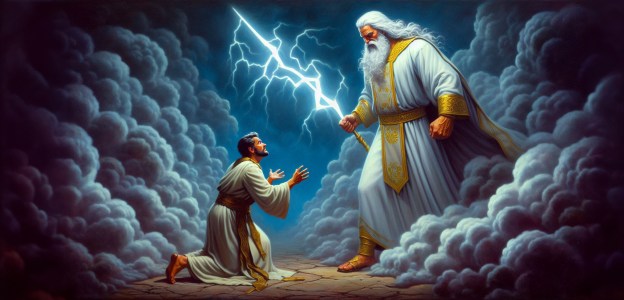
The Noblesse, makes the villain look up to him in defeat, mirroring how Jesus will flip the script on His adversaries. When Jesus talks about coming on the clouds, He’s not planning a peaceful parade; He’s promising a divine showdown. Think less “slice-of-life” genres and more “apocalypse horror.”

This is like what is happening in the above passages. The high priest in a position of authority, forces Jesus to answer the question if He is the messiah. Jesus answers by confirming that He is the messiah. Jesus follows this up with a threat. He says, from now on, you will see Me at the right hand of the power, and coming in the clouds of glory. This is both a statement of reality and a threat. Right now, in the position of a man born under the law, and under the authority of the high priest He is forced to answer his question. But Jesus says, from now on forward, the roles will be flipped. I will be in the position of authority, looking down on you. Jesus has a mic-drop moment with the high priest, essentially saying, “You’re the boss now, but wait till you see Me in My final form!” He’s not just the humble carpenter; He’s hinting at His gig as the cosmic judge, riding on clouds like a divine superhero.

The Old Testament quote of “coming on the clouds of glory,” is about God’s judgments. It is apocalyptic language that describes God destroying His enemies. (see Deut. 33:26, Isaiah 19:1, Isaiah 34:4-6, Isaiah 13:5–10 Daniel 7:13-14) It is symbolic language describing real acts of God’s horrific judgments. It is not symbolic language to describe invisible spiritual or more symbolic things, but historic acts of God’s judgement. The first mention of this apocalyptic language is the Exodus story and God’s destruction of Egypt. God did not literally ride the clouds, like a Sky Rider, but God did bring in darkness, sickness, storms, frogs and a real angel came and killed all the first born of Egypt.  Jesus in Matthew 24 quotes Isaiah 13, 34, and Daniel 7 as a packaged deal that belongs to Him. He rides the clouds. He will bring judgement. He will be the one bringing the plagues of Egypt on His enemies.

Thus, when Jesus says that not only, will His and the high priest’s positions change, but also defines Himself with the Old Testament apocalyptic language, it is a full on threat.  Jesus is saying, I will be in authority, the next time our eyes meet, but I am also judgment.  He is saying, My authority will not be used for your salvation, but destruction. From now on, when our eyes meet, you will be kneeling looking up, and I will be looking down on you, with a sword in My hand. This is where our eyes will meet.

This will help us understand why Stephen was asking Jesus not to hold their murder of him, against them. Stephen, right before becoming the first Christian martyr, has a vision. He sees Jesus not as the guy who walked on water, but as the celestial commander in chief, standing (not even sitting!) at God’s right hand. It’s like Jesus went from indie band lead, at the corner café, to the headliner at the universe’s biggest rock concert. Stephen saw Jesus in all authority and power, at the right hand of the Power. Jesus is not the humbled man that we all read about in the gospel. He is now in all authority and power. From His position of power He works in the saints to advance the Kingdom of God on earth. He is in a position of military power. He is a ruling king who is currently in a military campaign. He is the King who rides the skies to bring destruction on His enemies. This is His current status.

Thus, when Jesus is looking down on the murder of Stephen, He is a King, in a current military campaign, watching His enemies killing His soldier. Any normal King would bring down fast destruction. In 70 AD, in the destruction of Jerusalem, King Jesus did just that. This is why Stephen is crying out for Jesus to hold back, because Jesus’ position is the current Sky Rider.  Stephen knows Jesus’ position and so is asking for more time for the church to try and bring the Jews to repentance and faith. He’s basically asking Jesus, “Hold off on the divine wrath, okay? Give us a bit more time to win some souls.” He knows Jesus isn’t just chilling up there; He’s actively directing the celestial troops.

Jesus was correct. The next time His enemies saw His eyes, they were kneeling in terror, and He was Riding across the Sky in the destruction of Jerusalem.

Let us not forget that this is the same Jesus we pray to everyday. It is this same Jesus, who is still sitting at the right hand of Power. He is still in a military campaign to advance the kingdom of God, through the church by preaching, baptism of the Spirit, healing, casting out demons and resurrecting the dead. Sometimes it is good to repeat Stephen’s prayer for more time, and other times it is good to ask king Jesus to mount up and ride the skies

Jesus isn’t just the gentle shepherd; He’s also the king with a sword, ready to ride the clouds into battle. So next time you pray, remember, you’re talking to the Cloud-Rider, the Sky King, and He is ready to bring the thunder! He is so ready, that Stephen pleaded with Him to hold back.

[1] Used Grok AI 2024, to help me with some of the witty summaries.

Eschatology In A Nutshell

If someone sums up eschatology without baptism of the Spirit for power, they have no idea what they are talking about.

Acts 1:6-8 NIV. “ Then they gathered around him and asked him, “Lord, are you at this time going to restore the kingdom to Israel?” But you will receive power when the Holy Spirit comes on you; and you will be my witnesses… to the ends of the earth.”

The context is about eschatology. Jesus has sat down on his eternal throne and is ruling. The disciples did what most do, they made eschatology about politics. However, Jesus rebukes them and says eschatology is about being baptized in the Spirit for power and miracles.

The important part to note is that in eschatology the followers made it political and Jesus made it about miracles and the Spirit for power. By making it about politics they made it about man. Religious elites make the baptism of Power belong only to the apostles, and thus they still make it about man. They use religious words, but the result is a man-centred doctrine in what it means to be God-centred. In Peter’s sermon on Pentecost, he made baptism of power about Jesus and His eschatology position, sitting at the right hand of the Power. It had nothing to do with the apostles, thus, the baptism of power still remains, because Jesus still remains at the right hand of the Power. The Power was faithful to His promise to give Jesus the authority to pour out power.

Jesus is still faithful in pouring out power on “all whom the Power calls to Himself,” (Acts 2:39).  The Baptism of power is connected to God predestination of the elect. Peter’s point is not directly about repentance, but baptism of the Spirit and to this Peter directly connects, as many as God calls to Himself. This is why Peter says the gentiles were granted salvation and eternal life when He witnessed them speaking in tongues (Acts 10:44-47). In His Pentecost sermon Peter already said that being baptised in the Spirit is about God calling His predestined ones to Himself. Thus, when Peter saw the gentiles speaking in tongues, and then he told the other disciples, they concluded God elected them to eternal life (11:15-18).  In fact, Peter said because the Spirit was given to them, it was proof they should be baptised in water. And let us not forget that water baptism is a sign that they have died and were raised in new life with Jesus. Speaking tongues was proof they were elected to eternal life.

Peter’s argument for the baptism of power is based on two points. One is the Father being faithful to His promise (2:33) to Jesus, so that Jesus has the authority to pour out power. The second part of the argument is that Jesus is sitting on His throne, at the right hand of the Power (2:31-36). These are the 2 relevant factors, in Peter’s argument, for the conditions in pouring out the baptism of power.  Peter, who is an Apostle, gives no scriptural quotes or logical connections, that the baptism of the Spirit is connected to the apostles. Zero.  What do the religious elites know that Peter did not?

In addition to the Spirit baptism of power, there is the issue of authority. Jesus gave the disciples the authority to heal the sick. In fact, it was a command, because He said, you “heal the sick,” and “cast out demons,” and “preach the gospel.” Then Jesus did the same with 72 others, and so no one can logically say it was only for the apostles. To further insure this, Peter in Acts 3, after commanding a healing, says it was by “faith in Jesus,” and not by the authority of an apostle.  Faith in Jesus is what causes a person to receive salvation, and it is the same faith that commands sickness to leave. It is heavily God-centred. It is not man-centred on the apostles. It is centred on Jesus and His position of authority, while He is sitting at the Father’s right hand.

The next major event after the baptism of the Spirit Acts 3-4, shows how Jesus’ plan for power is how to apply His eschatology.

After being released from prison the Christians got together and prayed. They quoted Psalms 2, a militaristic Psalm, and asked that God would apply this to their situation of government opposition, by healing the sick, miracles and boldness to preach the gospel. God responded back with a resounding Yes.

This is how they applied eschatology. This is how they applied the doctrine that Jesus is on His eternal Throne and rules forever. This is how they applied the doctrine that King Jesus gave them power to advance His Kingdom when they face opposition, even when their enemies use the government to persecute them.

In context of eschatology advancement under King Jesus, they mentioned 3 things, healing, miracles and bold preaching. Many only preach (and they are not even good at that), which is only 1/3rd of the disciples applied eschatology. It is no surprise they fail at kingdom advancement.

Provoking the Jews with Jealousy

Paul first quotes (Rom. 10:19) “provoke them to Jealousy,” from Deuteronomy 32:21. This was Moses’ prophecy in how God was going to deal with Israel’s unfaithful heart. In Romans 11:11 and verse 14 Paul repeats this and says his plan to save the Jews is to provoke them to jealousy.

This isn’t some cult leader. This is the scripture. This is Moses and Paul under the inspiration of the Holy Spirit writing scripture. They think the best way to save the Jews is the provoke them by making them jealous of the gentiles. Some elitist fool might think there is a better way, but God’s way is always the best way.

How does jealousy work? You become jealous when someone has something you want or you think rightly belongs to you. The Jews became the Jews because of Abraham. The Jews started with God singling out Abraham and blessing him with the gospel (Galatians 3) of health, wealth, fame, favor, blessings, military victories, supernatural healing and promising to do the same for Abraham’s descendants.

The blessing of Abraham, which we have today through Jesus, (Galatians 3) includes the baptism of the Spirit and healing. Healing, long and strong life, the Spirit and miracles is part of the ancient promise of God, and not even the law, which came after, or the atonement of Jesus can negate it; rather, Jesus’ resurrection makes it accessible to the whole world. Jesus also carried our curses on the cross, so that we have the blessing of Abraham today.
The blessings and curses of the law teach us about the blessing of Abraham, they do not negate it. The blessings of the law is nothing less than the Blessing of Abraham based on works and merit, rather than grace and promise. Yet, the blessing of Abraham came first, based on grace. In Christ the curses are gone and the blessing of Abraham is already active for the believer.

What is the blessing of Abraham when spelled out in the law? It is the Deuteronic blessings as seen in Deuteronomy 28. In Exodus it says God will turn off sickness, so that sickness doesn’t even happen. Another good summary of these blessings is in Leviticus 26: 3-13,

 “If you follow my decrees and are careful to obey my commands,  I will send you the seasonal rains. The land will then yield its crops, and the trees of the field will produce their fruit.  Your threshing season will overlap with the grape harvest, and your grape harvest will overlap with the season of planting grain. You will eat your fill and live securely in your own land.

 “I will give you peace in the land, and you will be able to sleep with no cause for fear. I will rid the land of wild animals and keep your enemies out of your land.  In fact, you will chase down your enemies and slaughter them with your swords.  Five of you will chase a hundred, and a hundred of you will chase ten thousand! All your enemies will fall beneath your sword.

 “I will look favorably upon you, making you fertile and multiplying your people. And I will fulfill my covenant with you.  You will have such a surplus of crops that you will need to clear out the old grain to make room for the new harvest! 11 I will live among you, and I will not despise you.  I will walk among you; I will be your God, and you will be my people.  I am the Lord your God, who brought you out of the land of Egypt so you would no longer be their slaves. I broke the yoke of slavery from your neck so you can walk with your heads held high.”

Yet, in Jesus Christ the law is fulfilled and the curse is taken away. We are forgiven, which by this alone makes us righteous(because the law is both commission and omission) and we are also declared to be God’s righteousness. If we want to see the full manifestations of these blessings we must take them in faith and obedience, but Jesus alone has already purchased them and given to us by unmerited favor.

Jesus gives us the blessing of Abraham. When Jesus was healing people, He would make remarks that healing was daily bread as part of the Abrahamic blessing. This is how the Jews understand themselves as children of Abraham.

Yes, it includes things like forgiveness, a peaceful home, pleasure with your spouse, joy with your children and communion with God.  But it also includes all the miracles of health, wealth and various miracles to overcome troubles and be victorious in life.  

Paul’s strategy is for the gentiles to be so full of Abraham’s blessing manifesting in their lives with being declared righteous, healed, healthy, wealthy, victorious, favored, peaceful homes, famous, and regular miracles from God that the Jews become Jealous and envious. Paul wants the Jews seeing God lavishing so much attention and good things on the gentiles that they turn green with envy.

Thus, the only way to provoke the Jews to jealousy is to have the full blessing of Abraham manifested in your life. The only people who have the potential to do this are Expansionist. The cessationist reject the blessing of Abraham that includes the baptism of the Spirit and miracles on the demand of faith, thus, it is impossible for them to provoke the Jew to jealously because they cannot produce the full blessing of Abraham in their lives.  The charismatics are better, but their weak stance on the gifts and faith make it only slightly better. Only those who in principle believe Matthew 21:21, John 14:12, Acts 1:8, 2:39, Gal. 3:5,13-14, have the potential to provoke the Jews to Jealousy.

Thus, those who understand this have the honor and responsibility to do it. Only Expansionist have the ability to bring an end to this age, by provoking the Jews to jealousy.

The Gospel Is The Baptism Of The Spirit For Miracles

If Jesus sitting on the throne is the foundation eschatology, and His commands for power still stand, then applied eschatology for Christians is baptism in the Spirit, faith and miracles.

“Always remember that Jesus Christ,
a descendant of King David, was raised from the dead.
This is the Good News (GOSPEL) I preach,”
 2 Timothy 2:8 (NLT).

Tradition and men have a tendency to limit God, man and the gospel. In this case they limit Jesus’ nature, His position of authority and glorification of man in the gospel. Imputed righteousness and being declared righteous is an awesome doctrine, but there is more that the bible defines that belongs to “good news,” than a few narrowly selected pet doctrines. Men are habitually and systematically man-centered, and this leads to limiting God, His gospel and the elect. This happens because their worldview, despite having many scriptural terms, starts with themselves. They see the world from their limited human experience and then force God, the gospel and the elect into this limitation. We know who they serve.

Paul teaches in this passage that the gospel includes that Jesus was raised from the dead “as a descendant of King David.” This refers to the promise God made to “King” David about a descendant that will come from him. There are two aspects of this promised person. One, he will be the saving Messiah. The second, is that He will be a “King” on a throne, ruling in power and authority.

This descendant of King David, according to Paul, is connected to the fact that Jesus was raised. When you and I are resurrected, it is not necessarily connected to us sitting at God’s right hand as King and Judge over all things as what is inherit in us; however, this is precisely what it means for Jesus. Because we are connected to Jesus as part of His body, by God’s decision, then we share in His power and authority. Not as the head, but we do indeed share in what Jesus’ experienced. We are not just sub-heirs, but co-heirs. Jesus judges in authority, and likewise we will also one day judge angels, etc. The point is that what happens to Jesus in resurrection, also happens to us. For example, Paul argues in 1 Corinthians 15 because Jesus had bodily resurrection, we to will have a bodily resurrection.

Jesus is raised as the promised King, from King David, who sits on a throne of power. That is, Jesus’ resurrection by the Father from the grave, cannot be disconnected from the fact that His rising is a rising to sit on a throne. The doctrine of Jesus rising from the grave is the same thing as His rising to sit at the right hand of the Power, because the two cannot logically be separated. One cannot separate Jesus’ resurrection from His sitting on the throne as a King. Jesus raised from the grave is not to some nebulous place in the clouds. We are told and know where He was raised to. He was raised to the right hand of the Power. This doctrine for Paul, is “the gospel he preached.”

Also note, this is Paul to Timothy. Furthermore, this is the gospel Paul preached to the gentiles; thus, is not a specific doctrine for Jews or something like that.

Peter, in the first recorded apostolic gospel sermon, harps on this aspect of Jesus being King David’s descendant, who was raised to the position of throne power and authority. Peter devoted a good amount of space to make this point about Jesus. 

Peter sums up Jesus’ rising as the seated King from David as,

“both messiah and King.”

Thus, this promised descendant from David, according to Peter includes both the “saving Messiah” and “King” aspect to it. The resurrection is part of the gospel, most would admit, but the resurrection cannot be separated from that fact that it is a resurrection as a King to a throne. This last part of the gospel is the focus of eschatology, as it pertains to this side of eternity and Jesus ruling. This power the Father “worked in Christ, raising him from the dead and seating him at his right hand in the heavenly places,  above all rule and authority and power and lordship and every name named, not only in this age but also in the coming one, and he subjected all things under his feet,” Ephesians 1:20-22. Again, Peter does not separate the saving and Throne aspect of Jesus Christ as the risen descendant of David. It was the gospel Paul preached and it was also the gospel Peter preached. The promise included both, and thus cannot be separated by theologians without blaspheme.

Peter then makes connection to the baptism of the Holy Spirit. His argument is this. Jesus as the descendant from King David, was raised to the right hand of God. What does Jesus do, sitting at the right hand of the Power?  Peter argues that in His position of power, has poured out power on His chosen ones, through the baptism of the Spirit. What does this newly seated King do with His position of Power? Well, He starts to empower His people. What will this seated descendant King of David do with all this authority and power? Peter’s answer is this: He gives us His power and authority so that we can overcome the world and spread His kingdom to every corner. Jesus gives us power to cast out demons, to heal the sick, and make mountains obey us. This is what Jesus does with power.

Thus, to say, “the gospel is the baptism of the Spirit, for speaking in tongues, casting out demons and healing the sick,” is true and should have no resistance. Jesus had to be cut up into a bloody pulp, under the Father’s wrath, and then resurrected to the right hand of Power, in order to have a contractual right to pour out the Spirit for power.  Thus the gospel is the baptism of the Spirit for miracle power; the gospel includes more, but not less than this. It is no less the gospel than the forgiveness of sins, because both are produced by the same thing, which is the blood, death and resurrection of Jesus to the right hand of the Power. To be against the statement, “The gospel is the baptism of Spirit for miracles,” is to trample the blood, death and resurrection of Jesus to God’s right hand.  To be against the baptism of the Spirit for speaking in tongues and power, is to be against the blood, death and resurrection authority of Jesus Christ. To be against the baptism of the Spirit for miracles, is to mock how the reigning Jesus Christ uses His authority from the right hand of the Power.

Paul said if you deny the resurrection then your faith is destroyed, and your hope is vain. However, there are more subtle ways to deny the resurrection rather than doing it directly. In the logic of Modus Ponens it would be resurrection as the antecedent and the manifestation and effects and application of resurrection would be the consequent. But the logic of Modus Tollens is also valid. If you deny the consequent, then you deny the antecedent. If you deny the baptism of the Spirit for miracles and speaking tongues, then you deny the resurrection of Jesus to God’s right hand.

Men and tradition, who use many scriptural terms, mock the gospel continually. You need to remove such a faithless mocker from your life. They spit on the blood of Jesus, trample on His death and make a mockery of His decisions made from His position of authority. Do not even eat or wash your hands with such people. Instead, honor the decisions that Jesus made, as He sits in all authority, at the Father’s right hand. We must seek to be baptized by the Spirit and to be constantly growing in Spiritual power for miracles and spiritual physics. The Spirit will become your personal instructor, as if Jesus Himself were right there with you, giving you instruction. The baseline spiritual power, as recorded in Acts that all get for being baptized, is speaking in tongues for inward edification (1 Corin 14:4,18). If you must start, then start there, and then seek more than more power. I have heard many ministries say they started after they first had a season of increased speaking in tongues. This gift is a spiritual gateway to other spiritual gifts. In my experience this gift is not utilized as it ought, and many have paid harsh price for its neglecting. And if you don’t care about yourself, then have some compassion and care for others and God’s kingdom expanding. Praying in tongues will help you have power to expand God’s kingdom.

Sit At My Right Hand

Peter in Acts 2, during his Pentecost sermon mentions a few time this idea of “Jesus sitting at the right hand of the Father.” Many people saw them speaking in tongues and wanted to know what is going on. And so, Peter’s main point is about the outpouring of the Holy Spirit.  Thus, the doctrine of Jesus sitting on His eternal throne at the Father’s right hand is being connected with the baptism of the Spirit.

Peter mentions Psalm 16 and 110, which both speak of Jesus sitting at God’s right hand, as connected to Him pouring out the Spirit. Acts 2:33 “Therefore having been exalted to the right hand of God, and having received from the Father the promise of the Holy Spirit, He has poured out this which you both see and hear.”

The Father promised Jesus a reward for completing the work He assigned Him on earth. This reward was Jesus ruling in authority from the Father’s right hand. Jesus would sit on the throne that He will be ruling from forever. From this position, Jesus was promised He could pour out the baptism of the Spirit on all those who call on the name of the Lord to be saved (Joel,  2:28-32). Peter quotes Joel teaching us that this is the age designated for anyone to call on the name of God to be saved and that He Spirit will be poured out for power. This happened because Jesus is now sitting on His eternal throne of power at the right hand of Power. From here Jesus pours out Power on all who ask.

The interesting point is Peter’s quote of Psalm 110. Peter directly connects this Psalm to Jesus pouring out the Spirit, as Jesus sits at God’s right hand.

“Exalted to the right hand of God, he has received from the Father the promised Holy Spirit and has poured out what you now see and hear. For David did not ascend to heaven, and yet he said, “”The Lord said to my Lord: “Sit at my right hand until I make your enemies a footstool for your feet,”” (Acts 2:33-35).

Peter quotes from this Psalm Jesus sitting at God’s right hand and Jesus’ enemies being made a footstool under Him. And this is in direct context with Jesus pouring the baptism of the Spirit, from God’s right hand. The Psalm goes on to say Jesus will rule over His enemies, crush them and pile up their corpses. Peter says this is connected to Jesus pouring out the baptism of the Spirit.

How is Jesus enemies going to be a footstool? Peter says it is directly connected to Jesus pouring out the Spirit on His people to empower them over sickness, demons, mountains and even other men (Paul and the Proconsul).

It is foolish to have any talk of eschatology and the advancement of the church over the gates of hell and human governments without this most basic teaching from Peter. Without this all talks of eschatology and governments is anti-Christian; it is anti-Jesus sitting at the right hand of His Father.

Empowered by the Spirit to Shine God’s Salvation to THE END OF THE EARTH

“And he says,
“It is trivial for you to be a servant for me,
to raise up the tribes of Jacob
and to bring back the preserved of Israel.
I will give you as a light to the nations,
to be my salvation to the end of the earth.””
(Isaiah 49:6 LEB)

Notice the last phrase, “THE END OF THE EARTH.”

This passage is directly about Jesus, God’s servant who would redeem and save His people. However, take special notice how both the apostle Paul and Jesus Christ use this passage of Scripture. They both quote it in the book of Acts, and both use it to refer to the church and not merely about Jesus. That is, Jesus through His redeemed church, will shine the Father’s salvation to the end of the earth.

First Paul.

“For so the Lord has commanded us,

‘I have placed You as a light for the Gentiles,
That You may bring salvation to THE END OF THE EARTH.’”
(Acts 13: 47 LSB)

Paul says that God commanded him and his ministry team, on the basis of Isaiah 49:6 to preach the gospel to all who will listen. How can this be, if the passage was about Jesus. The church is one body with Jesus. Jesus prays in John 17, in more than one way, that as the Father and Jesus is one, that the church be made one in Jesus. Jesus working through the Church, is Jesus working.

Next, we will see how Jesus command this passage for all disciples, and then ‘how’ this will happen.

“But [Jesus] said to them, “It is not for you to know times or seasons which the Father has set by His own authority;
but you will receive power when the Holy Spirit has come upon you; and you shall be My witnesses both in Jerusalem, and in all Judea and Samaria, and even to THE END OF THE EARTH.”
(Acts 1:7-8 LSB)

Jesus say it is by the baptism of the Holy Spirit that his followers will fulfill His command to expand His light to the end of the earth. In the next chapter, when the Baptism of the Spirit arrived, the Apostles only made up a small percentage. Thus, we are shown His baptism and command extends to all Jesus followers.

Three things. One, this gives proof that baptism of the Spirit is for all, for Jesus connects TO THE END OF THE EARTH kingdom expansion to the baptism of the Spirit.

Second, as long as this command stands, to obey God by expanding His salvation to the ends of the earth, the baptism of the Spirit still stands.

Third, without the baptism of the Spirit, one cannot obey this command to shine God’s salvation to THE END OF THE EARTH.

Matthew 4 shows something similar. Isaiah 9 is quoted about a light shining in Capernaum. Well, what happened in Matthew 4 and in Capernaum? Jesus is led by the Spirit to be tempted and filled by the Spirit for ministry. Jesus started His ministry only after He was empowered by the Spirit. Jesus said that He cast out demons by the “power of the Spirit” and not merely by His Son of God authority.  After this anointing of the Spirit for ministry, Jesus goes to Capernaum to (1) preach repentance and to (2) heal the sick. It is in this context that Isaiah is quoted by saying a “Great Light has Dawned.”

Thus, Jesus Christ “great light shining” is summed up with being empowered by the Spirit, preaching and healing the sick. Jesus’ command for His redeemed followers is the exact same thing. They are commanded to be baptized in the power of the Spirit, to preach and heal the sick.

The same thing He did, and the same way He did it.

Love Never fails – To Heal by Miraculous Power

Paul says this famous premise in 1 Corinthians 13. This love chapter is sandwich between the chapters on Paul’s teaching on the gifts of the Spirit. I remember Vincent Cheung saying something to the effect of, (as I paraphrase from memory) “if this chapter is read at a wedding, it is only proper to have a healing and miracle service afterwards, because that is the context of Paul’s teaching on love.” I agree.

It is odd that pastors and theologians who scream the loudest for “context” only do it on their few pet doctrines, but ignore it on everything else. The context for this doctrine of love is about God’s people having overwhelming spiritual power. Paul’s instruction is for God’s people, who have great power, is to use this great power in love, toward each other.

This next statement might be a shock for some, but it needs to be said. For those who do not have great heavenly powers of the baptism of the Spirit, Spiritual Gifts, Faith to move mountains, and are practiced in manifesting the Anointing Presence of God, this chapter of love is not applicable to them, or at the very least, it is mostly not applicable to them.

Paul starts the chapter by presupposing the audience does have faith to move mountains, give prophecies, speak in tongues, give to the poor and sacrifice themselves for each other. Those who do not fit the above presuppositions are those Paul is not addressing. He is addressing those who have spiritual power. This does not mean if you do not have spiritual power you are free from obeying God’s command to love your neighbor as yourself. What it does mean, is that for the Christian, love (like with the Sermon on the Mount) is elevated to a higher standard. There is no such thing as Christian love, that is not favoring others as yourself with healing, miracles and prophecies. A love that is without spiritual power is not a Christian love, by definition. Such a definition of love might the standards of non-Christians, but we are not non-Christians.

Jesus showed compassion and love over and over and over in the gospels, and it was always with the power of healing and miracles. Love without miraculous power is an anti-love, it is a love that Jesus does not know or lived. It is a love the apostles did not know or live. It is a love the New Testament church did not know or lived. Non-Christians live this type of love, but we are not non-Christians, unless you really are.

Love is to favor. Loving your neighbor is to favor them, the way you want to be favored. Jesus filled with the Holy Spirit for ministry, had power. When He saw a sick person, He favored them by using power to heal them and remove their suffering. This means, if I was sick and in pain, and I had power, I would favor myself by removing the sickness and pain from me. This is how Jesus favored those around them. This is how the apostle favored those around them. This is how the New Testament favored those around them.

Jesus commanded we pray in His name and get whatever we wish so that God is glorified, and we are filled with joy (John 14-16). Love others by praying for others to receive whatever you want for them, so that by Jesus giving this to them, God makes their joy full. Jesus was filled with the Sprit for ministry, and so commanded His followers to be baptized in the Spirit for power.

The gospels take the time to repeatedly show that Jesus demonstrated love and compassion by healing and using heavenly power to help people. Jesus then commands us to do the same. Then for extra measure Paul used the chapter on “love” in context of using spiritual power in church to help people. This is how the Bible defines Christian love. God’s love is not a powerless love. Before creation and after creation God’s love is not a powerless love. The Godman Jesus Christ, who the saints are imaged after, did not and does not love with a powerless love. The love that Jesus commanded the saints to use was not a command to have a powerless love.

God’s love is using power to favor others with help and salvation. Jesus’ love is using power to favor others with help and salvation. God commands us to love in the same way. We are to love the way God loves, which is to use heavenly power to favor others.

Remember when the Israelites went in to take the Promise Land? Do you remember that “they failed” to completely eradicate all the inhabitants? Did they fail or did God fail? God in the ultimate sense decrees everything; therefore, even their failure to obey His command to completely eradicate all inhabitants, was by God power and decree. However, the “failure” was theirs not God’s. “God’s command,” which is what “He wants for them,” is to completely take the Land and enjoy it. Both the moral accountability, and the failure to bring God’s desire for their good, was their failure and accountability.  God is not the objects He creates, thus, God’s command to man, does not categorically apply to Him, just as blue does not apply to the number 7. They failed to fully enjoy all the goodness of the Promise Land, because they failed to obey God. That failure is their accountability and responsibility, not God’s. That is, their failure is not God’s failure. The public failure of God’s people to fully enjoy what Almighty God promised, was on them.

The same with this phrase “love never fails.” If the saints are truly empowered and full of faith, the way “God commanded” them to be, then indeed “love never fails.” Love will see the need for a revelation, miracles, healing, truth or resurrection and because it has power to support all this favor surging in their hearts, then the blind see, the lame walk, the prisoner is set free, the dead are raised up and the poor have the gospel preached to them. However, if the saints are not in obedience to God’s command to have mountain moving faith and crowned with Spiritual power, so that they fail to love each other in miraculous power, then that accountability and responsibly is on them and not God’s definition of what love is. In such cases, God’s definition of love did not fail; rather, a person failed to obey God commandments, just like with the Israelites.

The Corinthians were prideful, however despite this, at least people were being healed and miracles were performed so that God’s people were favored with help and deliverances. If I were sick and in pain, I would pick a prideful Corinthian who has power to heal me, 1 million times over a so-called saint who was humble but lacked God’s power, and thus, lacked the ablity to love me by removing the pain. Neither, is a true definition of love, but the Corinthians were at least able to relieve suffering saints with the Spirit of God. That is, the Spirit of God did not leave the Corinthians, even though they had some selfish intentions. Paul corrected them and told them to seek even more power. The finger of God, was still moving to help those around them with power, despite some of their faults. However, without this power, then the finger of God does not break in with power, because the power is not there to begin with.

Let God’s people not repeat the mistakes that Israel committed in desert and Promise Land. Let us be filled with faith and the Spirit for heavenly power. Let us love like Jesus. Let us love by the definition revealed in the Scripture. Let us love like God. Let our favor be with power, so that “love never fails.” Let us favor our fellow saints as much or more than ourselves, and with this desire, let us be filled with faith and power. Let us fulfill our desire to help by wielding the power of God as our own, which is our rightful inheritance. Let our actions be the Finger of God that expands His Kingdom with love that never fails.

Expansionism: Applied Eschatology


This doctrine is reserved the Section on “Ethics,” however, I will briefly define it here for context.

I am using the term as Vincent Cheung as defined it, since his term properly encompass what I also believe the Scripture teaches on this subject. He was the first to use it, and it is a clear definition, thus I will use his.
I will let him define it here:

Expansionism is the Bible’s explicit doctrine on the subject of spiritual gifts, powers, and miracles. This is the only biblical perspective. I am unaware of any official recognition of the doctrine, so I have selected the term for it. The word is sometimes used in a political sense, but I mean it in a spiritual sense. It is applied to every aspect of the advance of the gospel, but in this context we will focus on the supernatural powers and miracles that God works in association with his people. This is the biblical doctrine that supernatural powers and miracles are to increase in God’s people beyond what Jesus Christ himself exercised. They are to multiply exponentially in quantity and frequency, in intensity and magnitude, in the diversity of representation, and in the scope of jurisdiction. There should be an accumulated momentum, so that compared to Jesus and the apostles, and compared to each previous generation, the church should demonstrate more miracles, greater miracles, miracles performed by more kinds of people, and miracles performed in more areas of the world…

Jesus would perform a miracle, and then he would say that the one who has faith can perform the same miracle, and even a greater miracle — a greater miracle than the one he did. It was as if he wanted to erase every doubt and condemn every excuse. He emphasized this doctrine again and again, and he formulated it in explicit terms. He referred to his miracles (John 14:11), and then he said, “I tell you the truth, anyone who has faith in me will do what I have been doing. He will do even greater things than these, because I am going to the Father” (14:12). This leaves no room for cessationism, but it is much more than continuationism. It is expansionism.

The Bible contains statements that promise us the ability to perform specific kinds of miracles by faith. For example, James 5:15 is a promise for miracles of healing. In fact, it is a command to perform miracles of healing as much as it is a promise. However, even before we learn about these promises, or even without them, John 14:12 guarantees the continuation and expansion of the miracles that Jesus performed. Even without Matthew 17:20, Matthew 21:21, Mark 11:23, and every other passage like these, the one who has faith possesses an irrefutable and permanent basis to perform the same kinds of miracles, such as to command a sickness to leave someone, or to command the restoration of a damaged or missing organ. John 14:12 encompasses all the miracles of Christ, so that miracles of prophecy, miracles of nature, and all other miracles, are also included and promised to those who have faith. That said, we indeed have Matthew 17:20, Matthew 21:21, Mark 11:23, and many other passages that dictate the doctrine of expansionism. It is inescapable….

… Before Christ ascended to the throne of God, he declared that the Holy Spirit would come upon the disciples, and they would receive the same power that he exercised in his ministry (Acts 1:8). Keep in mind that he had already promised that anyone could perform the same and even greater miracles by faith, and the disciples had already been performing miracles by faith, healing the sick and casting out demons in his name. Jesus did not want this to merely continue. He wanted more, much more. This would add still another dimension of spiritual power to their lives — faith upon faith, power upon power. Jesus was not satisfied until his followers had attained an excessive and ridiculous level of charismatic endowments. He refused to accept a mere continuation of his ministry, but he demanded an expansion, an escalation. He wanted the power they demonstrate to be outright absurd. He told them not to leave the city until the Spirit arrived. Then they were to expand, and carry this power “to the ends of the earth.”

When we come to the events after the ascension of Christ, we need to move quickly, because too many things happened for us to consider them in detail. The disciples were no longer just talking about it, but they were doing it. Expansion in every aspect was happening — the quantity of the miracles, the quality of the miracles, the diversity of believers, and the immensity of territories. There was an explosion of supernatural power, and miracles splattered all over the place.

On the day of Pentecost, the Holy Spirit arrived in a spectacular fashion upon the group of believers. Only ten percent of them were apostles (Acts 1:15), but all of them were directly infused with the same power to receive revelations and to perform miracles that infused Jesus Christ (Luke 4:14, 24:49, Acts 1:8, 2:4). Since the first day, the overwhelming majority of those who had prophetic gifts and miraculous powers were not apostles. Peter explained that it was exactly what was supposed to happen. He referred to the prophet Joel: “In the last days, God says, I will pour out my Spirit on all people. Your sons and daughters will prophesy, your young men will see visions, your old men will dream dreams. Even on my servants, both men and women, I will pour out my Spirit in those days, and they will prophesy” (Acts 2:17-18). The anointing of the Spirit had spread beyond a few kings and prophets, to Christ and his disciples, and now it would expand in power and scope to all kinds of people, penetrate all levels of society, invade all areas of the world, for all times in the future….[1]

Let me give a quick summary of this.

Expansionism is thus, the combination of the (1) discipleship “faith” Jesus mentions in “…whoever believes in Me will do the works I have been doing, and they will do even greater things than these,” John 14:12 (NIV).[2] This basic discipleship faith is meant for all disciples of Christ. First it says, “whoever believes in Me,” and the context is paralleled with loving each other—or is loving our Christian brothers only for the 12 original apostles?  (2) The combination of “baptism of the Spirit” that Jesus commanded, and Peter through the Joel prophecy, says it for all whom God calls to Himself in salvation.  (3) The combination of the “gifts of the Spirit” as mentioned briefly in Corinthians 12-14.

There is even more, such as what some call the mode of the “anointing presence of God,”(etc.) but we will just keep it to 3 for simplicity.

These 3 combinations are not meant as static; rather, they are meant as an ever increasing[3] expansion in and through the Church to bring the Kingdom of God on earth. That is, the millennium started when Jesus sat on His throne, at the right hand of the Power. He commands the ever increasing expansion of His kingdom on earth by commanding all to repent (baptism of faith), to be empowered (baptism of the Spirit). By these two baptisms, the chosen elect are to be filled with intellectual, ethical and missional power to expand His kingdom on earth, like the Israelites expanded into the Promise Land. This expansion will continue until the fullness of the gentiles are complete and the Jews experience an accelerated repentance in Jesus Christ.

This is what postmillennialism is missing; it has the structure without the content. It has the building but no people. It has a body but no soul. Since for about 1500 years the church has labeled expansionism as a heresy, then no classical doctrine of eschatology is able to be salvaged by combining it with expansionism and still calling it by its classical name, since the classical name contradicts expansionism.

Because expansionism is the correct application of eschatology, then one can simply term expansionism, as Biblical Eschatology and it would be sufficient.  However, for this book I will term the whole meaning of eschatology as “Right-Hand-of-the-Power-ology.” Or for short, Throneism, or Powerism. I would rather use these words, because the doctrine of expansionism, is a consequent of the antecedent, of Jesus as He sits at the right hand of the Power, and from this position, commanding and giving us His power to expand. Depending on, if one defines Jesus sitting at God’s right hand as much as a definition as what the church does, by expanding in power, faith, and miracles, then expansionism can be used as a complete term for biblical Eschatology. 

Also, from this doctrine of expansionism, we can throw the entire various definitions of cessationism into the garbage as blasphemy and rebellions against God. When all definitions fall horrifically short, it does not matter the version of it. Thus, when I rebuke cessationism, I am lumping all of them together, (ranging from those who say “all miracles and gifts have stopped,” to those who say “the gifts have mostly stopped, some miracles still might happen when we ask”), as heretics and deserving of judgment.  It does not matter if one arrow was 50 miles from the bullseye and the other 56 miles, and another was 59 miles. All are completely and ridiculous failures. At least with modern day Pentecostals and Charismatics their arrow was only 30 feet from the bullseye. Still, to miss the target that far off is embarrassing, yet, there is a significant difference of 30 feet compared to 50 miles. The cessationist were not even trying to aim for the Scripture.

Endnotes———————

[1] Vincent Cheung. “Expansionism: A Gospel Manifesto.”

From the ebook, Fulcrum. 2017. Ch. 1. Pg.5-11.
I quoted this at large, because I wanted to make sure there was plenty of context for Vincent to define this doctrine in his own words, thus, if I were to teach something different or disagree there is ample context to demonstrate.

[2] Compare this to John 3:16.

“…whoever believes in him shall not perish but have eternal life.”
John 3:16 (NIV)

“…whoever believes in Me will do the works I have been doing, and they will do even greater things than these.”
John 14:12 (NIV)

[3] Some might recognize the Smith Wigglesworth book title, Ever Increasing Faith.  Thus, it is not as if Vincent was 100% original in this, but that his definition is a fuller definition, in addition to being concise and clear

Baptism Of Power: Applied Eschatology

[This is a first draft canalized section, from the Eschatology section, from my systematic theology book. ]

When Jesus on His throne becomes central when thinking about eschatology, rather than man-centeredness, the application is power; this power comes from baptism in the Spirit. It also comes from an indominable faith that moves mountains, and approaches the throne of grace to receive the very thing one asks for. One becomes focused expanding the Kingdom of God, in power, truth and love.

The New Testament teaches in more than on place saying something to the effect, “by believing God’s love and forgiveness for you, you are empowered to love and forgive one another,” (i.e. Colossians 3:9-13). Thus, who would contend with us saying, “if you want to be mature in loving others, you need to be focused on God’s love for you,”? You need to be radically Jesus-centered focus, if you want to be mature in your own love and mercy given to your fellow brethren. The same is in eschatology. If you want Power to advance the Kingdom, if you want Power to help those who are suffering, then you must be radically focused on where Power comes from, Jesus on His throne. If you want Heaven’s power, then being focused on men and government is a contradiction.  The reason why so many focus on man and governments in eschatology, is because the LOVE being focused on man. Man-centeredness is their idol and god. They have their reward. Human power is all they will have.

As for us, we keep our minds where our life and power is at, the right of God with Jesus.

Jesus began to do and to teach, 2 until the day he was taken up, after he had given orders through the Holy Spirit to the apostles whom he had chosen…

4 He commanded them, “Do not depart from Jerusalem, but wait for what was promised by the Father, which you heard about from me. 5 For John baptized with water, but you will be baptized with the Holy Spirit not many days from now”…

they began asking him, saying, “Lord, is it at this time you are restoring the kingdom to Israel?” 7 But he said to them, “It is not for you to know the times or seasons that the Father has set by his own authority. 8 But you will receive power when the Holy Spirit has come upon you, and you will be my witnesses in Jerusalem, and in all Judea and Samaria, and to the farthest part of the earth.”
(Acts 1:1-8 LEB)

“And with great power the apostles were giving testimony to the resurrection of the Lord Jesus, and great grace was on them all,”
(Acts 4:33 LEB)

2:1 And when the day of Pentecost had come, they were all together in the same place. 2 And suddenly a sound like a violent rushing wind came from heaven and filled the whole house where they were sitting. 3 And divided tongues like fire appeared to them and rested on each one of them. 4 And they were all filled with the Holy Spirit and began to speak in other languages as the Spirit gave them ability to speak out.

14 But Peter, standing with the eleven, raised his voice and declared to them, “Judean men, and all those who live in Jerusalem, let this be known to you, and pay attention to my words! 15 For these men are not drunk, as you assume, because it is the third hour of the day. 16 But this is what was spoken through the prophet Joel..

30 Therefore, because he was a prophet and knew that God had sworn to him with an oath to seat one of his descendants on his throne, 31 by having foreseen this, he spoke about the resurrection of the Christ, that neither was he abandoned in Hades nor did his flesh experience decay. 32 This Jesus God raised up, of which we all are witnesses. 33 Therefore, having been exalted to the right hand of God and having received the promise of the Holy Spirit from the Father, he has poured out this that you see and hear.

And Peter said to them, “Repent and be baptized, each one of you, in the name of Jesus Christ for the forgiveness of your sins, and you will receive the gift of the Holy Spirit. 39 For the promise is for you and for your children, and for all those who are far away, as many as the Lord our God calls to himself.”

9:17 So Ananias departed and entered into the house, and placing his hands on him, he said, “Brother Saul, the Lord Jesus, who appeared to you on the road by which you came, has sent me so that you may regain your sight and be filled with the Holy Spirit.” 18 And immediately something like scales fell from his eyes and he regained his sight and got up and was baptized, 19 and after taking food, he regained his strength. And he was with the disciples in Damascus several days.

10:44 While Peter was still speaking these words, the Holy Spirit fell on all those who were listening to the message. 45 And those believers from the circumcision who had accompanied Peter were astonished that the gift of the Holy Spirit had been poured out even on the Gentiles, 46 for they heard them speaking in tongues and glorifying God. Then Peter said, 47 “Surely no one can withhold the water for these people to be baptized, who have received the Holy Spirit as we also did!” 48 So he ordered that they be baptized in the name of Jesus Christ. Then they asked him to stay for several days…

11:16 And I remembered the word of the Lord, how he said, ‘John baptized with water, but you will be baptized with the Holy Spirit.’ 17 Therefore if God gave them the same gift as also to us when we believed in the Lord Jesus Christ, who was I to be able to hinder God?” 18 And when they heard these things, they became silent and praised God, saying, “Then God has granted the repentance leading to life to the Gentiles also!”

19:1 And it happened that while Apollos was in Corinth, Paul traveled through the inland regions and came to Ephesus and found some disciples. 2 And he said to them, “Did you receive the Holy Spirit when you believed?” And they said to him, “But we have not even heard that there is a Holy Spirit!” 3 And he said, “Into what then were you baptized?” And they said, “Into the baptism of John.” 4 And Paul said, “John baptized with a baptism of repentance, telling the people that they should believe in the one who was to come after him—that is, in Jesus.” 5 And when they heard this, they were baptized in the name of the Lord Jesus. 6 And when Paul laid hands on them, the Holy Spirit came upon them and they began to speak in tongues and to prophesy.

____

If Jesus sitting on the throne is the foundation and focus for eschatology, and His commands for power still stand, then applied eschatology for Christians is baptism in the Spirit, faith and miracles.

As has been discussed in the previous section on salvation and the gospel, baptism of the Spirit is a (logical speaking) necessary consequence of the gospel. We will briefly go over this.

“Always remember that Jesus Christ,
a descendant of King David, was raised from the dead.
This is the Good News (GOSPEL) I preach,”
2 Timothy 2:8 (NLT).

As has been stated before, some traditions and heretical teachings have a tendency to limit what the term “gospel” means, as taught by the Scripture.  Imputed righteousness and being declared righteous by the Father is a super awesome doctrine, but there is more that the bible defines that belongs to “good news,” than a few narrow doctrines. As usually men are habitually and systematically man-centered, so that instead of yielding to a purely biblical definition of that the gospel means, they yield to tradition and men.  We know who they serve.

Paul teaches in this passage that the gospel includes that Jesus was raised from the dead “as a descendant of King David.” This refers to the promise God made to “King” David about a descendant that will come from him. There are two aspects of this promised person. One, he will be the saving Messiah. The second, is that He will be a “King” on a throne, ruling in power and authority.

This descendant of King David, according to Paul, is connected to the fact that Jesus was raised. This point of this is simple, for there are only two aspects to it. When you and I are resurrected, it is not necessarily connected to us sitting at God’s right hand as King and Judge over all things; however, this is precisely what it means for Jesus. Jesus is raised as the promised King, from King David, who sits on a throne of power. That is, Jesus’ resurrection by the Father from the grave, cannot be disconnected from the fact that His rising is a rising to sit on a throne. The doctrine of Jesus rising form the grave is the same thing as His rising to sit on the throne as King. One cannot separate Jesus’ resurrection from His sitting on the throne as a King. The doctrine cannot be separated like that. Jesus raised from the grave is not to some nebulous place in the clouds. We are told and know where He was raised to. He was raised to the right hand of the Power. This doctrine for Paul, is “the gospel he preached.”

Also note, this is Paul to Timothy. Furthermore, this is the gospel Paul preached to the gentiles; thus, is not a specific doctrine for Jews or something like that.

Peter, in the first recorded apostolic gospel sermon, harps on this aspect of Jesus being King David’s descendants, who was raised to the position of throne power and authority. It took up much of Peter’s gospel sermon.  Again, one cannot say, “this was for the Jewish audience,” when Paul as the apostle to the gentiles, to Timothy, says this is the gospel he also preached.

Peter sums up Jesus’ rising as the seated King from David as,

“both messiah and King.”

Thus, this promised descendant from David, according to Peter includes both the “saving Messiah” and “King” aspect to it. The resurrection is part of the gospel, most would admit, but the resurrection cannot be separated from that fact that it is a resurrection as a King to a throne. This power the Father “worked in Christ, raising him from the dead and seating him at his right hand in the heavenly places, 21 above all rule and authority and power and lordship and every name named, not only in this age but also in the coming one, 22 and he subjected all things under his feet,” Ephesians 1:20-22. Again, Peter does not separate the saving and Throne aspect of Jesus Christ as the risen descendant of David. It was the gospel Paul preached and it was also the gospel Peter preached. The promise included both, and thus cannot be separated by theologians without blaspheme.

Peter then makes connection to the baptism of the Holy Spirit. His argument is this. Jesus as the descendant King from King David, was raised to the right hand of God, and in His position of power, has poured power out His power to us, through the baptism of the Spirit. That is, what has this newly seated King done with His position of Power? What will He decree? What will this seated descendant King of David do with all this authority and power? Peter’s answer is this: He gives us His power and authority so that we can overcome the world and spread His kingdom to every corner.

“So again I ask, does God give you his Spirit and work miracles among you by the works of the law, or by your believing what you heard? 6 So also Abraham “believed God, and it was credited to him as righteousness.”

Understand, then, that those who have faith are children of Abraham. Scripture foresaw that God would justify the Gentiles by faith, and announced the gospel in advance to Abraham: “All nations will be blessed through you.”  So those who rely on faith are blessed along with Abraham, the man of faith,” Galatians 3:5-8 NIV

The promise to bless, from God to the man Abraham, thus includes the Spirit and miracles. Since even the Old Testament speaks of the saints having God’s Spirit to empower them to have faith and follow God, “the Spirit,” spoken by Paul to the Galatians is most likely referring to the baptism of the Spirit.  Paul further says, this blessing promised is “the gospel.” Thus, the gospel according to what the Scripture preaches, included the Spirit and miraculous power. Why is this “gospel” not systematically taught in pulpits today. Because many are preachers for Satan rather than obedient servants of God.

But when they did not find them, they dragged Jason and some other believers before the city officials, shouting: “These men who have caused trouble all over the world have now come here, and Jason has welcomed them into his house. They are all defying Caesar’s decrees, saying that there is another king, one called Jesus,”” Acts 17:6-7 NIV

Paul preached on throne aspect of Jesus enough, that the opponents had no issue summarizing, even if they slandered by taking the meaning in the wrong way, Paul’s gospel as a King on a throne who rules over all people.

Jesus in His last words in the Scripture says, “I, Jesus. …I am the root and the descendant of David, the bright morning star.” This whole apologetic revelation to John is predicated by Jesus on the metaphysics that He is the King promised from the line of David, who is even now on His throne.

In the gospel, it teaches and proclaims a metaphysics of Jesus sitting at the right hand of the Power. This teaching on metaphysics—from Jesus’ point of view or from the view of God as the only real cause in reality—includes how Jesus is using this power to not only give an inner ethical power, but also a missional kingdom advancing power, by the baptism of the Spirit. If the resurrection cannot be separated from metaphysics of Jesus sitting on the throne (Eph 1:19-23), and the throne doctrine cannot be separated from Jesus having all power and authority (Acts 2), and this power of Jesus cannot be separated from Jesus pouring out the baptism of Spirit according to the promise of the Father (Acts 2), and the doctrine of resurrection is part of the definition of the gospel (1 Corin.15), then the gospel includes Jesus on His throne ruling in power and pouring out the baptism of the Spirit.

Ethics, which is an application of this reality, is Jesus’ command for His followers to get answers to their prayers and be filled with His power. Our application of this is to obey it. Our responsibility and accountability is to obey our Master. Thus, our seeking to have answered prayers and filled with power is an application of the gospel, when considered in the category of ethics.  Thus, to make this clear, from a doctrine of epistemology and metaphysics Jesus’ resurrection to the throne and pouring out His power in the Spirit and causing His elect to have the faith to receive it, is the gospel, and not merely an effect.  However, viewed from ethics, which is God’s command and our response to this in obedience, can be view as an effect of the gospel.

Thus, the doctrine of eschatology is a narrowed doctrine of the last aspect the gospel. The gospel includes all the foundational doctrines such as the promises of God to Abraham (Gal.3.), about the sovereign deity of Jesus (John 1:1-4), His humbling, His obedience under the law, His substitutionary atonement for us, and His resurrection to the right hand of God, pouring out faith and baptism of the Spirit. Eschatology is merely a focus on the last metaphysics of the gospel. Remember, the doctrine of salvation is merely a subcategory of God’s absolute control over reality. God has controlled reality in all aspects of creation, the fall, the promises, the sending of His Son, His atonement, and now the Son’s enthronement with all authority and power given to Him. Eschatology is a focus on God’s control over reality in the present reality of His Son at His right hand.

When dealing with what man ought to do, we are asking about ethics. Christian ethics is about God’s commandments.

Luke records Jesus last command to the disciples as waiting in Jerusalem until they are baptized in the power of the Holy Spirit. They are already clean, and born again because Jesus says so. They are clean or born again because they believe in Him.

In the very beginning of John chapter 1 with the doctrine of the “LOGOS” John records, “In him was life, and the life was the light of humanity. And the light shines in the darkness, and the darkness did not overcome it,” (John 1:4-5 LEB). We are talking about an intellectual light, for the world did not “know” or that is intellectually perceive who He was. Their minds were dark in spiritual stupidity. Paul records it this way,

“This therefore I say and testify in the Lord, that you no longer walk as the Gentiles walk: in the futility of their mind, 18 being darkened in understanding, alienated from the life of God, because of the ignorance that is in them, because of the hardness of their heart, 19 who, becoming callous, gave themselves over to licentiousness, for the pursuit of all uncleanness in greediness,”
(Ephesians 4:17-19 LEB).

Although light can refer to ethical good, here John and Paul is using it for an intellectual understanding and belief. In fact Paul says in 1 Corinthians, that the Spirit alone knows God, and by us having the Spirit, we know God, and know Him in the same way God does, by His Spirit. Then He says, “We have received not the spirit of the world, but the Spirit who is from God, in order that we may know the things freely given to us by God, things which we also speak, not in words taught by human wisdom, but in words taught by the Spirit, explaining spiritual things to spiritual people. But the natural man does not accept the things of the Spirit of God, for they are foolishness to him, and he is not able to understand them, because they are spiritually discerned,” (1 Corin. 2:12-14 LEB).

The “things of the Spirit” is intellectually understanding and accepting knowledge about our standing in God and all the goodies given to us. The “things of the Spirit,” which the natural man cannot understand is about an intellectual understanding and assenting to the truth revealed in the gospel. In fact the famous dialog with Jesus and Nicodemus Jesus says only by being born again can you see/perceive the kingdom of God. “Jesus answered and said to him, “Truly, truly I say to you, unless someone is born from above, he is not able to see the kingdom of God.”… Jesus answered, “Truly, truly I say to you, unless someone is born of water and spirit, he is not able to enter into the kingdom of God.  What is born of the flesh is flesh, and what is born of the Spirit is spirit.  Do not be astonished that I said to you, ‘It is necessary for you to be born from above,” (John 3:3-6 LEB). The word for “see” here can mean to perceive and understand, and in context of chapter 1, where John makes the context of Jesus being the intellectual light, then John means for us to take it this way. Jesus says it is “necessary.” In context of light, being intellectual perception, then it is obvious why it is  “necessary” to be born from above, because how can one believe in the gospel if they do not understand it? Spiritual life, is intellectual life. Being born again, must therefore, happen before repentance, because you cannot repent without understanding and accepting the truth. This is only done after being born from above. In fact, Jesus makes this connection to intellectual assenting to the truth as part of the Spirit’s work. “The Spirit is the one who gives life; the flesh profits nothing. The words that I have spoken to you are spirit and are life.  But there are some of you who do not believe.” (For Jesus knew from the beginning who they were who did not believe, and who it was who would betray him.) 65 And he said, “Because of this I said to you that no one can come to me unless it has been granted to him by the Father,” (John 6:63-65 LEB). Jesus appeals to the overall sovereignty of God to work the work of a person being born again and having the intellectual light to understand and believe what Jesus is preaching; however, the immediate focus is on the Spirit that causes a person to see and believe what is being said.

Near the end Jesus says to the disciples, “the Spirit of truth, whom the world is not able to receive, because it does not see him or know him. You know him, because he resides with you and will be in you, (John 14:17 LEB). Jesus affirms the Spirit is already in them. The Spirit that gives intellectual light to understand and believe the truth. They are born from above. John in 1 John restates this saying, “You are from God … They are from the world; therefore they speak from the world and the world listens to them.  We are from God. The one who knows God listens to us; whoever is not from God does not listen to us. By this we know the Spirit of truth and the spirit of deceit, (1 John 4:4-6 LEB). John says we are of God (i.e. born from above) and the proof is the intellectual ability to listen what God says, understand it, and believe it. Reprobates do the opposite.

Jesus also says in John 6:27-29 that the work and command of God is to believe in the One who He sent, which is of course is Jesus. Thus, there is some overlap of an ethical light. The Spirit births in a man, the light to understand reality, by causing him to believe in the truth of God. The Spirit gives a man the courage to accept the wonderful reality of all the good things God as freely given him in Christ. However, the act of believing in Jesus’ salvation is the “work” and “commandment” of God (Acts 17:30). Thus, believing is both an intellectual light and ethical light. Thus, being born from above is both a birth of intelligence and ethics in man. Before they were intellectually and ethically dark. They are a new reality of intellectual and moral power.

Despite Jesus in chapter 14 saying the Spirit already resides in them, says the Father will send the Spirit, in Jesus’ Name. “But the Advocate, the Holy Spirit, whom the Father will send in my name—that one will teach you all things, and will remind you of everything that I said to you,” (John 14:26 LEB). John, also gives commentary about this other giving of the Spirit. “Now he said this concerning the Spirit, whom those who believed in him were about to receive. For the Spirit was not yet given, because Jesus had not yet been glorified,” (John 7:39 LEB).

What is this? The Holy Spirit already birthed the disciples in intellectual and ethical power? Jesus says in John17, in His high priest prayer, that the disciples already believe He was sent by the Father, except Judas. Thus, they already possess the power to believe Jesus. What else is needed? Missional power is what is also needed.

And he said to them, “These are my words that I spoke to you while I was still with you, that everything that is written about me in the law of Moses and the prophets and psalms must be fulfilled.” Then he opened their minds to understand the scriptures, and said to them, “Thus it is written that the Christ would suffer and would rise from the dead on the third day, and repentance and the forgiveness of sins would be proclaimed in his name to all the nations, beginning from Jerusalem. You are witnesses of these things. And behold, I am sending out what was promised by my Father upon you, but you stay in the city until you are clothed with power from on high,” (Luke 24:44–49 LEB).

Jesus already opened their mind to understand the Scriptures, they are already born from above with intellectual and believing light. They were baptized for repentance of sins. What more is there? Jesus says to wait until you are clothed with power. Many people are lazy and do not see the big picture or do not care about what God loves and cares about. Jesus is zealous to advance His Kingdom and then hand it to His Father. His command about missional power is a command to accomplish this zeal and love. Christians expose their true or false professions, by jumping on board with Jesus’ command and zeal or disobeying it.

Luke, who is the same author of the book of Acts, writes a few verses later in Acts chapter 1, gives more defining to the term “clothed with power.”

He commanded them, “Do not depart from Jerusalem, but wait for what was promised by the Father, which you heard about from me. 5 For John baptized with water, but you will be baptized with the Holy Spirit not many days from now”…

they began asking him, saying, “Lord, is it at this time you are restoring the kingdom to Israel?” 7 But he said to them, “It is not for you to know the times or seasons that the Father has set by his own authority. 8 But you will receive power when the Holy Spirit has come upon you, and you will be my witnesses in Jerusalem, and in all Judea and Samaria, and to the farthest part of the earth,”
(Acts 1:1-8 LEB)

Luke teaches that clothed with power and “receiving the power of the Spirit,” is being baptized in the Spirit. Jesus in John 14 says, “the Holy Spirit, whom the Father will send in my name.” Jesus further defines this at the end of Luke, “I am sending out what was promised by my Father upon you.” Peter teaches us in the Pentecost sermon, that this refers to the baptism of the Spirit. Peter says, when the Father seated Him at His right hand and faithfully gave Jesus the promise of the Spirit, then Jesus from the position of the Thone authority sees to it that He gives it to His disciples.  “Therefore, having been exalted to the right hand of God and having received the promise of the Holy Spirit from the Father, he has poured out this that you see and hear.”

The important part here is how Jesus defines the baptism of the Spirit. Jesus refers to the baptism of the Spirit as missional power to advance the Kingdom. “ You will receive power when the Holy Spirit has come upon you, and you will be my witnesses in Jerusalem, and in all Judea and Samaria, and to the farthest part of the earth.” Baptism of repentance and baptism for missional power are different categories. They are two baptisms. It is possible to receive both at the same time, but there is no direct teaching from Scripture that says it only or even mostly happens this way; nor do individual examples logically deduce such a doctrine.

Peter, under the Holy Spirit says this refers to baptism of the Spirit as a fulfillment of the Promise of Joel, which puts salvation for sin and them empowerment as part of the same promise. Peter says, “Repent and be baptized, each one of you, in the name of Jesus Christ for the forgiveness of your sins, and you will receive the gift of the Holy Spirit (baptize in the Spirit for missional power). For the promise is for you and for your children, and for all those who are far away, as many as the Lord our God calls to himself.”[1]

The two big takeaways here is that the Scripture interpreting itself, says Joe’s prophecy is for salvation and baptism of the Spirit for empowerment, and that they belong together for this age. How long is this age? Peter defines it by Jesus on the throne, and this is the other big takeaway, to “as many as God calls to Himself.” Thus, the age for Joel’s prophecy is in play as long as Jesus sits on the throne at God’s right hand, and God is still “calling people to Himself.” As long as Jesus is still at God’s right hand, and God is calling people to Himself, then Peter’s command to repent, and then be Baptist with power, still stands. It was not some crazy on TBN, this was the Holy Spirit speaking through Peter. Peter puts baptism of repentance and baptism of the Spirit together with “as many as God calls to Himself.” There is no logical law of logic or principle that can divide this. A person can do this, but since there is no logical way to do it, they can only do it by delusion and blaspheme.

Peter says to repent and be baptized for forgiveness. Thus, they must be born from above to do this, since only in spiritual intellectual life can one see and believe in the Kingdom. Next Peter says, and then you will be given the gift of the Spirit, which Jesus terms as “baptized in the Spirit,” for missional power. There is the baptism for intellectual and ethical life, and then Peter says, Jesus will give the baptism of the Spirit. These are two distinct and separate categories. To mix them up is both stupid and wicked. Jesus commands that we obey Him and receive both baptisms. Peter in the first apostolic sermon, commands all to be baptized for forgiveness, and then God will further baptize for power. The context is the audience asking about the baptism of the Spirit, which they are watching unfold in front of their eyes. Peter command is for there to be intellectual and ethical birth and baptism, and then the baptism of power will come.

Peter argues that this is promised in Joel, and his for all who call on God for salvation. Thus, it is not about apostles, or the age of the apostles, since both Joel and Peter put this baptism of power with the call for salvation together. Thus, after quoting Joel putting them together, and making Jesus on the throne as the foundation, Peter says, “promise is for you and for your children, and for all those who are far away, as many as the Lord our God calls to himself.” Remember Jesus commanding the disciples to be baptized in the Spirit to have missional power to be witness to Jerusalem and surrounding area and to the ends of the earth? Peter, under the power of the Spirit, says this promise (of missional power) is for all those far way, as many as the Lord God calls to Himself.” “Calling to Himself,” is salvation. Thus, this is not intended for the apostles, but for all who God will call to Himself. All who God will call to Himself, God gives them the promise of Joel, through Jesus Christ in authority dispensing it from His throne. Thus, this is an order and command to only believe in Jesus for salvation, but to believe in Jesus to give missional power (and out of love to Him) advance our Savior’s kingdom.

Thus, Jesus is the main actor here, not Peter, nor “any age of man.” Jesus is still on the throne. The Father has not taken back His gift of the Spirit to the Son. Jesus is still faithful to give repentance and the Spirit for all those who call out in faith, which was promised in Joel. The promise of Joel for salvation and missional power, is in play as long as the absolute sovereign God “calls people to Himself.” This is radically God focused, not apostle focused. The reigning Jesus defines this age, not man.

Jesus gives intellectual and ethical power for faith and salvation, and then gives the baptism of the Spirit for missional power to advance the kingdom.

10:44 While Peter was still speaking these words, the Holy Spirit fell on all those who were listening to the message. 45 And those believers from the circumcision who had accompanied Peter were astonished that the gift of the Holy Spirit had been poured out even on the Gentiles, 46 for they heard them speaking in tongues and glorifying God. Then Peter said, 47 “Surely no one can withhold the water for these people to be baptized, who have received the Holy Spirit as we also did!” 48 So he ordered that they be baptized in the name of Jesus Christ. Then they asked him to stay for several days…

11:16 And I remembered the word of the Lord, how he said, ‘John baptized with water, but you will be baptized with the Holy Spirit.’ 17 Therefore if God gave them the same gift as also to us when we believed in the Lord Jesus Christ, who was I to be able to hinder God?” 18 And when they heard these things, they became silent and praised God, saying, “Then God has granted the  repentance leading to life to the Gentiles also!”

Verse 10:48 says that Peter ordered them to be baptized in the name of Jesus. That is, they did water baptism, confessing they believed in Jesus for the forgiveness of sins and of a new life. However, in 11:17 refers to the “gift” of receive the Spirit as “baptized with the Holy Spirit.” Thus, before we get into specifics, the simple plain reading shows two distinct baptisms: one of repentance and the sign of water baptism, and then baptism of the Spirit for missional power. I say mission power, because Luke in chapter, through Jesus Christ defines this second baptism in this way, and thus, we will do the same.

This bears repeating. You cannot have biblical interpretation principles and only apply them to your opponent, and not apply them to yourself. Jesus and Luke’s first mention of the gift of the Spirit is defined as a second “baptism of the Spirit” specifically focused on “missional power,” not forgiveness or something else.

Peter says God gave them the “gift of the Holy Spirit.”  However, Peter affirms God already “baptized” them. They have already been baptized. But Peter still orders them to be baptized with water later. Thus, Peter affirms two baptisms. Why? Because the first baptism is the category of intellectual and ethical life. The second baptism is for missional power. Because the first baptism of new life is an intellectual and ethical power, it thus gives the ethical power to obey Jesus command to receive power for missions. Being born again, gives ethical life to respond to Peter’s order to not only repent but receive the baptism of the Spirit for power. The reason many do not receive the baptism of the Spirit is because the are still born from below. They do not have the intelligence and power of character to accept and receive the gift of missional power. God did not sovereignly “call them to Himself.”

However, as seen in Acts 19, Paul found “some who believed” that had not yet received the baptism of missional power. Therefore, it is possible to have the first baptism without the other. However, Luke records that Paul is quick to give them not only better explained baptism of repentance but also baptism of the Spirit. In fact, it is because they are already born from above, that they proved it by so quickly receiving the further teaching Paul gave them. They had the intellectual and ethical power to perceive and accept the further teaching Paul gave. They still did not have the missional power, thus, Paul fixed this with laying hands on them. Because they were truly born again, they not only obeyed by receiving the further teaching on repentance from Jesus, but also had the power to obey Jesus and receive His gift of the Spirit.

Some morons complain, “well if you make baptism of the Spirit a separate baptism like Peter and Jesus and Paul did, then you will make those who have not experienced the baptism of the Spirit to be second class citizens.” Well, of course the Scripture would make them second class, but not for the specific reason you might think. They would be second class in the same since the man in Corinthians made himself a second-class Christian by sleeping with his step-mother. The man was willfully disobedient, and unrepentant. Paul, handed him over to Satan, so that in the destruction of the flesh, he will be saved. In his excommunication, he really was a second-class Christian, even in the literal sense. However, we know the story. The man repented. He was then brought back as a true bother in Christ.

This is the same issue with baptism of the Spirit. When Paul found the believers who were not baptized in the Spirit, he did not excommunicate them or say anything harsh. He loved them by preaching a fuller gospel message to them. They did not hesitate to obey and receive what Jesus commanded. What would happened if they said, “we do not believe Jesus has ordered us to receive the baptism of the Spirit for missional power; the command is only for you apostles”? What if they kept refusing and started to teach there is no baptism of the Spirit for missional power after one has confessed repentance in baptism of water? Would Paul still have called them believers after that, or called them false teachers? I will not answer that for you. No, being ignorant of the baptism of the Spirit, or being hindered to receive it because false teachers, does not make one a second-class Christian (it would leave you less powerful to advance Jesus’ Kingdom); however, unbelief and refusal to even try to obey Jesus would make you one, if not much worse. Excommunication should be given to all who disobey this order and hinder others in their false doctrine; all believing Christians ought to hand these over to Satan, and perhaps God might sovereignly grant them repentance while their flesh is destroyed.

19:1 And it happened that while Apollos was in Corinth, Paul traveled through the inland regions and came to Ephesus and found some disciples. 2 And he said to them, “Did you receive the Holy Spirit when you believed?” And they said to him, “But we have not even heard that there is a Holy Spirit!” 3 And he said, “Into what then were you baptized?” And they said, “Into the baptism of John.” 4 And Paul said, “John baptized with a baptism of repentance, telling the people that they should believe in the one who was to come after him—that is, in Jesus.” 5 And when they heard this, they were baptized in the name of the Lord Jesus. 6 And when Paul laid hands on them, the Holy Spirit came upon them and they began to speak in tongues and to prophesy.

Luke records that these people, although limited in their understanding of the gospel, are “disciples.” Paul in fact presupposed they are believers saying, “when you believed?” Thus, they are referred to as disciples and believers by Paul and Luke, despite only having known John’s teaching and baptism of repentance. After teaching, Paul led them to be water baptized again in the name of “Jesus.” After this Luke records, “the Holy Spirit came upon them,” which Luke first mentions in chapter 1 as “baptized with the Spirit.” They are already saved. They are already born from above with the intellectual and ethical power to be “believers” and followers. With faith in Jesus’ gospel and being baptized in water to show their faith in Him, they then received the baptism of the Spirit, for missional power. The Kingdom advances. This is exactly what Peter preached in Acts 2. Repent and be baptized in water, and then you will receive the baptism of the Spirit for power. Thus, Paul shows there are two baptisms along with Peter.

Also, it is worth noting that “speaking in tongues” is mentioned regularly, when people are “baptized in the Spirit.” At the very least, the doctrine from this alone, without bringing in others, is that speaking in tongues is a regular power that the Spirit works in those He is baptizing with His power.[2]

From this alone we realize that Jesus advances the Kingdom not only by intellectual and ethical power, but also miraculous power. Speaking in other tongues is a regular sign when receiving Zeus’ thunder bolt. When there is speaking in tongues, the Kingdom advances. In fact, the speaking in tongues is what brought all the questions, that lead Peter to preach the sermon in which three thousand souls were conveyed form darkness to light. The Lion advances.

[1] () added by author.

[2] I believe the argument can be strongly made that it is almost always manifested when there is baptism of the Spirit (if no always), but this is only a basic systematic theology book. Consider the principle of first mentions. Speaking tongues is mentioned in the first teaching on the subject, and then regularly mentioned after to continue to reinforce this.