Tag Archives: ontology

Scripture Uses God’s Transcendence to Shove His Nearness In Your Heart

I was re-reading this essay from Vincent below. It struck a chord in my mind because I had recently read a passage of Scripture in Ephesians 3 that said and concluded the same thing.

First the quote from Vincent,

“Those who claim to provide a God-centered theology are often proud of their theological prowess, but in reality their solution is superficial… For this reason, they seem to think that God-centered religion usually stresses God’s transcendence. God himself does not think so. That is not how he presents himself in Scripture. That is not how he tells his own story. A God-centered theology listens to what God says about himself, and in his narrative, he stresses both his transcendence and his immanence.

He could be aloof, but instead he is closer than your own heartbeat. He could forget about you, but instead he counts your hairs. He could let you fend for yourself, but instead he feeds you and heals you, and works miracles for you. He could be too important to have anything to do with you, but instead he wants you to have faith in him and ask from him. He is so spiritual that he does not even have a body, but he promises he will strengthen yours. He is so transcendent that he created the world, but he is so immanent that he walked and talked with Adam. He is so transcendent that he could destroy Sodom, but he is so immanent that he engaged Abraham to negotiate with him. He is so transcendent that he could wipe out Israel, but he is so immanent that he allowed Moses to stand in his way and stop him. This is how he wants you to know him. This is God-centered theology.

I do not say that we should find the right balance, because it is not a matter of balance. It is not a matter of finding the right point on a scale, but a matter of right or wrong doctrine. Jesus was the most God-centered person who ever walked the earth. He was God himself, but more than anyone in Scripture, he was also the one who told us to pray for our needs and ask God for what we want. The “God-centered” people declares, “God is not Santa!” and they think that this is God-centered theology. It is true that God is not Santa, but this is because he is far better than Santa. Jesus said he is our Father, and it is his pleasure to give good gifts to his children. He does not bring us gifts only once a year, but Jesus told us to ask for our daily bread. They say, “God is not a cash machine!” It is true that God is not a cash machine, but this is because you only withdraw your own money from a cash machine. Paul wrote that God supplies all our needs according to his glorious riches in Christ Jesus. This is God-centered theology, because it listens to what God says about himself, rather than shoving divine transcendence back in his face no matter what he says.”
(Vincent Cheung. Faith Override. Sermonettes 9. 2016. Pg. 9-10)

It is obvious that when the Scripture reveals propositional truths and premises about His Transcendence, Sovereignty and Power it is directly revealing truths about them. There is no higher spiritual activity than theological reflection. We are to reflect on the truths about God’s divine nature, including His transcendence.

However, what I wish to focus on is a mistake people make when thinking about His transcendence, and that is the emphasis.  When the bible reveals or emphasizes His Transcendence (and here is the IMPORTANT PART) to His chosen ones, and to those seeking Him in sincerity, what is a common or if not the most common application or consequence or command given in light of this? Think carefully about it.

As Vincent points out in general, God’s interaction and teaching with His children has a focus on His transcendence and nearness. Likewise, even when God speaks of His transcendence to His chosen ones, the emphasis leads to a conclusion of God’s nearness and love.

Paul in Ephesians chapter 3 does exactly this. After talking about the transcendent God who uses His church to show off how manifold His wisdom is to all the powers at be, Paul’s first conclusion is “come boldly and confidently into God’s presence.” Then Paul’s next reaction is “when I think of all this, I fall to my knees and pray to the Father, the Creator of everything in heaven and on earth. I pray…,” and Paul prays that they will be made strong by His Spirit and love, and they both understand His and also experience His love greatly.

This is how Paul used the doctrine of God’s transcendence in relation for the saints.

And if that was not enough, Paul concludes a third time with this famous statement, “Now all glory to God, who is able, through his mighty power at work within us, to accomplish infinitely more than we might ask or think.

So, after theological reflection on God’s predestination and grace (chapter 1) and His secret plan revealing how God uses the Church (now made up of gentiles) to show off the transcendent great wisdom of God (for His glory), the application is not to fall on our faces and beg or say self-deprecating statements to impress God with our humility; rather, we are given a true application of humility which is to boldly approach God’s throne and ask, knowing not only will God give us what we ask for, but super abundantly more than that, even beyond what we can image.

This is like Jesus’ teaching on the sermon on the mount but on steroids. Jesus kept commanding us in that sermon to pray and expect to get what we ask for. A fish for a fish, and bread for a bread. Now we are told we will get the bread we ask for and even more bread, not something different, but more of the good things we asked for. God uses His transcendence to shove His love into our hearts, which causes us to trust in His love more, and cause us to have more boldness in asking for what we want.

It is demonic for the religious fanboys to mostly emphasis God’s transcendence to highlight self-deprecation and farness, when Scripture regularly uses God’s sovereignty and transcendence to highlight His nearness to His children and their bold access to Him. If you see God’s transcendence and then feel hesitation to approach God you are acting like an outsider, as if you have no covenant with God. For God’s contracted insiders and children, His power and sovereignty is a motivation to approach boldly, quickly, constantly and with their heads held high.  God’s transcendence for God’s children is motivation to receive what they ask for and then even much more.

“I was chosen to explain to everyone[c] this mysterious plan that God, the Creator of all things, had kept secret from the beginning.

God’s purpose in all this was to use the church to display his wisdom in its rich variety to all the unseen rulers and authorities in the heavenly places.  This was his eternal plan, which he carried out through Christ Jesus our Lord.

Because of Christ and our faith in him, we can now come boldly and confidently into God’s presence.  So please don’t lose heart because of my trials here. I am suffering for you, so you should feel honored.

When I think of all this, I fall to my knees and pray to the Father, the Creator of everything in heaven and on earth. I pray that from his glorious, unlimited resources he will empower you with inner strength through his Spirit.  Then Christ will make his home in your hearts as you trust in him. Your roots will grow down into God’s love and keep you strong. 18 And may you have the power to understand, as all God’s people should, how wide, how long, how high, and how deep his love is.  May you experience the love of Christ, though it is too great to understand fully. Then you will be made complete with all the fullness of life and power that comes from God.

Now all glory to God, who is able, through his mighty power at work within us, to accomplish infinitely more than we might ask or think.  Glory to him in the church and in Christ Jesus through all generations forever and ever! Amen,”
Ephesians 3:9-20


Love Never fails – To Heal by Miraculous Power

Paul says this famous premise in 1 Corinthians 13. This love chapter is sandwich between the chapters on Paul’s teaching on the gifts of the Spirit. I remember Vincent Cheung saying something to the effect of, (as I paraphrase from memory) “if this chapter is read at a wedding, it is only proper to have a healing and miracle service afterwards, because that is the context of Paul’s teaching on love.” I agree.

It is odd that pastors and theologians who scream the loudest for “context” only do it on their few pet doctrines, but ignore it on everything else. The context for this doctrine of love is about God’s people having overwhelming spiritual power. Paul’s instruction is for God’s people, who have great power, is to use this great power in love, toward each other.

This next statement might be a shock for some, but it needs to be said. For those who do not have great heavenly powers of the baptism of the Spirit, Spiritual Gifts, Faith to move mountains, and are practiced in manifesting the Anointing Presence of God, this chapter of love is not applicable to them, or at the very least, it is mostly not applicable to them.

Paul starts the chapter by presupposing the audience does have faith to move mountains, give prophecies, speak in tongues, give to the poor and sacrifice themselves for each other. Those who do not fit the above presuppositions are those Paul is not addressing. He is addressing those who have spiritual power. This does not mean if you do not have spiritual power you are free from obeying God’s command to love your neighbor as yourself. What it does mean, is that for the Christian, love (like with the Sermon on the Mount) is elevated to a higher standard. There is no such thing as Christian love, that is not favoring others as yourself with healing, miracles and prophecies. A love that is without spiritual power is not a Christian love, by definition. Such a definition of love might the standards of non-Christians, but we are not non-Christians.

Jesus showed compassion and love over and over and over in the gospels, and it was always with the power of healing and miracles. Love without miraculous power is an anti-love, it is a love that Jesus does not know or lived. It is a love the apostles did not know or live. It is a love the New Testament church did not know or lived. Non-Christians live this type of love, but we are not non-Christians, unless you really are.

Love is to favor. Loving your neighbor is to favor them, the way you want to be favored. Jesus filled with the Holy Spirit for ministry, had power. When He saw a sick person, He favored them by using power to heal them and remove their suffering. This means, if I was sick and in pain, and I had power, I would favor myself by removing the sickness and pain from me. This is how Jesus favored those around them. This is how the apostle favored those around them. This is how the New Testament favored those around them.

Jesus commanded we pray in His name and get whatever we wish so that God is glorified, and we are filled with joy (John 14-16). Love others by praying for others to receive whatever you want for them, so that by Jesus giving this to them, God makes their joy full. Jesus was filled with the Sprit for ministry, and so commanded His followers to be baptized in the Spirit for power.

The gospels take the time to repeatedly show that Jesus demonstrated love and compassion by healing and using heavenly power to help people. Jesus then commands us to do the same. Then for extra measure Paul used the chapter on “love” in context of using spiritual power in church to help people. This is how the Bible defines Christian love. God’s love is not a powerless love. Before creation and after creation God’s love is not a powerless love. The Godman Jesus Christ, who the saints are imaged after, did not and does not love with a powerless love. The love that Jesus commanded the saints to use was not a command to have a powerless love.

God’s love is using power to favor others with help and salvation. Jesus’ love is using power to favor others with help and salvation. God commands us to love in the same way. We are to love the way God loves, which is to use heavenly power to favor others.

Remember when the Israelites went in to take the Promise Land? Do you remember that “they failed” to completely eradicate all the inhabitants? Did they fail or did God fail? God in the ultimate sense decrees everything; therefore, even their failure to obey His command to completely eradicate all inhabitants, was by God power and decree. However, the “failure” was theirs not God’s. “God’s command,” which is what “He wants for them,” is to completely take the Land and enjoy it. Both the moral accountability, and the failure to bring God’s desire for their good, was their failure and accountability.  God is not the objects He creates, thus, God’s command to man, does not categorically apply to Him, just as blue does not apply to the number 7. They failed to fully enjoy all the goodness of the Promise Land, because they failed to obey God. That failure is their accountability and responsibility, not God’s. That is, their failure is not God’s failure. The public failure of God’s people to fully enjoy what Almighty God promised, was on them.

The same with this phrase “love never fails.” If the saints are truly empowered and full of faith, the way “God commanded” them to be, then indeed “love never fails.” Love will see the need for a revelation, miracles, healing, truth or resurrection and because it has power to support all this favor surging in their hearts, then the blind see, the lame walk, the prisoner is set free, the dead are raised up and the poor have the gospel preached to them. However, if the saints are not in obedience to God’s command to have mountain moving faith and crowned with Spiritual power, so that they fail to love each other in miraculous power, then that accountability and responsibly is on them and not God’s definition of what love is. In such cases, God’s definition of love did not fail; rather, a person failed to obey God commandments, just like with the Israelites.

The Corinthians were prideful, however despite this, at least people were being healed and miracles were performed so that God’s people were favored with help and deliverances. If I were sick and in pain, I would pick a prideful Corinthian who has power to heal me, 1 million times over a so-called saint who was humble but lacked God’s power, and thus, lacked the ablity to love me by removing the pain. Neither, is a true definition of love, but the Corinthians were at least able to relieve suffering saints with the Spirit of God. That is, the Spirit of God did not leave the Corinthians, even though they had some selfish intentions. Paul corrected them and told them to seek even more power. The finger of God, was still moving to help those around them with power, despite some of their faults. However, without this power, then the finger of God does not break in with power, because the power is not there to begin with.

Let God’s people not repeat the mistakes that Israel committed in desert and Promise Land. Let us be filled with faith and the Spirit for heavenly power. Let us love like Jesus. Let us love by the definition revealed in the Scripture. Let us love like God. Let our favor be with power, so that “love never fails.” Let us favor our fellow saints as much or more than ourselves, and with this desire, let us be filled with faith and power. Let us fulfill our desire to help by wielding the power of God as our own, which is our rightful inheritance. Let our actions be the Finger of God that expands His Kingdom with love that never fails.

Calvin Institutes, And God Being the Cause of All Things

Calvin Institutes[1]

Chapter 18, Book 1.

The sum of the whole is this,

since I say the will of God is the cause of all things,

all the counsels and actions of men must be held to be governed by his providence. Therefore, just as God exerts his power in the elect, who are guided by the Holy Spirit, He also exerts force in the reprobate to do him service.

When I say that God bends all the reprobate, and even Satan himself, at his will, some object that on The sum of the whole is this,—since the will of God is said to be the cause of all things, all the counsels and actions of men must be held to be governed by his providence. Therefore, as God exerts his power in the elect, who are guided by the Holy Spirit, He also exerts force in the reprobate to do him service.

..only happens by the permission, not by the will of God…

[Those who are against the will of God that causes all things, counter this by saying] this is done only by the permission of God, and not by the will of God. However, God himself, openly declares that he does this, and thus, rebukes their evasion of this doctrine.

What we formerly quoted from the Psalms, to the effect that he does whatever pleases him, certainly extends to all the actions of men.

David, not murmuring against God, but acknowledging him to be a just judge, confesses that the curses of Shimei are uttered by his orders. “The Lord,” says he, “has bidden him curse.” Often in sacred history whatever happens is said to proceed from the Lord, as the revolt of the ten tribes, the death of Eli’s sons, and very many others of a similar description. Those who have a tolerable acquaintance with the Scriptures see that, with a view to brevity, I am only producing a few out of many passages, from which it is perfectly clear that it is the merest trifling to substitute a bare permission for the providence of God [i.e. God’s will causes all things], as if he sat in a watch-tower waiting for fortuitous events, his Judgments meanwhile depending on the will of man.

2. With regard to secret movements, what Solomon says of the heart of a king, that it is turned hither and thither, as God sees meet, certainly applies to the whole human race, and has the same force as if he had said, that whatever we conceive in our minds is directed to its end by the secret inspiration of God. And certainly, did he not work internally in the minds of men, it could not have been properly said, that he takes away the lip from the true, and prudence from the aged—takes away the heart from the princes of the earth,

Many passages which declare, that God blinds the minds of men, and smites them with giddiness, intoxicates them with a spirit of stupor, renders them infatuated, and hardens their hearts. Even these expressions many would confine to permissions as if, by deserting the reprobate, he allowed them to be blinded by Satan. But since the Holy Spirit distinctly says, that the blindness and infatuation are inflicted by the just Judgment of God, the solution is altogether inadmissible. He is said to have hardened the heart of Pharaoh, to have hardened it yet more, and confirmed it.

[This is a good catch 22 Calvin brings up.]

Some evade these forms of expression by a silly objection, because Pharaoh is elsewhere said to have hardened his own heart, thus making his will the cause of hardening it; as if the two things did not perfectly agree with each other, though in different senses—namely that, man, though acted upon by God, at the same time also acts. But I retort the objection on those who make it. If to harden means only bare permission, the contumacy will not properly belong to Pharaoh. Now, could anything be more feeble and banal than to interpret as if Pharaoh had only allowed himself to be hardened? We may add, that Scripture cuts off all handle for such cavils: “I,” saith the Lord, “will harden his heart,” (Exod. 4:21).

I admit, indeed, that God often acts in the reprobate by interposing the agency of Satan; but in such a manner, that Satan himself performs his part, just as he is impelled, and succeeds only in so far as he is permitted.

3. I have said what is plainly and unambiguously taught in Scripture, those who are quick to defame what is taught by scripture, had better beware what their actions mean. If they want human praise for being humble, because they claim mysteries in scripture, then what greater anti-humility can there be, other than to utter one word in opposition to the authority of God—to say, for instance, “I think otherwise.”

—-

Chapter 23, Book 3

Here they repeat the distinction between will and permission, the object being to prove that the wicked perish only by the permission, but not by the will of God. But why do we say that he permits, but just because he wills? Nor, indeed, is there any probability in the thing itself—viz. that man brought death upon himself merely by the permission, and not by the ordination of God; as if God had not determined what he wished the condition of the chief of his creatures to be…  The first man fell because the Lord deemed it meet that he should…however, it was just, because he saw that his own glory would thereby be displayed. When you hear the glory of God mentioned, understand that his justice is included.

——-

Chapter 16, Book 1.

[ Not sure if I agree with Calvin that this is what Augustine taught, however, Calvin says it, to say he agrees with it. And I agree with Calvin this doctrine is correct. If God’s will is not the active/direct/primary, then it cannot be said to be a true cause of anything. ]

When [Augustine] uses the term permission [He means] that the will of God is the supreme and primary cause of all things, because nothing happens without his order or permission. He certainly does not figure God sitting idly in a watch-tower, when he chooses to permit anything. The will which he represents—if I may so express it—is an active will; for if God’s will is not active, then God’s will could not be regarded as a cause.

Chapter 18, Book 1.

[God’s decree and command is not the same thing, and thus, God is not unjust even though He is the author of sin]

4. Some say, if God causes the counsels and affections of the wicked, he is the author of all their sins; and, therefore, men, in doing what God has decreed, are unjustly condemned, because they are obeying his will. Here ‘will’ is improperly confounded with precept, though it is obvious, from innumerable examples, that there is the greatest difference between them … Thus we must hold, that while by means of the wicked God performs what he had secretly decreed, they are not excusable as if they were obeying his precept.

[Calvin is in context of affirming God causes all things. He is answering the objection, if God cause all things and God’s cause is not passive but active, then God is the author of sin, “by decreeing people to sin, and then punishing them for “obeying” His will.” God decrees/causes the wicked to sin. He answered is by saying God is not author of sin, (aka, “does evil by punishing people for obeying His will”) because of the category fallacy of decree vs precept. Calvin denies the author of sin, because of a category fallacy. Calvin does answer the objection by removing God as the ultimate/real cause from the definition. Thus, Calvin does not have an issue with God being the author of sin by decreeing and causing the wicked to sin, his issue is saying God is unjust by committing a category error. If you get rid of the category error, you get rid of the objection for calling God the author of sin (i.e. unjust), in the first place. Calvin is attacking the author is sin objection, not by removing God as ultimate cause from the objection, but removing the category error. Calvin’s argument reminds me of how Vincent Cheung might.

The author of sin is in the category of ultimate cause only real cause, because it refers in context here to God’s decree. If God’s decree does not mean ultimate/real cause, then you are mistaken, and if Calvin defines God’s decree as not ultimate cause then he is mistaken. It is possible the Calvin contradicted or changed the author of sin to not relate to ultimate cause in other places, but here he does. It is clear that saying “authorship in Calvin’s thought refers to secondary agency,” is false; rather, Authorship here refers to God’s decree. Again, God’s decree is about the only real cause, or that is ultimate cause. God’s decree does not refer to God being secondary to Himself in ontology; God’s decree does not refer to secondary objects or dual causes.]


ENDNOTE

[1] Calvin’s Institutes. CCEL eBook edition. publish domain. (www.ccel.org)

I have down a modern copy edit (light paraphrasing on some parts) on the English, on this material. See original for comparison.

Cannot Throw a Hammer at God’s Face…

What is humility before God? What is confidence before God? Good questions, but unfortunately such easy questions for Christian masochist’s become a den of demons.

I will protect the person behind this comment below and just call them Billy.

You can read at the end of this the original post, where Billy read and then gave this response to it.

4 Blessed [are] those who mourn, For they shall be comforted.
5 Blessed [are] the meek, For they shall inherit the earth. Matt 5:4-5.

You might want to get your intellect around the fact that Jesus does not promise these blessings to the confident, but to the humble. Consider the story he told of the Pharisee and the tax collector. It was the super humble tax collector who went home justified
“I tell you, this man went down to his house justified, rather than the other. For everyone who exalts himself will be humbled, but the one who humbles himself will be exalted.” Luke 18:14

If you read my original post used I the term “super humble,” to refer to those who think and act in false humility. I said, “super-humble people never receive God’s salvation, let us leave them to their religious masochism.”

The usual fallacies of ambiguity and non-relevance hide a doctrine of demons in this short comment.

Let us define humility. Humility is submission to God. We are told to “humble ourselves under the mighty hand of God, so that He will lift us up” (1 Peter 5:6). Humility is not a feeling or an emotion. Humility is an intellectual understanding of yourself relative to God. You understand God is big and you are dependent on Him. God’s hand is mighty and yours is not. But in this command to humble ourselves we are told to do it so that God will “exalt us.” Think about that. In this command to humble ourselves it is commanding us to seek our self-desire to be exalted. The command is not seeking God to be exalted, but us. We desire our own exaltation, but we are weak in and of ourselves, so we are commanded to submit ourselves to God’s so that His power will exalt us.

Again, super humble people have a problem with this, which is why they do not receive salvation or any other promise form God.

Let us define “confidence.” I mean the word the way it used in Hebrews 11:1 “Now faith is confidence in what we hope for and assurance about what we do not see, (NIV).

The term “confidence” is a relative word, like big or small. Confident in what? Confidence in self is obviously both stupid and wicked. The Scripture tells us we are created, and are dependent, and are weak. Non-Christians, and Christians before they were Christians, were intellectually blind and morally darkened. Thus, to have confidence in the self is a delusion and sinful.  When Christians are saved and renewed in the Spirit, are not intellectually blind anymore and the state of their soul is not darkness, otherwise they are not Christians. This does not mean they are perfect, but that their new-creation is radical transformation.

Since I am addressing Christians, I will deal with it from this position. Even though our minds are renewed and we are filled with God’s truth, and (hopefully) are baptized in the Spirit with powers from heaven, we do not have confidence in ourselves because every positive thing just stated is given and continually supplied by God’s power to us. This is something so painfully obvious that I wonder why I need to even say this. Therefore, our confidence is in God. He sent His Son for us, even when we were sinners to be a wrath appeasing atonement, simply because He favored us so much. He caused us to be born from above, with the washing and renewing of the Spirit. Jesus from the throne of David, at God’s right hand, pours the baptism of the Spirit to endowed us with heavenly powers and weapons. Every morning His tender mercies are new; His rod and staff comforts us as we walk in the valley of death. He is so faithful; the sun’s daily rising looks like a cheap copy.

I say this because any Christian can see this. They have read Hebrews 11:1 about faith is confidence in what God said. They understand some terms are relative. Even preschool unbelievers know this. Thus, why is it when I write about a confidence in Jesus, so-called Christians try to rebuke me by saying confidence is bad? What? Why is it when I write about God promising to give me the “mind of Christ,” and “the Power of Spirit,” and that I am confidence God works this in me so that “I have Mind of Christ” and “I have the Power of the Spirit,” I am publicly attacked by Christians by saying confidence is bad?

Ok, let me try this out. Confidence in God’s promise is good, except all the times it is not? I remember Vincent Cheung saying something to the effect of, “welcome to this mad-house called Christian theology.” Indeed, it truly is.

When I deal with some “Christians,” I feel like I am dealing with the most ridiculous stupid, bottom of the barrel insane people. Can you fault me for this? First they are not Christians. They are reprobates. You cannot actively attack God’s Word, which is attacking God over and over, without giving proof of your reprobation. You cannot keep attacking God and claim you are with Him at the same time. It doesn’t work that way.

Super humble people like to emphasis that “confidence” is only or mostly relative to man’s confidence in himself. However, this not the emphasis in Scripture. It is true, the Scripture mention at times how some have confidence in themselves, and by doing so they condemn themselves to burn in hell.

Scripture has a positive and not a negative emphasis. The Scripture’s positive message is God, with all this power and grace, and the message that for those with “confidence” in His many promises they will not be disappointed. The Scripture’s focus on confidence is a positive one, as it repeatedly highlights those with confidence in God.

In fact, our passage in Hebrews 11 is all about this focus. Jesus in the gospel does condemn those with confidence in themselves, but it also underscores repetitively those with faith (i.e. confidence) in God to heal them.

Thus, faith and confidence in God are referring to the same thing. To rebuke confidence is to rebuke faith. This is why I said the above is demonic. It is the job of demons to rebuke faith, ..well, and those who follow them. Since my topic was faith/confidence in God, to rebuke me, even if using a sleight of hand fallacy and make it “relative” to self rather than God, is to still rebuke faith by a sleight of hand fallacy. You cannot rebuke God, even by proxy, even by fallacies that put you one step back from directly slapping God and be in delusion that you will escape condemnation. You cannot throw a hammer at God’s face and claim the hammer did it.

And this brings us back the other term, “humility.” Humility is also a “relative” word. I have made this point before, and it bears repeating. Humility starts with Christian epistemology. Humility starts by submitting to the Word of God. Humility is acknowledging that you do not produce truth, you cannot obverse truth, you cannot calculate truth from science, and you do not have truth inherently; rather, God is truth, and the only starting point of knowledge for mankind.  You are exchanging your human starting point for knowledge with God’s promise and definition. This is where humility starts, and without this no action you do can intellectually or spiritually be defined as humble.

The fear of the Lord is the beginning of understanding. How do you expect to obey without understanding Him? Take your human speculation and submit yourself to God as your starting point for all knowledge.  Do this and we can at least start to talk about humility. If I do not see this from you on any one topic in Scripture, then humility is no longer part of the picture, at least on that topic.

Thus, if you want truth, you submit yourself to God and God will exalt you with His truth, His understanding and His intelligence.

This will be another painfully obvious point, but super humble people seem to miss this. Thus, to submit yourself under God’s command to repent and be saved is humble. “You” want to be “exalted” so high up that “you want” to be at peace with God and boldly approach the King of Kings, thus you submit yourself under God’s command for repentance and then God exalts you to be His son and even a co-heir with Christ forever.  You are not seeking to exalt God, but you are seeking for God to “exalt you” with salvation. Of course, this in the larger context exalts God. Here is the main point, this act of humility is also true for EVERY COMMAND and PROMISE, no matter how awesome and grandiose the promise is.

Jabez praying for God to enlarge his tent and give him peace, is an act of the most holy and debasing humility as defined by God’s word. Let that sink deep into your soul. To seek God to heal you based on His promise in James 5:15, is humility at its finest. Why? Because you are trading in your human speculation (my body is sick, and seems to want to stay this way for the future) and you are lowering and debasing yourself, by giving up your observations and your conclusion from them and bowing to submit to God’s definition (that says Jesus already took your sickness and if you ask in faith you will be healed). It is hard to lower oneself, greater than this.

I know some are thinking about the phrase, “in His own time,” from 1 Peter 5:6. But again, this is also defined relative to God’s own definitions and promises. The promise in James 5:15 is referring to a “miraculous” healing. That is, if not in the very moment, at least soon. Thus, to submit yourself under God’s mighty promise in this context means His timing is quick by definition, the whole new testament shows this. Any promise that conveys an immediate or fast response has the same definition to “God’s timing.” God’s timing for healing is fast; there is no way to remove this context out, unless you remove the Scriptures, or that is to remove God. The same for faith in the gospel and being born again. Stop letting excuses keep you out of healings and heaven. You only have one life.

If you are looking for God to exalt you by submitting your faith and confidence in God’s mighty promises, you are the pinnacle of humbleness. Do not let anyone steal this from you. Do not let Satan or those sided with him steal God’s definition from you. Be humble and seek God’s mighty hand to faithfully do all the things He promised. Be a Christian.

If you find it humble to ask God for forgiveness, knowing that if you ask in faith God will absolutely exalt you with forgiveness and adoption, but not humble to do the same with healing you or prospering you, then you are very definition of arrogance and pride. You have sided against God. You are a legacy of pride.

Be humble and seek God’s mighty hand to faithfully do all the things He promised. Be a Christian.

——————-

Original Post:

This foundation of Jesus is important, because He is head of the church; He is the Image that God’s chosen ones are created in. Everything else the saints gained from their new creation in Christ is built on this “Logos” foundation. We have already discussed, in the doctrine of man, what intelligence means. We learned the foundation of the Spiritual aspect of man is in this intellectual foundation. This foundation is to have true premises from God’s revelation and logically apply them to the world and oneself.

Jesus’ ability to think in this spiritual and intelligent way, is freely given to the saints, so that Paul even says we “have the mind of Christ.” Christ’s ability to be Spiritual and intelligent becomes the Saints’ ability to be Spiritual and intellectual. This is made reality by the Spirit of God poured into the saints and the “truth”; however, there is a particular emphasis on the “truth” of all the good things freely given them.

This theme we will see more and more. God’s ability becomes the Saints’ ability. The realm of impossibilities that are possible by God’s ability, becomes the saints’ realm possibilities. The power of God becomes the saints’ power. As Jesus was anointed by the Spirit with power to do His ministry, the saints’ have the same Spirit given to them to minister in the same power of Christ, with the one exception that Jesus promises they will have even greater power for miracles than Him. Super humble people have a problem with this, but since super humble people never receive God’s salvation, let us leave them to their religious masochism, for it is all they will receive in this life or the next.

This Logos of intellectual light and wisdom that made and logically decreed the whole future of the reality, is the logos that John says became flesh and stepped into the world He made. John says He was full of “truth” and “unmerited favor.” These themes of truth and grace will repeat themselves in John’s gospel, and the conclusion John gives is for us to believe in God’s Son and be saved.

 Desire vs Faith

We can define “desire” as one of two main ways, as “feelings / emotions,” or as “a want or wishful hope.”

Both of these definitions have the same non-relevance in regards desire being non-intellectual and having no necessary connection to faith, or no necessary connection to receiving the promise.

Faith is simply a mental assent to God’s truth. Having a desire or wishful hope to be saved, and mentally assenting to the gospel propositions as truth, is not the same thing.

The bible does speak of a “sound mind” and that we are to renew our minds. This is in two ways. The first and foundational meaning is to know the propositions of Scripture and assent to them, and deductively apply them to yourself and to decisions of good and evil about reality. You remove false propositions and replace them with true propositions from Scripture, and you remove invalid reasoning with deductive reasoning. The second part is what we call the psychological state of the mind. A renewed/mature mind will experience a more stable state of joy, and without even trying will keep gravitating towards wanting or desiring to please God rather than the self or man. However, as John says in 1st John 3, our hearts or that is, our irrational emotions and thoughts can condemn us, even when it is not true. Thus, you never base what is true or false by your emotions or by your up and down desires. You base what is true on “faith.” You do not base truth by sight for sensations is no truth or produces truth. Or simply put because we live by faith alone, and since sight is not faith, we do not live by sight. By the same reasoning, we do not live by feelings and desires, because these not faith. To go from sight to a proposition is invalid; however, it is just as invalid to go from desire/feelings to a proposition. In both case one is making a category error and denying the law of identity.

A wishful hope for healing is not faith. A wishful hope is not a mental assent to the fact that in Christ’s atonement “you” are already healed (Isaiah 53); that is faith. To desire to be healed, is on one hand something Jesus presupposes that people want; however, because desire to be healed is a command then even if you do not “feel” the desire to be healed, you can be obedient, if by nothing else, by pragmatically seeking to be healed by faith, in how the bible says to grow faith.

The desire would and often should be there, but it is not faith, and it is not needed to obey God’s commands. We should desire and seek for a sound mind, both in the intellectual, spiritual aspect, and also for a constant state of joy and desire for God. However, we do not start off with a mature mind when we are born again. We renew our minds by the means God has given us. If we do not start off with a perfect state of mind when born again, and having such a mind is required for us to ask and obtain our requests from God, then it would never happen. Think about the examples of faith in the Bible? Samson, when his eyes were stabbed out and bound in chains of slavery, was his mind in perfect joy? All he did was believe God would be faithful to His promise to use Samson. His faith was so great he is mentioned in Hebrews 11 with David, Moses and Abraham as a man who the world was not worthy to have utter Samsons’ name on their filthy lips.  It is true that having a joyful and peaceful state of mind for good things is able to help, so that even prophets asked for music to be played, and David would retreat and quietly meditate on God’s goodness; however, with or without the perfect desire, only one thing is needed, a mental assent that God will do what He said, without doubting it. When this is done you can ask for 100 mountains to throw themselves into planet Saturn and it will happen.

Also, like assenting to the fact that bananas are your favorite fruit, it is either mental assent that you do, or if they are not and you still affirm, “bananas are my favorite fruit,” you mentally assented to a lie or a delusion. A mental assent does not merely mean you affirm something like (2 plus 2 equals 4), if the context demands it. It is one thing to assent that figs exist, and a different thing to assent that figs are “my” favorite snack. This is either true or false; if false and you say it in your mind anyway, then all you have done is indulged in a mental delusion.

When we realize our faith is not where it should be we are told to renew our minds. We take off the old falsehoods and replace them with the truth. We “confess” them, even when we know we have doubts, not because we are delusional, but because the promise of God is that we can renew our minds and that the Spirit will help to strengthen us. We confess God’s promises, knowing God will be faithful to sanctify our minds so that soon, we can assent to them without doubts. Because the “foundation” is not us, but GOD, we have the confidence to read God’s promises, and confess them knowing God will renew and strengthen us, so that soon the doubts will be gone and an indomitable faith remains.

Obedience Proves you Understand the Scripture

All who follow his precepts have good understanding,”
(Psalm 111:10 NIV).

If you remain in me and my words remain in you, ask whatever you want and it will be done for you. My Father is glorified by this: that you bear much fruit, and prove to be my disciples,
(John 15:7-8 LEB).

 Ethics are the conclusion of one’s worldview. Without knowledge, there is no knowledge of ethics. Without a reality, then there is no reality for ethics to exist in. Without man, there is no man to command. Thus, on the major premises of epistemology and metaphysics, ethics conclude from this.

We read something interesting Psalm 111:10b. We are told that by obeying God’s precepts (i.e. Ethics) it “proves” that a person has good understanding or intelligence. Since obeying God is Christian ethics, it means obeying God concludes from “understanding” Christian epistemology and metaphysics. This is why the greatest test for exposing if a so-called Christian pastor, or historically famous theology is truly intelligent and understanding can be seen in their obedience of God. In obedience they prove they have understanding of Christian epistemology and metaphysics. However, like the religious hypocrites in Jesus’ day, some Christian ethics can be outwardly mimicked, at least to a degree. However, some ethics cannot be mimicked by hypocrites. For example, one such ethics is mentioned by Jesus in John 15. Jesus’ presupposes that bearing fruit for the Father is a command or precept. It is a Christian ethic. Jesus says by doing this ethic you “prove you are His disciples.” The ethic mentioned here is having faith to ask God for anything and then God give you this anything.

Even Jesus said it was more difficult to speak healing to the sick than speaking forgiveness of sins, because if you say, “get up and walk,” there is an immediate point of verification. False Christian converts do not have faith, thus, they cannot ask for God for anything and then get it. They cannot do the miracles that Jesus did, because they do not have faith or understanding.

The more difficult ethics that cannot be mimicked by false converts (such as healing, miracles and answered prayers), are ethics that give greater proof of greater understanding of God’s truth and greater Christian intelligence. It means you need to understand more of God’s sovereignty and Christian epistemology, and to believe them, in order to do such ethics. These ethics prove, you truly believe what the bible claims about God.

Thus, the real proof for a persons claim to ministry is not a degree, which is mere human approval, but doing the more difficult ethics. These prove such a Christian has great understanding of Christian epistemology and metaphysics. It does not mean they are perfect in their understanding, but as the Scripture says, it does prove they understand God. If your pastors and favorites theologians do not have such ethics in their life, they do not give Scriptural proof they understand God’s sovereignty, or biblical epistemology as well as they claim.

Do not let such disobedient weaklings be your instructors, in particular, if they directly teach against such ethics, or merely hold them back. 

  Jesus Does the Marvelous “Works,” that the Father Does.  

[This section is from the “Works of God” section,
from my Systematic Theology book]

…This mighty work of God is mirrored in Jesus Christ and His saving of the Elect. Indeed there are even two baptisms in the New Contract with Jesus. One for the removal of slavery and sins, and one for the power of God’s Spirit.

  Jesus Does the Marvelous “Works,” that the Father Does.

John 5:16–30 (NET)
16 Now because Jesus was doing these things on the Sabbath, the Jewish leaders began persecuting him.
17 So he told them, “My Father is working until now, and I too am working.”
19 So Jesus answered them, “I tell you the solemn truth, the Son can do nothing on his own initiative, but only what he sees the Father doing. For whatever the Father does, the Son does likewise.
20 For the Father loves the Son and shows him everything he does, and will show him greater deeds than these, so that you will be amazed.
21 For just as the Father raises the dead and gives them life, so also the Son gives life to whomever he wishes.
22 Furthermore, the Father does not judge anyone, but has assigned all judgment to the Son,
…27 and he has granted the Son authority to execute judgment, because he is the Son of Man.
…30 I can do nothing on my own initiative. Just as I hear, I judge, and my judgment is just, because I do not seek my own will, but the will of the one who sent me.

 Luke 4:16-20 NET
4:16 Now Jesus came to Nazareth, where he had been brought up, and went into the synagogue on the Sabbath day, as was his custom. He stood up to read, 4:17 and the scroll of the prophet Isaiah was given to him. He unrolled the scroll and found the place where it was written,

4:18 “The Spirit of the Lord is upon me,
because he has anointed me to proclaim good news to the poor.
He has sent me to proclaim release to the captives
and the regaining of sight to the blind,
to set free those who are oppressed,
4:19 to proclaim the year of the Lord’s favor.”

4:20 Then he rolled up the scroll, gave it back to the attendant, and sat down. The eyes of everyone in the synagogue were fixed on him. 4:21 Then he began to tell them, “Today this scripture has been fulfilled even as you heard it being read.”

  A few quick things about the works Jesus is doing.

The Father “works on the Sabbath.” Back the Exodus and wilderness story, on the Sabbath God first worked by giving them “food” to eat.[1] God then worked on the Sabbath to provide “sanctification”[2] for them. Thus, according to first mentions hermeneutics “God working on the Sabbath” on the behalf of man, is 1st a material-miracle blessing and then 2nd a spiritual blessing.  Most have this flipped upside down, or do not even consider the first because their parents are the same ones who complained in the wilderness. They do not like how God “works” on the behalf of man. The have the same attitude toward Jesus and His followers.

Also, in context of Exodus 16, we have in chapter 15 God healing them, and declares that He is “Yahweh who heals you.” Jesus does these same works the Father did.

Jesus Christ mirrors this in His working on the Sabbath. Our text starts with a common experience in the gospels. Jesus is healing on the Sabbath. Jesus is working material-miracle blessings on the Sabbath, just like His Father did.  Just like the Israelites in the wilderness who hated God for helping them, these in John 5 also hated God’s Son for helping them. Those who follow after the Father, and the Son by doing these same “works” to help man, are often persecuted by those who claim to follow God.

I know this sounds strange, but you need to let that sink in. The Father was providing one miracle supply after another for the Israelites; the responded with complaints and hating the Father.  God was richly helping them and they turned around and hated Him for it.  Jesus on the Sabbath was doing exactly what the Father did. He was richly supplying both material miracles and spiritual ones, and the Jews hated Him for helping them. They did the same thing to the disciples in the book of Acts. The same happens today.

Our verse in Luke shows that Jesus quotes Isaiah’s prophecy as being fulfilled by Him. The is about God healing, setting people free, preaching truth to them. This is God richly supplying every sort of material and spiritual blessing. The Father has been doing this works through the Scripture, and now Jesus is doing them as the Son of Man. In fact, when question by John’s disciples if Jesu was truly the one they were looking for He responded by saying,

“Luke 7:22–23 (NET) So he answered them, “Go tell John what you have seen and heard: The blind see, the lame walk, lepers are cleansed, the deaf hear, the dead are raised, the poor have good news proclaimed to them. Blessed is anyone who takes no offense at me.”

Think about what Jesus is saying about being offended. He is not preaching on hell, and saying do not be offended by this; rather, just like in Exodus and the Sabbath provisions, Jesus is preaching and providing great miracle supplies, and then says do not be offended. That is, do not hate God for richly providing material and spiritual blessings, as the Israelites did in the wilderness. Do not be offended at God richly pouring out goodies, if you do, then you burn in hell. Your body will be left in the wilderness just like the rest.

Jesus started His ministry, as the Godman, after He was empowered by the Holy Spirit. He did His ministry, not by the mere power of the Son of God, but as a “man,” born under the law, “empower by the Spirit.” After Jesus’ baptism and the Holy Spirit coming down to rest on Him, He became an explosive ministry of miracles, healings, truth and power. This was an antitype for how God’s chosen ones would follow in Jesus’ footsteps. Jesus commanded the disciples to wait in Jerusalem until they are baptized in the Holy Spirit for missional/miracle power. Jesus was baptized and empowered by the Spirit, as a man, and commands His followers to do the same.

I could go on and on about this, but this will have to suffice for now. We will transition to the “works that man will do” by quoting Jesus speaking of this very thing.

John 14:10–14 (NIV)
Don’t you believe that I am in the Father, and that the Father is in me? The words I say to you I do not speak on my own authority. Rather, it is the Father, living in me, who is doing his work.
Believe me when I say that I am in the Father and the Father is in me; or at least believe on the evidence of the works themselves.
Very truly I tell you, whoever believes in me will do the works I have been doing, and they will do even greater things than these, because I am going to the Father.
And I will do whatever you ask in my name, so that the Father may be glorified in the Son.
You may ask me for anything in my name, and I will do it.


[1] Exodus 16:22-30.

 He said to them, “This is what the Lord has said: ‘Tomorrow is a time of cessation from work, a holy Sabbath to the Lord. … See, because the Lord has given you the Sabbath, that is why he is giving you food for two days on the sixth day, (v. 23,29 Net). 

The first mention of the “Holy Sabbath,” is here. The first mention of Sabbath being a “holy” day is the day God provided so much miracle material provision, they stayed home and ceased from working. God worked so hard to provide for them miracle food, they were able to cease from their work.  This ceasing from material work, due to God’s abundant miracle provision, “sets them apart to Yahweh, (i.e. Holy)” and makes them a “cut-above” all peoples of the earth.

It is true that in Jesus’ atonement, He becomes the spiritual provision of forgiveness, sanctification, adoption and redemption; however, this does not negate the first mention of this is about material provision. Thus, the teaching about the first mention of God providing on the Holy Sabbath, is more than, but not less than, God providing abundant material miracle provision.

Fools often use one Scripture to cancel out another. But as we see here, as it often is, the Scripture for the sake of God’s love to man, keeps adding not subtracting blessings. Let us be true children of God, and in faith, obtain all the provisions of God, and by this become “Holy people of God.”

 [2] The next big mention about the Sabbath and God’s supply is in Exodus 31. God just gave Moses instructions about the Tabernacle, and all the symbolic parts that represent God’s mercy, salvation and nearness to them. In verse 12 it says, “And the LORD spoke to Moses, saying, speak also to the Children of Israel, saying: “Surely, My Sabbaths you shall keep, for it is a sign between Me and you throughout your generations, that you may know that I am the LORD who sanctifies you (NKJV).”

At first God is the abundant material supply through miracles; next, is the abundant spiritual supply of mercy, salvation and nearness.

Thus, we can conclude the Sabbath was designed by God to be a day where “God works” by supplying so much material and spiritual blessings, that man rests from their works. Their “receiving” and “trusting” in God’s abundance miracle supplies, makes them “holy,” set-a-part to God as His chosen people.

Therefore, in Gospel of Jesus Christ, not only imputed righteousness is provided(spiritual) but also healing (material) (Exodus 15:26, Isaiah 5:4-5, James 5:15), and finances (Exodus 36:5, 2 Corinthians 8:9)

Sola Scriptura: The Soiled Diaper of the Reformation

Until the Reformed renounce the WCF, they are no less Catholic, with their triple epistemology. Because “SOLA SCRIPTURA” is no less a triple epistemology than the Catholics, it is not redeemable. It cannot be saved. It is to be trashed. God might have temporarily used sola scriptura, like a dipper, in the early days, but He has long ago thrown this soiled diaper in the trash. The Reformation took the idea of only standing on Scripture for knowledge and soiled it with empiricism and tradition. Sola scriptura is now God’s target practice. We ought to do the same.

Their cessationism alone soiled the Scripture as the only starting point for knowledge. But their boast about leaving Catholicism is also naive and delusional. They could not leave it alone. Man (WCF) and empiricism managed to be equal starting points for knowledge. They were abused under Catholicism and when they tried to leave, they became the abusers and abused Scripture with addition starting points, despite their honest intention to solely use scripture. Its tragic, but it is also demonic. They blasphemed. Also, the doctrine of God’s sovereignty, which Martin Luther largely got correct, (except faith and miracles) the Reformed soiled that diaper too with the WCF.  They served their purpose that God ordained for them, and afterwards God discarded them. The proof is that in application God did not predestine them for faith, healings and casting out demons, when Jesus said you give proof you are a disciple and that He “chose you” by you asking getting what you want (John 15). Jesus said the ones he predestined will bear fruit. Jesus says, you will know them by their fruit.

“…If anti-faith and anti-miracle ministers and groups were ever useful, they are not useful anymore. God has exploited them for his own purpose. The salt now has no flavor, and it is ready to be thrown out and stepped on by men. They are holding people back, and they should be discarded and forgotten. The church has recovered to a point that we no longer need teachers who refuse to teach the word of God as it is written. It has reformed indeed, and then reformed again. There are those who refuse to continue after the first small step, who after they have rejected Satan, refuse to continue with Christ and welcome him in all his fullness. But there is only one Christ. If you do not receive him — all of him, since he is one — then you reject him. For the church to move forward, it must cast aside these useless people like wet dog poo, and leave them behind to die….”
Vincent Cheung. “The Primacy of Healing Ministry.”
From ebook. Contract, 2020.

[The below, is slightly out of context from the source, but should be followable. It is a person, Johnny, who was offended by uncle Vincent Cheung’s teaching on God’s sovereignty and saying God is by logical necessary the metaphysical author of sin and evil.]

1.  I agree with Johnny’s analysis of Gordon Clark. The traditional definition of “sola scriptura,” does not mean what we mean by saying, “the Scripture is our sole epistemology.” They mean the scripture plus, what God sovereignly caused the Reformers to say and doctrinally formulate at the time. (In this, the Reformed are nothing more than a rehashed version of Catholicism, with their dual and even triple epistemologies.) The main sovereign work of these men forming doctrine is the WCF. And it is clear the WCF, (in addition to other heresies, such as cessationism) affirms secondary causes relative to God. Clark, because he was a Presbyterian must affirm the WCF. Thus, his only recourse was to irrationally make the WCF affirm the type of sovereignty that Martin Luther and himself taught. What Clark and Luther taught contradicts the WCF: thus, somebody is teaching the truth and the other a blasphemy. But the WCF is almost Arminian level weak on God’s sovereignty. It is blasphemy. There is no rescuing it. Clark was grasping at straws in order to make himself look like a good Presbyterian. The author is correct that Clark’s remarks to make the WCF be as sovereign as the Bible teaches was a failure.

2. Johnny’s remarks on Luther, however, are incorrect. Luther clearly teaches God both creates and causes/moves evil and sin in people and demons, and not merely “lightly nudges some evil that ontologically was put there in the man, apart from Himself.” To Luther, the same directness God uses to cause “faith” is the same sovereign directness God uses to cause unbelief (i.e. sin) in a person or demon. Luther, who was writing in non-stop syllogisms and the necessary connections of arguments clearly states that God is not what He creates and causes, by logical deduction. According to Luther if God creates or cause evil, it has no logical necessary connection that God is that Himself. The author does not know what Luther taught.

“……But what do they effect by this playing upon words” This is no more than saying, the act is not God Himself. This remains certain, that if the action of God is necessary, or if there is a necessity of the consequence, everything takes place of necessity, [then] how much [more] the act be not God Himself. But what need was there to tell us this? As though there was any fear of our asserting the things done were God Himself….” [2]
[i.e. God is not what He causes. If God creates a river and directly causes it to move north, then God Himself is not a north flowing river. The same with men and their good and evil choices that God directly causes. Or if God causes a man to choose evil, then God is not that.]

“…Paul teaches that faith and unbelief comes to us by no work of our own, but through the love and hatred of God (228).”
[God the author of all good and evil, of all things by direct causation]

“…What I assert and maintain is this: that where God works apart from the grace of His Spirit, He works all things in all men, even in the ungodly; for He alone moves, makes to act, and impels by the motion of His omnipotence, all those things which He alone created; they can neither avoid nor alter this movement, but necessarily follow and obey it, each thing according to the measure of its God-given power. Thus all things, even the ungodly, cooperate with God(267).”
[God the author of all good and evil, of all things by direct causation]……..”

3. Johnny says Vincent’s argument infers God made Adam defective and this infers something further, saying,

If the defect of man is something caused by God, then God must have this defect in itself…”

This connection in this hypothetical syllogism is not a “necessary connection.” At best it might be said to be a sufficient one, but a syllogism only works if the connection is necessary. The only way for this connection to be necessary is if God is “NOT” separate from His creation as taught by pantheism (etc.). That is, unless the author proves the Bible teaches pantheism, he has no necessary connection in his argument. But if what he says is true, then by implication if God creates a north flowing river then God Himself is a north flowing river.

(3.a) John Calvin clearly taught that God could have created Adam in a type of perfection that would have given Adam the “strength” to not commit the original sin. Calvin says it is the height of injustice to suggest God had to create Adam with the strength to not fall to sin. So not only does Calvin contradict the author, he but provides a counter argument. If God did not create Adam with the strength to withstand a nuclear bomb, is that a “defect”? No, it is not a defect. It is a matter of strength and weakness. That fool has no idea what he is talking about. And as Romans 9 shows, God loved and hated in order to show His previous goal of showing His power and mercy. This original goal for the elect is truly perfect, compete and God-level valuable. Since the order of the decrees are in logical order, then if we were to talk about defect or perfection, it is the original decree for the elect that is to be evaluated, and not the last decree, which is last, in a long list of decrees to get to this perfect original goal.

(3.b) Also, as Luther shows, it does not logically follow that what God creates and causes, proves that God Himself is what He creates and causes. Luther even points out that His opponents understood this logical inference, and is asking why they need to state something so painfully obvious. Since, Johnny contradicts this obvious thing, when even Luther’s opponents agree with him, then he must be dumber than a litter child.

He also slanders and bears false witness to what Luther actually taught. He commits the same mistake he accuses Gordon Clark of. Luther is still considered part of the Reformed, and so to a degree, Luther is nebulously part of the “sola scripture’s” triple epistemology Catholic copycat. He slandered Luther to make him say what the WCF says. This is the result for having people, like the Pope, and empiricism, part of your “sola scriptura.” When there are contradictions between two divine fathers, you have to pick a side and bear false witness of the other to make them say the same thing. These are lovers of men, and the approval of men. They have their reward.

However, whether Luther this or Calvin that, I do not care. I do not bear the label of Reformed or Presbyterian. I do not adhere to “sola scriptura,” because no one has proved the Bible teaches that men and empiricism are a triple epistemology with itself.

4. The person, despite his rhetoric, keeps meta-morphing God’s commands, epistemology and ontology together like a child, the very thing Luther accuses Erasmus of. This person is a delusional and not some biblical hero.

5. “…Cheung, recognizes that the reformed doctrine denies that God is the author of sin….”

I agree with the author. When the Reformed chose the WCF (over Luther’s Bondage of the Will) as its creed, it publicly and formally denied God is the metaphysical author of sin, along with faith and expansionism. There is no rescuing this. The Reformed willfully chose this, they bear it. As long as the WCF stands the Reformed are no less Catholic than the Catholics.

The Decrees of God, vs, Demonic Fatalism

This is from the forthcoming book: Systematic Theology

As said before, affirming God’s absolute sovereignty can be said in one simple deduction and applied in every instance. It is so simple a 2nd grader could do it. The whole section you just read could have been said in one page, if not for wicked, stupid and lazy people resisting the doctrine.

God is absolutely and directly sovereign over all things; thus, God is sovereign over x, y and z (etc.). Why do I need to hold people’s hands to apply this?

I often in this context, refer to this as “God’s causality over all things.” Or in philosophy, Christian metaphysics and ontology. The Scripture usually refers to this in two terms, God’s sovereignty, or God’s decrees. And in particular with the term “decrees,” we are dealing with what is the central issue or the biblical focus on God’s sovereignty. The reason for this is simple, it is a no-brainer, easy to affirm God is totally sovereign over this moment as I write, or as I do anything, whether I sin or do acts of faith. This is painfully easy to understand and affirm. However, sense we are not dealing with mere abstracted fatalism, or pantheism, but an intellectual God, then the core issue of affirming God’s sovereignty is knowing what He decreed. The focus is on an intellectual Mind that had a goal for what He wants and with perfect control over His mind and infinite understanding, set goals and worked the order of reality to accomplish His purposes and intentions.

 Blessed is the God and Father of our Lord Jesus Christ, who has blessed us with every spiritual blessing in the heavenly places in Christ, 

 just as he chose us in him before the foundation of the world, that we should be holy and blameless before him in love,

 having predestined us to adoption through Jesus Christ to himself according to the good pleasure of his will, to the praise of the glory of his grace that he bestowed on us in the beloved, 

 in whom we have redemption through his blood, the forgiveness of sins, according to the riches of his grace, 

 that he caused to abound to us in all wisdom and insight, making known to us the mystery of his will, according to his good pleasure that he purposed in him, 

 for the administration of the fullness of times, to bring together all things in Christ, the things in the heavens and the things on the earth, in him 

 in whom also we were chosen, having been predestined according to the purpose of the One who works all things according to the counsel of his will, 

 that we who hoped beforehand in Christ should be for the praise of his glory, 

 in whom also you, when you heard the word of truth, the gospel of your salvation, in whom also when you believed you were sealed with the promised Holy Spirit,  who is the down payment of our inheritance, until the redemption of the possession, to the praise of his glory.

Ephesians 1:3-14 LEB

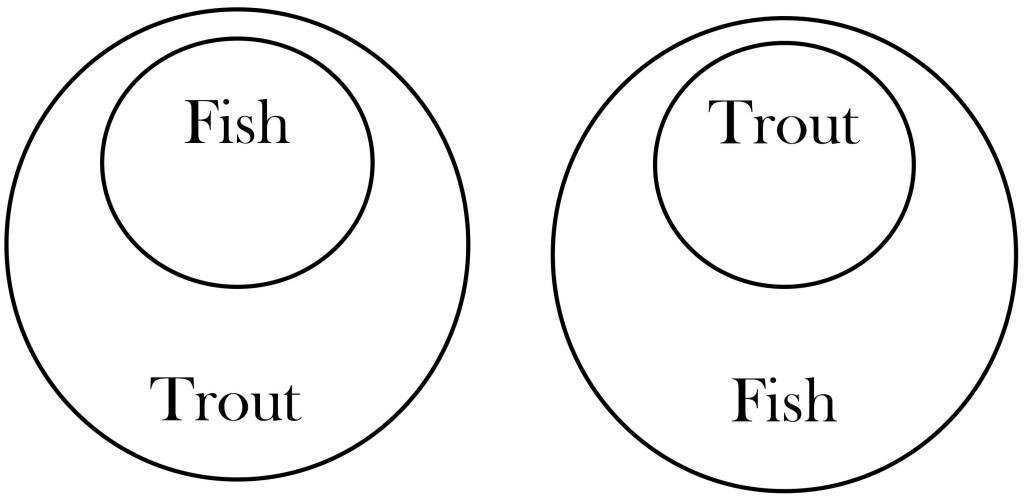
An understanding of some basic logic and understanding of category statements could be helpful here. For example, if I say, “all fish are trout,” is categorically different than saying “all trout are fish.” (See picture for a simple circle diagram.)

When dealing with categories, if all the subject, (not just some) is numerically or by attribute belongs to the predicate, then subject is a smaller circle fully inside the larger predicate circle. Thus, the subject is universally contained in the predicate. The logic is simple.

The first one is false, the other is true. In Genesis God established categories of the things He created. Thus, even if we mix in some specific induction, we know as infallible truth, God created fixed categories for animals, fish, vegetation, and etc.. We know there are many types of each in each of the broad categories. Thus, we know to say, “all fish are trout,” or, “all birds are sparrows,” is false, for there are many types of fish and birds, not just trout and sparrows. Thus, to casually flip the subject and predicate, of categorical truth claims is against Biblical teaching.

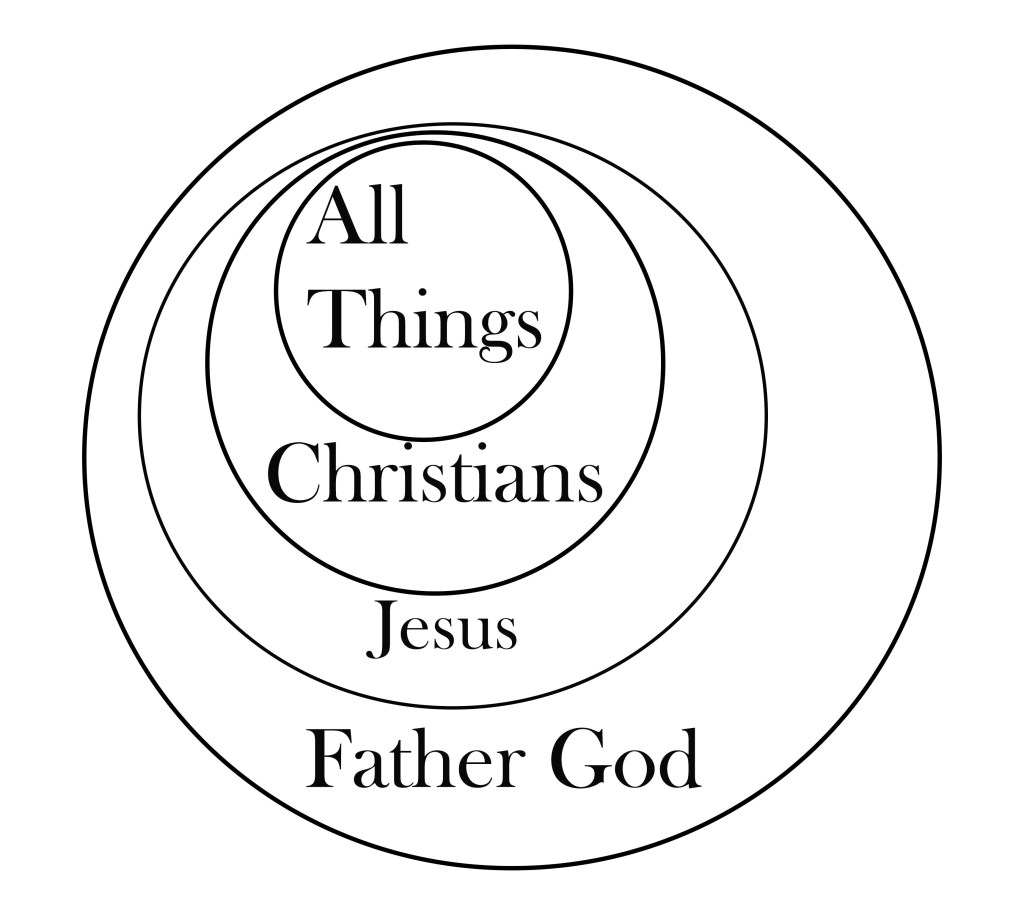
This is important to remember, because we are dealing with the ORDER of God’s decrees. It is important not to flip things around. If God decrees “x” as first, then it is not second or seventh. Congratulations, we just left second grade and now we can finally move on to forth grade teaching on God’s sovereignty. It is not bear control. An intelligent Mind ordered the world for His own goals. As we saw with an early circle diagram from 1 Corinthians 3, the order of multiple categories is crucial.

People who keep saying—God is in control, God is in control of my life, God is in control of this situation and even those who affirm with more boldness, God is in control and He is even the author of sin and evil—are spiritual infants. They never left second grade. They are mentally stunted. The question is, “how is God in control,” and “what has God commanded you to do, in light of His control of it.” Just saying God is in control, is of little help if it is applied like pantheism or fatalism. The decrees of God show His control is determinism in accordance to His own good purposes. Knowing God is in control is not boiled down to having a pagan, “Zen state of mind” about life; it is not boiled down to being calm. God was in sovereign control, when He directly and absolutely caused all those people in the gospels to be sick, blind, dead, leprous and demon possessed. What did Jesus do about this, as a man born under the law of God? He healed, resurrected and set those people free by the power of God. He commands us to do the same. If you do not do this, then the doctrine of God’s sovereignty is both wasted on you, and it shows you never believed above an infant level understanding of God’s sovereignty.

To say God is in control is not an ethic. It does not tell you what to do. However, if we say God has used this sovereign control, to DECREE us to be children of God, and DECREED we have bold access to His throne of grace, well then, this actually has huge implications for the person stating it. To say God has used His sovereign control, to DECREE for us to have power over sickness and demons, has huge implications. This shows us how God is in control. And some basic ordering of His control. It gives us understanding about our definition of Christians. God is not pantheism. His control over the world is explained and understand as His ordered decrees about all things.

What good is it for a sinner to realize they are a born a sinner by God’s control over their life, and say, “well, God is in control”? Do they forget God has used His control over reality to DECREE that there is salvation in Jesus Christ, and for those with faith, then a new life, a new soul and a new world is theirs for the taking.

In my experience, when I hear Christians say, God is in control or God’s Will, it has more in common with pagan fatalism than it does with God’s decrees of determinism. They are spiritual perverts and liars. God has used His sovereign control to DECREE that the elect are to be victorious (in everyday life difficulties) over sin, besetting sins, sickness, diseases, terrors of the night or day, demons and poverty. This so-called Christian appeal to, “God is in control,” is in reality an appeal to fatalism, and thus they let the sickness and demons roll right over them. In such acts these spiritual losers, are prostrating themselves to demons and their doctrines. These people are part of Reformed churches as much as they are part of Pentecostal churches. They falsely claim to assent to God’s sovereign control, but in reality they are liars. They believe in fatalism, and use this equivocation to negate the commandments of God. God’s specific descriptions of His sovereign control in His decrees, because of their detailed nature, are often accompanied with commands. That is, with detailed decrees, which are usually about the church, God gives commandments about the specific descriptions of reality He has ordered.  For example, God had decreed salvation for the elect in the atonement of Christ. God therefore commands repentance and faith in the gospel. God is in control, even when He directly caused the elect to be born sinners. However, by the decree of God, the elect believe what God has revealed. They believe by faith in Jesus they are saved. And so they are.  Also, God has decreed healing to be part of the atonement for the elect. With this specific description of God’s decree, God then commands us to have faith to be healed. God is in control, even when He directly caused the elect to have sickness and troubles. However, by the decree of God, the elect believe what God has revealed. They believe by faith in Jesus they are healed and delivered. And so they are.

Fatalism comes in and negates these commands, because God is in control, or, God’s will. Because God is in control, and thus, is ultimately in control over the fact you are sick and diseased, thus, you will pray, but what will happen by God’s control, will happen. This sounds humble and religious to spiritual perverts, but not to God. It is applying a demonic doctrine of fatalism over God’s determinism. God has used His sovereign control to decree that those with faith, will be healed, will cause Satan to depart and be victorious.

Fatalism is used to negate the details of God’s sovereign decrees. These people might be those who are quick to point out how the religious leaders in the gospels negated the commands of God by their traditions. Well, fatalism is a human made doctrine with its own traditions. Our religious leaders of today, mask their human doctrine with a biblical sounding topic—God’s sovereign control—but their wicked and sinister goal is to negate the commandments of God with it. They are sons of hell, leading others to be even greater sons of hell than they are.  

———————Endnotes——————–

Picture diagram of 1 Corinthians 3:23