Tag Archives: idenity

Direct and Constant Access to God

Years ago, when I first dove into Vincent Cheung’s commentary on Colossians, it hit me like thunderclap. There I was, flipping through chapter 2, and Vincent further explains what Paul calls “shadows” or “shadow religion”—those rituals, holidays, and sensory crutches that masquerade as piety but throw a veil over the direct, unfiltered access to God that Jesus secured for us. It’s not just ancient Jewish festivals Paul was warning against; Vincent applies it straight to our modern mess, like Christmas trees and Easter bunnies, turning what should be a vibrant, Spirit-drenched faith into a dim echo of the real thing. The church today needs this message hammered home, because we’re no better than those early believers clinging to calendar days, thinking they add something extra when Jesus already delivered the full package. His atonement is finished, His ascension locked in that ongoing ministry of blessings at the Father’s right hand—no bells, no smells, no seasonal vibes required to tap into it. We’ve got it all, right now, if we’d just believe.

In his Commentary on Colossians (2008), Vincent Cheung unpacks Colossians 2:16-17: “These are a shadow of the things that were to come; the reality, however, is found in Christ.” He drives home how Paul is dismantling the Colossian heresy that promised deeper spirituality but delivered nothing but chains. Vincent writes, “The regulations mentioned—’Do not handle! Do not taste! Do not touch!’—refer to things that are all destined to perish with use, because they are based on human commands and teachings. Such regulations indeed have an appearance of wisdom, with their self-imposed worship, their false humility and their harsh treatment of the body, but they lack any value in restraining sensual indulgence” (Colossians 2:21-23). Then he ties it to contemporary traps: “Christian traditions like Christmas or Lent often function the same way, imposing man-made observances that veil the direct reality of Christ. They suggest we need these shadows to approach God, when the substance is already ours in Him.” It’s a reminder that anything sensory—sights, sounds, smells—we lean on to “feel closer” to God is just a step back into the old covenant’s dim previews, when we’ve got the high-definition fulfillment in Jesus.

Paul isn’t mincing words—these observances were pointers, not the point. The reality is Christ, full stop. No more veils, no more middleman rituals. Satan loves these shadows because they distract from the direct line Jesus opened. The church today is starved for this truth—we’re drowning in sensory religion while the Spirit’s river flows untapped, and the word is not believed.

 In a world where barriers seem to define so much of our existence—whether it’s the red tape of bureaucracy, the emotional walls we build in relationships, or even the digital firewalls that guard our online lives—it’s liberating to consider what the Bible teaches about our access to God. This isn’t some distant, occasional privilege reserved for the spiritual elite, like a VIP pass to a concert that only works on special occasions. No, through Jesus Christ, we have direct and constant access to the Father, a reality that reshapes everything from our answered prayers to our eternal confidence. As I reflect on this, I can’t help but think how the faithless complicate what God has made straightforward.

The New Testament paints a vivid picture of this access, rooted in the finished work of Christ. Consider Ephesians 2:18, where Paul declares, “For through him we both have access to the Father by one Spirit.” Here, the apostle is addressing the radical shift brought by Jesus’ death and resurrection, tearing down the dividing wall between Jews and Gentiles, but more broadly, between humanity and God. Before Christ, access was mediated through priests, sacrifices, and the temple veil—a system of shadows that pointed forward but never fully delivered the intimacy we now enjoy. That veil, symbolizing separation due to sin, was literally torn in two at the moment of Jesus’ crucifixion (Matthew 27:51), signaling that the way into the Holy of Holies is now open to all who believe. It’s not a seasonal thing, like waiting for the right festival or the perfect alignment of stars; it’s constant, available at any hour, in any circumstance. Hebrews 4:16 urges us to “approach God’s throne of grace with confidence, so that we may receive mercy and find grace to help us in our time of need.” Boldly! Not with timidity or hesitation, as if we’re crashing a party uninvited. This is the throne room of the universe’s Sovereign, and we’re welcomed as sons and daughters, not strangers.

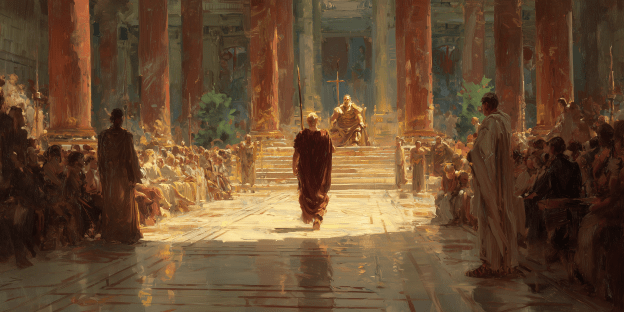
We can approach those ancient throne room doors to God Himself. We can push against them and swing those massive doors wide open. As we look, the middle of the throne room is empty. But off to the sides are angels and other heavenly hosts. They do not stand in the middle, before God, because they don’t have that type of access. But we do. All eyes watch us as we march down the center aisle, with our heads held high. We march in with boldness, as if we are God’s sons, who are co-heirs—not just mere sub-heirs—with Jesus Christ. We walk in with our heads held high, as if we are the very body of Jesus Christ, because we are. We were not first given a specific reason to come in at that moment. But we can anyway, unannounced. We stand before the throne, looking at God face to face, and boldly make our requests known to God. And God gives us what we ask for. God does this because when He sees us, He sees His Son. He thinks we are part of His Son, and God’s thoughts are the only thoughts that matter on the subject. God is correct, and I agree with God. I am part of Jesus and get prayers answered while boldly walking in and asking without hedging. Who am I to disagree with the Power?

To grasp the depth of this, we look back to the Old Testament contrasts that highlight the new covenant’s superiority. In Exodus 19, when God descended on Mount Sinai, the people trembled at a distance, warned not to touch the mountain lest they die. Even Moses, that great mediator, approached with fear and awe. Yet, in the New Testament, we’re invited to draw near without such dread, because Jesus has become our great High Priest who “ever lives to intercede” for us (Hebrews 7:25). This intercession isn’t a barrier; it’s the guarantee of our direct line to the Father. Romans 5:2 echoes this: “through whom we have gained access by faith into this grace in which we now stand.” Notice the present tense—we stand in it now, not sporadically or conditionally. Faith is the key that unlocks this, and as Vincent Cheung aptly notes in his commentary on faith’s role, it provides “unhindered, direct access to God,” serving as proof of our election. We don’t manufacture this access through rituals or good deeds; it’s gifted through Christ’s atonement, where He bore our sins and opened the path once for all.

 In Ephesians 2, it says we’re sitting with Jesus in the heavenly places. Not that we will be one day, but we already are. If you don’t see yourself that way, it’s because you do not believe God’s word and think He is a liar. Repent and start to agree with your Creator. Think about it. At this very moment, when the Father thinks of you, He thinks you are right now seated with Jesus, who sits at His right hand. He never thinks less of you than in that position with Jesus. If you are not experiencing the benefits of being seated with Jesus right now, that’s your fault and unbelief. God thinks you are, and so you are.

Too many Christians treat this access like an old phone line they only pick up in emergencies, crackling with static from doubt or tradition. They pile on layers of “helps,” like special days or sensory aids, thinking it draws them closer, when in reality, it veils the directness Jesus secured. Days like Christmas or Easter, while culturally ingrained, aren’t biblical doctrines, and so they can subtly shift our focus from revelation and the Spirit to a fleshly starting point. The early church faced similar temptations with Jewish festivals, as Paul warns in Colossians 2:16-17: “Therefore do not let anyone judge you by what you eat or drink, or with regard to a religious festival, a New Moon celebration or a Sabbath day. These are a shadow of the things that were to come; the reality, however, is found in Christ.” Shadows! They’re not the substance. The reason a person wants a shadow and not the real thing is because they do not believe the real exists, or worse, they don’t like it. Our access isn’t enhanced by smells of incense or sounds of carols; it’s sustained by the Holy Spirit, who cries out “Abba, Father” within us (Romans 8:15). This reluctance to embrace constant access often stems from unbelief, masquerading as humility. We think, “Who am I to march boldly into God’s presence?” But the Bible flips that: “How dare you not boldly approach, when Christ has paid such a high price?”

Delving deeper into Scripture, Ephesians 3:12 reinforces this boldness: “In him and through faith in him we may approach God with freedom and confidence.” Freedom—that’s the Greek word parrhesia, implying open, unreserved speech, like chatting with a close friend rather than petitioning a distant king. This isn’t license for irreverence, but it shatters any notion of intermittent access. Jesus Himself modeled this in His prayers, addressing the Father intimately, and He invites us to do the same in John 16:26-27: “In that day you will ask in my name. I am not saying that I will ask the Father on your behalf. No, the Father himself loves you because you have loved me and have believed that I came from God.” See that? No middleman needed beyond Christ’s ongoing mediation, which empowers our direct petitions. This ties into our identity as co-heirs with Christ (Romans 8:17), where all things are ours, including this unfettered communion. It’s about asking for wants and getting them, but it also includes all sorts of benefits, such as constant and direct fellowship, where we abide in Him as branches in the vine (John 15:4-5), drawing life, miracles, prosperity, and every sort of favor, moment by moment.

Hebrews 10:19-22 urges, “Therefore, brothers and sisters, since we have confidence to enter the Most Holy Place by the blood of Jesus, by a new and living way opened for us through the curtain, that is, his body… let us draw near to God with a sincere heart and with the full assurance that faith brings.” The “new and living way” isn’t static; it’s dynamic, sustained by faith that actively receives. Unbelief can hinder this, much like the Israelites who limited God by their grumbling (Psalm 78:41). They had manna from heaven, yet craved Egypt’s leeks—a foolish trade. Similarly, if we doubt our access, we forfeit the peace, power, and provision flowing from God’s throne.

“Beloved, now we are children of God… we shall be like Him, for we shall see Him as He is. And everyone who has this hope in Him purifies himself, just as He is pure,” (1 John 3:2-3 NKJV). “Set your mind on things above, not on things on the earth. For you died, and your life is hidden with Christ in God. When Christ who is our life…,” (Colossians 3:2-3 NKJV). We draw strength not from self-effort, but from this constant access, where our seated position in Christ refines us by walking in that position when we ask, receive, and praise God. As we see ourselves better as already seated with Jesus, seeing His rich life pouring into us, the more we purify ourselves. The better we see how awesome we are in Christ and walk in that bold access, the more we have power to walk in purity and holiness. People often try to do the opposite of John’s instruction. The order is to first believe who you are, and the proof that you are believing your identity in Christ is if you can boldly ask and receive miracles, and then by doing this you will purify yourself in holiness.

Imagine waking up, not with a list of rituals to “get right with God,” but with the immediate awareness that the throne room doors are swung wide. You pray for healing, and James 5:15 assures, “The prayer offered in faith will make the sick person well; the Lord will raise them up.” You seek wisdom, and James 1:5 promises generous provision without reproach. Even in trials, like Peter’s denial followed by restoration (John 21), access remains, because our standing is in Christ’s righteousness, not our performance. The callings and gifts of God are irrevocable. God sees you as already righteous without any sinful markings on your record. And what God thinks is the only thinking that matters. This is irrevocable. Your righteousness record is forever. God thinks you are a royal priesthood, now, not later. God thinks you are seated with His Son in the heavenly places. This is irrevocable. It was based on Jesus’ finished work and given freely to you in grace. It has nothing to do with your performance.

Direct and constant access to God isn’t a theological footnote; it’s the heartbeat of the gospel. It mocks the idea that we need additives to spice up our spirituality, reminding us that Christ is sufficient. As we stand in this grace, let’s live it out with the frank boldness it deserves—no more hiding behind shadows when the Light Himself beckons us near. If we’re not experiencing this daily, perhaps it’s time to examine our faith, repent of unbelief, and step into the throne room. After all, the Father isn’t stingy; He’s extravagantly welcoming, eager for our company. In the words of 1 John 5:14-15, “This is the confidence we have in approaching God: that if we ask anything according to his will, he hears us. And if we know that he hears us—whatever we ask—we know that we have what we asked of him.” That’s not wishful thinking; that’s gospel power, yours for the taking. Because God sees us as part of His Son, and thinks the blessing of Abraham already applies to us, “what we want” is the threshold that qualifies as “asking according to His will.” The only time what we want is not God’s will is if it violates a specific command or a word of direction the Spirit spoke to us. Thus, we can always ask in confidence knowing, “what we want” is what we get.

 Faith isn’t waiting around for special days or moods; it’s grabbing hold of the promises now, because Jesus is already interceding with all the good stuff He pledged. Think about it: if the early church got tangled in Jewish Sabbaths thinking it helped their standing, aren’t we doing the same with Christmas carols and advent wreaths? It’s like showing up to a feast with your own sack lunch—you miss the bounty because you’re stuck on shadows. And let’s be frank, if your faith needs twinkly lights to sparkle, maybe it’s time to check if the power’s even plugged in. Imagine trading divine Wi-Fi for a holiday dial-up connection—talk about a spiritual lag!

Shadow religion veils the intellectual, spiritual core of Christianity. It’s empiricism in pious drag, basing faith on feelings and festivities rather than revelation. But Jesus’ high priestly role means constant access—no calendar needed. If we’re born from above, we’re insiders in the Father’s house, with rooms prepared. If your Christmas ham tastes better than the bread of life, you’ve got your feasts mixed up. That’s like preferring MRE meal to a gourmet banquet from the King.

Let’s ditch the veils and live in the full benefits that Christ already won for us—bold, direct access, and miracle-ready. To drive it home, consider the ethical fallout: shadow religion dishonors Christ’s sufficiency. As sons, we’re co-heirs with eternal rooms prepared (John 14:2-3), yet holidays suggest that calendars somehow help us sit closer to Jesus in the heavenly places. However, miracles aren’t holiday perks; they’re gospel proofs. If you tie them to Christmas, you’re unbelieving the very good news that sets us free. If you think miracles happen more around Christmas than from a daily prayer spoken in faith, then maybe check who’s really guiding your sled—your flesh or faith? Santa’s list might be naughty or nice, but God’s access is always “yes” in Christ—no reindeer required.

This delusion of seasonal surges stems from defective anthropology, viewing man as sense-bound rather than Spirit-led and word-based. The gospel tells us we are redeemed, righteous, headed to glory, designed for miracles now. Calendars chain us to the old man; faith unleashes the new creation (2 Corinthians 5:17). Feeling closer via festivities? That’s flesh talking, empirical highs mimicking intimacy. Do you feel distant? That is the chill of a religious shadow, exposing your drift from reality. The cure? Deductive faith in Scripture: Jesus’ finished atonement and our current reality seated with Him means miracles come through faith, not calendar dates.

The Scientific Process

After my own studies and discussions with Grok xAI, I’ll outline a step-by-step breakdown of modern science. Some still believe science is rational, deductive, and logical. We’ll dissect the process and reveal it’s anti-logical from start to finish, despite using modus tollens.

Karl Popper exposed the anti-logical nature of scientific experimentation, particularly the nonsense of affirming the consequent. To counter induction’s irrationality and this fallacy, Popper proposed scientists use modus tollens to invalidate hypotheses. Modus tollens is a valid deductive form. Yet, if you lack upfront truth, affirming the consequent is the only way to positively affirm a claim, if the logic is to correctly correspond to your actions. Popper aimed to minimize this by favoring deduction. The catch? At best, modus tollens can say something is wrong—it can’t confirm truth. Today, top scientists recognize induction and science’s irrationality, leaning into falsification for better experiments.

If we admit science offers no truth, only pragmatic usefulness, then adding modus tollens at the end enhances practical outcomes. We support this. As noted, science fulfils God’s command to dominate the world for practical benefits—a blessing He ordained. But that’s all science is. Even when its utility seems impressive, its statements about reality are false.

Since the scientific process is rooted in inductive and observational fallacies, it’s irrational and anti-logic. Slapping modus tollens on the end doesn’t erase this irrationality; it just improves pragmatic results. It’s right to acknowledge science’s baked-in anti-logic and compensate with deduction—if we clarify this is for usefulness, not knowledge.

Before detailing the process, let’s define falsification. Grok xAI (2024) put it this way:
“The origin of falsification, per Popper, is rooted in the idea that a hypothesis must be scientific if an experiment or observation could prove it false. This was a direct jab at the inductivists and verificationists of his time. Popper’s philosophy was like saying, ‘Science isn’t about piling up evidence for your theory; it’s about daring it to fail.’”
This is accurate but needs unpacking to avoid confusion. Popper critiqued scientific experimentation (i.e., “verification”) that relied wholly on affirming the consequent to link hypotheses to reality.”

Grok calls it a “jab at inductivists,” which can mislead. Even with modus tollens, science remains overwhelmingly inductive. Though Popper shifted “verification” to the “pre-hypothesis” stage rather than the endpoint, falsification swims in a sea of inductive reasoning and observation. Grok was correct that “Popper would have it… it must be possible to conceive of an experiment or observation that could prove it false.” Popper’s falsification operates within “inductive observation” and “inductive experiment.”

Thus, despite jabbing inductivists, Popper’s method still employs induction. Science isn’t one thing—it’s a process. I once heard a scientist claim, “Science is only deductive because it’s only about falsification, specifically modus tollens.” This misrepresents Popper’s approach, which integrates induction and observation. When I asked Grok (2024), it responded, “Absolutely not! Popper argued a theory must be falsifiable, aligning with modus tollens’ deductive logic to disprove it. But induction isn’t sidelined:

  • Initial Phase: Science starts with observation and inductive reasoning to form hypotheses.
  • Ongoing Nature: As hypotheses are tested, scientists refine them with new observations and inductive leaps, keeping induction central.”
    Since falsification uses induction, it’s inherently irrational, violating the laws of identity and contradiction. It’s a systematic affirmation of false premises in unsound arguments, pretending to deny something.

Calling “science deductive” is false. I wouldn’t even say it’s inductive and deductive—its “deduction” is unsound. I wouldn’t label an unsound argument deductive unless we’re pretending in a fantasy world. Generously, we could call science heavily inductive with some deduction tacked on.

This matters for Christians. The Bible uses only sound arguments, rejects induction’s anti-logic, and shows our observations can be wrong. It dismisses empirical observation and induction for knowledge. Thus, falsification isn’t a biblical standard and can’t yield knowledge. Some fools hybridize this irrational human method with the Bible’s rational approach, claiming falsification aids understanding Scripture and truth. This is blasphemy—melding the irrational with God’s rational system defames His mind as irrational or endorsing irrationality. Similarly, fake presuppositionalists claim the Bible ratifies observation and empiricism for knowledge—nonsense.

Another reason to reject falsification: its maxim—“something must be provably wrong to have credibility”—is false. The law of contradiction (LoC) isn’t falsifiable; denying it requires using it. Self-authenticating truths, like the LoC, render falsification inapplicable. At best, falsification fits inductive observations. The Bible, as shown in epistemology, is self-authenticating—unfalsifiable. It can’t be proven wrong because any attempt presupposes it; Scripture declares itself true and all else false. We don’t use falsification to read the Bible or find truth. If it’s such a great rule for Christians, why doesn’t its maxim apply to Scripture?

Note the maxim says “for credibility,” not “to prove true.” Falsification is negative—it can’t produce positive claims without violating logic. Since the Bible rejects observation, empiricism, and induction for knowledge, and falsification uses them, Christians don’t employ it for knowledge. Even using modus tollens—directly, in reductio ad absurdum, or falsification—is only negative, offering no positive truth. When someone says, “I don’t see God healing today,” it’s wrong not because of falsification but because Scripture rejects inductive observation outright.

There’s nothing wrong with modus tollens to show something is false—Scripture uses this deduction. St. Augustine and Paul (1 Corinthians 15) did too, free of empiricism or observation assumptions. But if someone uses empiricism as a standard, showing documented healings should convince them if they’re consistent. We can use modus tollens to refute them with their own flawed epistemology. The catch? Induction’s conclusions don’t logically follow premises, so they can reject evidence due to its inherent uncertainty. Even a deductive argument using observation—ours or theirs—becomes unsound, leaving conclusions skeptical. Induction offers no logical binding to accept any conclusion—you can dismiss or embrace as you please.

As a Christian, the Bible says God heals, and on faith’s demand, He will (John 15: Jesus predestined us to ask and receive). I expect healings. My observations are private knowledge—and if I applied these with deductions from Scripture “for myself,” then my self-knowledge is what the bible asserts. But shifting private to public knowledge violates logic’s laws. Scripture alone is our starting point for knowledge about healing. Anyone using inductive observations to argue miracle healing is a fool, rejecting the Bible as the sole epistemic foundation.[1] Such debates aren’t about healing but epistemology—Scripture’s deductive logic versus induction’s fallacy. Tell them they’ve abandoned Christian doctrine on knowledge and logic; if they don’t repent, boycott and excommunicate them.


The Scientific Process

Observation and Hypothesis Formation (Inductive Step)

Note: “Scientific experimentation (affirming the consequent)” has been pushed back to “hypothesis formation.”
Scientists observe phenomena in nature or data, noticing that when event A occurs, phenomenon B follows. This resembles affirming the consequent: “If A, then B; B happens, so A caused it.”

  • Example 1: (A) Rain occurs, (B) my yard gets wet. (B) I see my yard wet, so I hypothesize (A) it rained.
  • Example 2: (A) Bacteria add chemical X to solution H, (B) it turns red. (B) I see it red, so I hypothesize (A) bacteria added X.

Formulating the Hypothesis (Setting Up for Modus Ponens)

Initially, scientists observe B (a fallacy) to check their idea. If testing’s possible, they run preliminary affirming-the-consequent experiments for merit. Then, they frame hypotheses as modus ponens: “If A, then B; A, thus B.” They pretend a necessary connection exists to apply modus tollens later—not to affirm the consequent but to predict outcomes. They say, “If hypothesis (A) is true, under these conditions, we’ll see (B).”
In layman’s terms, this is logical voodoo, a void, or superstition.
Two ways this bait-and-switch happens:

  1. Vincent Cheung’s Example (A Gang of Pandas):
    1. “If (A) is a cause, then (B) is a result. B happens, thus A caused it.”
    1. Restated as modus ponens with B and A flipped, using a false conclusion to build an argument.
  2. Direct Pretence: Pretending inductive “If A, then B” is real or pretend it’s a necessary connection. This is like misstating a math problem to reflect reality. If I buy 4 apples at $1 each, calling it calculus is delusional if it doesn’t match reality. Scientists engage reality via affirming the consequent due to observation—they can’t avoid it. Restating it as modus ponens is delusional because it doesn’t mirror their actual interaction with phenomena.

Experimental Design (Testing via Modus Ponens)

Scientists design experiments controlling A to see if B follows, mimicking modus ponens:

  • If hypothesis A is true, under specific conditions, B occurs (If A, then B).
  • They ensure A is present.
  • They check if B happens (A leads to B).
    This isn’t just to affirm the hypothesis (a fallacy) but to test predictions under control. Yet, problems still abound:
  • The setup stems from a fallacy—using a false conclusion from observation and affirming the consequent to fake a connection. This restated logic doesn’t reflect their real-world engagement; it’s fabricated.
  • They only pretend it’s modus ponens—in name only. Some admit the connection is merely sufficient, making falsification tentative, not necessary, contradicting the very definition of logical inference.
  • Controlled tests can’t rule out infinite unknowns (e.g., heat affecting results unbeknownst to a scientist ignorant of it).
    Vincent Cheung notes, “The idea is simple. To know that any experiment is “constructed properly” the scientist’s knowledge must be “bigger” than the experiment. But if his knowledge is already “bigger” than the experiment, then he hardly needs to perform the experiment to gain knowledge that is limited by the experiment. The only way to be sure that one has identified and controlled all variables that may affect the experiment is to possess omniscience. The conclusion is that only God can tell us about the universe.”[2]

Falsification Attempts (Modus Tollens)

Here’s the shift:

  • If B doesn’t occur when A is present: “If A, then B; not B, therefore not A” (hypothesis falsified).
    Scientists aim to confirm hypotheses (affirming the consequent), but better ones seek disproof. Misaligned results falsify, and this leads to rethinking and refinement.
    Yet observation and affirming-the-consequent thinking build the argument for falsification. Induction underpins science’s foundation and definition. The “deductive” arguments are unsound—born from false conclusions, misrepresenting reality. It’s deduction by pretence. Before falsification, the hypothesis’s necessary connection is unknown. Falsification deems it wrong, which says little.
    The experimental connection has two interpretations:
  • If honest (connection is sufficient or a guess), falsification is uncertain, not necessary—violating deduction’s essence.
  • If claiming necessity, it’s pretence, falsifying only a pretend reality, breaching contradiction and identity laws.
  • Finally, saying “laws are formulated by falsification” is a non-sequitur. Negative propositions can’t yield positives without adding information—violating logic. Laws from falsification can only say “this isn’t that.” Positive laws from falsification defy logic; negative isn’t positive.

The point is that observation and affirming the consequent thinking and testing is involved in formulating the argument that will be tested by falsification. Thus, induction is both the foundation of science and therefore involved in the definition of science. The so-called deductive arguments are unsound, because they are created by false conclusions and the logic does not reflect their interaction with reality. It is deduction only by pretending. Before falsification is used, it is not known if the major premise of the syllogism (hypothesis) has a necessary connection. Falsification says this unsound argument is wrong. which is not really saying that much.

The connection in their experiment can be taken in two ways. If they are honest and admit the connection, at the very best is sufficient or a guess, then if falsification is used, the falsification is only a guess, but not a necessary falsification. This violates the very definition of deduction, which is necessary. If they insist the falsification is necessary, then they violate the laws of contradiction and identity. If they want to insist their connection in their experiment is necessary, then it is only by pretending. Thus, if they use falsification, it is only falsifying a pretend reality.

Lastly, there is the part where scientists say, “laws… are formulated by falsification.” This is false. It is a non-sequitur fallacy. Remember our rules for category syllogisms? We talked about distribution of terms but also the quality and quantity of a syllogism. If the propositions of an argument are negative, you cannot get a positive out of it. The same here.  Falsification can only say, this is wrong, but to then turn around and say we have a law that says, “this is this,” is to add more information than what the argument says. Laws, formulated by falsification can only say at best, “this is not that.” Every positive law stated by scientists using falsification is a violation of the laws of logic. To say negative is a positive is anti-logic.  


[1] This is different from starting with the truth given by scripture, and then present your healing as “testimony” that agrees with the truth. You are saying the bible is the proof, and my testimony agrees with the truth, not the other way around.

[2] Vincent Cheung. A Gang of Pandas. Sermonettes Vol.1.

clem-onojeghuo-CJtNSIOicD0-unsplash

There Is No Essential “Me” Left

To sound pious one fool quoted Romans 7 where Paul says, “in me nothing good lives,” to suggest that Christians cannot look inward to see glory, honor, righteousness and immortality.  

First Paul was referring to a hypothetical typical Jew, and not to himself after being born from above. Mistaking this for Paul after being re-created in the image of Jesus Christ has caused destructive conclusions and blasphemies.

Second, their conclusion is “apart from God, there is nothing good in me.” There is a serious problem with this.  Since “my” inner man is born-from-above and the image of Jesus, and “my” mind is the Mind of Christ, then apart from God, there is no essential “me” left. My old-man is dead, and no longer my identity. This does not mean I live in pragmatic sinlessness, but that my definition and reality is spiritual, divine, and holy. Example, apart from God upholding my body into existence, with the exception of my socks, I have nothing left. The clothes on my body is not my identity or definition. And so, if God destroyed me right now, except my socks, I have nothing essential of my identity and definition left.

Likewise, Paul mentions in 1 Corinthians 3 about the fire burring away things not built upon Christ. These dead works are not part of my essential definition and new creation in Christ. Thus, they can be burnt away, and I am still fully “me” and not half of me.

If you have any essential anything that is not your identity being the nature of God and the Mind of Christ, then you are not saved.

If you have been re-created in God’s nature and the Mind of Christ and out of your belly is flowing rivers of living waters, then if you look inward, you will see glory of the image of Jesus. The only way for this not to be true, is if your identity has not been re-created in a new, heavenly reality.

Your inner-man is a new reality, your outer tent that clothes your inner-man, the flesh, and its attraction to empiricism/emotions is not your essential reality. It is secondary, dead, and wasting away. To define “yourself” by the old-man as your essential identity is to define “you” as the old-man, and thus “you” cannot be a new reality in Christ.

To glorify God for the power of the gospel, you must look inward and see “you” as a new divine creature, a superior species, a child of God, being birthed with His nature as your nature. You cannot diminish this reality without destroying the gospel of Jesus Christ.

 The gospel is not too good to be true. It is very believable because God says it true, and God is trustworthy. Satan and the old-man are liars. God tells you the truth. He tells you correct definitions about reality. Emotions are a lair. God describes reality as it truly is.