
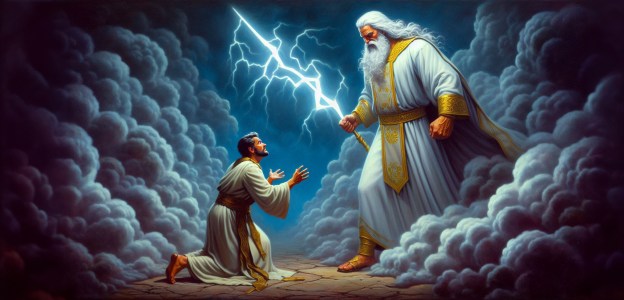
Jesus said to him, “You have said it. But I tell you, from now on you will see the Son of Man sitting at the right hand of the Power and coming on the clouds of heaven.”
(Matt. 26:64 LEB)
And Stephen said, “Behold, I see the heavens opened and the Son of Man standing at the right hand of God!”
(Acts 7:56 LEB)
I remember seeing a Korean manhwa (anime cartoon) called Noblesse. The Noblesse was a loner character who kept bad vampires in check, by destroying them. In the first main showdown the Noblesse would not look at the villain in the eye, when they were face to face. This infuriated the villain. The Noblesse, then used his power to force the bad guy into a kneeling position. Now, when their eyes met, from the position of the villain looking up and the Noblesse looking down, he said, “this is where our eyes meet.”
The Noblesse, makes the villain look up to him in defeat, mirroring how Jesus will flip the script on His adversaries. When Jesus talks about coming on the clouds, He’s not planning a peaceful parade; He’s promising a divine showdown. Think less “slice-of-life” genres and more “apocalypse horror.”
This is like what is happening in the above passages. The high priest in a position of authority, forces Jesus to answer the question if He is the messiah. Jesus answers by confirming that He is the messiah. Jesus follows this up with a threat. He says, from now on, you will see Me at the right hand of the power, and coming in the clouds of glory. This is both a statement of reality and a threat. Right now, in the position of a man born under the law, and under the authority of the high priest He is forced to answer his question. But Jesus says, from now on forward, the roles will be flipped. I will be in the position of authority, looking down on you. Jesus has a mic-drop moment with the high priest, essentially saying, “You’re the boss now, but wait till you see Me in My final form!” He’s not just the humble carpenter; He’s hinting at His gig as the cosmic judge, riding on clouds like a divine superhero.
The Old Testament quote of “coming on the clouds of glory,” is about God’s judgments. It is apocalyptic language that describes God destroying His enemies. (see Deut. 33:26, Isaiah 19:1, Isaiah 34:4-6, Isaiah 13:5–10 Daniel 7:13-14) It is symbolic language describing real acts of God’s horrific judgments. It is not symbolic language to describe invisible spiritual or more symbolic things, but historic acts of God’s judgement. The first mention of this apocalyptic language is the Exodus story and God’s destruction of Egypt. God did not literally ride the clouds, like a Sky Rider, but God did bring in darkness, sickness, storms, frogs and a real angel came and killed all the first born of Egypt. Jesus in Matthew 24 quotes Isaiah 13, 34, and Daniel 7 as a packaged deal that belongs to Him. He rides the clouds. He will bring judgement. He will be the one bringing the plagues of Egypt on His enemies.
Thus, when Jesus says that not only, will His and the high priest’s positions change, but also defines Himself with the Old Testament apocalyptic language, it is a full on threat. Jesus is saying, I will be in authority, the next time our eyes meet, but I am also judgment. He is saying, My authority will not be used for your salvation, but destruction. From now on, when our eyes meet, you will be kneeling looking up, and I will be looking down on you, with a sword in My hand. This is where our eyes will meet.
This will help us understand why Stephen was asking Jesus not to hold their murder of him, against them. Stephen, right before becoming the first Christian martyr, has a vision. He sees Jesus not as the guy who walked on water, but as the celestial commander in chief, standing (not even sitting!) at God’s right hand. It’s like Jesus went from indie band lead, at the corner café, to the headliner at the universe’s biggest rock concert. Stephen saw Jesus in all authority and power, at the right hand of the Power. Jesus is not the humbled man that we all read about in the gospel. He is now in all authority and power. From His position of power He works in the saints to advance the Kingdom of God on earth. He is in a position of military power. He is a ruling king who is currently in a military campaign. He is the King who rides the skies to bring destruction on His enemies. This is His current status.
Thus, when Jesus is looking down on the murder of Stephen, He is a King, in a current military campaign, watching His enemies killing His soldier. Any normal King would bring down fast destruction. In 70 AD, in the destruction of Jerusalem, King Jesus did just that. This is why Stephen is crying out for Jesus to hold back, because Jesus’ position is the current Sky Rider. Stephen knows Jesus’ position and so is asking for more time for the church to try and bring the Jews to repentance and faith. He’s basically asking Jesus, “Hold off on the divine wrath, okay? Give us a bit more time to win some souls.” He knows Jesus isn’t just chilling up there; He’s actively directing the celestial troops.
Jesus was correct. The next time His enemies saw His eyes, they were kneeling in terror, and He was Riding across the Sky in the destruction of Jerusalem.
Let us not forget that this is the same Jesus we pray to everyday. It is this same Jesus, who is still sitting at the right hand of Power. He is still in a military campaign to advance the kingdom of God, through the church by preaching, baptism of the Spirit, healing, casting out demons and resurrecting the dead. Sometimes it is good to repeat Stephen’s prayer for more time, and other times it is good to ask king Jesus to mount up and ride the skies
Jesus isn’t just the gentle shepherd; He’s also the king with a sword, ready to ride the clouds into battle. So next time you pray, remember, you’re talking to the Cloud-Rider, the Sky King, and He is ready to bring the thunder! He is so ready, that Stephen pleaded with Him to hold back.
[1] Used Grok AI 2024, to help me with some of the witty summaries.
 Oshea Davis