Tag Archives: ontology

kelly-sikkema-FqqaJI9OxMI-unsplash

A Disciplined Son, Sitting In His Room, In His Father’s House

What is the fear of the Lord? The fear of the lord is defined by its context. At times is simply means to worship the lord, as Jesus quotes to the devil. But at times it means awful dread of judgment. And lastly it can mean, as a legitimate son, to fear the discipline (not condemnation) of your father.

Vincent Cheung writes regarding a besetting sin,

It is good that instead of excusing yourself, you admit your sin and you are taking it seriously. Even if the sin persists, remember to never lose this – never begin to make excuses or to think that it is not a sin.

It is correct that true faith in Jesus Christ leads to holiness. However, a stubborn sin – or two or three – can tend to capture our attention to the exclusion of other aspects of our lives. When you take your entire life into account, is the basic disposition toward holiness? Is there an overall growth in knowledge, reverence, purity, and good works? If so, then this is consistent with a genuine faith in Christ. Instead of allowing a stubborn sin to become a stumbling block for your whole faith, you should consider the fact of your continuing growth in Christ to draw strength and encouragement in the ongoing battle against the remaining evil… So even if you draw on the strength and pressure of a Christian community, see to it that your main focus remains on Jesus Christ. He is the sole Mediator, the Lord of the conscience, and the Shepherd of your soul.[1]

“Therefore, since we are surrounded by such a huge crowd of witnesses to the life of faith, let us strip off every weight that slows us down, especially the sin that so easily trips us up. And let us run with endurance the race God has set before us. 2 We do this by keeping our eyes on Jesus, the champion who initiates and perfects our faith…
7 As you endure this divine discipline, remember that God is treating you as his own children. Who ever heard of a child who is never disciplined by its father? 8 If God doesn’t discipline you as he does all of his children, it means that you are illegitimate and are not really his children at all. 9 Since we respected our earthly fathers who disciplined us, shouldn’t we submit even more to the discipline of the Father of our spirits, and live forever?[g]
10 For our earthly fathers disciplined us for a few years, doing the best they knew how. But God’s discipline is always good for us, so that we might share in his holiness. 11 No discipline is enjoyable while it is happening—it’s painful! But afterward there will be a peaceful harvest of right living for those who are trained in this way,”
(Hebrews 12:1-3,7-11. NLT)

“Then Jesus answered, “Will you really lay down your life for me? Very truly I tell you, before the rooster crows, you will disown me three times!
“Do not let your hearts be troubled. You believe in God[a]; believe also in me.  My Father’s house has many rooms; if that were not so, would I have told you that I am going there to prepare a place for you?  And if I go and prepare a place for you, I will come back and take you to be with me that you also may be where I am.  You know the way to the place where I am going,”
(John 13:38, 14:1-4. NIV)

“He will judge everyone according to what they have done.  He will give eternal life to those who keep on doing good, seeking after the glory and honor and immortality that God offers.”
(Romans 2:6-7 NLT)

“But of Him you are in Christ Jesus, who became for us wisdom from God—and righteousness and sanctification and redemption— that, as it is written, “He who glories, let him glory in the Lord,”
1 Corinthians 1:30-31.

So right after Jesus tells Peter that Peter will betray Him (people have forfeited their souls for less), Jesus says not to worry, but remember He is preparing a room in His Father’s house for all the disciples, including Peter.

Peter did suffer the disgrace and sorrow for what he, but Jesus restored him, and Peter upon receiving this freely given love, freely gave it back to the brethren by strengthen them.  Peter never stopped from having a room in the Father’s house.

When I was disciplined by my parents, my mom would make me wait in my room for my dad to come and give me a spanking. As Hebrews 12 says, discipline is not pleasant. How obvious this is. It is proper to “fear” the unpleasantness of discipline. The point to remember is this, it is discipline, and not condemnation. For those in Christ Jesus we never fear condemnation, because Jesus was already condemned in our place. [2] This is a fear a Christian should never experience, and any voice or feeling that says otherwise is a lie from Satan. Our judgment has already happened. Only grace and life are before us. It is a bight day, today in Christ. It is a brilliant future.

However, I want to bring your attention to this aspect.  I waited for my dad’s discipline, in my “room” in my “father’s house.” Think about that. The same is for our heavenly Father. For all those truly born-from-above, we never leave our Father’s house. Even if we wait for discipline, we wait as sons, in the safety of our own rooms.  And even in the extreme example of the parodical son, when the son left his room on his own, the father’s always had a room waiting for the son’s return.

Any discipline is to help you mature as a son. That is, the good things you are seeking, such as blessings, health, prosperity (etc.) God our Father wants to give this to us, more than we want to receive it. We are already in Christ, righteous in God’s sight, reconciled and co-heirs with Jesus. By faith, at any time we can approach God’s throne; our sins do not negate this. However, if our sin is to often or too big, it can hinder our conscience to be sin focused and not righteousness focus, and this will hinder our faith, and this will hinder us freely receiving all the good things from our Father. God’s discipline for His sons, is not to remake us as sons because our sins stopped us from being sons; no, our Father desires to mature us to understand we are beloved sons through Jesus and on this foundation, in faith freely receive the good things promised us. God wants to give more than you want to receive.

When we are sick, we need to have a relentless focus on our healing, on the word of God about healing day and night. We are not to focus on our sickness, we are to focus on the healing already accomplished by Jesus in His finished atonement. We are not to focus on the pain, but the how much God loves us and wants our healing more than we want it. Sickness is from the devil, it is a curse of the law and Jesus started to demolish it in His ministry and has commanded all His disciples to continue this battle. We are commanded to have faith to be healed.

The same for sanctification, even in besetting sins. We need to have a relentless focus on our righteousness in God, and not our sin. Hebrews 12 in context about the sins that so easily ensures us, says to focus on Jesus who began and will strengthen our faith. The application is obvious. We do not focus on what our eyes see, or minds feel, or body experiences; rather, we focus on all the promises of God that are yes through Jesus Christ. We focus day and night that we are the righteousness of God in Jesus, that we are children of God, beloved and reconciled once and for all time. We can march into the throne of heaven at any time and place to ask and receive from Almighty God, as dear children.  We need to see that even all our future sins are forgiven, forgotten and gone. Paul says in 1 Corinthians 1 that not only did Jesus become our righteousness for us, but also our “sanctification.” Jesus did not only start our faith, but He will be faithful, (not you), HE will be faithful to mature and finish our faith. In blood, Jesus promises in the New Contract, that God will write His laws on our minds so that we love God, by obeying His commands. This was not your promise to God, but God’s promise to you. The Father pointed to His Jesus’ bloody corpse and said on that day, I promise I will cause you to love Me. This is love, not that we loved God, but that God so loves us that He sent His son to be a wrath appeasing atonement for us. The old man has already died, and the new man is already here. We are free from the law of sin and death and now we reign in this life through Jesus Christ.

This does not diminish our sickness by focusing on our healing promised in Jesus, instead of the pain, but is obedience to focus on what God tells us to focus on. The same for sin and righteousness. It is obedience to focus on our righteousness, sonship and value in Christ and not sin conscience.  Psalm 1 says you will have success in all that you do if you think on God’s word day and night. We know the way. It is Jesus. It is a relentless focus on our beloved identity in Him, and that all the good promises are our definition and yes through Jesus.

ENDNOTES

[1] Vincent Cheung. Habitual Sin. Sermonettes Vol. 6. 2012. Pg.81.

[2] Now, if you are in extreme, gross sin (there are degrees of sin), it is not wrong to remember the dread of condemnation, in the sense that Paul says, check and see if your election is sure; yet, these are extremes that most Christians should not relate to (2 Corinth. 11:20-22, 27, “guilty of sinning against the body and blood of the Lord.”). Yet, even in this extreme, God killed them with sickness before they could forfeit their salvation. And yet, in this extreme James 5:15 still applies, “Such a prayer offered in faith will heal the sick, and the Lord will make you well. And if you have committed any sins, you will be forgiven,” NLT. God wants you to prosper.


damir-kopezhanov-emm1EBmBoj0-unsplash

FAITH QUOTES

[These quotes are from various preachers and teachers from the “2022 Southwest Believers’ Convention.” From Aug 4-6, 2022, from the Kenneth Copeland twitter page.]

Therefore I tell you, whatever you ask in prayer,
believe that you have received it, and it will be yours
– Matthew 11:24

If you live in Me [abide vitally united to Me] and My words remain in you and continue to live in your hearts,
ask whatever you will, and it shall be done for you.
-John 15:7 (AMPC)

“The destroyer is rebuked for our sake and His weapon of sickness and disease cannot prosper against us.”
– Kenneth Copeland

“We resist sin…we resist sickness and disease.”
– Kenneth Copeland

“When you can’t recognize yourself, doubting likely has become a habit in your life.”
@jesse_duplantis

“God never anointed Jesus to go about putting sickness on anybody.”
@terripearsons

“Fear is not okay.”
– Kenneth Copeland

“You are supposed to be healed today!”
-Kenneth Copeland

“Jesus paid the bill for our healing with His own blood.”
-Kenneth Copeland

“Doubt will steal your face, because it has no face. It’s an identity thief.
@jesse_duplantis

“An unlimited God can be limited by His own people!”
@jerrysavellemin

“You start acknowledging God over all the good things that happen to you and more good things will happen to you.”
@jerrysavellemin

“The battle may not be your choice, but the outcome is.”
@jesse_duplantis

“We can limit God through small thinking and negative talking.”
@jerrysavellemin

“God’s warehouses are full! All He wants to do is Bless His kids!”
@jesse_duplantis

“Faith brings our hopes into reality.”
@jerrysavellemin

“Now faith is being sure of what we hope for and certain of what we do not see.”
– Hebrews 11:1

“Faith knows ahead of time what God will do.”
– Keith Moore

“When God tells you that He wants you to do something, and you have an assignment, you can get bold — Nothing can stop you, nobody bigger than Him.”
-Keith Moore

“Get out of the boat of religion and start walking on the water because Jesus is not in the boat He’s on the water.”
@jesse_duplantis

“You’re moving from Victory to Victory. Your Victory is already done!”
@Creflo_Dollar

“Now is the time to know that without Him you can do nothing.”
@Creflo_Dollar

“The very law of mankind should be total dependence on God.”
@Creflo_Dollar

Declare it until you believe it: “I am the righteousness of God.”
@Creflo_Dollar

“The thing that gives you eternal value is that God Himself chose you and paid the highest price for you.”
Keith Moore

“We’re not righteous in God’s eyes because we do right. We’re righteous because of Jesus.”
@Creflo_Dollar

“Righteousness is your stance and position with God. It’s the ability to stand in the presence of the Father with no fear, shame, guilt, inferiority, or condemnation.”
Creflo Dollar

“There’s absolutely nothing that God’s favor can’t accomplish.”
@jerrysavellemin

“The favor of God changes rules, regulations and policies in your behalf.”
@jerrysavellemin

“Start putting your faith in what Jesus has already finished.”
@Creflo_Dollar

“You don’t have to talk God into it. He wants to do it, He desires to do it, He gets great pleasure out of it.”
@jerrysavellemin

“Zero + Zero is Zero. Zero + Faith is plenty!”
-Kenneth Copeland

“I depend on favor every day of my life.”
@jerrysavellemin

“And without faith it is impossible to please him, for whoever would draw near to God must believe that he exists and that he rewards those who seek him.”
– Hebrews 11:6

“I’m righteous because of Jesus. As long as Jesus is alright, I’m alright.”
@Creflo_Dollar

“You can’t leave up to God, what God has left up to you.”
– Keith Moore

“Victory is a finished deal.”
@Creflo_Dollar

“God wants you to depend on Him so He can show you His commitment to take care of you.”
@Creflo_Dollar

“Doubt makes you the center of your belief.”
@jesse_duplantis

“When the disciples obeyed Jesus, their boats were so full they began to sink.” Kenneth Copeland

“Grace is God speaking to you, faith is you speaking to Him.”
@JeremyPearsons

“Religion makes beggars out of men and women.”
-Keith Moore

“The household of faith is faith in the morning, faith in the noontime, faith when the sun goes down.”
@JeremyPearsons

“There’s always somebody telling you you can’t, God says you can. Who’s lying?”
jesse_duplantis

“Jesus did everything by faith in His Father, and it’s the same Father dwelling in you and me, and it’s the same faith.”
Kenneth Copeland

“We are the body of Christ, in this hour — we are the transition piece.”
@terripearsons

“Doubt is an unconscious atheism.”
@jesse_duplantis

“You can’t come to Him in faith and not have something happen!”
@terripearsons

“People who know how to use their faith are operating on a different level.” @terripearsons

“Don’t talk the world. Talk The WORD.”
@jerrysavellemin

“Divine moments change your entire existence!”
-Kenneth Copeland

And whatever you ask in prayer, you will receive, if you have faith.
– Matthew 21:22

sydney-angove-KUE0JaaS3U8-unsplash

Judgment OR Salvation

In the scripture the terms “salvation” and “deliverance” have similar meanings, but not the same. Deliverance usually is in the context of judging an enemy to rescue someone out of slavery and trouble. This is seen in Israel crossing the Red Sea and the Egyptians were drowned in it. Salvation includes this, but it also means more (Heb. 9:28). On this judgement aspect the two terms are interchangeable.

When Jesus mentions in John 16 that the Holy Spirit “correct the world about judgment, because the ruler of this world has been judged,” this is what we mean by deliverance. Judgement is referring to all aspects of power and command that belongs to a ruling king. Salvation is this and the addition of His positive works of righteousness freely given (Romans 5) and positive blessings given to us by His Contract in blood (Hebrews 8).

Jesus executes judgement on Satan by binding him up and blundering his house.

“But if it is by the Spirit of God that I drive out demons, then the kingdom of God has come upon you. “Or again, how can anyone enter a strong man’s house and carry off his possessions unless he first ties up the strong man? Then he can plunder his house. “Whoever is not with me is against me, and whoever does not gather with me scatters,” (Matthew 12:28-30 NIV). (see Acts 10:38, Heb. 2:10-14, Colossians 2:15)

Jesus is the caption of salvation for His chosen ones. Satan is the chief enemy against Jesus’ kingdom, and thus, the King must deal with Satan to show His power. Jesus does this. Jesus removes the dominion of Satan and replaces it with His dominion. This is Jesus’ judgment and deliverance. The Holy Spirit corrects the souls of men about this, because they have sided with Satan against the Kingdom of God. Satan is defeated; his kingdom is weakening. Soon he, and all who align with his rule, will be thrown into hell. But Jesus’ kingdom will last forever and ever, amen.

In Satan’s dominion, his law was a law of accusation, bondage, and fear. Jesus defeated this. He obtains His Kingdom by war and conquest. Jesus bound, plundered, and casts out Satan; He neutered his power and accusations against His chosen ones. Jesus came to earth and by His power, even power showed in sacrifice, defeated Satan in battle. Jesus is a mighty warrior. The devil defied the saints of God. Jesus with one stone, killed Satan and cut off his head. In Jesus’ atonement and resurrection, it was 100 times truer, “Today the whole world will know there is a God in Israel.”

“Now is the time for judgment on this world;
now the prince of this world will be driven out.”
John 12:31

In Jesus’ dominion, He rules with the law of unmerited favor and sonship. The Father has transferred us from the kingdom of darkness into the Kingdom of the Son of His love (Colossians 2:13). These additional super blessings of being sons of God, even co-heirs with Jesus and being highly favored by God and not merely forgiven and in a neutral standing with God, is the fuller meaning of “salvation.” The word salvation can mean just judgement or the fuller meaning depending on context. David often used salvation as God both delivering him, and setting his feet in a good and prosperous place. Jesus does this for all His saints through His atonement.

The substitutionary atonement of Jesus is both a deliverance in power and a substitutionary exchange were Jesus gives us His righteousness and highly favored status. Thus, the finished atonement of Jesus is the fuller meaning of salvation.

kevin-grieve-KFoFUm20mwk-unsplash

Substitutionary Atonement: Curses For Miracles

For He made Him who knew no sin to be sin for us, that we might become the righteousness of God in Him.” (2 Corin.5:21 LEB).
Though (Jesus) was rich, yet for your sakes he became poor, so that by his poverty he could make you rich.” (2 Corin. 8:9 NLT)
“Surely He has borne our sickness, And carried our pains… And by His stripes we are healed.” (Isaiah 53:4-5 LEB).

“Christ redeemed us from the curse of the law by becoming a curse for us, because it is written, “Cursed is everyone who hangs on a tree,” in order that the [gospel] might come to the Gentiles in Christ Jesus, so that we might receive the [gospel]
of the Spirit [ & miracles, – verse 5,8] through faith,”
(Galatians 3:13-14 LEB).

Sin for righteousness.

Poverty for prosperity.

Sickness for health.

Curses for Spirit and Miracles.

Interestingly, the reverse for curses is the baptism of the Spirit and miracles. Tradition the rejects these things as a common experience for the believers and so put themselves under a curse, by doctrine and practice. If you are not under miracles, then by Paul’s argument you are still under a curse.

Paul argues in the beginning of chapter 3 that by faith they were filled with the Spirit and miracles, and not by doing the law. Thus, Spirit and Miracles are put together by Paul. Next, Paul says this is the blessing of Abraham that God promised, and this promise is also for gentiles who have faith. Then Paul says, the Scripture preached this blessing as the “gospel” to Abraham.

Two important notes in how Paul is using terms. Paul uses the terms “God” and “Scripture” as interchangeable, and terms “blessing to Abraham” and “gospel” as interchangeable.

Thus, when verse 14 says that we might receive the Spirit, it has already been defined by Paul along side with “miracles,” and that they are together defined with the interchangeable terms, “blessing and gospel.”  By defining the gospel as the Spirit and miracles Paul is defining the gospel or blessing by important specific effects, and not defining it in its broadest meaning. Therefore, in Paul’ argument it is not a straight “curses for blessings” conclusion, the way it might mirror, sins for righteousness. Paul is going straight to the effects. Curses for the Spirit and miracles.

This should not be a surprise if you consider the origin of this gospel, which is Abraham. God’s blessing to him equated in an onslaught of miracles after miracles. Physical miracles of his and his wife’s bodies, prosperity, favor, military victories over multiple kingdoms, the King of Salem giving him bread and wine and talking with God face to face (etc.). Thus, when we are grafted into this blessing by the atonement of Jesus and faith in Him, we are grated into an onslaught of miracles.

Paul’s argument is that through Jesus by faith, we have the same gospel that was promised to Abraham is given to us. Simple and beautiful.

Thus, even after the death and resurrection of Jesus, Paul’s argument is the gospel of Abraham is the foundation for the abundant miracles and Spirit of power being demonstrated in the Galatian church. The church receives this freely in faith and not by works of the law. Thus, the foundation for the current New Testament church dispensation is the ongoing gospel of Abraham. Therefore, any argument about miracles ending with the apostles, is stupid, anti-scripture and anti-gospel.

The reason people say such things, is because they are men who are focused on men, albite good men, but men nonetheless. They love men, love the praise of men and will do anything to side with men. God is just an afterthought and decoration. As demonic as it is, God is used as an exegesis principle to help them focus on men.

The Scripture is focused on God. God and His swearing by His name to bless Abraham with unending miracles in the foundation. All those who turn to this God and His gospel of miracles, will not be put to shame.

The important point is that the “age of miracles” is interchangeable with the “age of the gospel of Abraham.” If this gospel stands, it is an age of miracles and the Spirit.  The only 2 ways for abundant miracles to stop is (1) God stops being faithful to His promise to Abraham (which He swore by His Name to do, Heb. 6:13-14) or (2) people do not believe in God’s gospel promise (Rom. 10:16).

Many men have conspired with demons to say it was the first reason and not their lack of faith that explains the lack of the effects of the gospel, which is miracles and the Spirit in their life. They have their reward.

But for us, let us partake of the Lord’s Supper and remember the sufferings of Jesus that exchanged our sin for His righteousness, our sickness for His Health, our poverty for His wealth, and ours curses for His miraculous power. Let us be Christians and live the gospel of Abraham that Jesus made ours by being literally nailed to our curses on that tree. God wanted this. Just as God wanted Abraham to be blessed with a life of miracles, He wants you to be.

adrian-dascal-b4kBc7hFG74-unsplash

YOU Have The Ability, If YOU Believe

If I can?” Jesus asked.
“Anything is possible if you have faith.” TLB

What do you mean, ‘If I can’?” Jesus asked.
Anything is possible if a person believes.” NLT

The word for “can” or “able” means ability or power to do something. The word for possible also has a similar meaning of having a powerful ability to make something happen. It appears Jesus is making a play on words. Jesus is in effect saying, “If I have the ability? No, you have it mixed up. You have the ability, if you believe.”

Jesus is doing a play on words in that, one, Jesus is showing that He is offended at the question. “If I am able. Of course, I am able.” The grammar shows Jesus with emotion, “IF I CAN!” The point is that Jesus expects the presupposition that a person coming to Him for help believes He is able.

The second aspect is how Jesus takes what the father says, and uses or puts it back on the father. The father was asking about Jesus’ ability, and Jesus turns around and says there is ability to heal here; however, it lies with you and your faith.

Context. Think about the desperate father wanting his child healed. This is a public place with a crowed watching. What does Jesus do? Does he take the father aside to a private place and correct him privately? No. In front other others, during ministry time, Jesus corrects this emotionally desperate father about a theological mistake.

If someone needs a healing, and there is a theological issue stopping it, then the most loving thing you can do is to correct the mistake, even publicly so that they can correct themselves and receive the healing they so desperately need. If you are easily offended, then do not expect to get healed, for Jesus corrects those He loves. Our heavenly Father disciplines (not condemns) those He loves. Why? Because God wants you healed, prosperous and matured more than you want it.

About the second point, it is important to see how the man tried to put the responsibility on Jesus but Jesus takes the responsibility off of Himself and puts it on the desperate father. Even though the father did not have full confidence in Jesus that He had the ability, yet, it is enough the he thought it possible for Jesus to have the ability. If Jesus has the ability, and a desperate father is asking for help (how does not have the ability) then the accountability is on Jesus to heal. However, Jesus switches this around. He says the father, through faith, can heal his child, and thus, the accountability lies with the desperate father to heal his child, because God desires mercy more than sacrifice. Jesus showed neighbor love helps those in need (the beaten man on the road) and makes the need go away.

The father accepts this accountability and responds in an appropriate manner. If the responsibly is the father’s, because by faith he has the ability, then the father needs faith. Therefore, the father says he has faith, but it is imperfect and so asks Jesus to help his unbelief.  This is good theology. This is how to correctly respond with the accountability God as placed on us. Jesus healed the child.

Many in my day, do not follow this scriptural example. They take the (we will call it a hat) the hat of ability and responsibility and put it on Jesus’ head, saying, “if you will, then you can heal me.” But Jesus’ takes this hat off his head and puts it back on their head saying, “you can heal yourself, by faith in My promise. The responsibility of this healing is on your shoulders, not mine.” Instead of responding to Jesus like the desperate father, they take the hat of responsibility that Jesus put on their head, and they throw it down at Jesus’ feet saying, “I will suffer for the glory of God, by the will of God. We will not have you rule over us, by telling us what we are responsible for. We will decide this ourselves.”

God is the one who decides what man is responsible for, not man. That what it means to be God and in all authority.

Jesus tells us what He will do with people who will not accept His authority to rule over them. Jesus says these predestined reprobates will be slaughtered at His feet. “But these enemies of mine who did not want me to be king over them—bring them here and slaughter them in my presence!’” Luke 19:27 LEB

The good news is that we are children of God; we are so superior, so loved and so close to God as insiders, we can heal, cast out demons and throw mountains into the sea. Angels and all other created beings do not have this special insider status that the children of God do. Jesus has removed all our sins from us. He has cleansed us and made accepted as beloved in the Father’s sight. He bore all our sins, our sickness and curses. He gave us His righteousness, health and blessings. God has reconciled us to Himself and adopted us into the very family of God. Jesus’ finished atonement has given us the right to wield the authority and power of God so that we can heal, cast out and bless. God wanted this. It was His idea to do this. He wants it. You are not fighting against God to wield this type of power. If you resist this, it is then you will be fighting against God.

Think about how much God loves you. He puts His power in your right hand, and His authority in your left. He wants you to overcome this world, because Jesus your forerunner overcame it. He wants you to be self-aware that you are a child of God, and a co-heir with Jesus Christ. He wants you to look down and see you are wearing sandals and He wants you to feel that are clothed in the best robe from the Father’s wardrobe. God wants you to be aware you are wearing His signet ring on your right hand. He wants you to lift your right with the ring and to order the servants, because you are His child and heir.

If you want to see how much of an insider status you have as a child of God, then consider the viewpoint of an angel. God commands one to go and they go, he tells another to come and they do. They are servants of God. As God’s creation, we will always be bondservants of God, but we also have the addition of being children of God. Imagine an angel seeing Jacob wrestling God for a blessing, when God has commanded Jacob to release Him? No angel would dare to disobey a direct word of God. But as children, God’s first doctrine for us is faith, and no other doctrine after this can contradict it. It is the first primordial doctrine for God’s children.[1] It is their insider status. Imagine an angel looking at Moses standing in front of God, after God said He would wipe out Israel, and say, “Don’t you do it.” No angel would dream to do such a thing, and those who did are now demons. Imagine an angel looking at the gentile woman hijacking Jesus’ analogy, for her own desire, after Jesus told Her it was not her time and it was morally wrong to give what belongs to Israel and give it to her. No angel would do such a thing. However, for God’s children, their insider status (faith), gives them the privilege to do this. Act like the children of God. God wants you to act like children of God, because God re-created you as children of God. He wants this.

You must start somewhere. Today is a good day. Ask for Jesus to help your imperfect faith. Run to win the race. Jesus is the author of our faith. Look to Him, and He will make you a hero of faith. He will strengthen you. Remember faith is not how much you love God, but how much God loves you and has reconciled you to Himself.

This is mature doctrine. Oh Lord, let those who have ears, hear.

ENDNOTES———-

[1] These last few statements were influenced by Vincent Cheung’s essay, “Faith Override.”

yoann-boyer-eFP9G9d7OM4-unsplash

Submit To Being A Sinner, Or to God’s Command?

“If God be our sovereign, we ought to subscribe to his afflicting will without debates. . . . It is God’s part to inflict, and the creature’s part to submit. . . . It is an unreasonable thing not to leave God to the exercise of his own dominion.”
— Stephen Charnock

I saw this quote on social media, and will assume it is correctly attributed and quoted.

Let me see here. The argument being presented here is God’s causality (afflicting), which is the major premise, and the conclusion is an ethic (man submitting). I have already written at length about this issue of making a category fallacy with ontology (God causing) to ethics (what man ought to do). You cannot go from God causing in the premise, to concluding ethics in the conclusion, without human delusion and superstition. The bible does not do this, and the bible does not violate the laws of logic.[1]

Therefore, leaving this broad issue, I want to just show the superstition of this statement by using this statement against itself. We will use the same category of God causing something, and then concluding with another type of ethic.

“If God be our sovereign, we ought to subscribe to his afflicting will without debates. . . . It is God’s part to inflict all mankind with being born sinners, and the creature’s part to submit to this; or that is, to be sinners. It is unreasonable to fight God’s sovereignty. If God sovereignly afflicted you to be a sinner you ought to resign yourself to this and be one.  If God wills, then maybe one day God will remove this from you, until then be the sinner God caused you to be.”

The problem is obvious. Christian ethics, “what we ought to do,” is based on God’s commandments, not on divining the stars and His causality. It is true God has sovereignly afflicted all mankind to be born with Adam’s sinful record and even with a sinful nature (Romans 5). However, what we “ought” to do about this is not divined from human speculation like voodoo; rather, it comes from what God has commanded us to do in this situation. Pagan superstition will take metaphysics and ontology and conclude an ethics with it. However, it is logically invalid to conclude in a category that is not part of the premises. This logical fallacy is best termed as superstition. A pagan witch doctor will look at reality and causality and superstitiously conclude an ethic. Example: the stars are in this position, an albino animal was seen doing this or that, therefore, we “ought” to do this x or y.

Christianity is not superstition; it starts with God’s revelation and concludes using God’s logic. So what, if God caused you to be born a sinner? There is no promise or command in such a statement about reality, and thus, there is no conclusion for what you ought to do. What has God commanded and promised? God has commanded all to repent and to believe in His Son Jesus Christ for salvation. Even though God caused us to be sinners, He has commanded us to stop being sinners by believing in His Son.

Another problem with the above, is that it disrespects God, by shoving His commands aside. It abuses God’s sovereignty to remove the responsibility of obeying God’s command. This will not work.

The same problems as the above are true, when we apply God’s sovereignty to God inflicting us with sickness and everyday troubles. On the relative level, or from our perspective, Satan causes much or all sickness (Acts10:38). However, on the ultimate level, God causes all things. Even though it was the evil spirit that deceived the false prophets and Ahab, God manipulated it, sent it and even controls its mind.

Thus, God sovereignty afflicts with sickness and troubles, if we are talking about the only real level of causality, which we are because God causes all to be born with Adam’s sinful record and to be sinful in nature.

Back to sickness.

“If God be our sovereign, we ought to subscribe to his afflicting will without debates. . . . It is God’s part to inflict all mankind with sickness, and the creature’s part to submit to this, as their ethic; that is, to be sick, until God’s does something different about it…”

Again, this abuses God’s sovereignty to remove the responsibility to obey God’s command. God commands repeatedly in the scripture to get healed. James says if you’re sick, you are to give a prayer of faith, (along with the elders) and God will heal you. And if you have sinned, God will also forgive you. James is not telling you to merely pray about your sickness, but is commanding you to pray and get healed. It is not a suggestion. It is not a suggestion to praise God, when God has done good things for you. God promises to heal when we ask in faith. This is Christian ethics. God’s promises are the new creation, the new identity of the Christian in Christ. It is not optional to get healed, because it is not optional to disobey God, and not optional to operate in your new identity in Christ. It is your responsibility to use your own faith and be healed.

Jacob wrestling God, even when God told him to let Him go, was accepted because God always accepts faith. The lepers and blind men were not healed because God’s sovereignty saved them, but because their faith saved them. This is how Jesus, the most God-centered man who ever lived, framed the issue. Therefore, this is how we will frame the issue. Healing and victory over the troubles of life, are the will of man, not God. This is how God wants you to see it. The blind and lepers did not go to Jesus because God sovereignly healed them first, and thus, conclude from this it is ethical for them to submit to health because God sovereignly caused it. No. They heard the promise of God, which is true Christian ethics, and had faith to obey God. Faith is super high-level obedience to God. Without it, you cannot please God, because without it you are disobeying Him.

Abusing God’s sovereignty to cast aside these commands is of no use. All will be held accountable to submit to them.

The quote talked about “submitting” and “pledging” yourself to what God causes. Why not submit yourself to God’s commands and obey them? Why not resign yourself to obey God’s promises, without debates. How unreasonable would it be to not let the Sovereign Creator command His subjects and expect them to obey Him? Human tradition will use all sorts of biblical language (particularly about God’s sovereignty) to try and remove their accountability from obeying God’s commands. This is a demonic abuse of God’s sovereignty.

Jesus and the apostles repeatedly said we ought to “submit” to obeying God’s commandments. We love God by obeying Him. No amount of abusing God’s sovereignty can remove this accountability off your shoulders. Sure, there is some broad ideas of God’s providence we need to keep in mind, knowing He will work all things and troubles of life to our good. This should give us, not only longsuffering, but also meekness and faith to acquire the promises of God for victory. But even if we are under our Father’s discipline, we are commanded to submit to this by submitting to His commands to repent, overcome and then be blessed. But if you ignore God’s commands that tell you what to do in specific troubles, and you cast them aside like a common thing, then have no confidence God will work all things for the good, for a reprobate like you.

Here is a pro tip. If you are talking about ethics, go to God’s commands and promises and obey them. If a person is talking about submitting to God’s sovereignty, but not His promises, avoid them as if they were dipped in a vat of deadly plague. They have no clue what they are talking about. They stand in the town square calling out to the simple minded. They have perfumed their books and studies with spices, but under the covers of their books they are filled with witchcraft and superstition. The stairs of their houses lead to hell, and their churches to hades. Flee spiritual immorality.

ENDNOTES

[1] For clarity I am referring to deductive logic and basic laws of logic (which is how God’s mind is structured). Deductive logic starts with God revealing, or a God starting point for knowledge. I am not referring to inductive logic, which presupposes a human starting point. Some use the term “human logic,” as including all logic, but that is blaspheme, because God is Logic itself. However, inductive logic (including the scientific method that uses the fallacy of affirming the consequent) presupposes a human starting point of knowledge. Thus, in this sense, inductive logic can be termed “human logic.” Likewise, the laws of logic and deductive logic, because it presupposes a God starting point for knowledge, can be called God’s logic.

Science: the Fallacy of an Undistributed Middle Term

QUEST. Is the fallacy of affirming the consequent a type of inductive reasoning; or is inductive a type of the fallacy of affirming the consequent; or are the two completely unrelated? Induction is defined as arguing from a particular to a universal.
Affirming the consequent: P ⊃ Q; Q; ∴ P.

ANS. Affirming the Consequent and inductive reasoning are similar or comparable, if we define inductive reasoning as “having more information in the conclusion than what the premises contain.”

In essence, the informal fallacy called, “non-sequitur” – “does not logically follow from the premises”—is what all inductive reasoning is.

Deduction: Conclusion has information only contained in the premises.

Induction: Conclusion has new additional information the premises do not contain.

For example

E1. All [things that comes to pass] are [determined by God]. B is C
E2. [Man’s moral acts] are [things which come to pass]. A is B
E3. Thus, [man’s moral acts] are [determined by God], & [not responsible]. A is C & D

The conclusion “man’s moral acts are determined by God,” is obviously already contained in the original premise, “All that comes to pass are determined by God.” If all things are determined by God, then so is man. Simple enough. However, the term “not responsible” and the necessary connection to it are not in the premises. This the essence of all inductive reasoning, it a non-sequitur.

As for affirming the consequent, depending on the terms and its simplicity many of them can be interchanged with categorical logic. Be forewarned not all can be interchanged like this.  It needs to be a simple,  If A then B is C. (Example, “If A is B, then C is D,” type of arguments will not work. 

The thing to remember is if one does truth tables in Natural Deduction, one will see that the simple forms (modus ponens, modus tollens) do not become invalid with complexity (for example with multiple conjunctions). Thus, the key is to master the basic forms, and realize they will continue to be valid, even in complexity, long as one keeps the form. Since scientific experimentation uses the form of affirming the consequent, and denies theory’s with a modus tollens, all one needs to do is understand these basics. Also, keep in mind, basic propositional logic like modus ponens, focus on the necessary connections, while basic category logic will focus on necessary category realities. If you have one, because these are “necessary,” then you have the other, but they are not the exact same thing. 

This simple modus ponens is stating the B and C terms, the third term, which is missing is an implied fill-in-the-black, ‘A’ subject.

If a mammal, then warm blooded. (B is C)
Is a mammal. ( B )
Thus, warm blooded. ( C )

The argument is based on the presupposition that mammals are warm-blooded (B is C) is a given truth.

M.1 If [Bats] are [mammals], then they [warm-blooded].  A, (B is C)
M.2. [Bats] are [mammals]. A is B
M.3. Thus, they [Warm-blooded]. A is C.

Even though the first line of this Modus Ponens, M.1., has all three terms (A is B is C), the main emphasis is that B is C, like the major premise of a Category Syllogism. Next, M.2. is A is B, which is similar to the minor premise of a Category Syllogism. Finally, the conclusion is A is C.

B is C
A is B
Thus, A is C.

This Modus Ponens is hypothetical in form only. The essence of this argument is the comprehension and extension of the terms, not mainly about the necessary connection from B to C. Thus, we will put this into a bullseye syllogism.

N.1. All [Mammals] are [Warm-blooded]. B is C.
N.2. All [Bats] are [Mammals]. A is B
N.3. Thus, All [Bats] are [Warm-blooded]. A is C.

Now, let us review Affirming the Consequent, which is the structure for scientific experimentation. We will use a simple enough form that it can be used in categorial logic.

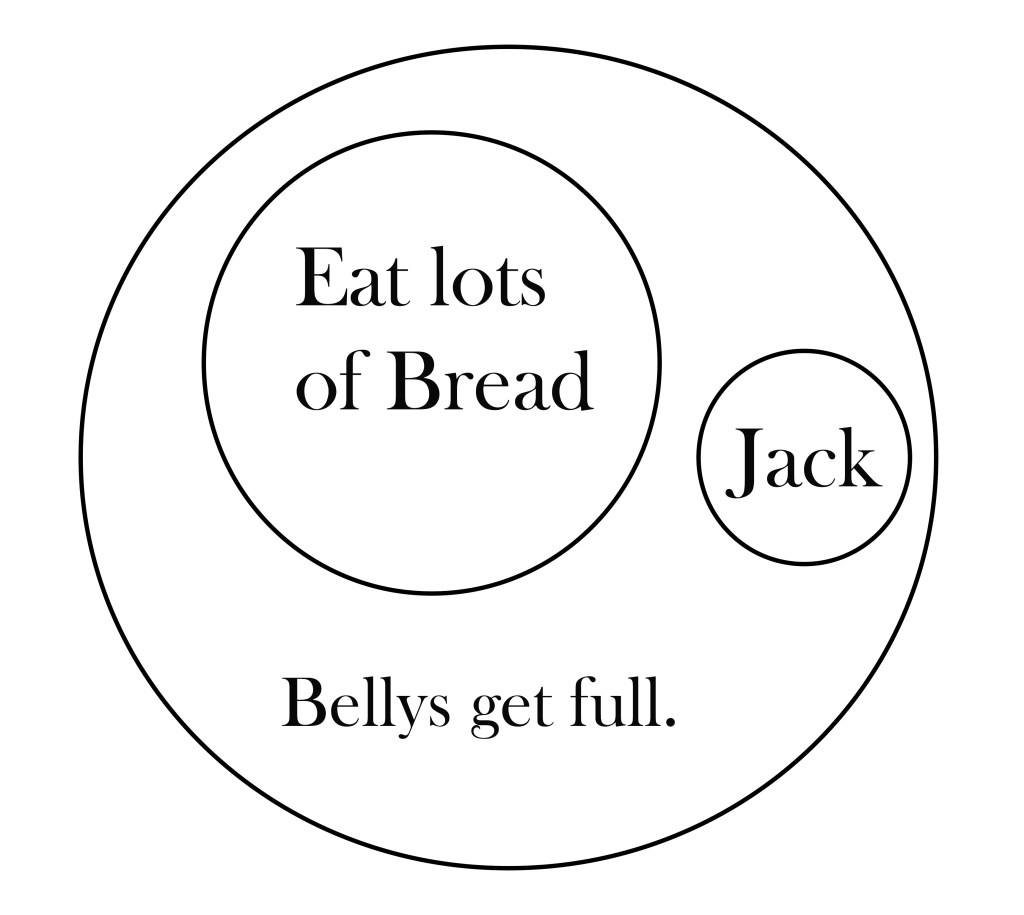
H.1. If [Jack] eats [lots of bread], then his [belly gets full]. A, (B is C)
H.2. [Jack’s] [belly got full].  A is C
H.3. Thus, [Jack] ate [lots of bread] A is B

B is C
A is C
Thus A is B.

This of course is a fallacy. It could be that Jack ate lots of durian rather than bread. Let us put this into categorical logic to see the fallacy.

Y.1. All [who eat lots of bread] are [those who belly’s get full]. B is C
Y.2. All [Jack] is [he who belly got full]. A is C
Y.3. Thus, [Jack] is [He who ate lots of bread]. Thus, A is B

If you noticed, the information in the conclusion has more than what the premises provide. This is the fallacy of an undistributed middle term. The picture below will help show a visual of this logical fallacy.

Thus, the fallacy of scientific experimentation, if restated in a category fallacy, is the fallacy of an undistributed middle term.


Scripture: Sufficient to Condemn John MacArthur & Justin Peters

Justin Peters recently had an interview with John MacArthur. They touched on the subject of faith and miracles.

The first thing MacArthur says about the Charismatics is that their miracle-seeking is “doubt looking for proof” and “looking for a sign to validate it.”

This is calling good evil, and evil good. It’s saying black is white and white is black—like a magician’s sleight of hand, but without the applause. This is a sleight-of-hand fallacy to shift blame from oneself to something else. In the Bible, it wasn’t those doing miracles and seeking to do more miracles that Jesus said, “an evil generation seeks a sign” about; it was said against those who did not believe or do miracles and were asking Jesus and His followers to perform more signs for them.

MacArthur and Peters are the same Pharisees today. They do not believe, and they are the ones who keep asking for a sign (which is empirical evidence) to give proof if a doctrine is true or false. The Charismatics already believe; they do not seek signs, just as much as Jesus and the New Testament church did not seek signs, because they already believed. Paul said that Jesus was raised not on empirical evidence, but because the Scriptures say so. Empirical evidence can never give proof if any biblical doctrine is true or false; it cannot make a truth claim about any aspect of reality. People who ask for a sign not only show themselves to be spiritual perverts and unbelieving, but it also reveals they commit spiritual harlotry with empiricism as a starting point of knowledge over Scripture. Thus, when they say “sola scriptura,” what they really mean is “sola empiricism,” or “sola David Hume”—because nothing says “Bible alone” like outsourcing your epistemology to an 18th-century skeptic.

I would recommend these essays by Vincent Cheung for more reading on this issue of who is really seeking a sign, and who is not. (I am not affiliated with Cheung, only recommending his material). The Reformed have it in reverse order. Their doctrine is a 180-degree contradiction to scriptural doctrine—like trying to drive a car backward and calling it progress.

The Sign of Jonah

Signs of an Apostle

The Miracle Majority

Behold, I Give You Power

Another issue brought up was the sufficiency of Scripture. I agree it is an important issue, but for the opposite reason they state. Peters said, “A growing battle today is not inerrancy of the Bible but the sufficiency of the Bible.” MacArthur then responds, “The Bible gives you everything.” Other things don’t give you this, such as “philosophy or politics, or waiting around for a prophecy.”

Interestingly, considering how sufficient the Bible is, the remark is then given by Peters: “The charismatic prophets do not have a good track record.” Yet, this is an appeal to a human starting point (empiricism) and the fallacy of attacking the person, not the argument. What it is not is an appeal to the “sufficiency of Bible” and the Bible as their epistemology. Like I said before, “sola scriptura” really means “sola empiricism.” It is a natural reflex for them to be stupid and sinful by appealing to empiricism rather than the Scripture, because they are reprobates. This is who they really are: men centered on men, like a bad selfie that forgets the landscape.

With straight faces, similar people have asked me, “Why do we not see so many miracles today, unless God does not want it?” They are like the people from Jesus’ hometown who said, “This is Joseph’s and Mary’s son,” and then in unbelief demand He prove by miracles who He claims to be. But their unbelief made that impossible. These people did not start with God’s revelation; rather, their starting point for knowledge was their human observations. Scripture records it was due to their lack of faith, and not the lack of Jesus being willing and able to heal. With such people, I am asking myself, what happened to starting with God’s revelation for knowledge? Where did God go? Why is it so automatic for them to start with a “human” speculation and “human” superstition—like defaulting to GPS when you’ve got a perfectly good map from the Creator Himself?

If they only mean to do a personal attack (a logical fallacy) by saying, “Oshea (or Johnny), how many miracles have you done,” then why do they default to argumentation that politicians use? Is it because politicians are such shining examples for how to argue for truth? (Spoiler: They’re not; they’re more like debate club dropouts.)

They are like the religious leaders who slapped Jesus and demanded He prove His claim as God by prophesying. They harlot themselves with David Hume’s empiricism in the open streets, and then march back into their pulpits, and after wiping off their sweaty faces, they say with a straight face, “sola scriptura.” Maybe if they could stop humping on empiricism for just a few seconds, they might wake up and realize the disgrace they are committing against their own souls—and against those who hear them, who deserve better than this philosophical slapstick.

For a detailed explanation of how Scripture is sufficient to condemn Peters and MacArthur, read the following essays:

Scripture: Sufficient Against Cessationism

Prehistoric Orthodoxy

Lastly, MacArthur responds with this,

If God gave miraculous gifts, why would He give it to people with such bad theology?”

I remember a quote from Vincent Cheung that gives a reason why God does such things.

“Christian ministers who teach this are often far from perfect, and subject to many criticisms, but this does not invalidate the point. Why do you think God allows many of these teachers to be so flawed and unrefined? He places a stumbling block to trip up those who walk in religious pride, who thumb their noses at those who do not present the promises of God in the way they like. God will put his blessings right in front of them, and they will fail to receive. This is his way to withhold the gospel from the unbelieving and hard-hearted.”[1]

——END NOTES——-

[1] Vincent Cheung. “God’s Extravagant Blessings.” Fulcrum. 2017 pg.33

God will boast about you!

I do not know you and so I will keep my thoughts on a basic level.

I will pray for you.

I am glad to hear you know your wrongs and desire to correct them. This self-awareness and disposition of your soul, about your mistakes and seeking God for help and restoration is something you must not lose, at all costs. This is a must have for proof you are saved.

If you read my essay, “God Rekindles Smoldering Wicks,” you know I once struggled with deep depression and came close to suicide. I know what it is to have a battle within the soul. I talked about having a relentless focus on God and His promises and His positive definition of me as a child of God in His Son. I still go over the promise verses listed there, almost daily. I make them my daily food. This was Vincent’s basic advice to me and it was great advice. I also take the Lord’s Supper almost daily in worship. I read faith devotions and materials, a few times daily.

And this brings me to my next point. Although I quote Vincent Cheung often, what got me out of my pit, had nothing to do with being a good little Clark or Cheung. Your statement about being a “good little Clark,” concerns me. It seems you being centered on “men” rather than “God,” is more natural for you. You might want to disagree with me on this, but in my experience people who say what you did, are in fact centered more on man than God. I am not saying you are unsaved by this, but that, at the very least, the natural tendency of your mind is not going to God first. If you want out of the pit, you must put off this old man, that thinks of man, and put on the new man, that is renewed by putting a mind that first thinks and sees yourself as a child of God standing in the very throne room of Yahweh. It must become secondhand nature for you to see yourself as a prince who belongs in the throne room of God your Father.

When I was getting out of the pit, I did not think of Vincent or Clark or any man. I pounded my mind with the word of God, and from this foundation began to pray in line with who God says I am, and all the good things He has blessed me with. Also having spiritual strength and faith to command demonic attacks and oppressive thoughts to leave is important, if that is how the evil one is attacking you. I could have memorized all that Vincent Cheung has ever wrote, but when I approach God in prayer, it means nothing. What matters are the promises of God and taking an immovable stance on them. When I approach the holy throne of God, what matters, is that I see myself as the righteousness of God, in Christ, so that this throne is a throne of grace and favor for me. Vincent, Clark, nor any man can help me or do this for me; they cannot do this for you either. When I approach God, I am clothed with the precious righteousness of Jesus Christ, who loves me. This is my faith, my hope and my shout of victory as I stand in the presence of God, asking for help. You should get to a point when standing in front of God, in His majestic throne room, before the elders, saints and angels, is more natural and reflexive than approaching any man.

Both in a divine trance/vison God gave me, and from advice from Vincent Cheung, I had to make a change to study more faith-based materials and devotionals and less theology. I needed to work on inner Spiritual strength more than going deeper in theology. I still study theology (and everyone is commanded by God to pursue theology), but my greater focus is inner strength now.

Systematic Theology is easy. Seriously, is it super easy! (This doesn’t mean there is no single point where it can be a little complicated). The older I get the more I realize this. Once I got it, I know it, and no one or demon can take it from me. God’s absolute and direct sovereignty over all things, is a child’s doctrine. Men ought not to boast about understanding it, as if it is a big accomplishment.

Faith is another issue. If you have faith to move mountains, then like the people mentioned in Hebrews 11, you are a man whom the world was not worthy to have known. That is worth boasting about! Like the gentile woman (or the Roman Centurion) who had with faith when Jesus sad it was not God’s will to heal her, but she took it anyway, God will publicly praise you! With faith, God will boast about you! Think about that. Rather than you wasting time boasting about men, with faith, God will use His time to boast about you. If you truly want God’s praise more than men, take an indomitable stance on faith. God’s approval, is the only type of praise that you should seek. Be a hero of faith.

Everyday I read devotions from those infamous health and wealth (word of faith) preachers, that everyone makes fun of. I obviously do not recommend them for overall Systematic Theology (for that see Vincent Cheung), but for basics of faith in God’s promises, I would recommend them to all. They are the only ones out there who obey and respect God by taking those promises of faith, deliverance, healing and material blessing with any kind of seriousness.

Vincent recommended me to leave my Reformed church, focus on spiritual strength with God’s word and faith-based devotions, and this was in addition to a divine vision I received from God about this. I encourage you to do the same. Even though this is not directly about how to deal with the immoral sin you committed, broadly speaking, it will be the way out of the pit. It will keep you out of the pit. It will even thrust you on top of the mountain of God, where God takes you by the hand and delivers you from all your troubles. God wants to do this. He said so. He promised it. He made all those wonderful promises and in blood ensures us He will always perform them, because He wanted to.

The promises are your definition. Listen carefully to me on this. God’s promises are not suggestions, they are in essence a technical definition of God’s children. They are you!

If turn your mind to this, so that these promises (definitions of you) are second nature to your thoughts, you will find yourself standing beside God on mount. Zion, looking down on all your troubles.  Turn you mind to the Jesus Christ in the gospels and book of Acts. He never left. He is waiting for you there.

-from email

You are My Sheep, and I Pray for You

In these promises to each other the Father promises that Jesus is a priest according to the order of Melchizedek. In summery, this means Jesus’ priesthood is before and different from the Levitical one. It is an eternal and permanent priesthood, that the Levitical one cannot override, which came later. The Levitical priesthood, particularly with the Day of Atonement, we see a teaching illustration to learn what the substitutionary atonement of Jesus will look like, who has the original and eternal priesthood.

In Jesus’ priesthood, we learn in Isaiah 53:12 that He both bore (like the escape goat) the sins but He also “interceded” for them. For example, the priest in Leviticus 16 on the Day of Atonement, only sacrifice and interceded for the children of Israel, and not Moab or someone else. The atonement is for Israel only, not other people. The priest only intercedes for Israel. As the next chapter says (17) the “life” of the animal is in the blood. This is like “life” currency. Jesus gives us the currency of His life in exchange for our currency (or debt) of death. The “intercession” is about telling the bank where you want the money to go. What would happen if you dropped off a briefcase of money without say where you want it? This is why Jesus intercedes, He is telling the Father where the life currency of His atonement goes.

In John 17 Jesus prays, “not for the world” but only for those whom “Father gave Him.” This means His sacrifice was only for those whom the Father gave Him, and not the whole world, as in every single person. If Jesus did not intercede for ‘x’ group, then Jesus did not die for them. We call this definite atonement. Jesus’ atonement was successful for a definite group and not universally for all.

John 10:26-27, Jesus says, “you do not believe, because you are not of my sheep! My sheep listen to my voice, and I know them, and they follow me.” The “you do not believe” is the conclusion, the “you are not my Sheep,” is the major premise for why we have this conclusion. If you are not already part of Jesus’ sheep, then it concludes you do not believe, and will not believe. Jesus is answering a question with a separate statement about metaphysics and its effects. The ones not believing Jesus, ask if He is the Messiah. To put Jesus’ statement into a syllogism, (1) if you are not my sheep, then you do not believe.” (2) You are not my sheep. (3) Thus, you do not believe what I say.” Also, Jesus in other places says there is only two options, sheep and goats. By saying they are not sheep He is saying they are goats.

If you are not part of Jesus’ sheep then you will never listen and believe what Jesus says. “And I have other sheep which are not from this fold. I must bring these also, and they will hear my voice, and they will become one flock—one shepherd. (v.16)” Combining this with the above meaning we learn, if a future person is not already now part of Jesus’ sheep, then they will not believe. Jesus teaches if someone is a sheep now, even if they are not-born-again now, they will believe in the future. His sheep, including those who are “going to believe” (future), believe because they “are” (present) already His sheep. These are those who Jesus interceded for, therefore they will believe at God’s predetermined times.

Jesus says “My sheep listen to my voice, and I know them, and they follow me. And I give them eternal life, and they will never perish forever (v27-28).” After saying those who asked if He was the messiah, are not part of His Sheep, He says straight to their face that He gives eternal life to His sheep, which excludes those He is talking to, because He said they are not part of His sheep. There is no teaching of TWO groups that receive Jesus’ “eternal life,” in the scripture. Therefore, the law of excluded middle applies here. If you are not part of this group, then you are a goat, a reprobate.

This also kills the very stupid teaching that says predestination, election, reprobation and God’s absolute sovereignty is an insider doctrine for mature Christians, and not outsiders. Jesus in a mixed audience, in the face of those He is calling reprobates, is teaching these doctrines. Jesus does this again, for example, in John 6, where He says only those the Father draws will come to Him to receive eternal life, and it is for these, that He gives up His life for. If Scripture is going to be your first principle for all knowledge, then get all those answers there, not from men.

The foundational we learn from this are two things about salvation. One is the decrees of God. God in His sovereignty plans and does all the saving of sinful man. Since we have already dealt with the overall doctrine of God’s sovereignty we will focus on this second important point. Jesus’ statements teach the foundation of salvation is about metaphysic, or reality that is. God decides ‘x’ is a sheep and ‘y’ is a goat. The sheep is in the category of a sheep and gets all the category realities that belong to it, and the same with the goat. The world is God’s playdough. He makes up categories from nothing, with all their attributes. He then creates individuals out of nothing, to put into these categories that He wants.

Jesus says for the sheep that He dies for them. He will give them eternal life and they will live with Him forever. This is the reality, the category of being a sheep. He is the only Potter. If God decides ‘x’ is a sheep, then it is so. No one, not even Satan, not even the ‘x,’ can stop it, not because the person will believe against their own will, but because the Potter molds their will to be a sheep, and thus they will believe. Salvation at its foundation metaphysics, not ethics or about man and his choice. Because it is metaphysics first, then therefore, choice and ethics, which are conclusions of epistemology and reality, will follow.

This is great news for all God’s chosen ones who have cried out to God to save them. They will not be disappointed. Despite their internal struggles (even besetting sins) and the attacks of men and devils, even all this cannot stop them from being sheep, cannot separate them from God’s love, and cannot stop them from inheriting eternal life. This becomes a cornerstone for the believers to correct themselves and mature their faith, knowing they are winners. Their faith has overcome the world, because they are children of God.

[this is taken from my Systematic Theology book]