Category Archives: Christian Logic

Nazism, Communism and Christianity

Hitler used the emotional pull of nationalism (appealing to nationalism is something almost all governments in all times have done—in some form– from its people since the dawn of time), as a slip of hand, to enforce his Darwinian Eugenics.

When the Japanese government wants to protect the Japanese way of life and its borders through rallying the people, (thus engage in nationalism) it is not as though they are now Nazis. When Israel says it ought to protect their way of life and its borders from those around them (i.e. nationalism), it is not as if they are Nazis. Or does nationalism make Jews Nazis? That would be a logical fallacy in more than one way. If a liberal gets their wish and this very hour the government is transformed into their ideal form of government, does it make them a Nazi or fascist because they are now proud or like their government? But I digress.

Nationalism is a tool to be used. It is a sub, sub category of other philosophy questions: it is not an ultimate question about First Principles of knowledge, Logic or of Metaphysics or Ontology or Ethics.

In America, biblical principles were used to form the government, although it was only partial, for there were other philosophies used as well. For example, I do not believe the bible supports a democracy. This is where things get a little convoluted. To “conserve” (i.e. conservatives, or conservatism) means to stay with your initial or original starting point, or standard or epistemology. This is often called the “right.” To be liberal means to liberate from this original starting point because you believe all or part of it is false. This is often called the “left.”

Therefore when referring to the scripture, it is always wrong to be liberal, and always right to be a conservative. However, with governments, this get complicated because their starting points are often mixed and or unclear. Since the Western world was so heavily influenced by Christianity, and the much modern liberal movement (for the last 100 years) is about liberating Christianity from the government, homes and culture, we will broadly define the terms from this point, although there is more to it.

Thus any philosophy of government that liberates from biblical principles is “liberal,” “left,” and any attempts (as imperfect as they are) to stay with biblical ones are conservative or right. Thus, Nazism and Communism are both far left or liberal governments, for both heavily liberate from the Biblical and its worldview.

Totalitarianism is ruling a people, with all power given to one or a few. King David as a king ruled by totalitarianism. Jesus does as well. But neither King David or Jesus are Nazis or Karl Marx. Just because a star is round and an apple is round, does not make them the same thing. Since the bible is the starting point for all knowledge, then any correct aspect of government was first stolen from the bible, and then corrupted with additional speculations from men.

We will deal with Nazism in particular, but fascism is the same. It is categorically impossible to say fascism(or Nazism) is right and communism left because both fascism and communism are founded on the epistemology of empiricism and the metaphysical of Darwinism’s evolution and survival of the strongest.  Hitler’s form of fascism argues a more direct connection from Darwinism to fascism but fascist like Mussolini went from Darwin to Nietzsche to fascism. Nietzsche using Darwinism said God is dead and man is a “superman” who rules by strength and not weak things such as kindness. Thus all forms of fascism is a denial or contradiction of Christian epistemology, metaphysics, logic and ethics. All forms of fascism are liberal to all Christian foundations and doctrines about reality. Every answer of ultimate questions that Christianity gives, fascism liberates from it.

Let us go over the basics of these government’s ultimate questions.

**Nazism: is Darwinism plus Eugenics with the ethic that they ought to force natural selection and survival of the fittest with totalitarianism. Fascism, in general would replace direct Darwin ethics with Nietzsche ethics, which are founded on Darwinism.

Nazi Epistemology – Empiricism (knowledge through sensation).
Nazi Metaphysis – naturalism and natural selection
Nazi Ethics – People OUGHT to enforce a natural selection for the good of man by totalitarianism. (or Fascism (Nietzsche: The new superman ought to rule by might)

**Communism: is Darwinism plus the theological idea that man is inherently good, plus the ethic that man ought to have this goodness in man ensured by the force of totalitarianism.

As a side note I must say as irrational as Hitler was in making a “ought” from descriptive premises of metaphysics, at least I understand his invalid, inductive direction. He sees survival of the fittest (thinks he does), and then metamorphoses (invalidly) this into an ethic. Marx was beyond stupid and irrational. He believed in evolution and Darwinism, but instead of embracing survival of the fittest as an ethic as Hitler did, he decided to neutralize the metaphysics he affirmed as an ethic. LOL? So he both invalidates what he affirms as a metaphysics, and then metamorphoses this into an ethic. Its like saying, “humans are organic. This is a human. Therefore, we will use government to replace their bodies with non-organic material, because it is morally good to not have an organic body.” Beyond stupid. There are so many category fallacies its hard to keep up.

Communism Epistemology – Empiricism (knowledge through sensation)
Communism Metaphysics – is naturalism and Darwinism.
Communism Ethics – it is morally good to oppose survival of the fittest observed in Darwinism and use government to force (people who are born inherently good -whatever that means) to be economic and social equals.

**Christianity: The scripture is the only starting point. Metaphysics is God’s absolute and direct control over all things. And ethics is God’s command.

Christian Epistemology – Contradicts Empiricism.
Christian Metaphysics – Contradicts Naturalism, national section and contradicts that man is inherently good.
Christian Ethics – contradicts government “ought” to use force to ensure natural section, and contradicts that government “ought” to enforce the inherent goodness of man by equalizing economic and social levels.

Thus, Christianity has no contact with Nazism or Communism in any important aspect of ultimate questions. To conserve to Christianity would be to liberate from both Nazism and Communism. Also to conserve to either Nazism or Communism would to be liberate from Christianity.

The question is who does have contact with the important philosophy topics of these two systems? American liberals. Liberal theologians.

Who has empiricism for their Epistemology?
Who has naturalism or Darwinism for their metaphysics?
Who has Nietzsche as their ethics?

Those who do, have foundational contact with Nazism/fascism and communism the ultimate questions of life. These are liberal, left government philosophies, for they liberate from the ultimate questions given by scripture and conserve to anti-biblical epistemologies and metaphysics.

bayzid-ahmmed-Gklygrxsisc-unsplash (crop)

“So…I should throw rocks at gay people?”

Science commits a triple logical fallacy of empiricism, observation and affirming the consequence (i.e. experimentation.) This necessarily leads to denying the law of contradiction because of skepticism, which is impossible.

Even the bible shows man’s observation is not always correct, 2 Kings 3:16-24, John 12:28-29, Matthew 14:25-27, and Matthew 28:16-17.[1] The importance is significant. If I showed one place in the Bible was wrong, then it would move the whole bible into skepticism as a starting point for knowledge. It would mean that I cannot prove any one statement is true. This is skepticism. But skepticism denies the law of contradiction. Try denying your own existence without using it?

The point is this, a contradiction has no being in the mind or in reality. Yet, the bible shows man’s observation (empiricism) is mistaken. It also shows Jesus appealing to the law of contradiction and being called the LOGOS itself. Thus, empiricism is not a starting point for knowledge. And in addition to these fallacies, scientific experimentation uses affirming the consequent. For example, “If I speak there is a sound. There is a sound; therefore I spoke.” Yet, this irrational structure is the foundation for all experimentation. And yet, it is supposed to produce “knowledge?” LOL!

I have skipped many other problems with science but just focused on a few. If you need more reading, then I would recommend Vincent Cheung and the essay, “A Gang of Pandas.”

Johnny responded with:

“So…I should throw rocks at gay people?”

So… how long have you been abusing children? Getting past loaded questions and other informal fallacies, let us focus on the actual issue.

Since you used an ethic by saying “should,” ( I did not ) the burden of proof is on you to prove you have knowledge of what is an ethic without presupposing the bible, or that is, presupposing my worldview that says you are wrong.

The bible clearly defines ethics, and even establishes the ontology of ethics. How can you rationally question me about any ethic whatsoever, if you cannot produce a sound argument to tell me what is an ethic? You cannot. You are intellectually broken and malfunctioned.

How do you know what is an ethic if you use empiricism, without producing multiple category errors? How do you avoid category errors when you use descriptive premises, to then go to an “ought” in the conclusion? Did you smell an ethic? Did you see it? But an ethic is an invisible proposition in the mind about right or wrong revealed by God. To even understand what is an ethic you must presuppose the bible, but the bible says you and all anti-Christian systems are wrong.[2] Thus you are wrong by logical exclusion.

Here is an ethic that corresponds with reality, rather than the delusions you invent. The bible says all who do not believe in Jesus Christ as God’s only Son and repent are already judge by Father.

ENDNOTES

[1] Vincent Cheung first brought this to my attention.
Vincent Cheung. Presuppositional Confrontations. 2010. Pg 70.

[2] See Vincent Cheung, Captive To Reason, 2009 pg 44.

agung-raharja-RSwyYi7h8gA-unsplash

A Superior Species

We declare God’s wisdom, a mystery that has been hidden
and that God destined for our glory
.
1 Corinthians 2:7

Its all fun, joy and praises when I mention we need to glorify God, praise Him, give Him all the credit, and extol His Name above all others, and this is as it ought to be. However, once I mention how highly God has exalted man as a superior species in Christ, then I am attacked. The reason for this is the church being under the oppression of tradition and false humility. People are stuck at the doorway of forgiveness, being centered on their sin; they are centered on themselves.  This doorway into the next life, is so precious and magnificent that they remine there. They never truly inter in the glory and privilege of being children of God. They never experienced what it means to be child and sit at the table of their beloved Father.

The Logic of Denying the Consequent is used throughout the Scripture. If there is a logical necessary connection from the antecedent to the consequent, then if you deny the consequent, you deny the antecedent. The part that makes this work is if the connection is necessary and not merely sufficient. Ultimately, this means it must be a truth, but only God is able to reveal truths. However, since the scripture gives us truth and uses this logic, then so will we.

For example,

Galatians 3:18, “For if the inheritance is of the law, [then] it is no longer of promise; but God gave it to Abraham by promise.”

M.1. (P) If inheritance if of the law, (~Q) then inheritance is not by promise.
M.2. ~(~Q) It is by promise.
M.3. ~(P) Thus, inheritance is not by the law.

This example is given to lead to our present subject. If you deny the consequences of man’s highly exalted position produced by Jesus’ atonement, then you deny the atonement. There is no way around this.

Does Jesus sit in the heavenly places?
So does man (Ep. 2:6, Col. 3:1-3).

Is Jesus blessed with every spiritual blessing in the heavenly places?
So is man (1:3).

Does Jesus have the Mind of Jesus?
So does man (1 Corinthians 2:16).

Was the gospel predestined for the glory of God?
Yet, it was also predestined for the glory of man (1 Corinthians 2:7)

Does Jesus have direct access to the Father?
So does man (Hebrews 4:16, 10:19)

Is Jesus heir of the world?
So is man (Romans 4:13).

Does everything belong to Jesus, including time?
It also belongs to man ( 1 Corin. 3:23).

Does Jesus have the intellectual and ethical power to judge all things?
So does man ( 1 Corin. 2:15)

Jesus is the only begotten son of God, but in this context, I ask, is Jesus a child of God?
Yet, so is man (1 John 3:1,9, 4:13)

Is creation liberated into the liberty of God?
Yet, it is also liberated into the glorious liberty of man (Romans 8:21).

How glorious and valuable is the resurrected Jesus Christ?
Man also has this glory and image (Romans 8:30)

Did Jesus have the fullness of the Spirit of God on earth? (Acts 10:38)
So does man (Acts 1:1-8)

Does Jesus dwell in the house of God?
So does man (John 14:1-3)

Does God judge Angels?
So does man (1 Corinth. 6:3)

The same love the Father has loved Jesus, Jesus loves man. (John 15:9)

The same love the Father loves Jesus, the Father loves man. (John 17:23

The same glory the Father gave Jesus, Jesus gives this glory to man. (John 17:22)

The same Spirit of God, who knows God exactly (because it is God’s Spirit), God has given to us, so that we have the Mind of Christ.

If we deny pantheism (as the bible does), then we must affirm, as the Scripture does that God does these glorious thing to man, not Himself. When Peter says to humble yourself under God’s hand, he says God will exalt “you” and not Himself.  It was Jesus, who created all things and sustains all things by His power, who said, “give to Caesar what belongs to Caesar.” If this is so for a pagan, how much more is this true for all thing magnificent things God as given His children.

God promised to make Abraham’s name great and famous. Abraham became excessively rich and defeated a combination of many armies. Even to this very day Abraham is sung in the songs of millions and millions of Christians. Even in Heaven Abraham is famous (Matthew 8:11). The promise was to make His friend’s name great, not His, and it happened just as God said. God made Moses like a God to Israel and Pharaoh. God promised to do the same for Joshua, by making him great in the eyes of Israel. It was never recorded that Jesus was teleported by the Spirit, but this glory was given to a man, a table bearer named Philip.

To diminish the glory of man, particularly the born-from-above man, is to diminish the glory of God, because God said He has greatly exalted and glorified man through Jesus Christ. It would be to say God is defective and stupid at accomplishing His desires. To trample on the glory, fame and exaltation God has given His chosen ones is to trample on the blood of Jesus Christ as a common and ineffectual thing.

We are part of Abraham’s blessing, fame and glory (Gal. 3-4).

God does not mind sharing His glory, authority and power, for example, with His friend Abraham or giving the disciples 12 thrones, and all saints the inheritance of being His children; however, what God will not share is the credit and praise that belongs only to Him for all the good things He predestined for our value. Praise and credit is one type of glory (there are many types of glory), however, this type of glory, God will not share. Herod learned this the difficult way. Fame, power, favor, thrones, an eternal name, riches God has no issue lavishing these glories on His friends and children.

God has made us a superior species in Jesus Christ. Any denial of the unmeasurable magnitude of this reality is a denial of the gospel and blood of Jesus. There is no risk of pride, for we know God has give all these things to us by unmerited favor and mercy. Jesus loved us to the point of the cross. To accomplish these great things for us He was nailed to our curses. However, by the magnificent promises of God we partake of the divine nature itself. It is our new identity. We are glad to recognize this and praise God for eternity. We are filled with inexpressible joy for all the good things God as lavished so freely upon us. Oh, what great love this is, that God calls us His highly beloved children.

mi-pham-FtZL0r4DZYk-unsplash

Flooding the Gospel with Funding

2 Corinthians 8:9 NLT,
“You know the generous grace of our Lord Jesus Christ. Though he was rich, yet for your sakes he became poor, so that by his poverty he could make you rich.”

2 Corinthians 9:8 LEB,
“And God is able to cause all grace to abound to you, so that in everything at all times, because you have enough of everything, you may overflow in every good work.”

The more you gain financially, the more you’re a threat to the devil.”
(Kenneth Copland. Twitter, Aug 2022)

This shipwrecks people’s faith. It’s a mockery of what it means to ­­follow Jesus. Jesus was not rich, nor His disciples; and yet, nobody was a bigger threat to the devil and Him.”
(Johnny Billy)

Part of the substitutionary atonement of Jesus is the aspect of Jesus taking on (being imputed) our poverty and in exchanging crediting His elect with His wealth. Paul’s statements above, are in context of money, and giving this money to fund the gospel ministry and aid. Paul says the foundation of this, is not the Corinthians working hard for their own money, but just like with sin and righteousness, Jesus worked hard by taking on their poverty, and in exchange freely credited wealth to the Corinthians. Paul argues part of the reason Jesus deposited such financial excess to His elect, (not the only reason), is for the purpose of giving this excess to fund the church and gospel ministry.

Peter said it was not good for him and the apostles to focus on serving tables, but rather on the ministry of the word and prayer. The reason is because the ministry of the word is the most powerful ministry. The bible always shows this to be the case; indeed it is God’s gospel (the word) that is powerful to save. Peter’s short sermon in Acts 2 brought in 3 thousand souls out of the kingdom of darkness and conveyed them into Kingdom of God’s unmerited favor. The point is this, severing tables is a good thing (and those who do this will not lose their reward), but a focus on a ministry of the word is always the most important. Therefore, how obvious it is to see that a ministry that lacks money and thus, must divert time away from a ministry of the word, to other do things, is a ministry that is being hindered. A ministry that is fully funded and is able to and does focus on the ministry of the word with power, will be a very fruitful ministry.

It is not a secret how poorly the church overall gives tithes. Many pastors end up begging for financial help. God sees their pain. However much that Satan rejoices in a defunded police, that allows the innocent to be unprotected, Satan much more rejoices in a defunded church, so that the preaching of the Word is hindered. The funding of the church is 100 times more on the hearts of Christians than the funding of any other organization.

“Look! The wages you failed to pay the workmen who mowed your fields are crying out against you. The cries of the harvesters have reached the ears of the Lord Almighty” (James 5:4).

The money that you withhold from preachers who proclaim the word of God to you, who teach you sound doctrine, who defend you against assaults and deceptions, and who pray for you, so that your faith would not fail, now testifies against you before the Lord. It will stand as a witness against you in the day of judgment, as evidence of your injustice and cruelty. God will hold you responsible for every lack that they endure. He will charge to your account every occasion that their wives worry about the future. He will punish you for every night that their children go to sleep hungry. And what about those who have to do without the ministry of preachers who lack the resources to reach them? Surely their blood is on your hands.”
Vincent Cheung. “Preachers and Their Wages.”

Those who oppose Christians seeking, teaching and asking Jesus to give them financial prosperity, are those who have sided with Satan, and are enemies of the gospel and blood of Jesus Christ. Logically, Prosperity is no less the gospel, than the forgiveness of sins and healing. Because financial abundance is produced by the gospel of Jesus Christ, it is received in the same way forgiveness and healing is, by faith.

Jesus said,

Luke 16:9 NIV, “I tell you, use worldly wealth to gain friends for yourselves, so that when it is gone, you will be welcomed into eternal dwellings.”

He is instructing us to use earthly prosperity to gain spiritual friends (the chief of friends is God) so that when you died, God will welcome you to His eternal house. You can either set your mind on money and by your own effort attain it (the love of money), or in “faith” in the gospel receive an abundance of wealth by God’s power, so that you can use it fund the ministry of the Word, help those in need and use it even for your own enjoyment. Yes, you can use money on earth in such a way as to exchange it for eternal blessings.

Johnny Billy’s statement is an attack of the blood of Jesus Christ. It is also mis-leading and stupid. Jesus’ type of ministry is one that even many missionaries do not follow. How many go from town to town, nonstop preaching, healing the sick and casting out demons? Jesus said He had nowhere to lay His head, because of this specific way to do ministry, and not as a general statement about ministry itself. Also, Jesus and the disciples had enough money to fund them with all the people following them, and so much extra that Judas was able to steal from the money bag and it not be a problem. This might not be a definition of wealthy, but they were not poor either. And lastly, their specific ministry does not negate the doctrine that Paul taught saying Jesus exchange His wealth for our financial lack, so that we have His wealth to fund the gospel.

In addition to these mis-leading statements it is self-damning.  Johnny says that Jesus and the disciples, did not have prosperity, but they were still a bigger threat to the devil than anyone.

This is stupid for a few reasons. Jesus and the disciples were funded by money for their ministry. Many people and women followed, supported and provided for them. This is the very reason why Paul said Jesus died with our poverty and gave us His wealth, so that we can support the gospel.

Kenneth Copeland often teaches on healing and even casting out demons. Jesus and the disciples were supported and funded for their ministry. What did they focus on in their ministry that was such a threat to Satan?

“And you know that God anointed Jesus of Nazareth with the Holy Spirit and with power. Then Jesus went around doing good and healing all who were oppressed by the devil, for God was with him,”
Acts 10:38.

Jesus was a treat to Satan being able to victimize people, by healing thousands of them.

Jesus said He was opposing the kingdom of Satan by casting out devils and healing. Jesus said God anointed Him to heal, heal, heal, resurrect the dead and preach the gospel. I wonder how many of those who criticize the prosperity gospel, heal the sick, heal the sick, heal the sick, resurrect the death and cast out demons? If they do not, then their ministries are not a gospel ministry and their ministries do not oppose a threat to the devil. So when they are opposing ministries that do focus on healing, casting out demons and encouraging faith to receive money through the gospel to finance a real gospel ministry, they are in fact mouth pieces for Satan. They have sided with the devil to oppose ministries that are the only true threat their god victimizing people.

Let us instead focus on being a true threat to Satan by healing the sick and teaching God’s chosen ones to have faith in the gospel of Jesus to receive financial help, and then to use this to fund gospel ministries that are pushing back the darkness and shining the light of heaven on the earth.

Indeed, you can tell the false gospel from the true gospel, by the sounds it produces. The false gospel will produce sounds of demons yelling and foaming out the mouths of people in joy, as people scream in pain, fear and poverty. However, the biblical gospel will produce sounds of demons screaming in fear, and the saints shouting for joy, in healing, forgiveness, blessings and prosperity!

“Many evil spirits were cast out, screaming as they left their victims.
And many who had been paralyzed or lame were healed.
So there was great joy in that city.”
(Acts 8:7-8).

And when you hear this sound, then flood such gospel ministries with funding.

Let the demons scream and the saints shout for joy.

Everlasting Love, A Simple Deduction

From afar Yahweh appeared to me, saying,
I have loved you with an everlasting love.
Therefore I have drawn you with loyal love
,” Jeremiah 31:3 LEB

Let us look at the beauty of this basic deduction.

To have a good deduction you need exact definitions that do not change. This meaning of the “everlasting love,” is both simple and at the same time I could easily do a small book to cover all the systematic depth behind this definition. For simplistic sake we define it as God favoring His elect from the very beginning of His decrees about them. Relating to time, from the very moment of God forming the elect in the womb, God’s plan was to favor them.

The application (or in technical terms, ‘logical inference,’ or ‘deduction’) that God tells Israel is that God will therefore draw them to Himself in the Promise Land with a loyal love.

B.1. All [those God loves with an everlasting love] are [those God draws to Himself in a faithful love].
B.2. All [Israel] is [he who God loves with an everlasting love].
B.3. Therefore, [Israel] is [he who God draws to Himself with a faithful love].

Or to put this into a more readable propositional modus ponens.

C.1. If God loves ‘x’ with an everlasting love, then God loves ‘x’ with a faithful love.
C.2. God loves ‘x’ with an everlasting love.
C.3. Therefore, God loves ‘x’ with a faithful love.

This is a simple example of the unending logical inferences God makes in the Scripture concerning His chosen ones. Because God is the LOGOS or LOGIC itself, He uses logic with absolute perfection, and when the content is about His chosen ones, it is both perfect and filled with hope and love.

When God thinks about anything in reality, it is a logical deduction, and so the Bible, which is the public portion of God’s mind revealed to man, is a rigorous structure of deduction.  However, like the above, the logic most of the time is simple and easy to follow. With basic reading comprehension skills and basic logic, the vast majority of the Scripture can be understood by anyone with faith to believe. It is not that books about biblical exegesis and hermeneutics are bad, but they are often overkill.

Once we read that God is absolutely and directly the cause of all things, then the syllogism is so simple that a 2 grader can do it. Therefore, God directly and absolutely causes evil and sin.

The issue is not that the application (i.e. deduction) of God’s truth is inaccessible; rather, faith is inaccessible for most men, and without faith, one cannot see, accept or want to accept the basic premises and application of God’s Word. However, with faith, then not only is forgiveness of sin accessible, and all doctrines and their application, but the power to move mountains becomes available, along with all the good promises of God including healing, miracles and material blessings.

.

Science: the Fallacy of an Undistributed Middle Term

QUEST. Is the fallacy of affirming the consequent a type of inductive reasoning; or is inductive a type of the fallacy of affirming the consequent; or are the two completely unrelated? Induction is defined as arguing from a particular to a universal.
Affirming the consequent: P ⊃ Q; Q; ∴ P.

ANS. Affirming the Consequent and inductive reasoning are similar or comparable, if we define inductive reasoning as “having more information in the conclusion than what the premises contain.”

In essence, the informal fallacy called, “non-sequitur” – “does not logically follow from the premises”—is what all inductive reasoning is.

Deduction: Conclusion has information only contained in the premises.

Induction: Conclusion has new additional information the premises do not contain.

For example

E1. All [things that comes to pass] are [determined by God]. B is C
E2. [Man’s moral acts] are [things which come to pass]. A is B
E3. Thus, [man’s moral acts] are [determined by God], & [not responsible]. A is C & D

The conclusion “man’s moral acts are determined by God,” is obviously already contained in the original premise, “All that comes to pass are determined by God.” If all things are determined by God, then so is man. Simple enough. However, the term “not responsible” and the necessary connection to it are not in the premises. This the essence of all inductive reasoning, it a non-sequitur.

As for affirming the consequent, depending on the terms and its simplicity many of them can be interchanged with categorical logic. Be forewarned not all can be interchanged like this.  It needs to be a simple,  If A then B is C. (Example, “If A is B, then C is D,” type of arguments will not work. 

The thing to remember is if one does truth tables in Natural Deduction, one will see that the simple forms (modus ponens, modus tollens) do not become invalid with complexity (for example with multiple conjunctions). Thus, the key is to master the basic forms, and realize they will continue to be valid, even in complexity, long as one keeps the form. Since scientific experimentation uses the form of affirming the consequent, and denies theory’s with a modus tollens, all one needs to do is understand these basics. Also, keep in mind, basic propositional logic like modus ponens, focus on the necessary connections, while basic category logic will focus on necessary category realities. If you have one, because these are “necessary,” then you have the other, but they are not the exact same thing. 

This simple modus ponens is stating the B and C terms, the third term, which is missing is an implied fill-in-the-black, ‘A’ subject.

If a mammal, then warm blooded. (B is C)
Is a mammal. ( B )
Thus, warm blooded. ( C )

The argument is based on the presupposition that mammals are warm-blooded (B is C) is a given truth.

M.1 If [Bats] are [mammals], then they [warm-blooded].  A, (B is C)
M.2. [Bats] are [mammals]. A is B
M.3. Thus, they [Warm-blooded]. A is C.

Even though the first line of this Modus Ponens, M.1., has all three terms (A is B is C), the main emphasis is that B is C, like the major premise of a Category Syllogism. Next, M.2. is A is B, which is similar to the minor premise of a Category Syllogism. Finally, the conclusion is A is C.

B is C
A is B
Thus, A is C.

This Modus Ponens is hypothetical in form only. The essence of this argument is the comprehension and extension of the terms, not mainly about the necessary connection from B to C. Thus, we will put this into a bullseye syllogism.

N.1. All [Mammals] are [Warm-blooded]. B is C.
N.2. All [Bats] are [Mammals]. A is B
N.3. Thus, All [Bats] are [Warm-blooded]. A is C.

Now, let us review Affirming the Consequent, which is the structure for scientific experimentation. We will use a simple enough form that it can be used in categorial logic.

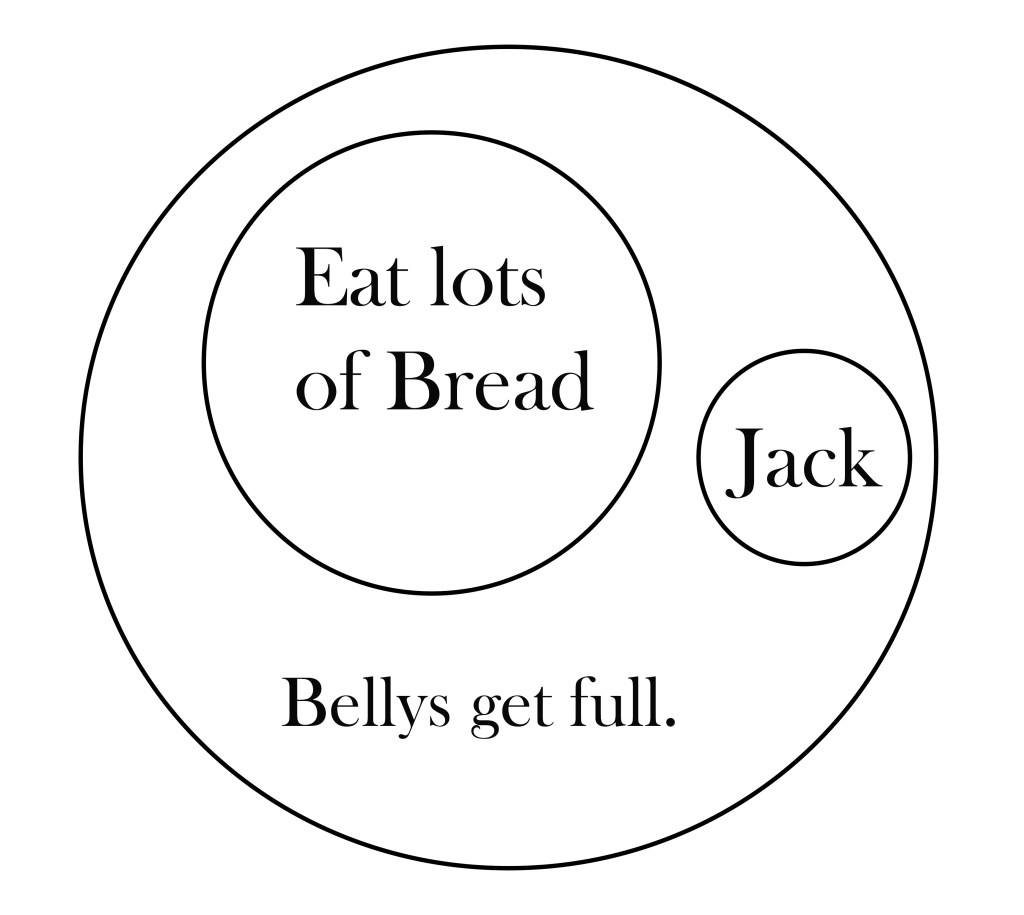
H.1. If [Jack] eats [lots of bread], then his [belly gets full]. A, (B is C)
H.2. [Jack’s] [belly got full].  A is C
H.3. Thus, [Jack] ate [lots of bread] A is B

B is C
A is C
Thus A is B.

This of course is a fallacy. It could be that Jack ate lots of durian rather than bread. Let us put this into categorical logic to see the fallacy.

Y.1. All [who eat lots of bread] are [those who belly’s get full]. B is C
Y.2. All [Jack] is [he who belly got full]. A is C
Y.3. Thus, [Jack] is [He who ate lots of bread]. Thus, A is B

If you noticed, the information in the conclusion has more than what the premises provide. This is the fallacy of an undistributed middle term. The picture below will help show a visual of this logical fallacy.

Thus, the fallacy of scientific experimentation, if restated in a category fallacy, is the fallacy of an undistributed middle term.


I Reserved 7000 Who Have Not Bowed to Empiricism

The only real problem with tackling adult doctrines like God’s sovereignty, predestination, election, and reprobation is that if you’re still a spiritual child, you’ll predictably end up injuring yourself and everyone in your vicinity. I recall Vincent Cheung dropping a line like this a few years back, and it just keeps ringing true every time I bump into churchgoers who prove the point.

When knowledge fails to amplify a person’s faith, it merely enhances their talent for faking it. Simply because some self-appointed expert decides to wrestle with an “adult” doctrine doesn’t automatically grant them spiritual or intellectual maturity. Sure, you could hand a baby the keys to a Ferrari, but he’s bound to total it in seconds. Plopping him behind the wheel doesn’t magically age him up. In the same vein, the vast majority of theologians are nothing more than spiritual toddlers clumsily juggling adult concepts. They toy around with ideas like divine sovereignty, the covenants, and the grand arc of redemption history, but the moment they try to drive—when they start formulating, teaching, and applying these doctrines—they cause massive pileups in people’s faith. [1]

I recently had another short exchange with a person (we’ll dub them Billy for anonymity) on the topics of faith and healing. I was laying out some key Bible verses about faith and healing, while encouraging them to actively cultivate and strengthen their own faith. I made a particular point about how faith in God’s promises—be it for forgiveness or physical healing—ensures you receive what you’ve asked for in prayer.

I pulled directly from John 15:7-8: “If you remain in me and my words remain in you, ask whatever YOU want and it will be done for you. My Father is glorified by this: that you bear much fruit, and prove to be my disciples.”

Not only does this passage explicitly state that you’ll receive what “YOU” personally desire (it doesn’t limit it to what GOD might want, but emphasizes “YOU”), but Jesus Himself positions these answered prayers—for the very things “YOU WANT”—as His genuine test of orthodoxy and discipleship. The gospel is Jesus’ Creed, and answered prayers is His test to see if you are legitimate. He declares that it “proves” you are truly His disciple if you pray for what you want and God provides them.

And why is that the case? It’s because only those who are true insiders within the Contract enjoy this level of privileged access to the Father. Outsiders simply don’t have the clearance. Jesus is offering up a test of orthodoxy that’s impossible to counterfeit or simulate. Only legitimate children of God can casually ask for anything they desire, and watch as the Father delightedly grants it. Reprobates and those outside the covenant are barred from this access and the vibrant life it brings.

This mirrors the kind of proof Jesus provided for His own identity as the Son of Man. The religious phonies and obsessive fanboys would obsess over external rituals, like washing the outside of a cup, to fabricate an appearance of being part of the Elect. But since they are, in reality, reprobates, they can’t deliver the authentic proof of orthodoxy, which boils down to genuine faith. Faith provides unhindered, direct access to God and serves as irrefutable evidence that you’re among the Elect. Jesus demonstrated that God was listening to His prayers, and through that, He showcased the Father’s full approval. This wasn’t something He achieved through His own isolated power; rather, God bestowed upon Him the fullness of the Spirit (a gift we’re also explicitly commanded to pursue and receive), and granted Him every request He made in prayer. By doing so, Jesus proved that His insider relationship with God was of the most intimate variety possible. Jesus urged people to believe Him, precisely because of His miracles. “Don’t believe me unless I carry out my Father’s work. But if I do his work, believe in the evidence of the miraculous works I have done, even if you don’t believe me,” John 10:37-38. And here’s the kicker: God commands us to do something similar, to receive answered prayers for miracles as tangible proof that we are indeed Elect insiders, rather than reprobates destined for the flames. He insists on a form of proof that no reprobate could replicate.

Aside from Jesus’ Creedal “proof” for discipleship, there’s also the truth about just how intimate our status as Contract insiders truly is. God loves us deeply; He views us as cherished children who sit at His family table. We can boldly ask for whatever WE want, and He will joyfully hand it over. The Father destroyed His only begotten Son by the agony of crucifixion. He was scourged and torn apart. He motions toward Jesus’ bloodied body and declares, “This is how seriously I take my promises.” He goes to great lengths to provide assurance that He will fulfill what He has pledged. And He has pledged to give us whatever we ask for in faith. Pause and reflect on the sheer lovingkindness of God toward us, on the unwavering loyalty of His unmerited favor for those He has chosen to love!

Billy came back with this retort:  
“Where are all these miracles? I do not see them. If what you are saying is true, then no one is saved.”

In my head, the immediate reaction was, “You David Hume empiricist whore, you spiritual adulterer and faithless pervert. You have sold out your soul to worldly philosophy at the most bedrock level of your worldview, outright rejecting God in the process.”

Aware that this individual prided themselves on being “Reformed,” I chose to respond by drawing on how God Himself addressed a comparable accusation in Scripture. First off, Paul in Romans chapter 9 acknowledges that if we’re just going by human observation (that is, empiricism and inductive reasoning), it might appear God has failed to save His people. But Paul counters that God hasn’t failed at all, because His promise was always to bless those included in the promise through election, not merely those born naturally as Jews. An overwhelming surplus of reprobates in no way invalidates God’s promise to save His elect ones.

Paul then references the story of Elijah and God as a prime illustration. Elijah was no minor figure in Israel—he was a heavyweight prophet, widely recognized, extensively traveled, and deeply experienced in the nation’s affairs. After enduring so much, he hits a low point of discouragement and complains to God that he is the sole remaining believer in all of Israel. As I mentioned, Elijah wasn’t some isolated rural farmer with limited exposure; he had seen and interacted with Israel. So, from a purely human evaluative perspective, his credibility for drawing an inductive—though fundamentally irrational—conclusion from his observations is better than most. He concludes, based on empirical data and inductive logic, that he is the last faithful one, and he presents this as truth before God Himself. But God rebukes Elijah, informing him that He has personally reserved 7,000 individuals who have stayed loyal. This ties directly into the Romans 9 framework, where God asserts that before people are even born or have done anything good or bad, He sovereignly chooses to love some and hate others, according to His election and reprobation. The lump was neutral; it wasn’t already bad or good. From this neutral lump God then creates good or bad things.

“God has not rejected his people, whom he foreknew! Or do you not know, in the passage about Elijah, what the scripture says—how he appeals to God against Israel? ‘Lord, they have killed your prophets, they have torn down your altars, and I alone am left, and they are seeking my life!’ But what does the divine response say to him? ‘I have left for myself seven thousand people who have not bent the knee to Baal.’ So in this way also at the present time, there is a remnant selected by grace,” Romans 11:2-5.

The very same response God gave to Elijah, Paul affirms, held true in his own era and continues to apply today.

Therefore, when someone whines, “I don’t see all these miracles and answered prayers (as Jesus described and commanded in John 15:7-8), so they must not exist, and so what Jesus said can’t possibly mean what it plainly states,” they’re behaving with the same irrational arrogance as Elijah did. God’s rebuke to Elijah is perfectly applicable here as well. God has reserved for Himself 7,000—or perhaps 70,000,000—who have not bowed the knee to empiricism (that modern Baal) and who haven’t abandoned Jesus’ directive for answered prayers. Regardless of what Elijah could observe and compute through his senses, God’s declaration is the sole valid starting point for all knowledge. God is truthful when He proclaims a remnant according to election, while Elijah was acting as a liar and a false witness against the truth. His false testimony stemmed directly from his reliance on empiricism and inductive conclusions.

So what if you personally don’t witness an abundance of answered prayers and miracles? Even if that implies there’s an excessive number of reprobates infiltrating the church, just as Paul noted with the Jews, it doesn’t indicate any failure on God’s part. It simply means the reprobates have failed to attain insider status due to their deficient faith, and as for the rest, it’s likely because you yourself are a reprobate, which explains why you’re not positioned to witness God’s power in action.

Religious fanboys and self-proclaimed Reformed enthusiasts love to bandy about doctrines like election and reprobation, but since these are mature, adult-level truths, they are utterly wasted on childish minds. This doctrine of reprobation is like a loaded gun pointed straight at their own faces, and they are the ones gripping the trigger. They will end up harming themselves and bystanders whenever they mishandle it. Perhaps the reason they fling around the term “reprobate” so freely is that, by God’s ironic providence, they themselves are reprobates and feel an unconscious affinity for the word.

I absolutely cherish God’s providence, especially because I don’t reject half the Bible to suit my preferences. As Vincent Cheung insightfully observes in “Predestination and Miracles,” I am predestined to experience miracles. But you outsiders, just because you have grasped a narrow sliver of God’s sovereignty and reprobation doesn’t exempt you from being reprobates yourselves. Similarly, just because Satan could lecture you on certain facets of hell doesn’t spare him from eternal imprisonment there. He might know it intimately because he’s experiencing it firsthand as God’s enemy.

If you are a genuine disciple, you will embrace with wholehearted faith all of God’s commands, promises, and His sovereign faithfulness. Those who have been “born from above” don’t fabricate excuses for their faltering faith if they encounter struggles; instead, they echo the desperate father seeking deliverance for his son, crying out, “Help my unbelief.” The Elect will pursue and obtain stronger faith. They are authentic disciples who mature in faith rather than in unbelief. They advance forward instead of retreating in fear. They are true insiders; thus, the Spirit whispers within their souls, “You are a child of God, so ask! And you will receive. Draw near to your Father, for He loves you deeply.”

There is a divine daycare drama: Spiritual losers are crashing theology cars, while the elect grown-ups cruise on miracle highways, leaving empiricist whiners in the dust.

Starting Point for Knowledge.

The other glaring issue in this person’s response is their rejection of God at the most profound level of worldview construction. That is, when confronting the ultimate question of knowledge (here using “knowledge” is exchangeable for truth), what serves as the foundational starting point or first principle from which you derive this knowledge? Every other ultimate question—whether concerning existence, causality, ethics, value, history, humanity, salvation, and beyond—will flow directly from this epistemological foundation. To call it merely important would be a massive understatement.

The Reformed cult loves to ridicule Catholics for their boastful dual starting point for knowledge, which adds the Pope to Scripture. But let’s dissect that: What is the Pope, really? He’s just a fallible man. When the Pope appends additions to Scripture, it’s rooted in the Pope’s observation and empiricism (a blatant logical fallacy) and often layered with additional fallacies of induction. The technical terms here are speculation (for empiricism) and superstition (for any inductive logic). The crucial element in both is a “man”-centered starting point for knowledge. In this epistemology, man does not begin with God’s direct revelation but with himself. Man, through some fallacious empiric process, magically extracts invisible true and false propositions from mere observation. Then, he employs superstitious induction to craft a premise from which to deduce further. But since this premise is built on speculation and superstition, even applying deductive logic can’t salvage or transform it into knowledge. It’s fundamentally a “man” starting point versus a God-revealed starting point that’s divinely disclosed, not sensorily derived. As Jesus told Peter, “Flesh and blood did not reveal this to you, but My Father has.”

By a straightforward logical analysis, empiricism is exposed as inherently irrational. Therefore, as a starting point for knowledge, it is ontologically impossible. It doesn’t exist.[2]

However, since Scripture is my starting point, what does my epistemology declare about empiricism? Vincent Cheung was the one who first drew my attention to these pertinent verses.

Commenting on 2 Kings 3:16-24 [3], he explains: “What did the Moabites see – blood or water? The Moabites thought they saw blood, but their senses deceived them. We know that they saw water that looked like blood because this is what the infallible testimony of Scripture says. Thus the passage points out that the senses are unreliable, and shows that we depend on divine inspiration to tell us about particular instances of sensations.” [4]

Vincent also references John 12:28-29, Matthew 14:25-27, and Matthew 28:16-17.

Even though these represent just a handful of divine revelations where empiricism (knowledge beginning with sensation) is shown to be erroneous, it’s enough to consign the entire approach to the trash heap of skepticism.

To underscore the gravity, consider if I could demonstrate even one instance where Scripture was false. For instance, what if it turned out Jesus was born in South Asia rather than Israel? The problem isn’t that every other premise would automatically be wrong; rather, there would be no infallible mechanism to justify any premise from scriptural. It would plunge the entire Bible (as a starting point for knowledge) into skepticism. But skepticism inherently denies the law of non-contradiction and is thus ontologically impossible.

If the notion that invisible knowledge arises from sensation is true, then where is the justification? How is this possible without violating the laws of contradiction and identity? Where is the sound argument to prove it?

Having a mental image of Mt. St. Helens is merely a copy of it (2); it’s not the actual mountain itself (1). That’s one categorical distinction, and then there’s yet another leap: forming propositional thoughts about (3) this indirect copy (2) of the real Mt. St. Helens (1). There exists no logical justification for these two categorical jumps between premises and conclusion. Essentially, the syllogism is as absurd as stating, “All dogs are mammals. All blue things are colors. Therefore, all humans are clouds.” There’s no more valid justification for that nonsense than for claiming that propositional thoughts in an invisible mind, based on a pictorial copy in my physical brain, constitute genuine knowledge about the actual Mt. St. Helens. Both are manipulating categorical realities as if they were malleable play-dough. That might fly in selling fantasy novels, but it falls flat when analyzing the reality.

This exposition has established that our sole viable starting point for knowledge is God Himself. Any starting point originating with “man” inevitably leads to skepticism, but skepticism is logically impossible and nonexistent. All human-initiated starting points for knowledge are illusory, existing only in realms of delusion and fantasy.

Most Christians intuitively grasp this without requiring all this technical breakdown. But when reprobates sneak into the Church and mislead the flock, it becomes necessary to deliver a thorough and scathing rebuke.

Many will affirm something like, “The Bible is our final authority.” But what I’m articulating here is even more foundational. I begin with the Bible as my exclusive public first principle for knowledge, and nothing else. If you claim ‘x’ is knowledge but can’t demonstrate it derives directly from the Bible or logically deduces from it, then by definition, it’s not knowledge.

Thus, when the Bible states that if I believe in God’s only Son for salvation from my sins and confess it, that’s a definitive truth claim about reality. It’s not a mere probability; it’s an eternally sure and reliable truth. If Billy counters, “Well, I’ve observed some Christians who renounced their faith and now worship Satan. Therefore, the Bible must be wrong, or people misunderstand it. What the Bible really means is that one can have faith in God for salvation, yet God might still reject them to hell.”

The core problem here is foundational. Billy has employed a “human” starting point to generate supposed knowledge, then uses that as a superior authority to override the Bible, forcing the Bible to conform its meaning to this human-produced “knowledge” via empiricism and induction. The fatal flaw is that all human starting points for epistemology yield nothing but speculation and superstition. No authentic knowledge emerges from a human epistemology—not even basic identifications like what constitutes a “tree” or a “dog.”

Most Christians, upon hearing Billy’s twist on faith and salvation, would be rightly alarmed; they’d at least have a hazy sense that he’s using a human starting point to dismiss what the Bible clearly teaches about faith and salvation. But when the conversation shifts to faith for answered prayers or faith for healing, suddenly a slew of Christians flip to human starting points as if they’re lifelong experts. They wield empiricism and induction like undisputed champions, enough to make David Hume and the Pope turn green with envy. If those historical figures could have clung to human foundations as instinctively as some Christians do, they would have lured even more souls to Satan’s side.

If resorting to empiricism for knowledge production feels so natural and automatic, then there’s a strong likelihood it’s your actual master and foundational bedrock. If you don’t commence with God for knowledge, how on earth do you expect to conclude with His revelation? You won’t, naturally. What you start with is your ultimate authority. If you don’t start with scripture, its not your authority.

When you read Jesus declaring that if His words abide in you and you in Him, then you can ask whatever you wish and God will grant it, you must begin with this as unassailable knowledge and refuse to contradict it. Obviously, you can’t pit other Scriptures against this, because the Bible and Jesus repeatedly affirm that if you have faith—whether for salvation, healing, or whatever you desire—you will obtain it. Jesus specifies it’s what “YOU” want.

There is a wrong place to start: it’s in starting with YOU when generating knowledge. From this place, you can ask in faith and God might still deny it. To fall back on “I do not see…, or I observe…, or the church fathers did not see or observe,” makes you nothing short of a recycled Pope. You’re a spiritual pervert at the foundational level of knowledge. You don’t initiate with God to acquire truth; you begin with YOU. You’ve relied on speculation and superstition in equal measure to some primitive shaman gazing at the moon and deducing ‘x’ or ‘y.’

Why do people engage in this? First, it’s how reprobates naturally think and operate. They’re simply acting in accordance with their inherent nature. Apart from Scripture as the starting point, all alternatives (including every non-Christian religion) revert to some form of human starting point. Thus, it’s instinctive for reprobates to reveal their true human foundation when encountering biblical truths that unsettle them or provoke discomfort. Secondly, to camouflage their own human starting point, they’ll mock more blatant examples like the Pope. This allows them to hide in the shadows of obvious reprobates. They chant “sola Scriptura,” but it’s a magician’s misdirection for “sola empiricism.” Thirdly, they crave human approval, and since it’s natural for reprobates to favor human epistemologies, other reprobates will gravitate toward them, offering praise, validation, and financial support.

If you are truly not a reprobate but merely imitating one out of spiritual immaturity, then repent immediately while opportunity remains. Tomorrow isn’t promised. God is eager to forgive and restore you. He will fulfill what He has promised. If you ask in faith for God’s forgiveness, He will grant it. If you are an insider to His love and Contract, then ask and receive, because He desires you to do so. He commanded it precisely because He wanted to create scenarios where you ask and He provides. God orchestrated this dynamic, because He sovereignty wants it. He wants you to ask, while He pays the bill. You don’t need to grovel or beg.

Because of God’s promises, which He sovereignly chose to issue, and the Contract sealed in blood, God has made it necessary for Himself to heed your faith-filled prayers and bring you what you desire, be it spiritual or material. Jesus stated it was “necessary” for the daughter of Abraham (who had been bent over for 18 years) to be healed on the Sabbath. The term “necessary” here is akin to saying 5+5 necessarily equals 10. It’s not just a sufficient or preferable reason; it’s an inescapable one. Jesus asserts that because she is a Contract insider to God’s love, it is “necessary” for God to heal her. God set it up this way because He wants it.

Jesus, in perfect alignment, stood firmly on God’s Word as His source of knowledge, and those who truly follow Him will emulate that stance.

“And this woman, who is a daughter of Abraham,
whom Satan bound eighteen long years—
is it not necessary that she be released
from this bond on the day of the Sabbath?” (Luke 13:16 LEB)

Epistemological smackdown central: Where empiricist pretenders build crumbling sandcastles of sense-data delusion, Scripture loyalists fortify unbreachable truth citadels, laughing at the skeptical tide washing it all away.

————-

[1] Vincent Cheung. Faith Override. From the ebook, Sermonettes Vol. 9. 2016.

[2] Even the secular philosopher David Hume admitted as much about his starting point of empiricism leading to skepticism.

[3] While the harp was being played, the power of the Lord came upon Elisha, and he said, “This is what the Lord says: This dry valley will be filled with pools of water! You will see neither wind nor rain, says the Lord, but this valley will be filled with water. You will have plenty for yourselves and your cattle and other animals. But this is only a simple thing for the Lord, for he will make you victorious over the army of Moab! You will conquer the best of their towns, even the fortified ones. You will cut down all their good trees, stop up all their springs, and ruin all their good land with stones.”

The next day at about the time when the morning sacrifice was offered, water suddenly appeared! It was flowing from the direction of Edom, and soon there was water everywhere.

Meanwhile, when the people of Moab heard about the three armies marching against them, they mobilized every man who was old enough to strap on a sword, and they stationed themselves along their border. But when they got up the next morning, the sun was shining across the water, making it appear red to the Moabites—like blood. “It’s blood!” the Moabites exclaimed. “The three armies must have attacked and killed each other! Let’s go, men of Moab, and collect the plunder!”

[4] Vincent Cheung. Presuppositional Confrontations. 2010. Pg 70. http://www.vincentcheung.com

Good Tree – Good Fruit, Good Fruit – Good Tree

[This is a cannibalized section from the eschatology section from my systematic theology book, about the importance of the baptism of the spirit.]

“You will know them by their fruits. Are grapes gathered from thorn bushes or figs from thistles?
17 Even so, every good tree bears good fruit, but the bad tree bears bad fruit.
18 A good tree cannot bear bad fruit, nor can a bad tree bear good fruit,”
(Matt. 7-16-18 LSB).

“But whoever speaks against the Holy Spirit, it will not be forgiven him either in this age or in the coming one!
33 “Either make the tree good and its fruit is good, or make the tree bad and its fruit is bad, for the tree is known by its fruit.
34 Offspring of vipers! How are you able to say good things when you[q] are evil,”
(Matt 12:32-34 LEB).

“For there is no good tree that produces bad fruit, nor on the other hand a bad tree that produces good fruit, 44 for each tree is known by its own fruit. For figs are not gathered from thorn plants, nor are grapes harvested from thorn bushes. 45 The good person out of the good treasury of his heart brings forth good, and the evil person out of his evil treasure brings forth evil. For out of the abundance of the heart his mouth speaks,” (Luke 6:43-45 LEB).

Jesus puts a focus on bad words and bad doctrine in how He defines bad fruit, because the context is the Jewish leaders committing the blaspheme of the Holy Spirit with a false doctrine that affirmed the works of the Spirit come from Satan. In Matthew 7 this is said in context of obeying God’s law and Jesus showing the true standard God commands, and thus, this is a universal teaching on all obedience and disobedience to God’s commandments. So, although bad fruit is a universal category for all disobedience, Jesus does put a stronger focus on disobedience with affirming false doctrine. Jesus says, “how can you SAY good things, when you are evil.” This statement contradicts Jesus’ truth claims about reality; thus, they cannot say good things, because they are evil, and they are evil and so they say evil things.

In Matthew 7:17-18 Jesus makes 4 truth claims. We will put them from A to D. Since Jesus intends for us to add ourselves or someone else to this, and thus we have 3 terms and a deductive application. We will use hypothetical syllogisms for simplicity with modus tollens, rather than categorical syllogisms and contrapositions, which can be a little more difficult (for understanding why and how) for those who have not studied logic. Example, the contraposition for, “all [good trees] are [good fruit bearers],” in the defined context of Jesus’ truth claims[1], would be “all [bad fruit bearers] are [bad trees].” In natural deduction this rule is transposition or contraposition.[2]

However, beyond this the scripture plainly says in 1 John 3:7, “he one who does what is right is righteous.” Thus, if good fruit, then good tree.

A, If good tree, then good fruit.
B, If bad tree, then bad fruit.
C, If good tree, then no bad fruit.
D, If bad tree, then no good fruit.

Jesus is repeating Himself in premise C and D, because their logical conclusions in Modus Tollens are the same for A and B.

In essence, with premise A and B, with the uses of Modus ponens and Modus tollens, we have 4 deductive conclusion or outputs.

Jesus defines the context in a way that these are opposites, and that there is no other options. When it comes to person and the law of God, there is obedience or disobedience; there is no other option. When it comes to a person and being born again in spiritual life or under spiritual death, there is no other options. Therefore, the negation will be said as “bad fruit or tree,” or “good fruit or tree,” since in context this is what the negation is.

If we only had premise “A” and we did a Modus ponens and tollens (or in categorical contraposition), then we can say “because bad fruit, thus bad tree,” but not, “because good fruit thus, good trees.” However, with premise B, and then with Jesus’ further restating this doctrine in premise C and D, we have the latter conclusion. Also, C and D close off any overlap for the categories of obedience (good fruit) and disobedience (bad fruit) for humans.

Syllogism A.

A.1.(P) If good tree, (Q) then good fruit.
A.2. (P). Good tree
A.3. Thus, (Q) good fruit

Then the Modus Tollens, Ab.

Ab.1. (P) If good tree, (Q) then good fruit.
Ab.2. ~(Q) bad fruit.
Ab.3. Thus, ~(P) bad tree.

Syllogism B.

B.1. (P) If bad tree, (P) then bad fruit.
B.2. (P). Bad Tree.
B.3. Thus, (Q) bad fruit.

Then the Modus Tollens, Bb.

Bb.1. (P) If bad tree, (P) then bad fruit.
Bb.2. ~(Q) Good fruit.
Bb.3.  Thus ~(P) Good tree.

When Jesus says, “you will know them by their fruit,” it is being used as a proof. Jesus is saying, “x” proves that there is “y.” By using the Modus tollens we see bad fruit does prove bad tree, and good fruit proves a good tree. This can sometimes be seen with past, present and future tense verbs. As a category statement, “A good tree DOES or WILL produce good fruit.” Using the logic of double negative in reverse order, “if you produce bad fruit, then you have been or are a bad tree.”

The positive statements are positive statements about “metaphysics.” They are what God has created and sovereignly caused. The modus tollens, are being used as a way for us to discover and “prove” what metaphysics God as put us into, through our obedience or disobedience.

These statements of Jesus are universal; they are all encompassing statements about all good works in obedience and all bad works in disobedience. Jesus takes a few words from the Jewish leaders and says, “this specific bad fruit of false doctrine you said, is proof you are a bad tree.” Thus, applying this knowledge in deduction, any biblical premise that narrowly speaks of one type of bad or good fruit, even if only mentioned in one premise, applies to all four possible combinations shown. Whether it is John in “1st John,” talking about the good or bad fruit of loving God or loving your brother, it applies to all 4 combinations. “The one who hates his brother is in the darkness,” (1 John 2:11 LEB).

The same with Jesus saying,

“7 If you remain in me and my words remain in you, ask whatever you want and it will be done for you. 8 My Father is glorified by this: that you bear much fruit, and prove to be my disciples… 16 You did not choose me, but I chose you and appointed you that you should go and bear fruit, and your fruit should remain, in order that whatever you ask the Father in my name he will give you. 17 These things I command you.”[3]

Vincent Cheung has a great essay on this called, “Predestination and Miracles.”

God has chosen us, and predestined us. Predestined for what? There was more to what Jesus said: “You did not choose me, but I chose you and appointed you to go and bear fruit — fruit that will last. Then the Father will give you whatever you ask in my name.” God predestined us to bear fruit. What is this fruit? Christian teaching often assumes that fruit refers to spiritual and ethical effects such as improvements in character, works of charity, and also works of ministry, such as saving sinners and building churches. This is not entirely wrong, but the biblical idea of fruit includes much more, and Jesus clearly had other things in mind when he made the statement.

Even in the same verse, we can see that Jesus had in mind not only works of preaching and charity, because he said his followers would produce fruit and that “the Father will give you whatever you ask in my name.” Gospel life and ministry is characterized by answers to prayers. What kinds of prayers? Wait, this is weaker than the way Jesus said it. The doctrine of prayer in historic unbelief is that “God will answer your prayers if it is his will (regardless of what he promised). Or, you can say that he always answers your prayers — sometimes he says yes, sometimes no, sometimes maybe, sometimes later. Or, when you ask for egg, he will give you a scorpion, so that when you ask for spiritual growth, he will give you cancer to teach you a lesson.” Among us, we have never accepted this view of prayer. We recognize it as satanic deception. But Jesus did not even say, “God will answer your prayers” or “God will always answer your prayers.” He said, “God will give you whatever you ask.” This is how God wants us to think about our relationship with him. This is how he wants us to think about discipleship. This is how he wants us to think about faith and prayer. God will give me whatever I ask when I approach him in the name of Jesus. No hiding behind a thousand qualifications. No excuses for me or for him.

God will give me whatever I ask. I will have whatever I ask. What I ask, I get. And I am predestined for this. So I am chosen to get whatever I ask. I am predestined to get whatever I ask. It is my foreordained destiny to receive whatever I ask God in the name of Jesus. If you have never heard this, then you have never heard the Bible’s doctrine of predestination, you have never heard the Bible’s doctrine of prayer, you have never heard the Bible’s doctrine of the name of Jesus, and you have never heard the Bible’s doctrine of discipleship. Just several verses earlier, Jesus said, “If you remain in me and my words remain in you, ask whatever you wish, and it will be given you. This is to my Father’s glory, that you bear much fruit, showing yourselves to be my disciples” (15:7-8). Getting whatever we ask from God is intertwined throughout his discourse with the notions of bearing fruit, being his disciples, and loving one another. Thus getting whatever we ask from God is as pervasive as the gospel itself. It cannot be taken out and thrown away without tearing apart the entire gospel, and thus also our salvation. Here bearing fruit is almost the same thing as getting whatever we ask from God, and by getting what we ask from God, we show ourselves to be true disciples of Christ.[4]

The metaphysics that God sovereignly causes, is that a disciple (good tree), produces the (good fruit) of asking and receiving what they ask for.

Jesus defines good fruit as obeying His commandments. His command here, is to disciples (not merely apostles) to pray and get what you pray for. You need to think about that. It is a command from your God; it is not a mere suggestion or self-help tip. Jesus has already defined good and bad people by obedience and disobedience with 4 possible combinations, and thus, the same applies here. Bad fruit is praying and not receiving what you pray for. Thus, if you pray and do not receive because you lack faith, you are producing bad fruit. A continued life of this bad fruit is proof you are not His good disciple. A continued life of this bad fruit is proof Jesus did not predestine or appoint you to bear good fruit. It proves you were chosen by God to be a reprobate.

The apostles said, “then God has granted them repentance to life.” God’s sovereign work caused and predestined these with spiritual life (born from above) and reconciled them to Him, by repentance (faith). It is a statement of metaphysics; they are saved; they live in Spiritual life now; they live reconciled to God. When applied for good or bad fruit, it is the same as has been demonstrated, it is a test of proof.

The same is for baptism of the Spirit. If baptism of the Spirit (good fruit), then proof of the metaphysics that you are did repent and are in the category of spiritual “life” and “saved,” (good tree).  Bad fruit is not being baptized in the Spirit. A continued rebellion and disobedience in not being baptized in the Spirit is proof of reprobation, especially in context of doctrine. If you continue in affirming the false doctrines that God does not command you to love your brother, and that Jesus did not teach that truth does set you free, and Jesus did not teach that you get what you ask for in faith, and that God does not command you to be baptism in the Spirit, then you give strong proof you are a reprobate. If continued affirmation of false doctrine on this doctrine is not repented of, then stronger proof of God’s predestination of your reprobation. The same for hating your brother, (etc.). Hebrews 12 affirms that Christians have besetting sin. “let us lay aside the sins that easily entangle us.” It does happen. But the same chapter says to look to Jesus who is the author and “perfecter” of our faith. We are told to get free. We are told Jesus is able to heal dislocated shoulders. The great danger is not repenting and being arrogant. To be arrogant and unrepentance in continued false doctrine is a great, if not the greatest danger of proof for reprobation. Jesus was very compassionate with those who were at least trying to repent and follow, “lord help my unbelief.” Paul, after correcting the Corinthians for many sinful actions, kept encouraging them to repent and get better. At the end of the letter, he says to double check and make sure your election is sure. If no repentance of your bad fruit, then you give proof of reprobation.  For the false teachers that Paul dealt with, he didn’t record that even prayed for God to save them, but says regarding the coppersmith that God would “repay him” for the harm of the false doctrine and unbelief he was spreading.  Likewise Paul says in Philippians 4 the women and Clement’s names are in the “book of life (v.3),” because of their labor in the gospel. That is, Paul says their election of being saints is certain, because of their good fruit, and not because Paul received a divine revelation about them. We can do the same. Jude, regarding the false teachers, says they are reprobates destined for hell with the demons. However, regarding the Corinthians who were not affirming false doctrines as false teachers, but sinning in sins of passion, Paul corrected them and told them that “temples of God” do not behave that way.

We will now examine these arguments by putting them into syllogism A and B from above, since these two alone will output all the combinations we need.

Love and hating your brother.

Syllogism A.

A.1.(P) If born from above, (Q) then love for your brother.
A.2. (P). Born from above.
A.3. Thus, (Q) Love for your brother.

Then the Modus Tollens, Ab.

Ab.1. (P) If born from above, (Q) then love for your brother.
Ab.2. ~(Q) hates your brother.
Ab.3. Thus, ~(P) proof of being born from below.

Syllogism B.

B.1. (P) If born from below, (P) then hates your brother.
B.2. (P). Born from below.
B.3. Thus, (Q) hates your brother.

Then the Modus Tollens, Bb.

Bb.1. (P) If born from below, (P) then hates your brother.
Bb.2. ~(Q) loves your brother.
Bb.3.  Thus ~(P) proof of being born from above.

Ask and get what You pray for.

Syllogism A.

A.1.(P) If good disciple, (Q) then ask and get what you ask for.
A.2. (P). Good disciple.
A.3. Thus, (Q) ask and get what you ask for.

Then the Modus Tollens, Ab.

Ab.1. (P) If good disciple, (Q) then ask and get what you ask for.
Ab.2. ~(Q) ask and not get what you ask for.
Ab.3. Thus, ~(P) proof of bad disciple.

Syllogism B.

B.1. (P) If bad disciple, (P) then ask and not get what you ask for.
B.2. (P). Bad disciple.
B.3. Thus, (Q) ask and not get what you ask for.

Then the Modus Tollens, Bb.

Bb.1. (P) If bad disciple, (P) then ask and not get what you ask for.
Bb.2. ~(Q) ask and get what you ask for.
Bb.3.  Thus ~(P) proof of good disciple.

Baptism of the Spirit.

Peter and the apostles defined the “good tree” as repentance to be “saved,” and repentance of “life.” Thus the metaphysical category is life and saved. We will call this saved and unsaved.

Syllogism A.

A.1.(P) If saved, (Q) then baptism of Spirit.
A.2. (P) saved.
A.3. Thus, (Q) baptism of the Spirit.

Then the Modus Tollens, Ab.

Ab.1. (P) If saved, (Q) then baptism of the Spirit.
Ab.2. ~(Q) no baptism in the Spirit.
Ab.3. Thus, ~(P) no proof of being saved.

Syllogism B.

B.1. (P) If unsaved, (P) then no baptism of the Spirit.
B.2. (P) unsaved.
B.3. Thus, (Q) no baptism of the Spirit.

Then the Modus Tollens, Bb.

Bb.1. (P) If unsaved, (P) then no baptism of the Spirit.
Bb.2. ~(Q) baptism of Spirit.
Bb.3.  Thus ~(P) thus proof for being saved.

______________ENDNOTES_______________

[1] That is, without context, as you might find in a logic textbook, you would need to say, “all [non-good fruit bearers] are [non-good trees].” However, unlike a logic book, that mostly gives the absolute minimum context of something, in Christianity we have a substantial context of knowledge about the world. We know exactly what Jesus means by “non-good trees” for humans commanded to obey His words, they are “bad trees.”

[2] I have seen some morons in modern logic want to deny the “law of excluded middle,” which is what makes this reverse double negative logic work. Aside from all rules showing this to be valid, included truth tables, it is interesting that those denying this are liberal theologians and atheist and empiricists who do not have an epistemology that is able give them truth in the first place. With a necessary epistemology that gives substantial knowledge about the world, with clearly defined categories, then the law of excluded middle is valid, strong and absolute. But beside all this, Jesus and the Bible assumes the law of excluded middle. Do not let those who do not have truth to begin with, be your teachers. Leave them alone to wonder in their own delusions.

[3]  Emphasis by author.

[4] Vincent Cheung. Predestination and Miracles. From the ebook, TRACE. 2018. Pg. 73-74

Always God’s will To Heal Someone

Joe Carter at TGC, when talking about Bill Johnson at Bethel Church says,

The Johnsons are frequently criticized for their teachings, which often veers from the suspect to the outright heretical. A prime example is Bill Johnson’s….it is always God’s will to heal someone:”[1]

Some educated people, like the famous Erasmus, who was defeated by Martin Luther over an informal fallacy of a category error[*], are dumb at the most fundamental level. Or as Luther says, dumber or less educated than grammar school children, swinging on the monkey bars.

The gospel they use to condemn others of being heretical would make them twice as guilty, if not more. To shoot their opponent with their bb gun, they must shoot themselves with a .50 cal. pistol. Yet they do it anyway, somehow thinking they, “got them”?

I do not know the whole teaching of Bill, and so will not comment on him, but only on this one thing being said.  What Bill said is correct, if “God’s Will,” is meant as ethics, since “God’s Will” can mean either Christian ontology or ethics. And from my limited exposure, it seems to me, this is how Bill means it. (Let me give this quick side note. If Bill meant “God’s Will,” as God’s precept and when you criticize him, taking it to be ontology, then congratulations, you just committed the sin of slander and bearing false witness.) When asking what God’s will is for me, then the context is about ethics. Christian ethics is what God commands us to do. The bible commands us to have faith to be healed. It is not a suggestion, just as it is not a suggestion to repent of your sins in Jesus name, in faith. It is a command. James 5 says if you are sick then pray in “faith.” James is not merely saying to pray if you are sick, and then “see what happen.” James command is to get healed by faith, and if you have sinned you will also be forgiven.

Because it is always God’s command for healing when you are sick, then it is always God’s Will for healing.

When the disciples failed to heal the boy in Mark 9, due to their lack of faith, Jesus went behind them and healed the boy anyway. Why? Because it is always God’s Will to heal by faith. It is always God’s will to forgive sins, because it is His commandment to us. God is still alive, even if some Christians do not like this fact. Thus, God’s commandments still stand today.  If it is always God’s will for His commandments to be believed and obeyed, then healing and forgiveness is always God’s will.

On ultimate level causality, God causes all things. This is sometimes referred to as, God’s will. God caused, Thomas the Twin, to doubt Jesus resurrection; this was “God’s Will,” on the ultimate or only real level of causality. But God’s Will in regards to ethics, (what you ought to do) is to believe God. And so, Jesus rebuked Thomas, even though Thomas went along with God’s Will (causality) by not believing in Jesus’ resurrection. Even when God causes us to sin, for God causes all things, it is invalid to conclude this is what we “ought to do.” Paul clearly says in Romans 5 that God caused all people to be born as guilty sinners, and causes them to do sin. However, God’s commands all to repent, despite that He causes all to be born sinners, separate from their freedom and choice, (Acts 17 “he now commands all people everywhere to repent”). You cannot conclude, “Because God caused me to be born guilty and caused me to be control by sin, that it is “God’s Will,” for me to be a sinner.” No, what God causes and what He commands are not the same category. Color and numbers are not the same category. Why do I need to say this to grown adults?

Jesus rebuked Thomas, not on grounds of God’s causality, but of ethics. Jesus told him to do God’s revealed command, which is to believe in the Son of God.

Look, what happens if we mix categories up?

G.1. (~P) If God caused(ontology) the Apostle Thomas to not believe Jesus’ resurrection, (~Q) then it is right(ethics) for Thomas to not believe what Jesus commanded.
G.2. (~P)
G.3. Thus. (~Q).

Or in a simply form:

B.1. If God planned unbelief, then ok to not believe.
B.2. God planned unbelief.
B.3. Thus, it is ok to not believe.

Again, this is unsound and false. It does not matter if it is ontology level 1, regarding God’s sovereign plan about reality, or if it is level 2, regarding God’s direct causality right now. To go from ontology to ethics is not a necessary connection. It is invalid and a false description of reality. It is invalid to conclude an “ought” from your observations, which is an “is.” What you observe is at best what something “is”; although, I would be cautious to even affirm this, due to the logical fallacy of empiricism and induction. There is not a necessary connection (p), to an (q) ought. Those who practice this fallacy, practice a doctrine of witchcraft and divination. It is a demonic stronghold over the mind. It has similarities to ouija board practitioners.

God caused the Pharaoh to not obey His command, by making the Pharaoh’s soul hard. However, this secret causality of God, does not negate His command(ethic), to let His people go. The same is with the gospel call to repentance. God might decree, and then cause human reprobate F or H or O, to not believe the gospel; however, what they “ought” to do is what God commands and not what God causes or decrees. The Pharaoh was a lawbreaker by disobeying God’s command to let His people go; therefore, He is accountable. Now, Responsibility is not based on Pharaoh’s freedom, but on God’s sovereign control to hold Pharaoh accountable to His command, period. Pharaoh did not resist God’s causality, because nothing can. Pharaoh is guilty because he disobeyed God’s command.

This is a similar stupid mistake that Erasmus made in mixing up ontology with ethics. Even if God hardened Pharaoh’s heart, Pharaoh is judged by God’s Will, that is, by God’s command to let His people go. We are also judged by this same impartial standard. We are judged by God’s commands.

This gospel of Jesus Christ is not narrowly about the forgiveness of sins, for that is only the doorway into the life of the Spirit. This gospel is about all the benefits it acquired, at that time and place (not another time, and another place), in Christ’s atonement. Galatians says that faith in Jesus grafts one into the promised blessing of Abraham. What does this promise of God mean? This promise includes, according to Paul, the Spirit and miracles. And let us not be naïve; if Paul is mentioning the Spirit and miracles, in context of the New Testament, it must be presupposed this is a common experience in the Galatian church. Yet, Scripture argues this common miracle experience is based on the very old promise that God gave to Abraham. God is merely letting His “Yes be Yes.” He is being faithful to His promise. God is not like man; God does what He promises, even if it is thousands of years later; and even if the people to who God promise did not realize this promise meant an abundant/common experience of miracles and Spirit in the New Testament Church; yet God knew, and He is faithful to do what He promised.

Thus, Jesus’ death and intercession grants this blessing for all individuals who have faith in Him. This is said on the relative level ontology. On ultimate level ontology, it was not accomplished by their faith; rather, Jesus’ atonement did, and it was accepted and declared as final and good by the Father. As stated earlier about God’s direct and arbitrary-sovereignty that gives all things their definition, the same is true here as it is for all things. God’s sovereign choice decided that based on Jesus’ work the Elect are righteous and worthy to be adopted as His son’s. This act is good and righteous for God the judge to do so, because God thinks it is so. Therefore, faith as a purchased gift is sovereignly worked in those to whom this reconciliation was for. The Elect’s souls are far too weak to resist God’s power to awaken their tiny souls into the unstoppable power and life of His Spirit.

Isaiah says that Jesus as a High Priest, accomplished healing for His elect. In fact, Matthew 8:17 quotes this passage as demonstrating Jesus fulfilling what God promised. The point is that the blood and intercession of Jesus purchased this healing gift for those who take it by faith. Thus, it is not surprising to discover that faith for forgiveness of sins is accomplished by the same way. Jesus’ blood and intercession purchased it and all individuals predestined to be in the Covenant, will have faith to take it. Jesus says in John 15 we are “appointed,” or that is predestined for good works.[2] To Jesus this predestination of fruit includes loving others and having faith to ask and get anything from God.

Hebrews 10:29  (NLT)
“Just think how much worse the punishment will be for those who have trampled on the Son of God, and have treated the blood of the covenant, which made us holy, as if it were common and unholy, and have insulted and disdained the Holy Spirit who brings God’s mercy to us.”

“To say you can have faith, but God still might not heal you,” logically means, you trample the bloodshed of Christ as trash. It despises the compassionate nature of God. Healing is a provision of the Blood of Jesus as a High Priest, which is stated in Isaiah 53, and reaffirmed in the New Testament (Matt 8:17).  At the time and place of Jesus’ atonement (not something else), both forgiveness of sins and healing was accomplished.  Furthermore, the blessing of Abraham was accomplished by the same means. Both are based on the finished atonement of Jesus Christ. Therefore, if you negate “faith healing,” because it is produced by the bloodshed of Jesus as a high priest, then you logically negate “faith forgiveness,” because the bloodshed of Jesus is the cause of both. If you throw out one, you throw out the other. Bye, bye, forgiveness of sins: see you later.  There is only one Bible and one definition of the atonement. And this definition makes both healing and forgiveness based on the finished work of Jesus and received by faith.”[3]

The truth of the matter is the God is “obligated,” to answer our prayers once God makes a sovereign promise to do so. (i.e. Obligated to His nature that cannot lie.) 1 John says that God is “just,” to forgive us our sins, not “merciful.” 1 John 1:9 (LEB), “If we confess our sins, he is faithful and just, so that he will forgive us our sins.” Because of God’s sovereign promise to honor Jesus’ atonement and honor the promise of forgiveness of sin, when one asks in faith, God therefore, is “just” and “faithful” to forgive. You could be weird and call it, “forcing God to do our will,” but that would be a strange way to say it. God cannot lie. God is faithful. When God makes a promise, then He must fulfill it, or contradict His own nature. It was in God’s own freedom and sovereignty to make the promise to begin with. And so, He will sovereignly and happily keep His sovereignly made promise.  To sovereignly break the promise, would be to deny Himself.

What pathetic moron will say, “even if you believe in faith for salvation in Jesus, because God is sovereign, He might not forgive you, because it is arrogant to assume, God’s Will.” Lord forbid, we believe in “faith-forgiveness,” because it would mean God is not sovereign, right?”

Despite their rhetoric, the Bible is not their (non-faith-people, traditionalist, atheist) first principle for knowledge. Rather, it is their experiences, emotions, traditions and human empiricism. The kingdom of self dominates their tiny souls, because they start with their human speculations first, rather than God’s word. They would do us all a favor if they came out from the closet and just said, “Sola Empiricism,” and “David Hume alone.”

However, some do not even try to hide the fact that they are spiritual sluts with empiricism and human speculation and human superstition. With a straight face they ask me, “why do we not see so many miracles today, unless God does not want it?” They are like the people from Jesus’ hometown who said, “This is Joseph’s and Mary’s son,” and then in unbelief demand He prove by miracles who He claims to be. But their unbelief made that impossible. These peers did not start with God’s revelation; rather, their starting point for knowledge was their human observations. Scripture records it was due to their lack of faith, and not the lack of Jesus being willing and able to heal. With such people I am asking myself, what happen to starting with God’s revelation for knowledge? Where did God go? Why is it so automatic for them to start with a “human” speculation and “human” superstition? If they only mean to do a personal attack (a logical fallacy) by saying, “Oshea (or Johnny), how many miracles have you done,” then why do they default to argumentation that the politicians use?  Is it because politicians are such good examples for how to argue for truth?  They are like the religious leaders who slapped Jesus and demanded He prove His claim as God by prophesying. They harlot themselves with David Hume’s empiricism in the open streets, and then march back in their pulpits, and after wiping off their sweaty faces, they say with a straight face, “solo scriptura.”  Maybe if they could stop humping on empiricism for just a few seconds, they might wake up and realize the disgrace they are committing against their own souls, and against those who hear them.

But for you. Start with God’s revelation and believe Him. He wants you to know about all His benefits and to rely on Him to be faithful to fulfill all His promises, including both the spiritual and material one. Paul says in the prayer in Ephesians 3 that as we trust in Jesus’ great love for us, He will make our souls His home, and by this we become strong in the inner man. Trust in God’s policy of thought and action of favor to you[4], that always triggers on the highest, lowest, longest and widest application of life.

——-END NOTES——-

[1] Joe Carter, “9 Things You Should Know About the Bethel Church Movement.” www.thegospelcoalition.org

[*]Martin Luther’s point about confusing the category of an imperative and indicative is the first I know of who shows a category mistake with God’s causation and command. Vincent Cheung has been a help to me to understand this is greater clarity. See his, Systematic Theology, Healing and Atonement, and the essay called, “Ezekiel 18:23 and 33:11

[2] Vincent Cheung helped me to see this clearly in this passage. See, Vincent Cheung, Predestination and Miracles.

[3] Oshea Davis. Intercession and Predestination.

[4] This definition, I do not know if it is original to Vincent or not, but I learned it from him in his Systematic Theology book. “Love is God’s policy of thought and action of favor.”

The Transcendence and Nearness of God

Transcendence of God:

Attributes that describe God’s existence (such as, Infinity, Immutability, Timelessness (etc.)), show God’s existence to be Transcendent to every other type. This is where the base idea of holiness comes from, in the broadest sense. Holiness means God is a cut-above all others in a said category. However, God’s transcendence is a step greater than this, in that God is all together different in these categories. To be cut-above the competition does not “necessarily” mean a whole new category; it might, but does not necessarily donate that. The context will define how to understand it. At the very least, sometimes God Holiness does refer to His metaphysical attributes in the transcendent way.

“For thus says the high and lofty One—He Who inhabits eternity, Whose name is Holy: I dwell in the high and holy place, but with him also who is of a thoroughly penitent and humble spirit, to revive the spirit of the humble and to revive the heart of the thoroughly penitent [bruised with sorrow for sin].”
(Isaiah 57:15 AMP)

At other times God’s holiness refers to His moral perfection, in Justice, Mercy and His ability to help. In this light God’s Holiness is the internal value of His nature. Glory, is this (internal) value, shinning out in the public (external).

He is holy.
…They called to Yahweh, and he answered them.
…you answered them.
You were a forgiving God to them,
but an avenger of their wrong.
(Psalm 99:6-8 LEB)

Furthermore, this is like God being Ex Lex. Or that God is above all ethical laws. This is indeed true in a sense; however, God is more than merely above the law. God is categorically different (transcendent) from the laws even being applied to Him. Again, the idea of category errors come up. God’s laws are not so much below Him, as they are applied to the category of man. It is not so much that God is above moral laws commanded to man; they do not categorically apply to Him.

As said before God is the Foundation of theology, not something else. The foundation of how or if laws apply to God, is God; it does not start with man, inductively making up superstitions about it. No. God is the foundation. God is the foundation that gave laws to man. Not the other way around, despite how badly man wants it to be. God’s law is commanded to man, not to Himself. If man tries to say, “well this means, God must also behave this way,” is man starting with something not revealed in scripture. It is man starting with man, and using man’s induction to command laws on God. It is the height of rebellion and arrogance. God is the foundation for laws, not man.

Back to the point. Is the category of humans above the category of “subjects and predicates,” or do they have no necessary category relation to even ask such a question? Is red above the category of odd numbers, or is there no necessary connection to even ask such a question?

In a publication that I cannot presently find at Vincent Cheung’s website, called, Better than Ex Lex, he says something to the effect of, “my position is not merely ex lex; rather, the transcendence of God is that he doesn’t even have to be ex lex.”

If God has infinite wealth and supply, and owns everything, and even owns the persons who owns things, then God is categorically different from a billionaire, and not merely in degree.

If God has infinite propositions and infinite connections about these propositions, and understands them, not in a mutable linear way, but in an immutable all at the same time understanding, then God’s mind is not merely different in degree, but is categorically different from man’s mind.

The Nearness of God:

This doctrine of the Nearness or imminence of God is put right next to God’s Transcendence because the Bible often does so to show the value of God.

Though the Lord is exalted,

He regards the lowly [and invites them into His fellowship]; But the proud and haughty He knows from a distance,” Psalm 138:6. AMP

Although God is separate from His creation and Transcendent to it, yet, God has made man in a special way; namely, spirit and intellectual/rational. When you combine with this that in Jesus Christ, God has given us His very own Spirit, then you have an incredibly, special result. The Saints know God in the same way God knows Himself. This does not mean the saints are God, or become infinite and timeless; rather, it means that the way God knows Himself, intellectual and Spirit—by His very own Spirit—God causes the saints to know Him in this way. God is near to them, in the way God is near to Himself, that is, in a rational and spiritual way, even by the Spirit who knows Himself.

“No one can know a person’s thoughts except that person’s own spirit, and no one can know God’s thoughts except God’s own Spirit. And we have received God’s Spirit (not the world’s spirit), so we can know the wonderful things God has freely given us.

When we tell you these things, we do not use words that come from human wisdom. Instead, we speak words given to us by the Spirit, using the Spirit’s words to explain spiritual truths. But people who aren’t spiritual can’t receive these truths from God’s Spirit.”
1 Corinthian 2:11-13

There are two main ways God is near to those who He favors/loves. Nearness in relationship (intellectually and spiritually), and nearness in participation in God’s supply (receiving all His benefits).

In both the section on Epistemology and Metaphysics we have already dealt in a broad way, definitions for how God and saints are close spiritually and intellectually. God is the original. God made man in His image. God in Jesus, truly makes man in His image, by giving them not only truth, but also His Spirit. By this man gets to know and communicate with God directly, in precision, immediately and intellectually.

The second part of God’s nearness, is something many churches have decided to make war against God. They wish to be the foundation of theology and dictate to God, what gospel accomplishments they want and others they wish to trample under their filthy feet. However, despite their protest, God is still the foundation of the gospel and Jesus’ victory from the grave is still available to those with faith. As with every war, this is one God will also win along with the saints, and those who oppose will be trampled under God’s foot as worthless trash.

Our passage says after being near to God in spirit and intellect (or the inner man), the result is another necessary nearness. It is a nearness of practical blessings and goodies (outer-man).

“..so we can know the wonderful things God has
freely given us.”

I will chase this point for a little bit, since it is denied. I will end up going over some points about salvation, which will be explored more in a later chapter.

Many at this point, foam at the mouth like demons, about a doctrine called, “already-but-not-yet.” They are correct in the strictest sense of the definition. There are some benefits of Jesus’ finished atonement and New Covenant that are available now, and some are later. For example, healing is for now, and a new transformed body, that does not need healing, is for later. So far, so good. However, I mostly see pastors and lay people use this doctrine to emphasize what we do not get now. The problem with this is that the Bible contradicts this emphasis. The prophets, apostles and Jesus Himself, used this doctrine to emphasize the super-abundance of what we get here and now! Thus I am in agreement with Vincent Cheung that this doctrine when mainly used, is a logical/exegetical fallacy.[1] It is sad to see the elites of orthodoxy, who boast of their knowledge and intellect, act like demons by turning a biblical doctrine into a convoluted fallacy.

The Psalmist said in Psalm 103 to remember how God gives you so much free forgiveness, goodies, blessings and helps. We are not to remember God’s benefits for person x over there, or remember them to be given to us in another place or another time; rather, we are to remember God’s benefits us now, in the land of the living, for us.  This is not a suggestion. These are precepts and commands; and thus, they are Christian ethics. God commands you to not forget all the ways He benefits you, today, in this place. He forgives you, He heals you, He provides prosperity to you, He delivers you, and gives you an abundance of good things. God gives to you freely and unearned. You do not give to God.

This is similar to how Jesus gives proof to John the Baptist that He is the Messiah who is bringing in the Kingdom of God. Not the Kingdom of God later, but now. He says, “healing, healing, healing, healing, resurrection and truth proclaimed.” That is, healing is a physical not invisible reality, such as forgiveness and a cleansed soul. It is a miraculous physical reality. As to resurrection, Jesus meant it, as a second time for a present tense physical reality.  Thus, Jesus’ Kingdom now is referred to by Jesus as “miraculous physical, miraculous physical, miraculous physical, miraculous physical, miraculous physical and truth (which is invisible/spiritual). Thus, those who overemphasize the now part of Jesus’ Kingdom as the invisible, spiritual realities are enemies of Jesus, because they are working against His Kingdom and command. They are rebellious and disobedient.

Vincent shows how even Jesus Christ Himself, rebuked this ‘already-not-yet’ fallacy, when people used this nonsense on Him.

When Jesus went to raise Lazarus from the dead, Martha said to him, “Lord, if you had been here, my brother would not have died.” So the theologians tell us, “These things had happened in the past.” Jesus answered, “Your brother will rise again.” But Martha said, “I know that he will rise again in the resurrection on the last day.” So the theologians tell us, “These things will happen in the future.” Jesus answered, “I am the resurrection and the life.” The sisters applied the “already / not yet” principle on Jesus, but rather than displaying their theological education, it revealed their unbelief and ignorance. They did not even know Jesus very well. For Jesus, it is always a good time for a miracle. In the theology of Jesus, it is not a matter of time, but a matter of faith. He said to Martha, “Did I not tell you that if you believed you would see the glory of God?” And Lazarus was raised from the dead.[2]

The new covenant is active because, as Hebrews says in chapter 9, the death of the tester makes the testament active. The new covenant is active for you here, and now. This eating at the lord’s table, is eating the benefit that God is our God, and we are His people. God takes the tab for this table. You do not give to God; God gives to you. God want you to know about this. He wants you to know what a great benefactor He is to you in Christ, today, here in this place.  By Christ, in faith, it is freely given to you. It is already yours in Christ. Receive and eat.

God’s table of His best benefits is not given to the reprobates or even to clean angels; rather, it is only given the people He is nearest to. To you. To His redeemed, beloved children.

Hebrews points out in more than one place that the result of “God’s Will,” (for us to be holy), is for us to approach His throne of grace and receive what we ask of Him

The first mention is in Hebrews 4. What is the application for knowing our high priest has redeemed us? The idea of having peace with God is the ability and position to approach God, in His throne room of grace, to ask and then to receive the help we are asking for. There is no way to spiritualize this away. It is about receiving what we are asking for.

Jesus, when talking about prayer to God, teaches us something that opposes eastern religions like Buddhism (etc.). Such paganistic religions teach us that even if we do not change God’s will in our prayer, we have changed inwardly for the better, by seeking God. People who say such things are spiritual perverts. They are deceived and blind. Jesus contradicts this superstition about prayer and God, by teaching us that God gives a fish for a fish, and the Spirit for the Spirit. Let Buddha be damned, and Jesus and His teaching be highly valued.

“Ask and it will be given to you; seek and you will find; knock and it will be opened for you. For everyone who asks receives, and the one who seeks finds, and to the one who knocks it will be opened. Or what man is there among you, if his son will ask him for bread, will give him a stone? Or also if he will ask for a fish, will give him a snake? Therefore if you, although you* are evil, know how to give good gifts to your children, how much more will your Father who is in heaven give good things to those who ask him? Matthew 7:7–11 (LEB)

Since it is God’s, and not man’s definition that a “good” God gives you the very thing you ask for, anyone who teaches otherwise is spouting a doctrine of demons. Some bark up like mad dogs that, “what if you ask for something bad?” So what? What does this logically have to do with what I am saying? This is not a relevant point, because James says if you ask God for evil things (“God help me murder this person”), then you are God’s “enemy,” and so prayer is the least of your concerns. Since I am addressing Christians or those who at least claim to be so, and not sworn enemies of God, I will ignore logically non-relevant points.

Back to Jesus. He says, if you ask in faith you will get what you ask for. Jesus even says this in more than one way, in case we missed it. What Jesus is doing here with prayer, is the same He is doing throughout the “Sermon on the Mount.” You have heard it said “do not murder your brother, but I say to you, do not do it, even in your heart.” When Jesus teaches on judging people, His point presupposes that you are able to judge your brother, and to do it without hypocrisy. You do this by removing the wood from your own eye first. Some morons say, “you cannot judge without hypocrisy or bias”; yet, Jesus contradicts this in His sermon. He teaches the true ethical standard God demands for judging, and He expects His disciples to do it. It is good news to see in the new covenant, God promising to give us ethical power, “I will write my laws in your hearts.”

In this context of Jesus repeatedly correcting the low opinion of people’s thinking on God’s commands and standards, Jesus talks about “prayer and faith.” Thus, when we see Jesus saying, “if you ask God in faith, you get the very thing you ask for,” then we can infer the presupposition behind it, at least in the broad sense; and so, Jesus’ teaching is in opposition to the people’s low opinion of what they think prayer and faith should accomplish. It seems little has changed in 2000 years, for who can find a person who values and does prayer the way Jesus demands it? The Jews had a perverted and low view of prayer. From the Mount, Jesus corrects their error and describes the true ethical standard that God commands about faith. Whatever the low valuation of prayer the Jews had, it was not to the standard of, “if you ask in faith, you will get what you ask for.”  Jesus is expecting and demanding, (just like He demands us to not even lust in our hearts after another woman), to pray and get what we pray for.  Jesus in essence says, “You have heard it said, if its God’s will, then you might get what you pray for. But I say to you, It is God’s Will for prayer, if you ask in faith, you will get the very thing you ask for, because God is the good Father.” This is the type of Being we are dealing with. You must deal with Him and not someone else. Do you know Him?

Back to the two passages in Hebrews.

“So let us come boldly to the throne of our gracious God. There we will receive his mercy, and we will find grace to help us when we need it most,”
(NLT Heb 4:16).

Next, after several chapters of doctrine and theology about how Jesus accomplished salvation, Hebrews 10, starting in verse 19 gives us the conclusion or result.

“And so, dear brothers and sisters, we can boldly enter heaven’s Most Holy Place because of the blood of Jesus.

And since we have a great High Priest who rules over God’s house, let us go right into the presence of God with sincere hearts fully trusting him. For our guilty consciences have been sprinkled with Christ’s blood to make us clean, and our bodies have been washed with pure water.

Let us hold tightly without wavering to the hope we affirm, for God can be trusted to keep his promise,”
(Hebrews 10:19–23 NLT)

This is said as an application for learning how Jesus as the high priest of eternal power, has destroyed our sin and already made the New Covenant active in His blood.

In “context” of Hebrews 4 defining approaching God’s throne, as getting answers to our prayers for help, it therefore, does not mean the opposite in Hebrews10:19-23. The end says, “for God can be trusted to Keep His promise.” The promise that He will not remember our sins, and that He will be our God, who lovingly gives us help when we ask for it. The emphasis is on two points here by the preacher. One is the category fact or truths. You are holy in Jesus right now. You are beloved and stand before God, without Him remembering your sins against you.[3]

The second, is that you stand firm, believing these truths. You stand believing you are categorically holy, righteous and a child of God. That you believe you can boldly walk into heaven and push the door of God’s throne room open, and then you ask like a beloved son, for Him to help you. And that you stand believing He is the Good Father as He defined Himself to be in His word, so that He will indeed give you bread for bread.  The first part is always true, due to Christ’s finished work, whether or not a particular Christian has weak faith about it. However, if one has strong, unmoving faith about Jesus’ finished work, then truly you stand before God and He will answer your prayers.

The point is that Scripture makes the logical (or necessary) connection from Jesus’ atonement that makes us holy, to boldly going to God and getting “fish for fish, healing for a healing,” when we pray for help. Because the connection is not merely sufficient but necessary, then it is a “modus ponens” logical connection. If Jesus made you holy by His body, then you necessarily have access to boldly receive the things you ask for in faith.

If these two are necessarily connected, and they are according to Hebrews, Jesus and the apostles, then the logic of modus tollens applies. That is, if you deny the consequent you deny the antecedent. If you negate the application, you negate the foundation. If you negate getting our requests answered at God’s throne, then you negate being made holy by Jesus’ body. Novices play with the Bible like its play-dough. Their pet theories and traditions are not harmless when they make mistakes. They condemn themselves and turn the body of Christ into spiritual trash, in order to be fanboys of the past.

So to summarize, Hebrews knows no gospel that does not bring a person who is already perfected and “holy” to the throne of God, to ask and receive what they ask for. “God’s will,” is thrown around much today, but rarely do I see it used how the Scripture uses it. The preacher says it was “God’s Will,” to make us holy; however, we learn more. There was a pre-determined point why God desired to make us holy and perfected. The necessary result (or a previous in order Decree of God) is a person who by faith (who assents they have been made ‘holy’), stands at God’s throne, to ask and receive what they ask for. The conclusion is obvious, it is “God’s Will” for you to stand in faith, with your head held high, before His throne, to ask and receive a fish for a fish, mercy for mercy, son for a son, health for health, wisdom for wisdom, wealth for wealth, inner strength for inner strength, protection for protection in your time of need. To say this is “not God’s will,” is to logically say it is “not God’s will” for us to be made holy by the body of Jesus Christ.

Many educated people feel proud of their intellect and academia, but in their fanboy affirmation of the past—such things as cessationism and things like “only if it is God’s will” (negating God’s promises)—they expose themselves as plus ultra perverts. They think they know logic and knowledge; however, deductive logic, like math and truth, is not flexible. They try to bend the sword of truth to pervert it; however, they only end up impaled on it. Leave these voodoo practitioners, and return to standing firm in the truth that you are holy, and standing before the throne of grace. God made the world and defines His world as He wants. His Word defines you as already a holy child, who when you ask for help, then you will get the type of help you asked for. God is near to you, and you are near to Him. You are so near to God that you are sitting at His table. If you want some bread, reach for it. If you want some meat, then get a piece.

“In the same way, he took the cup of wine after supper, saying, “This cup is the new covenant between God and his people—an agreement confirmed with my blood. Do this in remembrance of me as often as you drink it.”

For every time you eat this bread and drink this cup, you are announcing the Lord’s death until he comes again.
( Corin. 11:25-26).

What does this proclaiming His “death,” mean in relation to Jesus saying the New Contract is “an agreement confirmed in my blood”?

Think about Hebrews 9 where this connection is made:

Now when someone leaves a will, it is necessary to prove that the person who made it is dead.  The will goes into effect only after the person’s death.

…Then he said, “This blood confirms the covenant God has made with you. (Heb 9;16-17, 20)

So, in the Lord’s supper we are proclaiming the new contract, by a death in blood, that is made active. Once there is death/blood it is active at the moment, not later. In the previous chapter, Hebrew 8, he says the new contract in addition to saying we are forgiven, says “I will be their God, and they will be my people.” Thus, this is already active by the death of the Tester, Jesus.

This phraseology in the Bible, is always about God blessing and prospering the inner and outer man.

Consider Lev. 26

“I will look favorably upon you, making you fertile and multiplying your people. And I will fulfill my covenant with you. 10 You will have such a surplus of crops that you will need to clear out the old grain to make room for the new harvest! 11 I will live among you, and I will not despise you. 12 I will walk among you; I will be your God, and you will be my people. 13 I am the Lord your God, who brought you out of the land of Egypt so you would no longer be their slaves. I broke the yoke of slavery from your neck so you can walk with your heads held high.” (NLT)

The death of Jesus not only is a negative, where our sins, sickness, poverty, abandonment and stupidity were transferred off of us, and conveyed onto Jesus, where he carried them away from us to the place of the skull. Jesus death, because it makes active the new covenant is also positive. It makes God our God, and we become His people.  This is always defined as God blessing the whole man in all areas of life.  This is active now, not later.  Jesus’ death has already put the new covenant into play. God is already ours as our beloved God, and we are already God’s.

Reading how the Bible at the beginning defines terms is important. God first defines what “I will be your God and you My People,” to Abraham (Genesis 15:1 “… I am your shield, and your reward shall be very great.” Genesis 17:7-8,”…I will establish My covenant between Me and you and your descendants after you in their generations, for an everlasting covenant, to be God to you and your descendants after you. …I will be their God.”). This promise to “be God to Abraham and his descendants” conveys spiritual blessings for being counted righteous for his faith, getting future promises, and much health, prosperity and favor in Abraham’s lifetime.

This will be explored more later, but Paul says in Galatians that miracles and the gift of the Holy Spirit (most likely referring to the baptism of the Spirit) is part of the Covenant of Abraham. Paul says, Jesus’ atonement grafts gentiles into this blessing of Abraham. Therefore, miracles, in the majority mode, is not to confirm Jesus (which is only a minority use of miracles) but God being faithful to perform the ancient blood oath to Abraham. Doing something to “prove” a future contract you intend to make (a sign), and performing an action that you are already bound by contract to perform, are two different categories.  For those who are savvy with logic, will see the implication of this. So what if the miracles for signs have ceased? Who cares? Miracles and the Power of the Spirit, (and the presupposition is that these are a common thing for the Galatian church, and those in Paul’s ministry) is part of the blood oath to Abraham. Has God negated His promise to Abraham? Then this majority mode of miracles and the power of the Spirit, as a common experience for Abraham’s descendants, is still active. Thus, if a church does not reflect what Paul teaches here, they are not spiritual descendants of Abraham. They do not have Abraham’s faith. They have not inherited Abraham’s blessing of miracles and the Spirit. They are damned and reprobates.

Leviticus 26 gives a summary of this same definition, as contained in the Mosaic Covenant; or as Paul says in Galatians, in the temporary covenant or tutor. The point to remember is that Jesus fulfilled this Mosaic covenant for us. In the gospel of Christ, we are unmeritedly and undeservedly credited as if we performed the stipulations of righteousness of Mosaic covenant.

This is a shadow of the New. That is, what you see here (lev.26) is much more so in the new blood oath, by Jesus Christ. The freedom from the slavery of Egypt in the New Contract, is about us being freed from sin. Freedom from the conscience of sin and from Satan’s oppressive accusations. God remembers them no more against us. So much so, we can march in the throne room of heaven to ask from God what we wish, “with our heads held high.” But that is just one part of “God being our God, and we being His people.” As being freed from Egypt is the foundation for the other blessings, so too within the New Covenant.

God’s promise is NOT blessing them with surplus crops in Egypt, but in the promise land. Their blessings awaited them in the promised land, not in Egypt. They needed freedom from the yoke of slavery first. Jesus does this for us in the New Contract. He frees us from sin and its guilt, so that He has a righteous foundation to lavish all His other blessings. Our promise land is not so much a place, for it is foundationally being brought near to God. The best land is nearest to God. There is however, a place for Jesus’ throne, and yet, the scripture says we have already (past tense) been raised and set with Jesus at God’s right hand. In 1 John 3 he goes so far as to command us to keep our thoughts where our lives are at, and our lives are not on earth, but are already hidden in Jesus, who is at the Power’s right hand. Thus, even if one wishes to make the promise land heaven, our lives are there. God is the foundation of theology and reality, and He considers us already with His Son. That is the only important point for us. So what, if you feel distant? What does that have to do with anything. Man is not the foundation of theology and reality; God is the foundation. He considers you as already with His Son, and therefore, you are.

John also says in chapter 4 that “as Jesus is, so are we in this world.” Jesus with awesome power, frees us from the law and Satan’s oppressive accusations against us. Now, He gives us a surplus of the Holy Spirit for miracles and healings; which is to say, since we are already in the promise land through Christ, Christ therefore, pours the promise land’s and kingdom’s power into us on earth, by the Spirit. Paul even says Jesus became poor for us, so that we might become rich, by His substitutionary death (in context it is decisively about money). Thus, Jesus multiplies our bank accounts and barns, because, in Jesus, our lives are already connected to the promise land. Our lives are even connected right up next to the Power, because our lives are connected to the valuable Person who sits at the Power’s right hand. If the blessings were so great in the Old Contract, then much more, when the Promise Land we are connected to now, is the true heavenly one! He pours over us an ocean of unmerited favor that is all for the taking by faith. How could someone be so depraved, so as to despise the oath of God, confirmed by the blood of His Son?

You cannot talk about “God’s Will,” and make it to be whatever you want it to be. If the Scripture makes certain effects as necessary connections, then the logic of modus ponens and modus tollens are now in play. Hebrews, as with other Scriptures make approaching God’s throne, to get the yes for your prayers, a necessary connection to God’s Will that made you holy. If you negate the consequence you negate the antecedent, which is the atonement.

“For God’s will was for us to be made holy by the sacrifice of the body of Jesus Christ, once for all time.”

MADE holy. This causality is God’s doing, and it is His promise. To be holy relative to or “before God,” is more than not being punished. In Ephesians 1 it says holy and “beyond reproach.” This means we are perfectly moral and flawlessly ethical before God, so much so, we are beyond even the hint of an accusation against the demand for absolute perfection. By the body of Jesus, this is now our reality, “BEFORE GOD.” Even if our sanctification is not perfect, it is a non-logical point, because God considers you holy and righteous before Him. And God is not fickle or emotional like man. He promised to treat you as holy and righteous, not something else. Thus, He interacts and treats you as perfectly and morally righteous. However, our holiness and righteousness by the body of Jesus, which we have now, is a God-level holiness, because it was performed by Jesus Christ and freely given to us. Our position with God is not us standing somewhere in the back corner of God’s throne room or somewhere even farther; rather, our position NOW, is with Christ at God’s right hand. Do you understand the position you have now in Christ and before the Power?

Christ being at God’s right hand, presently enjoys and partakes of the goodness that rightfully belongs to being in that position. Yet, we are now with Christ! Thus, to be made holy by Jesus, is to be a partaker of the holy God, now.

To be made holy is similar to how Paul said that we were made righteous in Christ in Romans 5:19.

“For just as through the disobedience of the one man,
the many were made sinners,
so also through the obedience of the one,
the many will be made righteous (LEB).”

By God’s sovereign control over His own creation, He authored and caused Adam to sin, and then by this He caused all mankind to be made into sinners by His direct and absolute causality. But the reverse is also true, but much more. God sent His Son and by His righteousness (holiness) God caused the elect to be made righteous. God is sovereign. Man has no free choice relative to God’s control on the ultimate level. God without asking humanity, and humanity not being free from God’s causality, made them sinners. Then God made some of them into His righteousness. However, there is even more to this sovereign control of God. In the New Covenant, God, without our consent and without us not being free to do otherwise, also made Himself to “be our God” and “made us to be His people.”  This New Contract is a packaged deal. If you negate one part, then you negate the rest.

To see what this means, consider the woman bent over for 18 years. Jesus said, because she was a daughter of Abraham it was “necessary” for God to heal His daughter. God was God to Abraham, and Abraham was God’s people. This is why Abraham was victorious when he defeated the 5 kingdoms and was blessed by Melchizedek, and why the other non-people of God were defeated. To be a true child of Abraham, means God is your God. We are so today in Christ (Galatians 3). This is a categorical truth. Recall an earlier comment about logical connections. A logical connection is only about “necessary” connections; logic is not about sufficient ones, for there is no valid inference with only sufficient connections.  Thus, Jesus said it was “necessary” for God to heal this woman, and not merely a good or sufficient reason. If God promises to be your God and you are part of His family, it is “necessary” for Him to benefit you with the goodness He promised.

This is what it means for “God to be your God, and You His people,” in the new covenant; and if you are a Christian, you partake of this benefit now. This is how the Bible over and over, defines what nearness to God means. If you do not know this you do not have nearness to God, or you are just really bad at being a child of God.

Not in another place, or in a different time, but here and now, “God is our God, and we are His people.” Act like it. Receive from your Father’s table. If God put you at His table (i.e. in Christ at God’s right hand) then it is God’s Will for you to partake of the fatness of His table. God is not a demon. God does not put you at His table, and then make you watch others enjoy a good meal, while you starve. David did not bring Mephibosheth to his table to torture him, like a demon, by making him watch but not partake. Mephibosheth sat at David’s table to enjoy the free supply of David’s bounty. You have heard it said that God disciplines His legitimate children, and this is true; however, the other side of the coin is also true. Taking food from your Father’s table is necessary for you to prove you are His legitimate child. Illegitimate children cannot ask and get what they want from God. You, take and eat. This is what the sovereign God has done. This is the type of Being He is. These things already belong to you.  It is His will, that you ask and receive what you ask for, knowing God is your God and you are His holy beloved child.  It’s God’s will that you behave like legitimate children and receive from your Father, who is NEAR to His children in spiritual and material benefits.

Through the atonement of Jesus, God is near to us in power, supply, blessings, healings, and “yes” to all our prayers, made in faith.

We will sum up this section with our systematic theology maximum. God is the foundation of theology, not man, not something else. God defines His nearness as intellectual and (inward) spiritual, as much as He does material, with the whole life of man blessed with His benefits.

ENDNOTES——————-

[1] Vincent Cheung. “The Already / Not Yet Fallacy.” Found in TRACE. 2018. Chapter 2.

[2] Vincent Cheung. The Already not Yet Fallacy.  From, “Trace,” 2018, chapter 2, page 8-9.

[3] God is all-knowing, so and it is not that God has spiritual forgetfulness; rather, God has a policy of thought and promise not to apply the consequence against you. He already did that on His beloved Son, Jesus. That is, for all practical, not intellectually knowing, purposes, God does not remember your sins.